1.2.3 a + b How much change occurs over time in the water and carbon cycles?
 Call Kai
 Learn
Learn Practice Test
 Spaced Repetition
 Match
Match Flashcards
 Knowt Play
1/52

There's no tags or description
Looks like no tags are added yet.
Name | Mastery | Learn | Test | Matching | Spaced | Call with Kai |
|---|
No analytics yet
Send a link to your students to track their progress
53 Terms
What is dynamic equilibrium in this context?
- a state of balance where inputs and outputs are equal, meaning the system's total amount of matters stays the same
- balance between all stores and flows in a system. This means that if there is an imbalance of one aspect of the system, such as the inputs, then processes and outputs will adjust to ensure that the system remains stable.
- Negative feedback loops are examples of the system self-regulating. Positive feedback loops are the opposite.
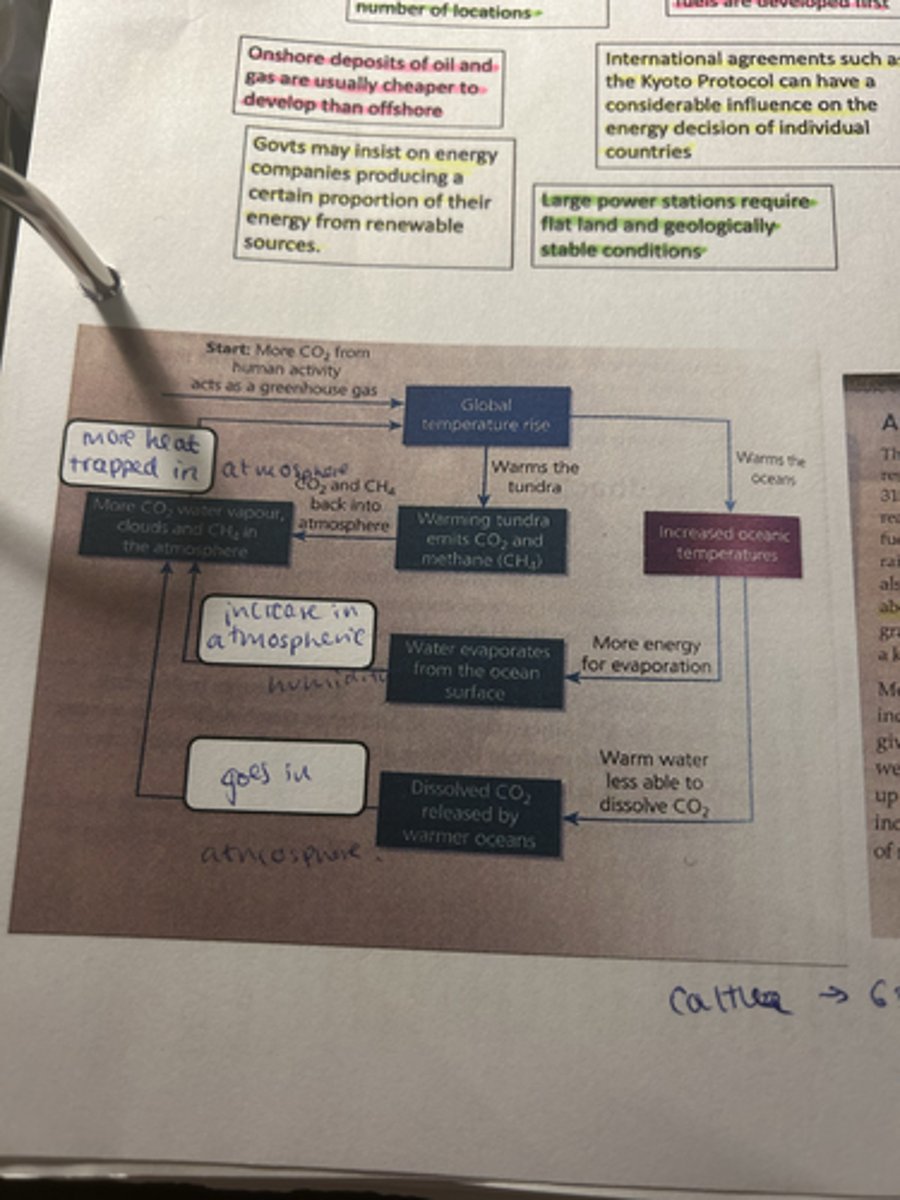
input: increased atmospheric levels of CO2 (50% in atmosphere), output?
- excess heat stored in atmosphere
input: excess heat stored in atmosphere, output for tundra?
- melts permafrost in tundra
- which releases c02 and ch4
input: excess heat stored in atmosphere, output for oceans?
- oceans warm - sea levels rise
- rainier and more extreme weather
input: excess heat stored in atmosphere, output for forests?
- in turn increases CO2 levels by combustion
- less C02 stored in trees
how does urbanisation affect water cycle?
- replaces natural land with impermeable surfaces, such as tarmac
- reduces infiltration, percolation and subsequent run off
- encourage fast drainage of water after precipitation into sewage systems; decreasing the lag time and increasing peak flows.
- floodplains occupied by infrastructure reducing water storage as floodplains are natural storage areas which increases river flow and thus flood risk.
how does urbanisation affect the carbon cycle? think process of urbanisation and what happens in urban settings after
- removal of vegetation reduces the amount of organic carbon sequestered
- combustion reactions from burning trees to get rid of them
- development of factories and houses with increasing vehicle usage which increases burning of fossil fuels via combustion from engines and emissions
- increases carbon emissions on a local scale from urban development and combustion.
How does farming affect the water cycle?
- when forest is cleared there is lower interception, evaporation and transpiration than forest and grassland ecosystems - short term flooding
- ploughing increases evaporation and soil moisture loss whilst furrows downslope act as drainage channels accelerating run off and soil erosion
- surface run off increases where heavy machinery compacts soils
- peak flows on streams draining farmland are generally higher than in natural ecosystems.
- long term aridity
How does farming affect the carbon cycle?
- clearance of forest for farming reduces carbon storage in above and below biomass.
- soil carbon storage is also reduced by ploughing and exposure of soil organic matter to oxidation.
- further losses occur through the harvesting of crops with only small amounts of organic matter returned to the soil
- soil erosion
- methane from cattle
- pasture only stores little amounts of carbon
How does forestry affect the water cycle?
- higher rates of rainfall interception
- the Sitka spruce -> interception is 60% in East England
- Upland England is half this figure as the species are conifers. Needle structure and high density increases of interception
- high rates of evaporation increases intercepted rainfall stored on leaf and is evaporated directly to atmosphere.
- reduced run off and stream discharge due to high interception and evaporation rates and absorption of water by tree roots.
- streams draining plantations have long lag times, low peak flows and low total discharge which increases transpiration (350 mm/year for the Sitka tree)
- clear felling to harvest timber increases run off and reduces evapotranspiration and increases stream discharge
how does forestry affect the carbon cycle?
- increases carbon stores, mature forest trees store 10x more than grassland soil 800 tonnes C/ha
- increases decomposition due to leaf litter
- more photosynthesis and respiration
- higher likelihood of forest fires
what are lag times and peak flows?
- lag time is the delay between peak rainfall and peak river discharge, while peak discharge is the highest flow rate of a river during a storm event
importance of peatlands
- peatland is estimated to contain one third of global soil carbon, despite covering only 3% of the land area
- 350k hectares of peatland in England
what are peatbogs
- soil with the direct product of the vegetation that created with it due to anaerobic conditions and a proportion of the vegetation that has not been fully decomposed
- high organic matter content
- good for agriculture
- hydrophytes
how much carbon do peatlands store in England?
- 580 Mt C
problems with peatland
when peatbogs are drained, their waterlogged conditions cease
this causes oxidation of the organic and dead matter
this triggers mass decomposition, releasing carbon into the atmosphere
case study of impacts of ground water extraction - River Kennet location
- southern england
- drains an area of 1200km
importance of the chalk streams near the river kennet
- upper catchment is comprised entirely of chalk, which is highly permeable
- 220k ppl rely on water
- very pure water which is rich in oxygen
An example of extraction that takes place in London
- Thames water abstracts groundwater from boreholes then pipes it to swindon
impact of extraction on stores and flows of the water cycle in the drainage basin?
- rates of groundwater extraction have exceeded rates of recharge, water tables have reduced flows by 10-14%
- reduced flooding and areas of temporary standing water
what are the characteristics of artesian basins?
- when sedimentary rocks form a syncline (downward bending U shape), there is an aquifer beneath, subject to artesian pressure, containing groundwater in its spores and confined by impermeable rock
what happens when artesian basins are tapped with a well or borehole?
- water flows to the surface
- the level as to which the water will rise - the potentiometric surface - is determined whether the water table height is above, below or midway through the well/borehole
- if above, it is artesian, if midway, waterfilled but non artesian, if below, dry
example of Artesian Basin and exploitation
- London is located at the centre of a synlical structure forming an Artesian Basin
- overexploitation in 19th and 20th century caused water table to retreat by 90m.
- now there is a declining demand
Background information of ARAL SEA
- between Kazakhstan and Uzbekistan
- shrunk in size by 90%
- Soviet Union diverted two rivers to irrigate cotton fields
- canals are poorly built so 50% of water soil is lost
negative feedback loop
- aral sea loses water and becomes shallower
- less water to be warmed up by same amount of solar radiation
- higher amounts of evaporation from the aral sea
how much CO2 is re/leased by burning fossil fuels? What proportion comes from burning fossil fuels?
- 10 billion tonnes annually
¾ from burning fossil fuels
is the atmosphere in balance?
- carbon dioxide and water vapour are not in balance due to human activity disturbing balance
why hasn't CO2 exceeded 500 parts per million ?
- increases absorption of carbon by oceans and biosphere
physical factors affecting the demand for and supply of fossil fuels?
- deposits of fossil fuels only found in number of locations
- large power stations require flat land and stable conditions
economic factors affecting the demand for and supply of fossil fuels?
- most accessible and lowest cost deposits of fossil fuels are developed first
- when energy prices rise, companies increase spending on exploration and development
- FDI essential in development of energy resources
political factors affecting the demand for and supply of fossil fuels?
- govs may insist on energy companies producing a certain proportion of their energy from renewable sources
- international agreements such as Kyoto protocol can have considerable influence on the energy decision of individual countries
- legislation regarding emissions from power stations will favor the use of, low sulfur coal, as opposed to coal with a high sulfur content
how much methane do cattle give off per annum?
- between 65 and 85 million tonnes
- 2nd largest contributor in world
other ways of methane emitting
- rice paddy fields 150 million tonnes
- permafrost with bogs inside melt release methane
what does an increase in oceanic temperatures lead to?
what is carbon capture?
- process of capturing and storing carbon long term including:
- process of removing carbon from the atmosphere and depositing it in a reservoir
- process of carbon capture and storage where co2 is removed from fuel exhaust gases
- storage of carbon either by natural processes or human activity in oceans and their sediments
positives of afforestation
- would reduce CO2 in atmosphere by 25%
- extra 1bn hectares of trees would be needed and the world could support an extra 0.9bn hectares of
- they would sequester 200 GT of CO2 which is 2/3 of extra carbon from human activities
- would also reduce floodrisk + increase biodiversity
negatives of afforestation
- takes atleast 20 years for tree to be effective
- requires a lot of space which we may not be able to rely on in 20 years time if countries are rapidly developing - at their expense?
- affects water cycle as well
what is CCUS (carbon capture and underground storage)?
- capturing carbon from a power plant and pumping it into injection wells where it dissolves in water and is then injected into fresh basaltive bedrock until it turns into solid minerals within the stone
advantages of CCUS?
- would be able to capture 10 million tonnes of carbon dioxide
- concentrate green energy in certain areas in north england for example to encourage development and create jobs
example of CCUS
- iceland
disadvantages of CCUS?
- expensive
- requires large amounts of energy -> counter productive
- possible leakages
what is the state of the equilibrium of the global carbon cycle?
- in a disequilibrium due to human activity through the burning of fossil fuels
- increases the concentration of CO2 in the atmosphere, acidity of the oceans and flux of carbon between stores.
what is neutralising the rising levels of atmospheric CO2?
- negative feedback loop as inc in CO2 stimulates photosynthesis and carbon fertilisation
diurnal changes in water cycle
- lower temperatures at night reduce evapotranspiration and transpiration
- convectional rainfall is a daytime phenomenon as the sun heats the ground
diurnal changes in carbon cycle
- daytime co2 flows from atmosphere to vegattion versus at night the flux is reversed
seasonal changes in water cycle
- UK solar radiation intensity peaks mid june 800 W/m2 so evapotranspiration is highest in the summer months
seasonal changes in carbon cycle
- in middle/high latitudes, the photoperiod (day period) and temperature affect seasonal changes in NPP
- in the northern hemisphere with full foliage -> the flow from the atmosphere to the biosphere -> atmospheric CO2 falls by 2 ppm
- end of summer process is reversed due to decomposition of leaf litter
what is considered long term?
millions of years
warming - Long term changes to the water cycle
stores - Loss of crysopheric stores as meltwater returns to oceans → ocean store increases; → sea level rises 100-130. Biosphere water stores expand as vegetation cover regrows.
flows - Higher evapotranspiration; faster exchanges between atmosphere, oceans, soils and vegetation. Accelerated hydrological cycle.
impacts: Wetter tropics, shrinking deserts, increased river discharge and global humidity.
warming - long term changes to carbon flows and stores
- stores: More heat = faster decomposition = more CO₂ released. permafrost melts → Thawing soils release long-stored carbon. Land released from ice can start releasing carbon again. Atmospheric CO₂ increases ~100 ppm
- flows: Faster decomposition and respiration; higher NPP; reduced CO₂ uptake by warm oceans.
- impacts: Strengthened greenhouse effect; expanded forests; faster carbon cycling and climate change
cooling - long term changes to carbon cycle flows and stores
- stores: Atmospheric CO₂ falls to ~180 ppm. More carbon stored in deep ocean (enhanced phytoplankton uptake + cold water absorbs more CO₂). Terrestrial carbon stores shrink as ice sheets replace vegetation; huge carbon accumulation in permafrost.
- flows: NPP falls; less photosynthesis; slower decomposition → less CO₂ returned to atmosphere
- impact: Slower carbon cycle; expansion of tundra and deserts; reduced vegetation carbon.
cooling - long term changes to water cycle flows and stores
- stores: Major transfer of water from oceans to ice sheets, glaciers and permafrost. Sea level falls 100-130 m. Biosphere water store shrinks as vegetation declines.
- flows: Lower evapotranspiration; reduced atmosphere-ocean-land exchanges; large volumes of water locked in ice → slower cycle.
- impacts: Drier tropics; rainforest replaced by grassland and deserts; one-third of land covered by ice; weakened global water cycle
how do flood plain fens provide an example of the importance?
- sequester large amounts of CO2 - 10% of all annual emissions - 35% of terrestial carbon store
- very productive and fertile for agriculture
- by draining land it lowers ground water tables causing plants to die and thus disrupts process
- agricultural intensification - fertiliser run off leads to nutrient enrichment and species are replaced by tall grass reeds- a eutrophic marsh