soci250 final
 Call Kai
 Learn
Learn Practice Test
 Spaced Repetition
 Match
Match Flashcards
 Knowt Play
1/69

There's no tags or description
Looks like no tags are added yet.
Name | Mastery | Learn | Test | Matching | Spaced | Call with Kai | Chat |
|---|
No analytics yet
Send a link to your students to track their progress
70 Terms
police concepts ladder (increasing seriousness)
racial profiling → mistreatment → brutality, violence → mortality
official police interactions (increasing seriousness)
stop and search → interaction (physical, gun drawn, gun pointed) → fired → injury (firearm, physical interaction) → death
racial profiling
a racial DISPARITY in police stop and search practices, racial differences in custom searches at airports and border-crossing etc
disproportionate attention on minority group
stop and search disparity based on race data
toronto youth crime and victimization survey (2000)
sample: >3300 high school students in public and catholic school
32 page questionnaire
stopped: 51.5% black (2/> times), 58.7% white (never)
black students 4x> likely to be stopped than white students even after controlling for control items
searched: 23.4% black (2/> times), 83.5% white (never)
black students 6x> likely to be searched than white students
anti racism act (2017)
mandated collection of race-based data by organizations in public sector, for purpose of eliminating systemic racism
2020: toronto police service started data collection
2022: detailed report by them
minorities and blacks were OVERREPRESENTED in many police interactions
use of force
over-representation in enforcement actions vs presence in toronto
black ppl 2.2x >
indigenous ppl 1.6x>
middle eastern ppl 1.3x>
type of force
black, south asian and east/southeast asian ppl MORE likely to experience higher uses of force compared to white ppl across all use of force
firearm pointed: 40% blacks, 26% whites, 10% east/SEA
US police brutality
black ppl 2.9x> likely to be killed by police than white ppl → over-representative of population
reasons
product of interlocking and intertwining branch of:
FORMAL RACISM across institutions, systems and structures
whiteness vs colour embedded in history (colonialism, slavery, residential schools) → social hierarchy
INFORMAL RACISM across media, discourse, cultural reproduction
portrayal of minorities (stereotypes)
use of race and esp blackness as “proxy for criminal dangerousness” embedded deep in american history
being a minority has many disadvantages + still living in residue of racism
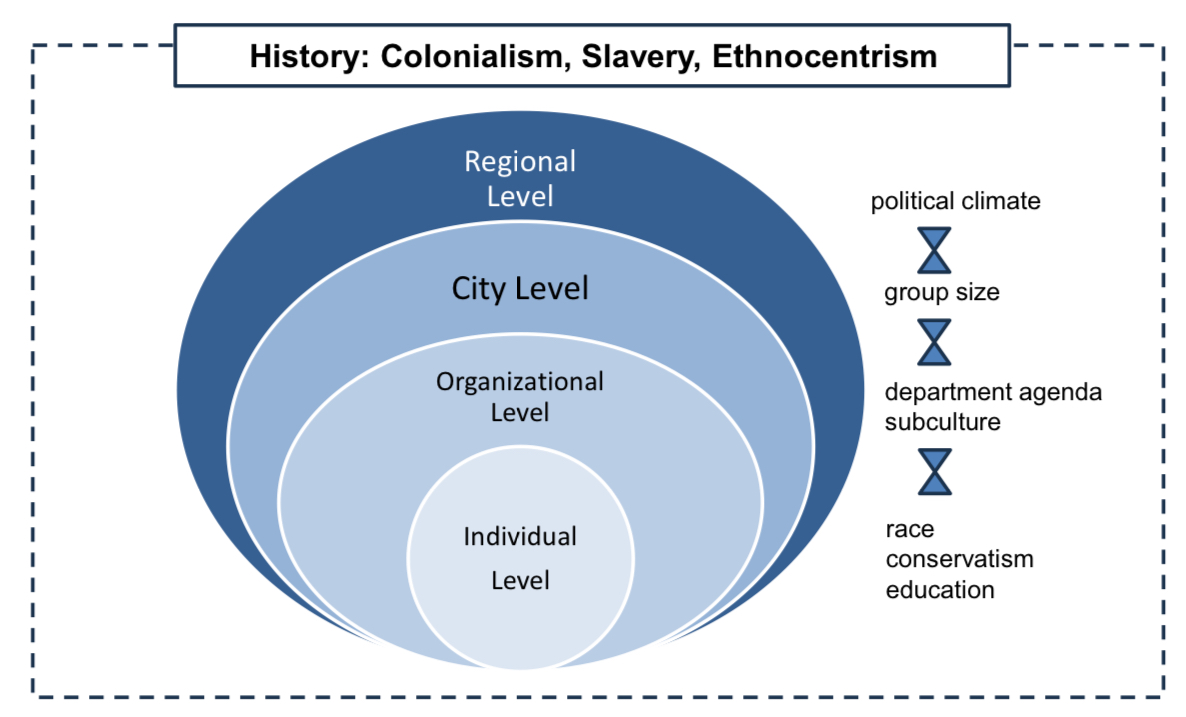
4 structural levels
individual → organizational → city → regional
group position (blumer and bobo & hutchings)
level of prejudice of majority group POSITIVELY related to collectively developed judgement abt position in the social order that the ingrp member should rightfully occupy rel to outgrp
neg attitudes toward outgrp are developed from a sense of group disposition; entitlement
4 elements of group position
belief about in-group superiority; ethnocentrism
views outgrp as “alien” and different; stereotyping (anti-immigration)
propriety claim over certain rights, resources and privilege; entitlement
outgrp member desire greater share of those rights, resources and privilege that are “understood” to “belong” to the in-grp members
privileges are innate
racial alienation attitudes of white respondents
harbouring this attitude = positively and statistically significant to see outgrp as competition (.28**)
republican values
less sympathetic to issues related to african americans vs democrats
group threat (& grp size)
level of prejudice of majority group is POSITIVELY related to the size of the minority group
the larger the minority grp = more competition over scarce resources
larger group = greater potential for collective (political) action against majority
effect of city size on complaints
% black: .040***
ratio prop black officers/citizens: -.81*
more black officers = less complaints
black dissimilarity: 2.56***
blacks highly segregated = more complaints
organizational level
SUBCULTURE mentality: insider vs outsider → traits include skepticism, cynicism, mistrust of others and moral conservatism
perpetuated through storytelling, work itself, interaction with outsider (strong pressure to conform to traits)
little room for individualism and personal opinion
police = HIERARCHICAL paramilitary organization
officers’ choices constrained by bureaucratic forces and preferences of management
performance often rated by “goal oriented” measure (drop in crime rate) and “means-oriented” measure (issuing tickets) → need to show productivity and doing a good job
predicting job stress among police officers
outgrp status: 0.360*** → increase job stress
ingroup status: -0.126** → decrease job stress
floyd vs city of NY
police need to show that they are making city safer but also that they are doing work → selective booking and over stopping
evidence: NYPD conducted 4.4M stops during 9 year period since 2004
over 80% stopped where black or hispanic → disproportional to city population
officers made more stops in neighbourhoods w LARGER MINORITY pops
at least 200,000 stops lacked legal basis
testimony of NYPD officer Pedro Serrano
individual level
effect of POLICE PERSONALITY (self-selection): authoritarianism, social dominance orientation, ethnocentrism, belief in “a just world”
most research on racial attitudes of police officer suffers from high degree of SOCIAL DESIRABILITY bias
individual level data
stereotypes
white police officers 9x> to believe african americans more violent than whites
conservatives more likely
education decreases likelihood of making any of those statements
resentment
white police officers more likely to resent special favours to african americans + believe that they should advance without special favours
conservative and education same as above
beliefs
being a white police officer stat pos association with having discriminating beliefs
conservative white police officers too
summary of individual level differences
white police officers report MORE racially conservative attitudes than whites outside law enforcement
differentiate themselves clearly from other whites even on explicitly declared self-reported survey measures
unique racial conservatism of white police play role in shaping conflict, abuse of power and disparate treatment of citizens of colour
findings consistent with group threat and power theories of intergroup relations
prediction: a person in a position of authority along w a sense of oppositional group interest can engender, may lead to stereotypic and neg views of ppl of colour (white officers)
use of force
having any degree = less likely to use force
being young, non-white, male and poor = more likely to experience force
integrated framework
interaction effect: variables in conjunction with others
issues that arise
criminal profiling and racial profiling hard to differentiate
same tactic used by racist and nonracist cop
same race violence
esp if in non-minority states
stop and search rates justified by actual/perceived rates
possible that minorities do offend more (Sohoni et al., 2020) → meta-analysis suggests small effect of race and likelihood of committing crime (do NOT reflect disparity)
4 elements of CAPO
involve degree of compliance by victim (/by person committing offence)
based on MORAL principles defined by the public
shifts in public opinion → changing laws
concerns the VISIBILITY of disorder
seen outdoors, affecting public/other people
definition is RELATIVE and EVOLUTIVE concept
constantly changing
prostitution legality
legal definition: defined as the exchange of sexual favours or money or other material goods (technically legal but laws make it illegal)
illegal before 2014
attempts to procure or solicit a person to have illicit sexual intercourse with another person
cannot talk about it
lives wholly or in part on the avails of prostitution
cannot hire ppl around the act itself
keeper of a bawdy house
cannot have anything to do with location where its happening
logic of prostitution laws
increase barrier to entry
decrease supply of sex workers
to protect the individual from exploitation
to protect adverse effect of exposure to prostitution
not visible = not a problem
reality of effects of prostitution laws
demand will continue to attract ppl into industry regardless of BTE → go even more underground
cost of operating alone is too high → ultimately join others
street prostitution may lessen but exposure still present through advertising (escort, massage, companionship = substitute language)
effects when logic does not reflect reality
not eliminated but makes it a private matter; exploitation remains
sex trade workers have LITTLE RIGHTS → discourages access to resources (police, healthcare)
sex trade workers continue to experience abuse, violence, poverty
sex work NOT seen as real work (gig economy)
new laws after 2014: bill 36
purchasing offence: ILLEGAL to purchase sexual services or communicate w the intention of buying sex → up to 5yrs in jail + fines that begin at $500 (increase w subsequent offences)
LEGAL to communicate and advertise yourself but not others
prostitution stats
juristat reported <1200 cases in 2017
less than 1% of all “other crimes”
underreported
police uninvolved unless it involves
public disturbance
legal status of worker (under age/refugee)
linked to OC
3 elements of sugar arrangement
sugar daddy/mommy: successful me and women who know what they want
driven and enjoy attractive company, money not an issue → generous when it comes to supporting sugar baby
sugar baby: attractive ppl looking for finer things in life
appreciate exotic trips and gifts
an allowance: typically prepaid credit card, cash or paypal transaction
covers sugar babys living expenses, rent, tuition w spending money left over
3 categories of arrangements
landscape changes over time
frank exchange of sex for money without any form of companionship
LT sugar arrangements that incl high levels of companionship
hybrid of first 2; LT sex for money exchanges w little social companionship
number 1 motivator to be a sugar baby
financial security (include money and tution fees)
issues with public order
plastic sexuality: an increase of acceptance that had freed idea of sex from reproduction to MALLEABILITY of erotic expression for all indivs due to social norms
commodification of sexuality: advertising; capitalistic
blurring of whats considered practical
performance of sexuality (waitresses, cheerleading)
neoliberal laws and policies: pushed consumers to accept the consumption of sexuality (tourism, licenses)
sugaring: blurring of romance and sex work
techniques to mentally and emotionally distance themselves from being associated w sex industry
license fee
body-rub parlour, body-painting studio and model studio → allow ppl to be legally nude inside establishment
loopholes exist in laws and legislations
cultural hegemony
dominant class subtly controls society by making its values seem natural through institutions
issues w cultural hegemony
definition of sexual r/s
men primarily play dominant role
role of women in society and relations to sex
more economically vulnerable
last resort strategy
role of agency in sex work
choice/desire to be in adult industry
what are the laws protecting
labour, morality, choice
definition of OC
criminal code
composed of 3/> persons in or outside of canada
has as one of its main purposes or main activities the facilitation or commission of 1/> SERIOUS OFFENCES (indictable) would likely result in the direct/indirect receipt of a MATERIAL benefit (incl financial), by the grp or any of the persons who constitute the grp
does NOT incl a grp of persons that forms randomly for the immediate commission of a single offence → must be planned
8 characteristics of OC
non-ideological: have no political affiliation (but may have political opinion)
hierarchical: chain of command (that cannot be broken)
exclusive membership: along kinship/ethnic lines bc trust v impt
perpetuous: ongoing, persist over time (generational but may grow/shrink)
organized through division of labour: each has specialized job
monopolistic: dominance over geographic area + limits competition
governed by rules and regulation: code of honour
use of violence: means to achieve ends + intimidation/defence
not by default since hospital bills and legal fees are exp, lose labour,
3 types of OC
small-scale
not affiliated w “traditional OC” families of historical variety
street level crimes
traditional OC
related to historical processes and linkages that reflect early immigration into US → take care of e/o for survival
italian mafia
(new) non-traditional OC
reflected in newer shifts and mvmts within criminal element that dont fit 2
cartel
lineage and bloodline may not matter as much → aligned interests more
small scale OC
ethnically homogenous due to membership boundaries (rituals, secret meeting place)
composition relative to geographic area
retail end of OC
profits used to maintain LIFESTYLE of members
large scale (T/NT)
ethnically homogenous due to membership boundaries due to trust issues
boundaries can be regional or transnational
manufacturing/wholesale side of OC
profits used to maintain operations and growth of enterprise
need for a unified model
criminology = DIVIDED discipline, comprised theories and perspectives that are at odds with o/a
all underlying assumptions have SOME support
there is a reason to believe that crime is strongly influenced by factors BEYOND INDIV’S CONTROL but also reflects exercise of agency w range of factors influencing degree of agency exercised
bridge structure and agency
theoretical issues
determinism vs agency (structure)
consensus vs conflict
timing of variables
determinism vs agency
research and theory suggest that indivs exercise greater agency when they are
motivated to alter their behaviour (e.g. given mentor, scholarships → breakthrough structure)
believe they can produce desired change
have the traits and resources necessary to exercise agency
are in environments that have weak/countervailing constraints, provide numerous opportunities for agency + encourage agency
consensus vs conflict
all functioning societies characterized by a CORE CONSENSUS; ppl condemning the unconditional use of personal violence and theft and cooperating in certain areas (defense from external threats)
structural functionalist
extent and nature of consensus and conflict vary → grp differences and self-interest diffs
crime results from the failure to participate in this consensus
grp differences in power → oppression
timing of variables
criminologists assumed variables that cause crime = fairly stable over time
linear effect
given change in a variable always results int he same amount of change in crime (but effect diff at diff time points)
additive effect
effect of a variable on crime does NOT depend on the level of other variables (but effect can be multiplied)
relative deprivation → GST
lagged effect
assume that it takes some time for a variable to influence crime (effects can be ST)
little consideration given to LT changes in these variables (evident over life-course of indivs) → need to devote attention to changes in cause of crime + manner in which certain causes change with the situation
developmental theory
builds on thornberry and colleagues’ interactional theory of gang membership (starts w more distal structural variables and progresses to more proximal processual ones)
focuses on early stages incl PRE-SCHOOL stage and years pertaining school entry
early childhood aggression and disruptive behaviours including stubbornness, defiance, disobedience and truancy = products of DYSFUNCTIONAL FAMILIES (esp in disadvantaged communities)
aggressive and disruptive behaviours likely followed by REJECTION by prosocial peers → opening door to antisocial/deviant peer influences
UN gang
located in fraser valley and abbotsford
consisted of upper middle class members (diff from US gangs)
ethnically diverse
operate in suburban neighbourhoods
not so much a gang but a “criminal business organization”
developmental theory x context interaction
diff mentality from larger cities
sometimes work with other gangs too (adaptable)
victimization overview
assumption: crime is indicative of a subject-object relation than of the perpetrator alone → 2 party event, not just criminal themself
focus of victimology
extent, nature and causes of criminal victimization
consequences for the persons involved and their needs and representation
victim characteristics; “victim profiling” → to solve certain types of crime
5 reasons for studying victims
crime is costly (lost of productivity, healthcare costs)
help to develop prevention strats
have a voice in CJS
assist victims to re-integrate back to normal life
can help to explain offending
victimization and substance abuse
ppl who have been victims = more likely to be offenders themselves (cycle of hurt/violence) → offset neg emotions
antisocial behaviour
growing evidence that crime victims are more likely to commit crime themselves → aka cycle of violence (intergenerational)
young children observe and imitate adult behaviour (Bandura’s modeling/learning theory)
more exposure to violence = more likely to be violent
being abused as a child increases odds of being a victimizer themselves
factors related to victimizer status
abused before 16y = 3.5x>
physically abused before 16y = 3x>
sexually abused before 16y = 2x>
impact of timing of any maltreatment on adolescent offending
maltreatment in adolescence only: delinquency (2x), arrest (almost 4x)
maltreatment in childhood only: delinquency and arrest (1x)
family structure and low hhld income NOT good predictor (not stat sig)
history of victimology
started in 60s as reponse to victims 3Rs: rights, reparation and representation
first grps started by parents of murdered children, later increased to address women who experiences assault and abuse
victimization surveys implemented to count ‘dark figure of crime’
4 main purposes of victimization surveys
provide info on the aftermath of their victimization
allows researchers to asess the CJS RESPONSE to victims
enables researcher to measure levels of fear of crime
enables researcher to tap into number of victims who do NOT report their victimization
victim characteristics
age
more protected as you age due to exposure and likelihood of drinking/partying
gender
being male = more likely to be victim of assault (physical OR sexual)
but not BOTH
social status (economic strata and crime prone area)
personal property crime: rich ppl more likely
marital status
married = less likely to be victim of crime since always protected, less risky behaviours and more connections
correlates of victim characteristics
older also more likely to be married, married ppl more wealthy due to dual income
victim precipitation theory (mendelsohn and von hentig)
actions are the “telltale” signs → presents themselves as potential target
active (instigator) vs passive (easy target)
stereotypes vs typologies (13 types)
carved out key relevant demographic factors
hentig’s victim typology
young
female
old
metally defective and deranged
immigrants
minorities
dull normals (simple minded ppl)
depressed
acquisitive (greedy)
wanton (promiscuous)
lonesome or heartbroken
tormentor (abusive parent)
blocked, exempted or fighting (victims of blackmail, extortion)
hindeland et al.’s lifestyle model
risk of victimization correlated w lifestyle
more active and more social = more RISK
unemployed more likely to be victim of robbery, assault and theft
employed = patterned lifestyle, same ppl around them
3 related hypothesis
3 hypotheses of lifestyle model
equivalent group hypothesis
offender-victim similar in SES characteristics
e.g. black on black violence
proximity hypothesis
offender-victim similar in social space
e.g. drug user and dealers
deviant place hypothesis
offender-victim in similar geographic space
victim prone bc they reside/work in disorganized high-crime areas
e.g. bouncer at club
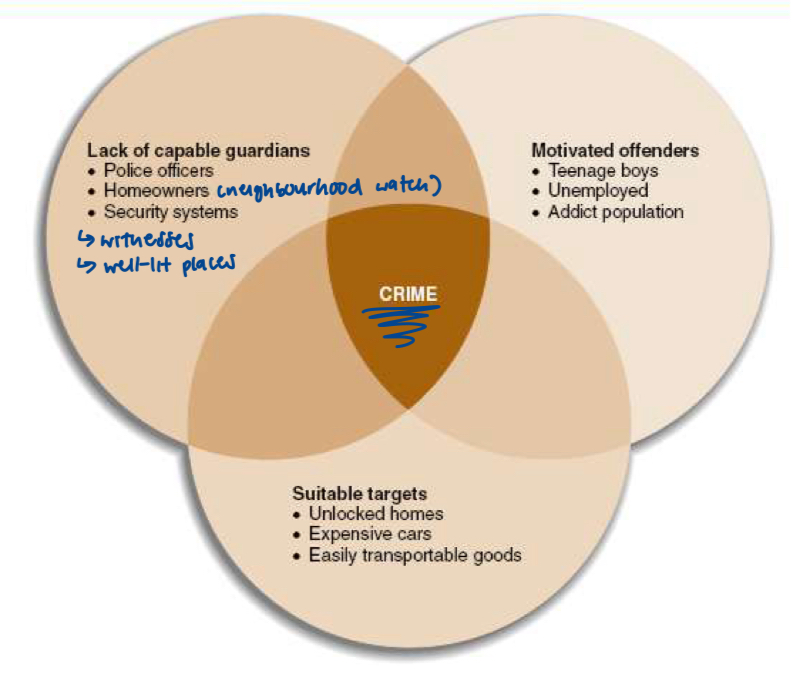
routine activities theory
focus on things we do everyday
routine activity PATTERNS affects likelihood of being victim of crime (target hardening)
depends on convergence of 3 elements
motivated offender
suitable target/victim
absence of guardian/protector
not necessarily a person → can be car, camera, lock, fake camera
strain theory
pre-ww2
bad economy
less B&E
men worked outside, women inside (hard target)
post ww2
good economy
more B&E
more women outside (house empty), bigger houses w more things (easier target with no witnesses/protection)
predictions of victimization
increased risk if:
live in high-crime areas
go out late at night
carry valuables
engage in risky behaviour
are without friends/family to watch or help them
application of victimology
can use characteristics of victims and work BACKWARDS to profile offenders
specific technique used: GEOGRAPHICAL PROFILING (Rossmo’s formula) → looking at where victims live/where bodies were dumped and work backwards to see where offenders reside/work
helps detective locate eyewitness, obtain confession and physical evidence faster and more effectively
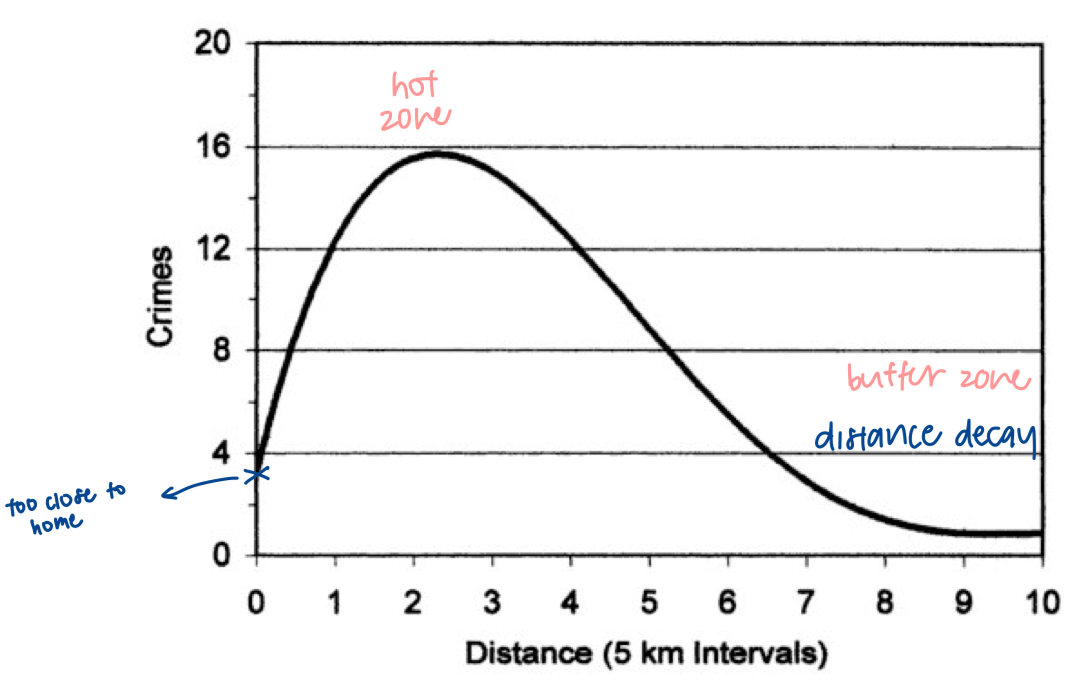
applies math formula that calculates the RESIDENCE-TO-CRIME DISTANCE function to narrow down offender’s location
buffer zone (unlikely to commit there) vs hot zone (likely to commit)
geographic profiling
most crimes happen within 6 mile radius