Week 13 - Forensic Anthopology
 Call Kai
 Learn
Learn Practice Test
 Spaced Repetition
 Match
Match Flashcards
 Knowt Play
1/35

There's no tags or description
Looks like no tags are added yet.
Name | Mastery | Learn | Test | Matching | Spaced | Call with Kai |
|---|
No analytics yet
Send a link to your students to track their progress
36 Terms
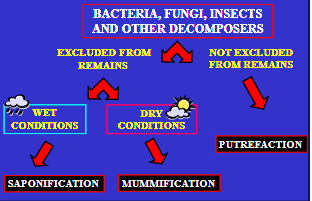
Decompositional Processes
the postmortem decomposition process driven primarily by bacteria, producing discoloration, gas formation, tissue liquefaction, and characteristic odors.
Putrefaction
Autolytic and Bacterial Decay
Early Post-Mortem Changes
Gas and Fluid Production
Insect and Scavenger Attraction
Putrefaction
Type of Decay:
anoxia
enzymes
cellular breakdown
Autolytic delay
Type of Decay:
enteric
environmental
bacterial decay
Types of Early Post Mortem Changes
Rigor Mortis
Livor Mortis
Algor Mortis
Types of Gas and Fluid Production
Noxious
Malodorous
T/F: Mummification involves the dehydration of organs and tissues as well as drying and shriveling of remains
True
Mummification Requirements
dry conditions
hot or cold
Hydrolysis of subcutaneous fat tissue - adipocere or “grave wax”
Saponification
Saponification requirements
moisture
anaerobic environment
High Ph
Who was involved in Time Since Death - the Postmortem Interval
Dr. William M. Bass
Types of Burials in Anthropology
prehistoric
historic
forensic
basic biological profiling includes
age
sex
ancestry
statute
the study of bones, focusing on their structure, development, function, and the changes they undergo during life and after death
Bone osteology
bone is living tissue
hardest connective issue
withstands tension and compression forces (6-10 times normal stress)
high survivability
Bone Characteristics
Parts of the Skeletal System
Cranial Skeleton
Axial Skeleton (torso)
Appendicular Skeleton
Cranial Skeleton
skill
cranium
mandible
teeth
Axial Skeleton
hyoid
sternum
ribs
vertebrae
Appendicular Skeleton
arms and hands
shoulder girdle
legs and feet
pelvic girdle
Dentition Types
Deciduous Dentition - 20 teeth
Permanent Dentition - 32 teeth
Tooth Types
incisors
canines
premolars
molars
Appendicular Skeleton: Upper Extremities
Scapula
Clavicle
Humerus
Radius
Ulna
Carpals
Metacarpals
Phalanges
Appendicular Skeleton: Lower Extremities
Innominate
Sacrum
Femur
Patella
Tibia
Fibula
Tarsals
Metatarsals
Phalanges
Places with Growth Plates
elbow
hip
ankle
knee
wrist
shoulders
clavicle
Growing Long Bone Components
Epiphysis (2)
Metaphysis (2)
Diaphysis (1)
+ Epiphyseal plate (growth plate)
Mature Long Bone Components
Epiphysis (2)
Metaphysis (2)
Diaphysis (1)
+ Epiphyseal line
2 Stages Used to Determine Age
Developmental (formative)
Degenerative (deteriorative)
Long bone lengths
dentition and dental eruption
epiphyseal union (fusion)
Degenerative changes in skeleton (bone breakdown)
Public symphysis degeneration (the surface morphology of the public symphysis changes with age)
Methods for Determining Age
Parts of the Body used for Sex Estimation
cranium
pelvis
T/F: the skill is the best area for sex estimation (accuracy ~90%), with the pelvis as next best (accuracy ~80%)
False - Pelvis is the best
T/F: Generally, the male skull is more robust and muscular than the female
True
Pelvis Sex:
opening is smaller, more obstructed
Pubic arch is V shaped
Male Pelvis
Pelvis Sex:
opening is larger and less obstructed
Pubic arch is U shaped
Female Pelvis
Forensic race determination
estimating the ancestry of unknown skeletal remains
Types of Timing for Trauma in the Skeleton
Antemortem (before)
Perimortem (during)
Postmortem (after)