MAR 3203 Chapter 16: Lean Operations
 Call Kai
 Learn
Learn Practice Test
 Spaced Repetition
 Match
Match Flashcards
 Knowt Play
1/22

Earn XP
Description and Tags
Name | Mastery | Learn | Test | Matching | Spaced | Call with Kai |
|---|
No analytics yet
Send a link to your students to track their progress
23 Terms
Lean operations
Eliminates waste through continuous improvement and focus on exactly the customer wants; driven by workflow initiated by the pull of the customer’s order
Encompasses all the related approaches and techniques of both JIT and TPS
When implemented as a comprehensive operations strategy, Lean sustains competitive advantage and increases overall returns
Just-in-time (JIT)
Continuous and forced problem solving via a focus on throughput and reduced inventory
Toyota Production System (TPS)
Focus on continuous improvement, respect for people, and standard work practices
Eliminate waste
Waste is anything that does not add value from the customer point of view
No bad parts
No inventory
No waste
Only value-added activities
Resources like energy, water, and air shouldn’t be wasted either
Minimize inputs and maximize outputs
Ohno’s seven wastes
Overproduction: Producing more than the customer orders or producing early
Queues: Idle time, storage, and waiting
Transportation: Moving material between plants or between work centers more than once
Inventory: Unnecessary raw material, work-in-process (WIP), finished goods, and excess operating supplies
Motion: Movement of equipment or people that adds no value
Overprocessing: Excessive work on a product
Defective product: Returns, warranty claims, rework, and scrap
The 5Ss
Sort/segregate — when in doubt, throw it out
Simplify/straighten — methods analysis tools
Shine/sweep — clean daily
Standardize — remove variations from processes
Sustain/self-discipline — review work and recognize progress
U.S. managers also add (6) Safety — built in good practices, and (7) Support/maintenance — reduce variability and unplanned downtime
Remove variability
Variability is any deviation from the optimum process
Lean systems require managers to reduce variability caused by both internal and external factors
Inventory hides variability
Less variability results in less waste
Sources of variability
Poor processes that allow employees and suppliers to produce improper quantities or nonconforming units
Inadequate maintenance
Unknown customer demands
Incomplete or inaccurate drawings, specifications, or bills of material
Improve throughput
The rate at which units move through a process
The manufacturing cycle time is the time between the arrival of raw materials and the shipping of the finished order
A pull system increases throughput
Pull systems and throughput
By pulling material in small lots, inventory cushions are removed, exposing problems and emphasizing continual improvement
Manufacturing cycle time is reduced
Push systems dump orders on the downstream regardless of the need
Lean and Just-in-time (JIT)
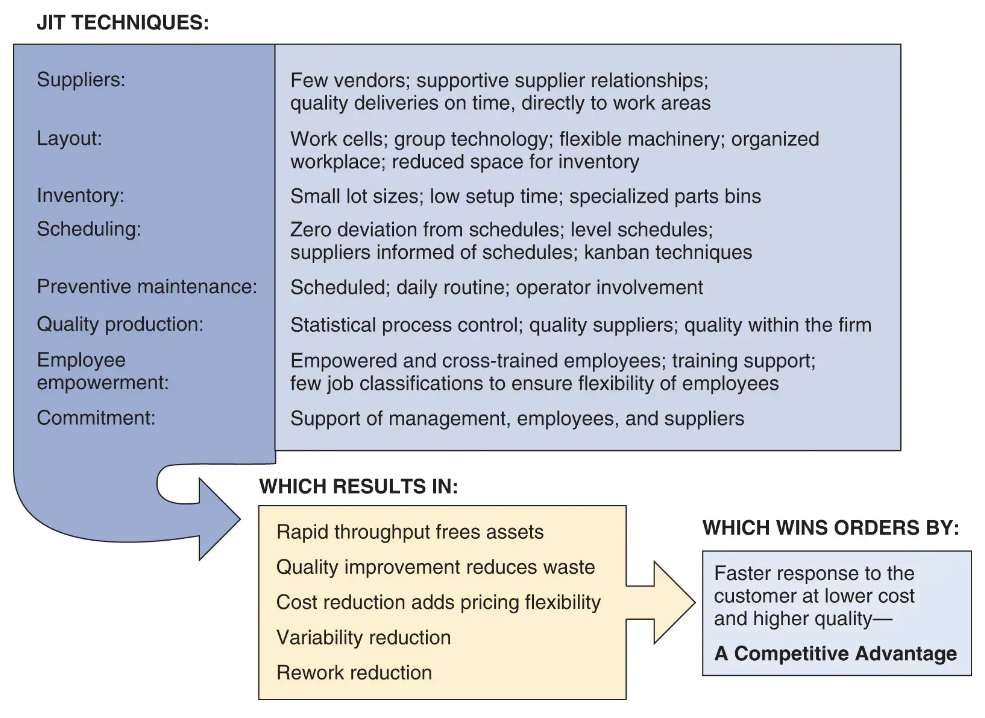
JIT with its focus on rapid throughput and reduced inventory is a powerful component of Lean
Materials arrive where they are needed only when they are needed
Identifying problems and driving out waste reduces costs and variability and improves throughput
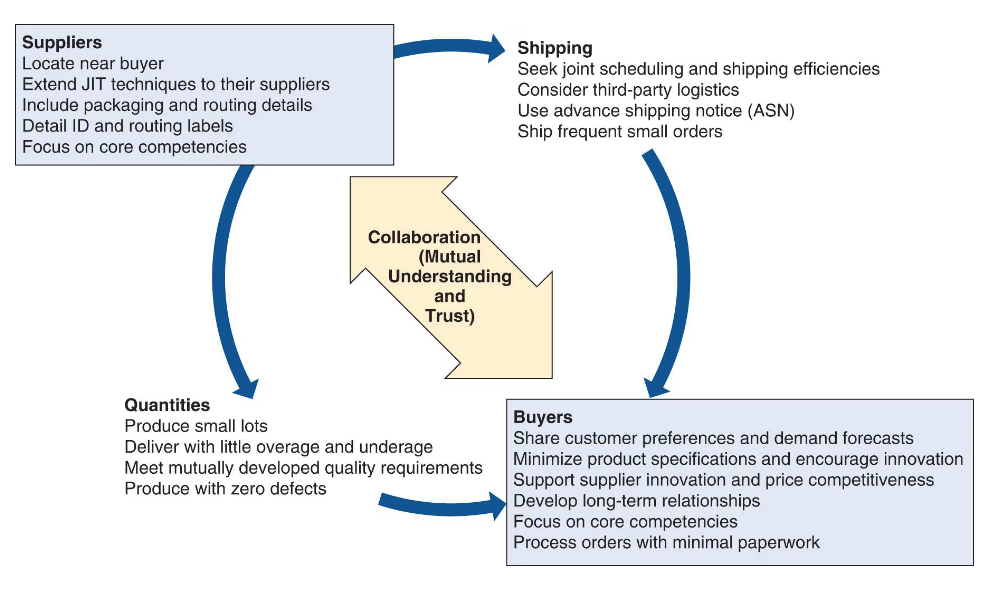
Requires a meaningful buyer-supplier relationship
Supplier partnerships
Exist when a supplier and purchaser work together to remove waste and drive down costs
Four goals of supplier partnerships:
Removal of unnecessary activities like receiving, incoming inspection, and excessive paperwork
Removal of in-plant inventory by delivery in small lots directly to the department as needed
Removal of in-transit inventory by encouraging suppliers to locate nearby and provide frequent, smaller shipments
Improve quality and reliability through long-term commitments, communication, and cooperation
Consignment inventory
An arrangement in which the supplier maintains title to the inventory until it is used
Concerns of suppliers
Diversification: Ties to only one customer increases risk
Scheduling: Don’t believe customers can create a smooth, coordinated schedule
Lead time: Short lead times mean engineering or specification changes can create problems
Quality: Limited by capital budges, processes, or technology
Lot sizes: Small lot sizes may transfer costs to suppliers
Lean layout tactics
Build work cells for families of products
Include a large number of operations in a small area
Minimize distance
Design little space for inventory
Improve employee communication
Use poka-yoke devices
Build flexible or movable equipment
Cross-train workers to add flexibility
Lean inventory tactics
Use a pull system to move inventory
Reduce lot size
Develop just-in-time delivery systems with suppliers
Deliver directly to the point of use
Perform to schedule
Reduce setup time
Use group technology
Lean quality tactics
Use statistical process control (SPC)
Empower employees
Build fail-safe methods (poka-yoke, checklists, etc.)
Expose poor quality with small lots
Provide immediate feedback
Toyota production system (TPS)
Three components are (1) continuous improvement, (2) respect for people, and (3) standard work practice
Continuous improvement: Build an organizational culture and value system that stresses improvement of all processes, kaizen — make it part of everyone’s job
Respect for people: People are treated as knowledge workers, engage mental and physical capabilities, and empower employees
Standard work practice:
Work is completely specified as to content, sequence, timing, and outcome
Internal and external customer-supplier connections are direct
Material and service flows must be simple and directly linked to the people or machinery involved
Process improvement must be made in accordance with the scientific method at the lowest possible level in the organization
Jidoka
Stopping production because of a defect, entrusted to all employees if any quality problems are spotted
Lean organizations
Understanding the customer and their expectations, functional areas communicate and collaborate to make sure customer expectations are met, and Lean tools are implemented throughout the organization
Attributes:
Respect and develop employees by improving job design, constant training, and building teamwork and commitment
Empower employees by pushing responsibility to the lowest level possible
Develop worker flexibility through cross-training an reducing job classifications
Build processes that destroy variability
Develop collaborative partnerships with suppliers to help them accept responsibility for satisfying end customer needs
Eliminate waste by performing only value-added activities
Building a Lean organization
Transitioning to a Lean system can be difficult, so leaders should build a culture of continual improvement, have open communication and demonstrated respect for people
Gemba walks are going to where the work is actually performed
Lean sustainability
Lean and sustainability are two sides of the same coin as both
Maximize resource use and economic efficiency
Focus on issues outside the immediate firm
Drive out waste because it adds nothing for the customer, while it is expensive and has an adverse effect on the environment
Lean in services
The Lean techniques used in manufacturing are used in services. Forecasts in services may be very elaborate, with seasonal, daily, hourly, or even shorter components
Suppliers: Every restaurant deals with its suppliers on a JIT basis
Layouts: Lean layouts are required in restaurant kitchens where cold food is served cold and hot food hot
Inventory: Stockbrokers drive inventory down to nearly zero every day
Scheduling: Airlines must adjust to fluctuations in customer demand through personnel availability