Sem 1 Lecture 2
 Call Kai
 Learn
Learn Practice Test
 Spaced Repetition
 Match
Match Flashcards
 Knowt Play
1/10

There's no tags or description
Looks like no tags are added yet.
Name | Mastery | Learn | Test | Matching | Spaced | Call with Kai |
|---|
No analytics yet
Send a link to your students to track their progress
11 Terms
Quensay to keynes (circular flow of goods only)
Bartering system:
one good is traded for another, both assumed to have the same value.
Limitations of bartering and benefits of money
Bartering limited to small population and amount of goods
Double coincidence of wants - people trading need to have the good they want at the same time, with a high population and more goods this is difficult
money is a medium of exchange and store of value, so many transactions can be made. Therefore fixing bartering limitations
How money eliminates circular flow of goods
money allows for groups of goods to have certain values
Many transactions take monetary form eg taxes
What is a circular flow?
The sum aggregate outflows must equal the aggregate sum of inflows
injections = leakages
As a model of aggregation and the economy as a whole, it is macro
Quensay’s circular flow model
Split french society into three classes:
Landlords - Earn rent
Artisans - Spend what they receive (luxury consumption)
Farmers - Workers who save what they earn for investment
Quensay’s circular model and the stationary state
The agricultural surplus remained constant each year hence no economic growth.
If landlords consume more of their rents they the surplus will decrease
If there is tax on land then the surplus will decrease
The only way for economic growth would be through increased agricultural productivity which in turn increase the surplus
Classical economists critique of Quensay model
Believed that artisans and farmers were more than just workers
Believed that Quensay had a view that was static rather than dynamic view.
Modern circular flow (without investment)
took agents as households and firms where an individual who consumes is a household and those who produce are a firm
Any transaction added value
Assumed that firms would produce only consumption goods and households would consume these with all their income
Therefore a stationary state as Total factor income = Total consumption expenditure
Modern circular flow of income with investment
Where households do not spend all their income and save some
Firms now produce consumption and capital goods
Savings now equal investment
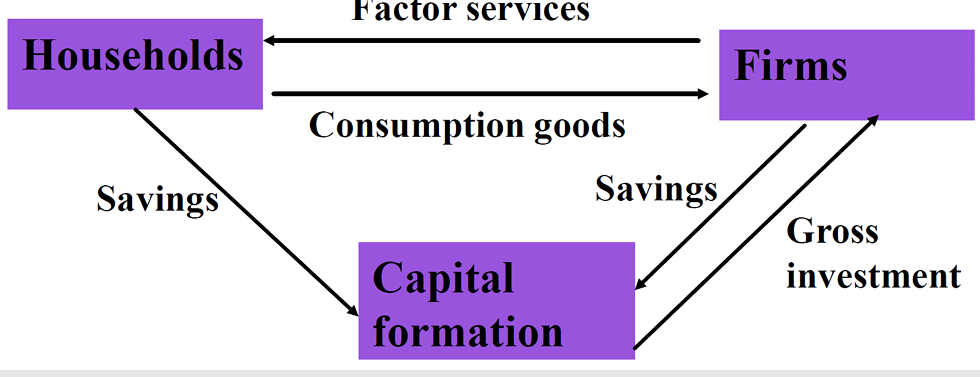
Modern circular flow of income with investment maths
Households income Y = C + S where C = what they consume, S = savings
firms output Y = C + I where C = Consumption goods, I = Capital goods (investment)
So equating the two we get that S = I.
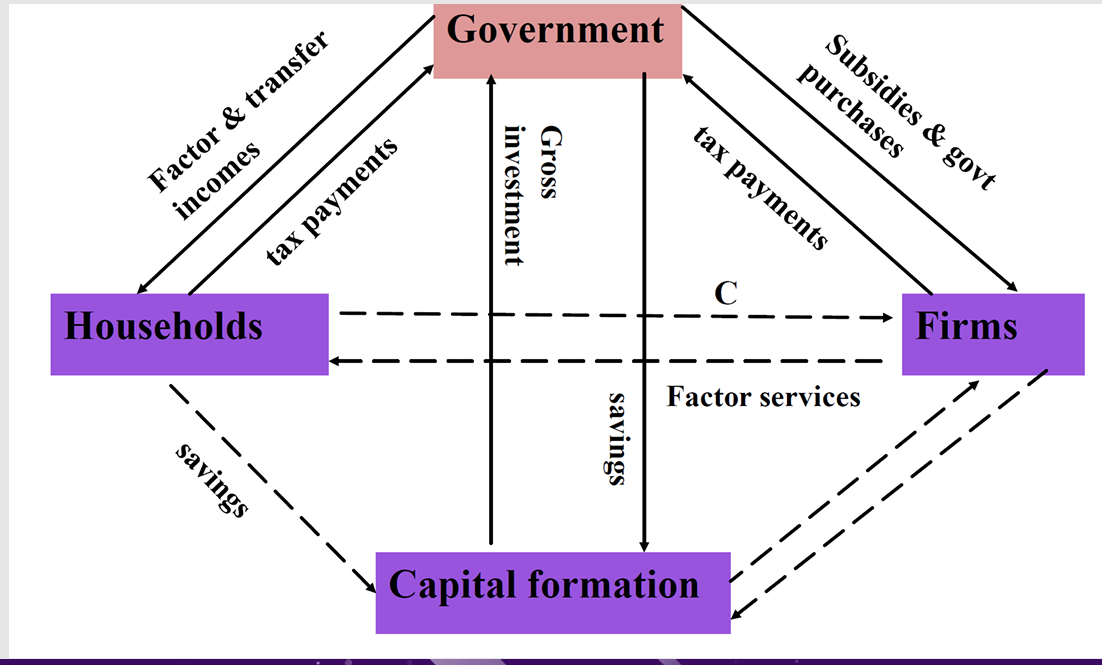
Modern circular flow of income with government
added sector means that the gov tax firms and households
this income is then spent on subsidies to firms and wages and transfer payments to households (workers in public sector and pensions, benefits etc)
Money that is not spent by government goes into savings which then contribute to capital formations (such as hospitals, roads etc)