muscles PART 2 [sliding filament model and sources of ATP]
 Call Kai
 Learn
Learn Practice Test
 Spaced Repetition
 Match
Match Flashcards
 Knowt Play
1/13

There's no tags or description
Looks like no tags are added yet.
Name | Mastery | Learn | Test | Matching | Spaced | Call with Kai |
|---|
No analytics yet
Send a link to your students to track their progress
14 Terms
What does myosin consist of?
-myosin tails
-myosin heads
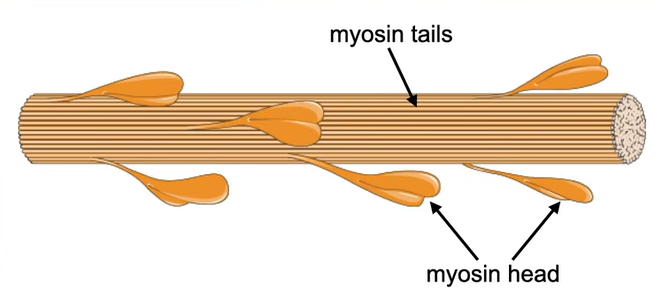
what does myosin head have?
-binding site for actin
-binding site for ATP
what does actin filaments consist of?
-tropomyosin and troponin [proteins]
-binding sites for myosin heads
![<p>-tropomyosin and troponin [proteins]</p><p>-binding sites for myosin heads</p>](https://assets.knowt.com/user-attachments/991ea212-41fc-4af4-ab79-1b805f57c1d3.png)
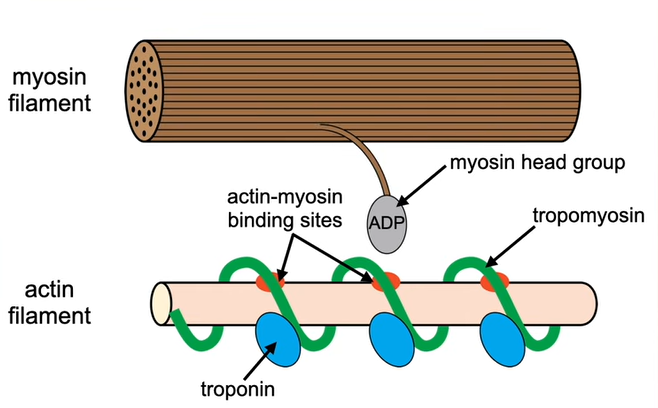
labelled diagram of sliding filament model
describe the sliding filament model of muscle contraction
-a nerve impulse causes the release of calcium ions from the sarcoplasmic reticulum [1]
-calcium ions bind to troponin, causing it to change shape [2]
-this causes tropomyosin to move aside, exposing the binding sites on actin [2]
-myosin head bind to actin, forming actin-myosin cross-bridge [3]
-myosin head performs a power stroke (tilts), pulling the actin filaments past myosin and releasing ADP [4]
-ATP binds to myosin head, causing it to detach from actin [5] [break actin-myosin cross-bridge]
-ATP is hydrolysed by ATPase to ADP and phosphate, releasing energy [6]
-this energy returns the myosin head to its original position [6]
-the myosin head reattaches further along the actin filament
-The cycle repeats, causing muscle contraction
![<p>-a nerve impulse causes the release of calcium ions from the sarcoplasmic reticulum <strong>[1]</strong></p><p>-calcium ions bind to troponin, causing it to change shape<strong> [2]</strong></p><p>-this causes tropomyosin to move aside, exposing the binding sites on actin <strong>[2]</strong></p><p>-myosin head bind to actin, forming actin-myosin cross-bridge <strong>[3]</strong></p><p>-myosin head performs a power stroke (tilts), pulling the actin filaments past myosin and releasing ADP <strong>[4]</strong></p><p>-ATP binds to myosin head, causing it to detach from actin<strong> [5] </strong>[break actin-myosin cross-bridge]</p><p>-ATP is hydrolysed by ATPase to ADP and phosphate, releasing energy <strong>[6]</strong></p><p>-this energy returns the myosin head to its original position<strong> [6]</strong></p><p>-the myosin head reattaches further along the actin filament</p><p>-The cycle repeats, causing muscle contraction</p>](https://assets.knowt.com/user-attachments/7ad3d03f-8bfd-464e-a13d-00fdf45cd179.png)
what happens after muscle contraction?
-calcium ions are actively transported back into the sarcoplasmic reticulum
-this requires ATP
-troponin returns to its original shape
-tropomyosin moves back, blocking the binding sites on actin
-the actin filaments slide back to their relaxed position
-the Sarcomere returns to its original length
-muscle stops contracting and relaxes
explain why glucose is required for the contraction of skeletal muscle [hint: mention why ATP is required]
-glucose is required for respiration to produce ATP
-ATP is required to detach myosin from actin [break actin-myosin cross-bridge]
-ATP is hydrolysed to ADP and phosphate to return the myosin head to its original position
-ATP is required to actively transport calcium ions back into the sarcoplasmic reticulum
what does a lack of ATP lead to in muscles and why?
-muscles cannot relax
-ATP is required to detach myosin from actin
-Without ATP, actin-myosin cross-bridges remain attached
why do muscles fail to relax after contraction if the sarcoplasmic reticulum is damaged?
-calcium ions are not reabsorbed into the sarcoplasmic reticulum
-calcium ions remain bound to troponin
-binding sites on actin remain exposed
-actin-myosin cross-bridges remain attached→ muscle cannot relax
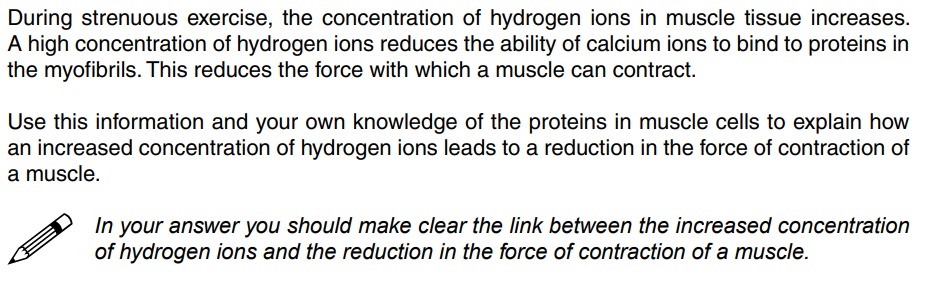
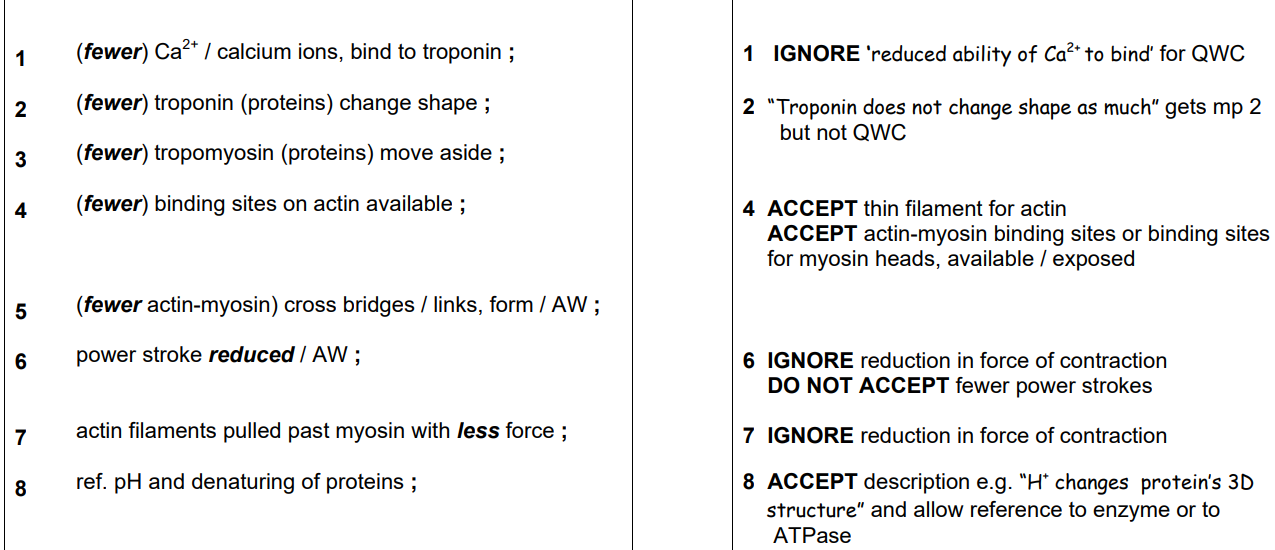
Sources of ATP for muscle contraction
-aerobic respiration
-anaerobic respiration
-creatine phosphate (phosphocreatine)
using aerobic respiration
-occurs if oxygen is available
-requires oxygen for oxidative phosphorylation in mitochondria
-produces more ATP
-cannot occur during intense exercise when oxygen supply is limited
-suitable for long periods of low-intensity exercise
using anaerobic respiration
-required during intense exercise when oxygen is limited
-ATP is produced by glycolysis
-pyruvate is converted to lactate
-build up of lactate decreases pH, causing muscle fatigue
using creatine phosphate
-found in the sarcoplasm of muscle fibres
-creatine phosphate donates a phosphate group to ADP to form ATP
-produces ATP quickly
-runs out quickly
-doesn’t require oxygen
-used during short bursts of intense exercise