10. Biotechnology and its Applications
 Call Kai
 Learn
Learn Practice Test
 Spaced Repetition
 Match
Match Flashcards
 Knowt Play
1/81

Earn XP
Description and Tags
Almost every line from the NCERT chapter! Please ready the Ethical Issues part yourselves, it's not that bad but it's honestly not flashcard-worthy. Everything else is here! There aren't a lot of diagrams here either. Anyway. Question mode: Flashcards Only. Answer mode: Answer with definition. Recommended study mode: Spaced Repetition (maybe??). Suitable for IAT, NEST, NEET revision. Good luck with exams!
82 Terms
What are three critical research areas for the betterment of biotechnology?
Providing the best catalyst in the form of improved organism usually a microbe or pure enzyme
Creating optimal conditions through engineering for a catalyst to act
Downstream processing technologies to purify the protein/organic compound
What are three options that can be thought for increasing food production?
agro-chemical based agriculture
organic agriculture
genetically engineered crop-based agriculture
How was the Green Revolution beneficial for food production?
It tripled the food supply
The Green Revolution succeeded in tripling the food supply, so it was adequate for feeding the growing human population.
True or false?
False.
The Green Revolution succeeded in tripling the food supply but yet it was not enough to feed the growing human population.
The Green Revolution resulted in increased food supply, due to which factors? (one major, one minor)
Major: use of better management practices and use of agrochemicals (fertilisers and pesticides).
Minor: use of improved crop varieties
The Green Revolution saw increased food production due to:
increased crop varieties through conventional breeding
use of agrochemicals (fertilizers and pesticides)
Why is it not possible to increase food production further now through these means now?
For farmers in the developing world, agrochemicals are often too expensive
Further increases in yield with existing varieties are not possible using cnonventional breeding
Why was “tissue culture” developed?
As traditional breeding techniques failed to keep pace with demand and to provide sufficiently fast and efficient systems for crop improvement, another technology called tissue culture got developed.
What is totipotency?
The capacity to generate a whole plant from any cell/explant is called totipotency.
The capacity to generate a whole plant from any cell/explant is called __________.
The capacity to generate a whole plant from any cell/explant is called totipotency.
What is an explant?
any part of a plant taken out and grown in a test tube under sterile conditions in special nutrient media.
An explant is any part of a plant taken out and grown in a test tube under sterile conditions in special nutrient media.
What is important about this nutrient medium?
The nutrient medium must provide a carbon source such as sucrose and also inorganic salts, vitamins, amino acids, and growth regulators like auxins, cytokinins etc..
What is micro-propagation?
The method of producing thousands of plants through tissue culture is called micro-propagation.
The method of producing thousands of plants through tissue culture is called ________________.
The method of producing thousands of plants through tissue culture is called micro-propagation.
What is tissue culture?
It was learnt by scientists, during 1950s, that whole plants could be regenerated from explants, i.e., any part of a plant taken out and grown in a test tube, under sterile conditions in special nutrient media.
The method of producing thousands of plants through tissue culture is called micro-propagation. This is used for increasing food production.
What is another important application of this method?
The recovery of healthy plants from diseased plants.
If a plant is infected with a virus, which part of the plant remains virus-free?
The meristem (apical and axillary)
Even if the plant is infected with a virus, the meristem (apical and axillary) is free of virus.
What is the benefit of this with regards to tissue culture?
one can remove the meristem and grow it in vitro to obtain virus-free plants. Scientists have succeeded in culturing meristems of banana, sugarcane, potato, etc.
What are somatic hybrids?
Isolated protoplasts from two different varieties of plants – each having a desirable character – can be fused to get hybrid protoplasts, which can be further grown to form a new plant. These hybrids are called somatic hybrids.
What is a protoplast?
Protoplast, is a biological term coined by Hanstein in 1880 to refer to the entire cell, excluding the cell wall. Protoplasts can be generated by stripping the cell wall from plant, bacterial, or fungal cells by mechanical, chemical or enzymatic means.
What is somatic hybridisation?
Isolated protoplasts from two different varieties of plants – each having a desirable character – can be fused to get hybrid protoplasts, which can be further grown to form a new plant.
This process is called somatic hybridisation.
What is a pomato?
Imagine a situation when a protoplast of tomato is fused with that of potato, and then they are grown – to form new hybrid plants combining tomato and potato characteristics. Well, this has been achieved – resulting in formation of pomato; unfortunately this plant did not have all the desired combination of characteristics for its commercial utilisation.
What are GMOs?
Plants, bacteria, fungi, and animals whose genes have been altered by manipulation are called Genetically Modified Organisms (GMO).
How has genetic modification been beneficial to plants with regards to plant production? (5 points)
Genetic modification has:
made crops more tolerant to abiotic stresses (cold, drought, salt, heat).
reduced reliance on chemical pesticides (pest-resistant crops).
helped to reduce post harvest losses.
increased efficiency of mineral usage by plants (this prevents early exhaustion of fertility of soil).
enhanced nutritional value of food, e.g., golden rice, i.e., Vitamin ‘A’ enriched rice
Genetic modification has been used to create tailor-made plants to supply alternative resources to industries, in the form of _______, _____ and ______________.
Genetic modification has been used to create tailor-made plants to supply alternative resources to industries, in the form of starches, fuels and pharmaceuticals.
Bt toxin is produced by which bacterium?
Bacillus thuringiensis (Bt for short)
What is the result of introduction of Bt toxin gene into plants?
Bt toxin gene has been cloned from the bacteria and been expressed in plants to provide resistance to insects without need for insecticides.
Examples are Bt cotton, Bt corn, rise, tomato, potato, and soyabean, etc.
What are 2 examples of lepidopterans (pests of plants)?
tobacco budworm
armyworm
What is an example of a coleopteran (pests of plants)?
beetles
What are two examples of dipterans (pests of plants)?
flies
mosquitoes
How does the Bt toxin gene kill insects that are pests of plants?
B. thuringiensis forms protein crystals during a particular phase of their growth. These crystals contain a toxic insecticidal protein, which exists as inactive protoxins. Once an insect ingests the inactive toxin, it is convered into an active form of toxin due to the alkaline pH of the gut which solubilises the crystals.
Why does the Bt toxin protein not kill the bacterium in which it is made?
The Bt toxin protein exists as inactive protoxins inside the bacterium, and it is only activated by the alkaline pH in an insect’s gut.
How does the Bt toxin protein affect insects (pests of plants)?
The inactive toxin gets activated in the alkaline pH of the insect’s gut. The activated toxin binds to the surface of midgut epithelial cells and creats pores that cause cell swelling and lysis and eventually death of insect.
Why are only specific Bt toxin genes incorporated into crop plants?
Bt toxins are insect-group specific, so the choice of genes depends upon the crop and the targeted pest.
The Bt toxin is coded by which gene?
cryIAc named cry
Which two Bt toxin genes control cotton bollworms?
cryIAc
cryIIAb
Which Bt toxin gene controls corn borer (pest of plant)?
cryIAb.
Which nematod infects the roots of tobacco plants?
Meloidegyne incognitia.
Nematode Meloidegyne incognitia infects which plant?
roots of tobacco plants.
A nematode Meloidegyne incognitia infects the roots of tobacco plants and causes a great reduction in yield.
Which strategy was adopted to prevent this infestation?
A strategy absed on the process of RNA interference (RNAi)
RNA interference (RNAi) takes place in all eukaryotic organisms.
What is the purpose?
cellular defense
What is the method of RNA interference (RNAi)?
This method involves silencing of a specific mRNA due to a complentary double-stranded RNA molecule that binds to and prevents translation of the mRNA.
What is mRNA silencing?
This method (RNA interference) involves silencing of a specific mRNA due to a complentary double-stranded RNA molecule that binds to and prevents translation of the mRNA.
The method of RNA interference involves silencing of a specific mRNA due to a complentary double-stranded RNA molecule that binds to and prevents translation of the mRNA.
Where does this complementary RNA come from when using RNA interference to produce pest-resistant plants?
The source of this complentary RNA could be
from an infection by viruses haveing RNA genoms
from mobile genetic elements that replicate via an RNA intermediate (retro-transposons)
Which vectors are used to introduce nematode-specific genes into host plants?
Agrobacterium tumifaciens vectors
How do nematode-specific genes aid in making host plants pest-resistant? What is the process by which they accomplish this?
The introduction of DNA was such that it produced both sense and anti-sense RNA in the host cells. These two RNA’s being complementary to each other formed a double stranded (dsRNA) that initiated RNAi and thus, silenced the specific mRNA of the nematode. The consequence was that the parasite could not survive in a transgenic host expressing specific interfering RNA. The transgenic plant therefore got itself protected from the parasite.
What is the benefit of biotechnological applications in medicine? (2 points)
it enables mass production of safe and more effective therapeutic drugs
recombinant therapeutics do not induce unwanted immunological responses (as is common in case of similar products isolated from non-human sources)
At present, how many recombinant therapeutics have been approved for human-use worldwide? How many are being marketed in India?
30
12
Why can insulin isolated from other animals elicit immune responses in the human body?
insulin produced in other animals has native proteins that the human immune system identifies as foreign proteins and tries to banish, etc
What is the protein structure of insulin?
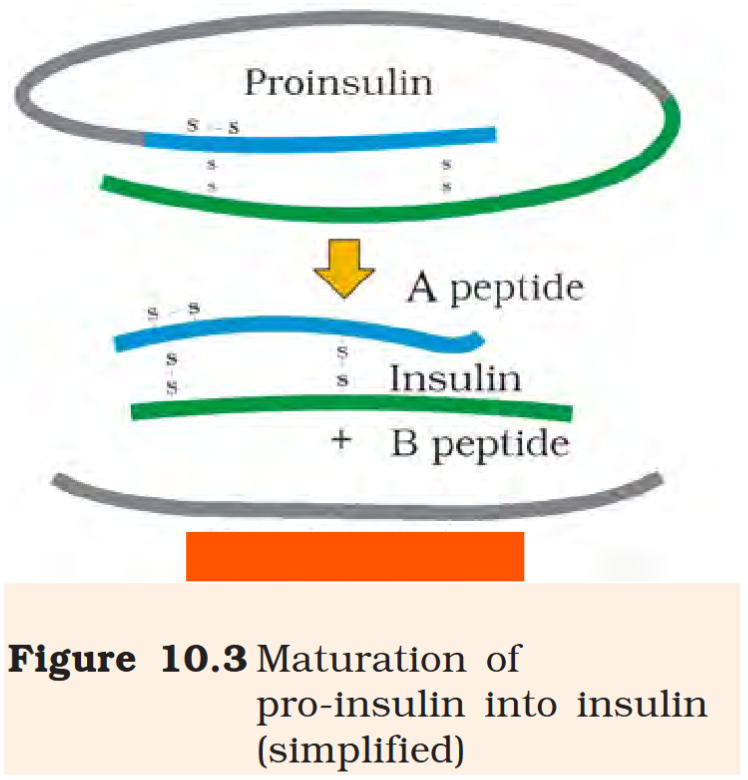
Insulin consists of two short polypeptide chains (chain A and chain B) that are linked together by disulphide bridges.
What is the protein structure of pro-insulin?
It is a peptide chain that consists of three key stretches (chain A, chain B, and chain C).
Chain C is removed to make insulin (chain A and chain B held together by disulphide bonds)
Insulin consists of two polypeptide chains (chain A and chain B) held together by disulphide bonds because of which amino acid?
cysteine
What was the main challenge for production of insulin using recombinant DNA techniques?
Getting insulin assembled into a mature form (and not pro-insulin).
The main challenge for production of insulin using recombinant DNA techniques was getting insulin assembled into a mature form.
In 1983, an american company Eli Lilly accomplished this feat how?
They prepared two DNA sequences corresponding to chain A and B of human insulin and produced them in plasmids of E. coli to produce insulin chains. Chains A and B were produced separately, extracted and combined by creating disulphide bonds to form human insulin.
What is gene therapy?
Gene therapy is a collection of methods that allows correction of a gene defect that has been diagnosed in a child/embryo. Genes are inserted into a person’s cells and tissues to treat a disease.
Correction of a genetic defect involves delivery of a normal gene into the individual or embryo to take over the function of and compensate for the non-functional gene.
The first clinical gene therapy was given in 1990 to who?
A 4-year-old girl with adenosine deaminase (ADA) deficiency.
What is the significance of adenosine deaminase (ADA)?
This enzyme is crucial for the immune system to function.
What are the three wasy in which ADA deficiency in children can be treated?
bone marrow transplantation
enzyme replacement therapy (injection)
gene therapy
How can gene therapy be used to treat adenosine deaminase deficiency?
As a first step towards gene therapy, lumphocytes from the blood of the patient are growin in a culture outside the body. A functional ADA complementary-DNA is then introduced into these lymphocytes, which are subsequently returned to the patient.
What is the problem with gene therapy being used to treat adenosine deaminase deficiency?
As transformed lymphocytes are not immortal, the patient requires periodic infusions of genetically engineered lymphocytes.
In which case can gene therapy be used to cure adenosine deaminase (ADA) deficiency permanently?
If the gene isolated from marrow cells producing ADA is introduced into cells at early embryonic stages, it could be a permanent cure.
Why is early detection and early diagnosis of diseases not possible through conventional methods of diagnosis?
Conventional diagnosis is done using symptoms, and by the time symptoms arise, the pathogen has already multiplied to enormous numbers.
Which techniques can be employed for early detection of diseases?
Polymerase Chain Reaction (PCR)
Enzyme Linked Immuno-sorbent Assay (ELISA)
How can low concentration of a pathogen be detected for early detection of diseases using biotechnological applications?
Low concentration of pathogen can be amplified using PCR (polymerase chain reaction) on their genetic material, so that detection of this pathogen is possible.
Which biotechnological method is used to detect HIV in suspected AIDS patients?
PCR
Which biotechnological method is used to detect mutations in genes in suspected cancer patients?
PCR
How can PCR be used to detect mutations in genes in suspected cancer patients?
A single stranded DNA or RNA, tagged with a radioactive molecule (probe) is allowed to hybridise to its complementary DNA in a clone of cells followed by detection using autoradiography. The clone having the mutated gene will hence not appear on the photographic film, because the probe will not have complementarity with the mutated gene.
How does ELISA (Enzyme Linked Immuno-sorbent Assay) work?
ELISA is based on the principle of antigen-antibody interaction. Infection by pathogen can be detected by the presence of antigens or by detecting the antibodies synthesised against the pathogen.
What are transgenic animals?
Animals that have had their DNA manipulated to possess and express an extra (foreign) gene are known as transgenic animals.
95% of all existing transgenic animals are which animal?
mice
What are 5 common reasons that humans can benefit from the study of transgenic animals?
Study of normal physiology and development
Study of disease
Obtaining biological products
Testing Vaccine safety
Chemical safety testing
How can transgenic animals aid humans in the study of normal physiological development?
Transgenic animals can be specifically designed to allow the study of how genes are regulated, and how they affect the normal function of the body and its development.
Example: study of complex factors involved in growth such as insulin-like growth factor.
By introducing geens from other species that alter the formation of this factor and studying the biological effects that result from it, information is obtained about the biological role of the factor in the body.
How can transgenc animals aid humans in the study of diseases?
These animals are specifically made to serve as models for human diseases so that investigation of new treatments for diseases is made posible.
Today, transgenic models exist for many human diseases. Give the 4 examples mentioned in NCERT.
cancer
cystic fibrosis
rheumatoid arthritis
Alzheimer’s
How can transgenic animals aid humans in producing biological products?
Transgenic animals that produce useful biological products can be created by the introduction of the portion of DNA (or genes) which codes for a particular product.
Example: the human protein (α-1-antitrypsin) used to treat emphysema
Similar attempts are being made for treatment of phenylketonuria and cystic fibrosis
Who was the first transgenic cow?
Rosie
What was the significance of the first transgenic cow?
Rose produced human protein-enriched milk (2.4 grams per liter). The milk contained the human alpha-lactalbumin and was nutritionally a more balanced product for human babies than natural cow milk.
How can transgenic animals aid humans in gauging vaccine safety?
Transgenic mice are being developed for use in testing the safety of vaccines before they are used on humans. If successful and found to be reliable, they could replace the use of monkeys to test the safety of batches of the vaccine.
How can transgenic animals aid humans in chemical safety testing?
(Toxicity safety testing)
Transgenic animals are made that carry genes which make them more sensitive to toxic substances than non-transgenic animals. They are then expoosed to the toxic substances and the effects are studied.
Genetic modification of organisms can have unpredicatable results when such organisms are introduced into the ecosystem.
True or false?
True.
The Indian Government has set up organisations such as ______________ which will make decisions regarding the validity of genetic modifications research and safety of introducing genetically modified organisms for public services.
GEAC (Genetic Engineering Approval Committee)
What is Biopiracy?
It is a term used to refer to the use of bio-resources by multinational companies and other organisations without proper authorisation from the countries and people concerned without compensatory payment.
Free C peptide