Andrology Exam - ALL REVIEW | Quizlet
 Call Kai
 Learn
Learn Practice Test
 Spaced Repetition
 Match
Match Flashcards
 Knowt Play
1/67

There's no tags or description
Looks like no tags are added yet.
Name | Mastery | Learn | Test | Matching | Spaced | Call with Kai |
|---|
No analytics yet
Send a link to your students to track their progress
68 Terms
During testicular dystrophy in a boar?
a. Ejaculate volume fluctuates within normal limits, sperm concentration may not change, both sperm motility and viability decrease
b. Ejaculate volume fluctuates within normal limits, sperm concentration increases, both sperm motility and viability remain normal
c. Ejaculate volume increases, sperm concentration may not change, both sperm motility and viability increase
d. Ejaculate volume decreases, sperm concentration decreases, both sperm motility and viability increases
a. Ejaculate volume fluctuates within normal limits, sperm concentration may not change, both sperm motility and viability decrease
(Lecture note:
Slow state, leading to loss of epithelial sperm, reducing the volume of the testicles with a hard consistency which leads to infertility)
Drugs which penetrate the barrier between the blood and the prostate gland are:
a. Sulphonamides and trimethoprim, erythromycin, clindamycin and fluoroquinolones
b. Erythromycin, clindamycin, tetracyclines and fluoroquinolones
c. Fluoroquinolones, amphotericin B and azithromycin
d. Clindamycin, cephalosporins and amicacin
a. Sulphonamides and trimethoprim, erythromycin, clindamycin and fluoroquinolones
(Lecture note:
Erythromycin (macrolide)
Clindamycin (lincosamide)
Chloramphenicol
Trimethoprim (antifolate → used with sulphonamides)
Ciprofloxacin, Enrofloxacin (fluoroquinolones))
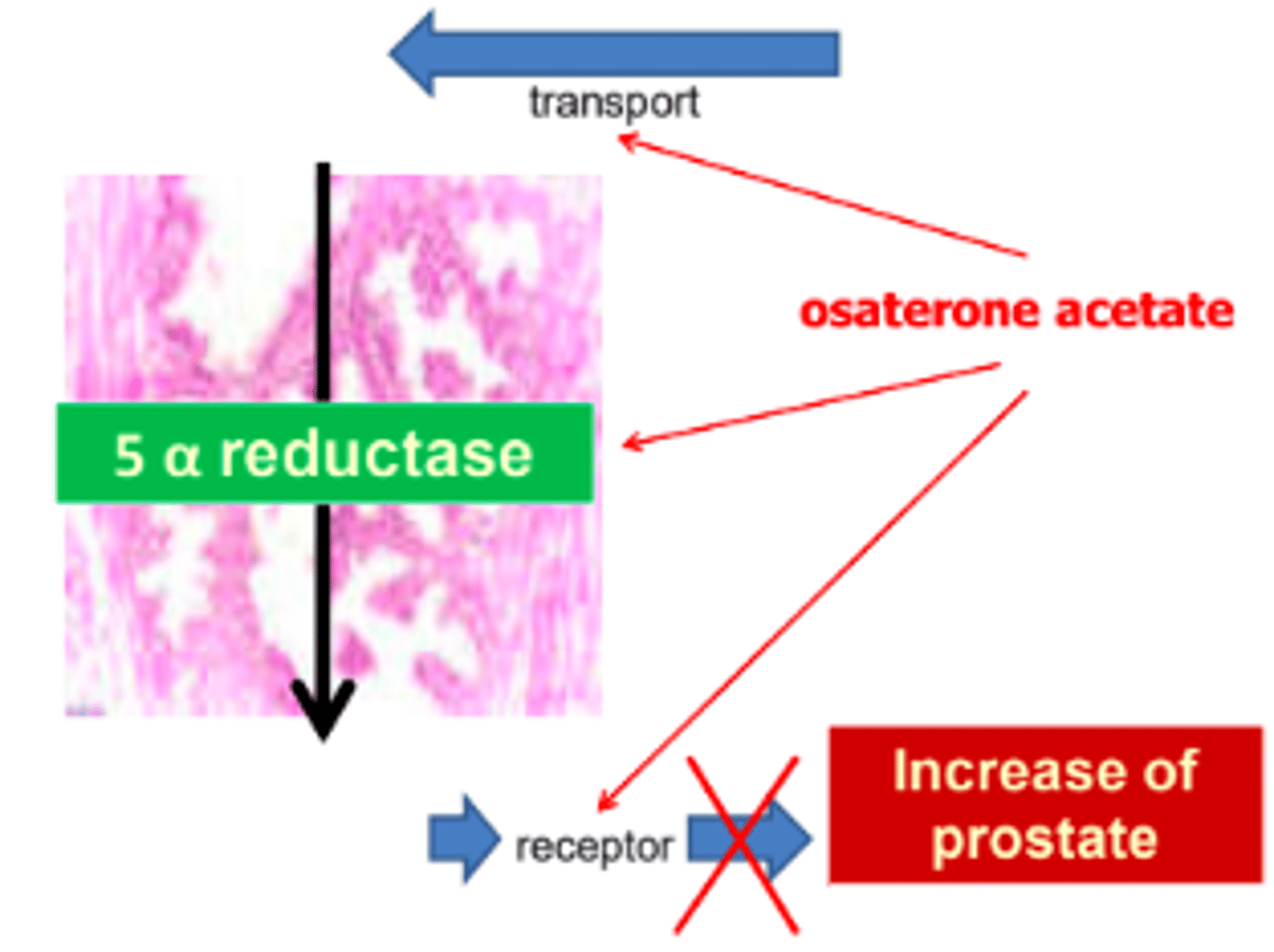
Osaterone acetate - mechanism of action
a. Blocks the androgen receptor and inhibits the action of 5-alpha-reductase
b. Impairs the uptake of androgen in the prostate, blocks the androgen receptors and inhibits the function of 5-alpha-reductase
c. Impairs the uptake of androgen in the prostate
d. Blocks androgen receptors in the prostate
a. Blocks the androgen receptor and inhibits the action of 5-alpha-reductase
(Lecture note:
Blocks the androgen receptors and testosterone metabolism to DHT which results in low level of intracellular androgen
Prevent binding of androgens with its receptors in the prostate and blocks the testosterone transport to the prostate)
Which is gonadal sex development/sex reversal syndrome
a. Has XY chromosome with no abnormalities of SRY gene
b. Animal with different genetic material from 2 sources (fusion of 2 zygotes)
c. Has female genotype but with malformation of ovaries
d. Has female genotype, gonads of testicular tissue and lacks SRY gene
d. Has female genotype, gonads of testicular tissue and lacks SRY gene
(A → male pseudohermaphroditism
B → Chimera/mosaic sexual disorder
C → Syndrome X0 - meiosis disorder
Lecture note
Chromosome XX
Lack SRY gene
Lack ZFY gene
Gonads structure is similar to testis → Clitoral hypertrophy, Intersex
Testes/ovotestes → male (XX male syndrome) or intersexual (cyclic animal) phenotype)
Cause of BPH (Benign prostatic hyperplasia)
a. Overactivation of estrogen
b. Administration of excess glucocorticosteroids
c. Young age
d. NSAIDs
e. Androgens
a. Overactivation of estrogen
(Lecture note
DHT overproduction and overactivity = hyperplasia in glandular part = cysts formation in parenchyma
→ Growth and activity of prostate is modulated by 5-alpha-dihydrotestosterone (DHT), testosterone metabolite, formed from action of 5-alpha-reductase
→ DHT is an androgen active at the intra and extracellular level
Estrogen increase receptor sensitivity for androgens → role for BPH formation)
Optimal fertility of a dog
a. 6-12 months of age
b. 18 months of age
c. 3-6 years of age
d. 8-10 years of age
c. 3-6 years of age
(A → puberty
B → sexual maturity
D → senile changes)
Unilateral cryptorchidism treatment
a. Unilateral castration of the undescended testicle & vasectomy of the descended one should be recommended
b. Removal of the undescended testicle and leaving the descended one
c. Bilateral castration should be recommended
d. A and C are correct
d. A and C are correct(?)
(**Another question has only C as a correct option
Lecture note:
Bilateral castration in dogs with cryptorchidism due to being heritable and having a 10x higher predisposition to neoplasia
Treatment not specified for other species)
Survival time of the sperm in the mare
a. 2-4 days
b. 1-2 days
c. 6 hours
d. 5 days
b. 1-2 days
(A → Lifespan of sperm in female tract
B → survival time with fertilizing capacity)
Treatment in rupture of corpus cavernosum penis in bulls
a. Treat most valuable bull - if treatment is not successful - slaughter should be recommended
b. Instantly treat
c. Slaughter should be recommended immediately
a. Treat most valuable bull - if treatment is not successful - slaughter should be recommended
(Lecture note:
Long time needed for recovery → treatment is ineffective in many bulls. Slaughter should be recommended
Conservative treatment can be applied for bulls with a relatively small, freely movable hematoma, antibiotic therapy and daily massage. 90 days of sexual rest. 10-50% effective.
Surgical treatment → should not be delayed for more than 7 days. Risk of adhesions with radical surgery treatment and in consequence inability to protrude the penis)
Testicular degeneration prognosis in stallions
a. Good prognosis
b. Poor prognosis
c. Guarded to good
d. Guarded to poor
d. Guarded to poor (?)
(Lecture note:
In most cases of degeneration the prognosis for return to service is guarded)
Prostatitis prognosis in breeding dogs
a. Good prognosis
b. Poor prognosis
c. Guarded to good
d. Guarded to poor
d. Guarded to poor (?)
(Lecture note:
Return of fertility is time requiring → spermatogenesis >60 days
Benign prostate hyperplasia as a complication)
Which sentence is correct about testosterone and estrogen
a. Estrogen is synthesized in Leydig and Sertoli cells and ABP transports estrogen to the epididymis
b. Testosterone is synthesized in Leydig and Sertoli cells and ABP transports testosterone to the epididymis
c. Testosterone is synthesized in Leydig and estrogen in Sertoli cells and ABP transports estrogen to the epididymis
d. Testosterone is synthesized in Leydig and estrogen in Sertoli cells and ABP transports testosterone to the epididymis
d. Testosterone is synthesized in Leydig and estrogen in Sertoli cells and ABP transports testosterone to the epididymis
(Info from the internet:
Leydig cells → produce and secrete testosterone, but also have two estrogen receptor subtypes so have the capacity to convert testosterone to estradiol.
Estradiol is the primary form of estrogen in the body
Sertoli cells → produce enzymes that convert testosterone to estrogen and DHT
ABP (Androgen Binding Protein) → binds to testosterone, DHT and estradiol. Binds testosterone and transports it in the seminiferous tubule to the epididymis.)
Third phase sperm
a. Spermatocytogenesis phase I forms secondary spermatocytes known as spermatids
b. Spermatogenesis phase III ends in transformation of spermatids to spermatozoa
c. Spermatogenesis phase II involves transformation of spermatogonia to spermocytes
b. Spermatogenesis phase III ends in transformation of spermatids to spermatozoa
(Lecture note:
I stage → mitotic division of spermatogonia leading to formation of primary spermatocytes
II stage → meiotic division leading to formation of spermatids)
When does preparation of boar for reproduction begin
a. Starts already at birth
b. Starts when the piglet reaches 30kg
c. Starts when the boar is 1 year old
d. Starts when the boar is 1 month
a. Starts already at birth
(Lecture note
Boars grow faster than gilts and hog → accommodate feed to their needs
For 6 months the demand for energy and nutrients is the same as for a 30kg piglet
Lysine, sulfur, vitamin A, zinc, manganese and iodine are particularly important
→ Lysine stimulates libido
→ Zinc stimulates maturation of spermatozoa
→ Manganese increases libido, prevents testicular degeneration
→ Methionine and cysteine affect sperm quality)
Reasons to exclude boar from reproduction
a. Age
b. Low quality of semen
c. Both of the above
d. None of the above
c. Both of the above
(Lecture note:
Low libido
Limb disorders
Nutritional mistakes
Other factors → disease, aggression, inability to jump on phantom, vaccination with live vaccine instead of inactivated, persistent oligospermia etc.)
BPH symptoms
a. Pain when palpable through rectum
b. Fever, weakness, anorexia
c. Reluctant to mate
d. Infertility
d. Infertility
(Lecture note
Can be asymptomatic with the only symptom being discharge from the urethra
Pain on defecation, ribbon/tapered stool, stilted gait, prostate is painless but strongly palpable under rectal exam, hematuria, blood in semen, infertility
Can resemble chronic prostatitis)
Acute prostatitis symptoms
a. Less frequent; strong painfulness of gland, edema, reluctance to mate, blood in semen, hematuria/polyuria, fever, weakness, anorexia, lethargy
b. More frequent; painless prostate, poor libido, low semen quality, infertility, hemospermia, straining to defecate
c. More frequent; may be asymptomatic or slightly symptomatic
d. Only symptom is discharge from the urethra
e. B and C are correct
a. Less frequent; strong painfulness of gland, edema, reluctance to mate, blood in semen, hematuria/polyuria, fever, weakness, anorexia, lethargy
Chronic prostatitis symptoms
a. Less frequent; strong painfulness of gland, edema, reluctance to mate, blood in semen, hematuria/polyuria, fever, weakness, anorexia, lethargy
b. More frequent; painless prostate, poor libido, low semen quality, infertility, hemospermia, straining to defecate
c. More frequent; may be asymptomatic or slightly symptomatic
d. Only symptom is discharge from the urethra
e. B and C are correct
e. B and C are correct
Most common penile neoplasia
a. Squamous cell carcinoma of penile/preputial mucosa
b. Transmissible venereal tumor (TVT)
c. Malignant mast cell tumor
d. Chondrosarcoma of os penis
e. Papillomas
b. Transmissible venereal tumor (TVT)
(**All options are possible neoplasias)
Stallion with decreased libido
a. Administrate GnRH
b. Administrate anti-anxiety drugs (diazepam) before breeding
c. Castrate as the they are not fit to be breeding stallions
d. A and B is correct
d. A and B is correct
In hypoplastic testicles in stallions the epididymis becomes
a. Adequately smaller in relation to hypoplastic testis
b. Significantly larger comparing to the testicle
c. Complete atrophy of the epididymis is noted
d. Significantly smaller comparing to the testicle
a. Adequately smaller in relation to hypoplastic testis
(Lecture note:
Poor prognosis for fertility
Epididymis is proportionally small in relation to the hypoplastic testis
Degeneration/atrophy → epididymis is relatively large compared to the testis)
Cryptorchidism may lead to
a. GDV
b. Neoplasia
c. Testicular torsion
d. Scrotal lesions
b. Neoplasia
(Lecture note:
3 neoplasms → interstitial cell neoplasm, teratoma, seminoma
Associated with intersexes and some cryptorchid testes are cystic)
Degeneration of testes
a. Impaired mating performance
b. Increased libido
c. Increased testicle size
d. Oligoathenozoospermia
d. Oligoathenozoospermia (?)
(It’s never specified in any lecture, but fibrosis will cause sperm disorders? I don’t know with a) if they mean if the animal will still mount or about their fertility.
Oligoathenozoospermia (info from the internet):
Sperm disorder that involves two disorders at the same time
Oligozoospermia → low sperm count
Asthenozoospermia → abnormal sperm motility)
Description of prostatic fluid
a. III semen fraction, painless collection mainly used in dogs
b. Slight number of erythrocytes and leukocytes, exfoliated epithelial cells of urinary tract are present physiologically
c. II semen fraction, painless collection mainly used in boars
d. A and B is correct
d. A and B is correct
Sexual maturity in boars
a. 6-10 months
b. 10-12 months
c. 2-3 years
d. 5-8 years
b. 10-12 months (or when between 130-160kg)
(A → puberty
C → optimal fertilizing capacity
D → senile changes)
Age of rams to begin breeding
a. 6-8 months
b. 16-24 months
c. 1-2 years
d. 6-10 years
b. 16-24 months (depends on weight and breed)
(A → puberty
D → senile changes)
BPH is the most common in:
a. No breed, age or sex predisposition
b. Older, non-castrated dogs
c. Older, castrated dogs
d. Younger, large breed dogs
b. Older, non-castrated dogs
How many sows per boar in productive farms:
a. 1 boar per 50
b. 1 boar per 100
c. 1 boar per 150
d. 1 boar per 300
a. 1 boar per 50 sows
(Lecture note:
Individual ‘from hand’ matings (productive farms) --> 1 boar / 50
sows
Breeding farm --> 1 boar / 15 sows
Artificial insemination –-> 1 boar / several hundred sows-currently)
Which cell is a haploid?
a. Spermatid
b. Spermatogonia
c. Primary spermatocytes
d. Secondary spermatocytes
a. Spermatid
(Spermatogonia & secondary spermatocytes → diploid
Primary spermatocytes → tetraploid)
Bull sexual maturity
a. 10-12 months
b. 2 years
c. 3-8 years
d. 18 months
b. 2 years
(A → puberty
C → optimal fertility capacity)
When do you know that a bull has cryptorchidism
a. From the moment of birth
b. Abnormality with the male phenotype expression due to affected testosterone secretion
c. Poor libido
d. Not possible to know before sexual maturity
a. From the moment of birth
Equine coital exanthema (EHV-3)
a. Transmitted at breeding, vesicles postules and ulcers on the penis and sheath.
b. May cause reluctance to breed due to pain.
c. Treatment is 3 weeks of sexual rest.
d. All of the above are correct
d. All of the above are correct
Which statement is correct about pharmacological treatment of prostatitis?
a. Most of the drugs cannot enter the prostate
b. Antibiotic therapy should last for min. 6 weeks
c. Castration is the only treatment method
d. Acidic drug pH works better
a. Most of the drugs cannot enter the prostate
(Lecture note:
Ability of the drug to penetrate the prostate depend on: pH of the drug (alkaline pH is better), level of solubility in lipids (high level) and ability to bind plasma proteins (weak binding)
Virtually any antibiotic will penetrate the prostatic tissue
Antibiotic therapy for min. 3 weeks (acute) or 4 weeks (chronic)
If BPH is present → anti-androgens or castration)
What treatment of prostatitis for a non-breeding dog
a. Castration
b. Anti-androgen therapy
c. Fluid therapy, analgesics
d. Administration of gestagens
a. Castration
How long does the clinical effect of 7 days of osaterone acetate administration last in dogs?
a. 2 months
b. 3 months
c. 5 months
d. 8 months
c. 5 months
XXX syndrome
a. Male phenotype with testes malformation and infertility due to azoospermia
b. Female phenotype with ovary malformations and infertility due to anestrus and permanent proestrus
c. Female phenotype with anestrus and infertility
d. None of the above
c. Female phenotype with anestrus and infertility
(A → syndrome XXY
B → Syndrome X0)
Spermatogenesis in dogs lasts for?
a. 50 days
b. >60 days
c. 60 days
d. 40 days
a. 50 days
Testicular degeneration and its effects
a. Increased size, softened consistency, fibrosis-solid structure
b. Decreased size, softened consistency, may be fibrosis-solid structure
c. Decreased size, hardened consistency, non-fibrotic
d. Increased size, normal consistency, fibrosis
b. Decreased size, softened consistency, may be fibrosis-solid structure
Transmissible venereal tumors (TVT) is caused by:
a. Secondary to prolonged or excessive parasympathetic stimulation
b. Secondary to decreased venous outflow (thromboembolism, mass lesion)
c. Opportunistic infections
d. Transmission of tumor cells through direct contact and tumor cell proliferation mainly on genitals and possibly on other mucous membranes
d. Transmission of tumor cells through direct contact and tumor cell proliferation mainly on genitals and possibly on other mucous membranes
Optimal bull fertility
a. 10-12 months
b. 2 years
c. 3-8 years
d. 18 months
c. 3-8 years
(A → puberty
B → sexual maturity)
Dogs reach sexual maturity at what age?
a. 6-12 months
b. 18 months
c. 3-5 months
d. 18-20 months
b. 18 months
(Puberty → 6-12 months of age
Optimal fertilizing capacity → 3-6 years
Senile changes → 8-10 years)
Which of the following sentences is correct
a. Estrogen is synthesized in Leydig and Sertoli cells and ABP transports estrogen to the epididymis
b. Testosterone is synthesized in Leydig and Sertoli cells and ABP transports testosterone to the epididymis
c. Testosterone is synthesized in Leydig and estrogen in Sertoli cells and ABP transports estrogen to the epididymis
d. Testosterone is synthesized in Leydig and estrogen in Sertoli cells and ABP transports testosterone to the epididymis
d. Testosterone is synthesized in Leydig and estrogen in Sertoli cells and ABP transports testosterone to the epididymis
(Info from the internet:
Leydig cells → produce and secrete testosterone, but also have two estrogen receptor subtypes so have the capacity to convert testosterone to estradiol.
Estradiol is the primary form of estrogen in the body
Sertoli cells → produce enzymes that convert testosterone to estrogen and DHT
ABP (Androgen Binding Protein) → binds to testosterone, DHT and estradiol. Binds testosterone and transports it in the seminiferous tubule to the epididymis.)
Which ingredient in boars feed increases libido and prevents testicular degeneration
a. Manganese
b. Zinc
c. Copper
d. Sodium
a. Manganese
(Lysine, sulfur, vitamin A, zinc, manganese and iodine are particularly important
→ Lysine stimulates libido
→ Zinc stimulates maturation of spermatozoa
→ Manganese increases libido, prevents testicular degeneration
→ Methionine and cysteine affect sperm quality)
Cryptorchidism – how can it be diagnosed
a. Careful palpation of scrotum and inguinal region
b. X-ray
c. FNA
d. Visual inspection
a. Careful palpation of scrotum and inguinal region
(Lecture note:
Ultrasound → may not be efficient to identify
Rectal palpation (decreased prostate)
Hormone assay)
Orchitis - causes
a. Consequence of epididymitis
b. Infection
c. Autoimmune destruction
d. B and C is correct
d. B and C is correct
(Lecture note:
Infection → Brucella canis, E. coli, Proteus vulgaris, Staphylococcus sp. Streptococcus sp. Mycoplasma canis)
Orchitis - diagnosis
a. Visual inspection and palpation
b. Semen collection and examination
c. Ultrasound and FNA
d. All of the above
d. All of the above
Orchitis - treatment
a. Antibiotic therapy
b. Castration
c. Glucocorticosteroid therapy
d. B and C is correct
d. B and C is correct
Bull optimal fertility
a. 10-12 months
b. 2 years
c. 3-8 years
d. 18 months
c. 3-8 years
(A → puberty
B → sexual maturity)
Why boars are culled
a. Age
b. Poor semen quality
c. None of the above
d. All of the above
d. All of the above
(Other factors:
Low libido
Limb disorders
Nutritional mistakes
Other factors → disease, aggression, inability to jump on phantom, vaccination with live vaccine instead of inactivated, persistent oligospermia etc.)
Stallion sexual maturity
a. 23-27 months of age
b. 3 years of age
c. 5-14 years
d. 18-20 years
b. 3 years of age
(A → puberty
C → optimal fertilizing capacity
D → Senile changes)
When does the inguinal canal close in dogs (testis won’t be able to descend anymore)
a. 6 months
b. 4 months
c. 2 months
d. 8 months
a. 6 months
How long is the effect of osaterone
a. 5 months
b. 6 months
c. 12 months
d. 24 months
a. 5 months
XXY sexual disorder
a. Female phenotype with testes
b. Female phenotype with ovaries
c. Male phenotype with asthenospermia
d. None of the above
d. None of the above
(Lecture note:
Syndrome XXY → male phenotype with testes malformation (agenesis, aplasia) and infertility due to azoospermia (no sperm).
Asthenospermia = reduced sperm motility)
XX sexual disorder
a. Lack of SRY
b. Chromosome XY
c. No abnormalities of the SRY gene
d. A type of genetic sex disorder
a. Lack of SRY
What stage of spermatogenesis is diploid
a. Spermatogonia
b. Spermatids
c. 2nd stage primary spermatocytes
d. 1st stage primary spermatocytes
a. Spermatogonia
Persistent frenulum
a. Congenital
b. Acquired
c. Both
d. Physiologically
a. Congenital
Genital disease in horses
a. Dourine
b. Coital exanthema
c. Contagious metritis (CEM)
d. All of the above
d. All of the above
Cytology of acute prostatitis
a. Lack of epithelial cells
b. Multinucleated cells
c. High neutrophils
d. All of the above
c. High neutrophils
(Lecture note:
Large number of erythrocytes
Larger number of leukocytes/bacteria)
Unilateral cryptorchidism treatment
a. Do not treat either testes
b. Castrate descended testes
c. Remove ectopic testes and vasectomy on the other
d. Remove ectopic testes and leave the other for reproductive use
c. Remove ectopic testes and vasectomy on the other
(Lecture notes:
For dogs -- says that treatment of choice is bilateral castration)
Sticker’s sarcoma (Transmissible Venereal Tumor) treatment
a. No treatment - spontaneous remission
b. Resection of tumor with wide margin
c. Chemotherapy (vincristine, vinblastin), radiotherapy, cryotherapy
d. All of the above
d. All of the above
(**About 20% of cases experience spontaneous remission.)
Treatment of BPH
a. Characteristics of drugs that penetrate prostate blood barrier → high pH, lipid soluble, low plasma protein binding
b. Minimum of 4 weeks
c. All of the above
c. All of the above
Increased chance of cryptorchidism
a. Hydrocele
b. Tumor or torsion
c. Increased keratohyalin
b. Tumor or torsion
Testicular degeneration affects
a. Enlarged testicles
b. Decreased libido
c. Oligospermia
d. Mating behaviour
c. Oligospermia
Which sentence is correct?
a. Testicular tissue degeneration leads to testicular enlargement
b. Testicular tissue degeneration leads initially to a loss of libido
c. Testicular tissue degeneration concerns mainly functional tissue i.e. seminiferous tubules, to a lesser extent Leydig cells, occur after a long exposure to the damaging factor and leads to a decrease in sperm number, sperm motility and morphology
d. Testicular tissue degeneration concerns mainly Leydig cells to a lesser extent seminiferous tubules, occurs after a long exposure to the damaging factor and leads to a decrease in sperm number, sperm motility and morphology
c. Testicular tissue degeneration concerns mainly functional tissue i.e. seminiferous tubules, to a lesser extent Leydig cells, occur after a long exposure to the damaging factor and leads to a decrease in sperm number, sperm motility and morphology
The example of disorders of gonadal sex differentiation is:
a. Hypospadias
b. Mosaicism
c. Sex reversal syndrome (XX and ovotestes)
d. Trisomy XXY
c. Sex reversal syndrome (XX and ovotestes)
Spermatogenesis in boars lasts for?
a. 7 weeks
b. 4 weeks
c. 6 weeks
d. 5 weeks
c. 6 weeks
Which of the following sentences is correct?
a. Spermatogonia, spermatocytes and spermatids are diploid cells
b. Spermatogoniogenesis ends with the production of intermediate spermatogonia
c. Spermatocytes I are haploid cells
d. Spermatocytogenesis ends with the production of spermatids
b. Spermatogoniogenesis ends with the production of intermediate spermatogonia
Which sentence is correct?
a. During BPH and prostatitis chronica in dogs the main clinical signs are: straining to defecate, intermittent urethral discharge not connected to urinating, pain around the prostate gland
b. During BPH and prostatitis in dogs the semen motility decreases and primary and secondary spermatozoa defects increase
b. During BPH and prostatitis in dogs the semen motility decreases and primary and secondary spermatozoa defects increase