marine marine: weekly reading questions 1-4
 Call Kai
 Learn
Learn Practice Test
 Spaced Repetition
 Match
Match Flashcards
 Knowt Play
1/37

There's no tags or description
Looks like no tags are added yet.
Name | Mastery | Learn | Test | Matching | Spaced | Call with Kai |
|---|
No analytics yet
Send a link to your students to track their progress
38 Terms
Charles Darwin formed a theory about how coral reefs developed and formed coral atolls.
a) True
b) False
a) True
Due in part to the need for improved ___________ , technological advances during World War II expanded our understanding of the ocean.
a) navigation
b) food
c) wind power
d) biodiversity
e) jobs
a) navigation
SCUBA diving was first developed in the ________.
a) 1920s
b) 1940s
c) 1960s
d) 1980s
e) 1890s
b) 1940s
The crust and outer mantle make up the:
a) inner core
b) outer core
c) asthenosphere
d) lithosphere
d) lithosphere
Two plates slide past each other at a:
a) transform boundary
b) convergent boundary
c) divergent boundary
a) transform boundary
Two plates collide at a:
a) transform boundary
b) convergent boundary
c) divergent boundary
b) convergent boundary
Mirrored bands of alternating magnetic polarity in oceanic crusts are evidence of ________________.
a) earthquakes
b) seafloor spreading
c) transverse faults
d) submarine trenches
e) sea mounts
b) seafloor spreading
The Coriolis Effect occurs because:
a) of the gravitational pull of the moon
b) of the gravitational pull of the sun
c) Earth's surface rotates around the axis faster at the equator than at the poles
d) Earth's surface rotates faster around the axis at the poles than at the equator
c) Earth's surface rotates around the axis faster at the equator than at the poles
Many shorelines on Earth have semi-diurnal tides. This means they have:
a) 1 high tide and 1 low tide per day
b) 1 high tide and 2 low tides per day
c) 2 high tides and 1 low tide per day
d) 2 high tides and 2 low tides per day
d) 2 high tides and 2 low tides per day
Why does the moon exert more than twice as much tidal force on the oceans than the sun does?
a) Solar gravity acts in the opposite direction from the moon's gravity.
b) The moon is 400 times closer to Earth than the Sun is.
c) The sun is 27 million times more massive than the moon.
d) The sun does not play a role in the formation of tides.
b) The moon is 400 times closer to Earth than the Sun is.
Upwelling occurs when:
a) wind moving parallel to shore results in water being pushed away from shore
b) wind moving parallel to shore results in water being pushed towards shore
c) wind moving away from shore results in water being pushed away from shore
d) wind moving towards shore results in water being pushed towards shore
a) wind moving parallel to shore results in water being pushed away from shore
In addition to the Coriolis Effect, which of the following is the greatest contributing factor to the formation of ocean gyres?
a) water density
b) winds
c) placement of continents
d) water temperature
b) winds
Fill in the blank: Waves begin to interact with the sea floor when the depth of the water is ________ the wavelength.
a) one quarter
b) one half
c) equal to
d) twice
b) one half
Which of the following does NOT affect wave size?
a) distance wind blows across water
b) wind speed
c) water temperature
d) duration of time that wind blows across water
c) water temperature
Which property of water refers to the amount of energy needed to increase the temperature of water?
a) Heat Conduction
b) Viscosity
c) Heat Capacity
d) Polarity
e) Heat of Vaporization
f) Surface Tension
c) Heat Capacity
After they have reached the ocean, which processes concentrate solutes?
a) evaporation and sea-ice formation
b) evaporation and precipitation
c) precipitation and sea-ice formation
d) runoff and sea-ice melting
a) evaporation and sea-ice formation
Where is the highest seasonal variation in sea surface temperature?
a) high latitudes
b) mid latitudes
c) the equator
d) seasonal variation is the same everywhere
b) mid latitudes
Which weighs the most, assuming equal volume of each?
a) Cold fresh water
b) Cold salt water
c) Warm fresh water
d) Warm salt water
b) Cold salt water
What is the name of the region that separates water layers of differing density?
a) Pycnocline
b) Thermocline
c) Subthermocline
d) Superhaline
a) Pycnocline
The Oxygen Minimum Zone between 200m and 1,200m depth is due to what factor?
a) A higher temperature
b) A higher concentration of decaying organic matter
c) A higher salinity
d) A higher pressure
b) A higher concentration of decaying organic matter
Which light zone allows for photosynthesis to occur?
a) euphotic
b) disphotic
c) aphotic
d) abiotic
a) euphotic
Carbon dioxide in the atmosphere has increased over the past century
a) Only because of deforestation
b) Only because of fossil fuel burning
c) Because of a and b, and other sources
d) None of the above
c) Because of a and b, and other sources
Sea surface temperature has
a) Increased the same amount over the past 100 years, irrespective of latitude
b) Increased along a straight-line trajectory over the past 100 years
c) Increased much more at the Equator and much less along the poles
d) Increased differently at different locations and at different decades in the past 100 years
d) Increased differently at different locations and at different decades in the past 100 years
ENSOs are associated with
a) Increased upwelling off the coast of California
b) A deeper thermocline off the coast of Peru
c) Localized changes in water temperature confined to Peru
d) None of the above
b) A deeper thermocline off the coast of Peru
Carbon dioxide in the atmosphere
a) Can be explained mainly by human additions from industrial activity
b) Has increased only in the past decade
c) Has declined since new regulations have taken effect
d) Has increased over the past 150 years in the atmosphere
d) Has increased over the past 150 years in the atmosphere
The North Atlantic Oscillation
a) Only affects climate in the open North Atlantic
b) May strongly affect sea level rise
c) Can have major effects on estuaries in northern Europe
d) Has an oscillatory period of 100 years
c) Can have major effects on estuaries in northern Europe
The Pacific Decadal Oscillation
a) Has its effects concentrated only in the coastal zone off of Japan
b) May strongly affect long-term sea level rise
c) Has a precise 10-year oscillation cycle
d) Can bring cold water species south along the west coast of North America
d) Can bring cold water species south along the west coast of North America
Climate oscillations
a) Can affect both the Atlantic and the Pacific oceans
b) Never occur in conjunction with longer-term trends
c) Usually affect only one ocean
d) Never have an oscillatory period less than 20 years
a) Can affect both the Atlantic and the Pacific oceans
Which property of water is responsible for the loss of heat from an organism swimming in the water?
a) heat conduction
b) heat capacity
c) heat of vaporization
d) heat tolerance
a) heat conduction
Homeotherm
Maintains a constant internal body temperature regardless of the environment (e.g., humans, birds).
"Homeo" = same
Poikilotherm
Internal temperature fluctuates and matches the environment (e.g., frogs, snakes).
"Poikilo" = varied.
Which is a homeotherm? Select all that apply.
a) clownfish
b) dolphin
c) seagull
d) sea anemone
b) dolphin
c) seagull
Which is a poikilotherm? Select all that apply.
a) clownfish
b) dolphin
c) seagull
d) sea anemone
a) clownfish
d) sea anemone
Some fish species produce glycoproteins that prevent the fish from ___________.
a) swimming
b) freezing
c) reproducing
d) eating
e) overheating
b) freezing
Fish eliminate salts through urine and their gills.
a) True
b) False
a) True
Gills are used in a variety of ways across the many species that have them. Which of the following is NOT a function of gills?
a) oxygen exchange
b) feeding
c) ion exchange
d) temperature regulation
d) temperature regulation
Which property of water best explains why it is more difficult to move through water than through air?
a) heat capacity
b) surface tension
c) viscosity
d) inertial forces
e) polarity
c) viscosity
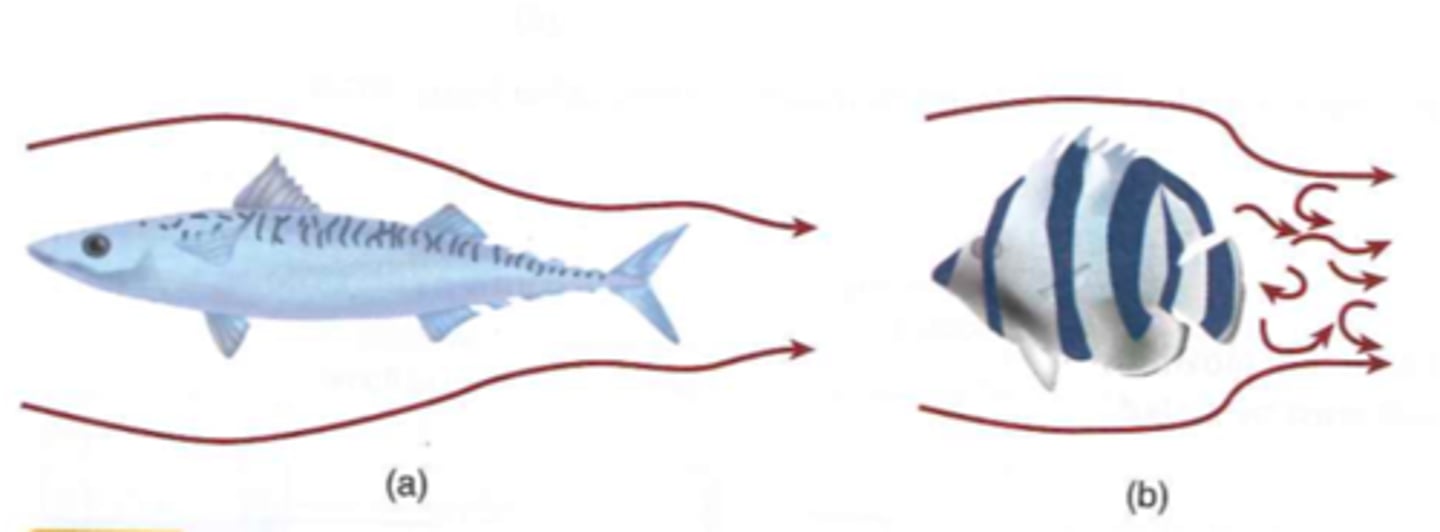
Which fish below experiences greater drag?
a) fish A
b) fish B
b) fish B