Physics II All Content
 Call Kai
 Learn
Learn Practice Test
 Spaced Repetition
 Match
Match Flashcards
 Knowt Play
1/135

There's no tags or description
Looks like no tags are added yet.
Name | Mastery | Learn | Test | Matching | Spaced | Call with Kai |
|---|
No analytics yet
Send a link to your students to track their progress
136 Terms
zeroth law of thermodynamics
any two systems placed in thermal contact will reach the same temperature (A=B, B=C, so A=C)
temperature
intensive quantity (independent of size)
filling a tire iwth air using ideal gas law
at first P = atm pressure and V inc. with n put into tire. once volume is constant, P inc. with n
ideal gases
volume dec. as pressure inc.
vapor pressure
pressure at which a gas coexists with its solid or liquid phase
proportional to temperature
partial pressure
pressure a gas would create if it occupied the total volume available
when vapor pressure exceeds partial pressure of water vapor,
water evaporates and ice sublimates
temp proportional to
vapor pressure
avg. KE
phase changes
energy enters/leaves the system without changing the temperature (Q=mL)
more energy required
to evaporate water below boiling point
steps of ice → steam
Temp of ice rises (Q=mcT)
At 0, ice melts (Q=mL)
Temp of water rises (Q=mcT)
At 100, water boils (Q=mL)
When all liquid turns into steam, temp rises again (Q=mcT)
conduction:
heat transfer through stationary matter by physical contact
Depends on cross-sectional area, material, thermal conductivity, and thickness
convection
heat transfer by macroscopic movement of fluid
radiation
electromagnetic radiation is emitted/absorbed
area of rectangle
change in v(P1-P2)
1st law of thermodynamics
E(int)=Q-W
Q
heat transfer into system
W
work done by the system
thermodynamic processes
- work = area under the curve
- Subtract work from total if going in negative direction
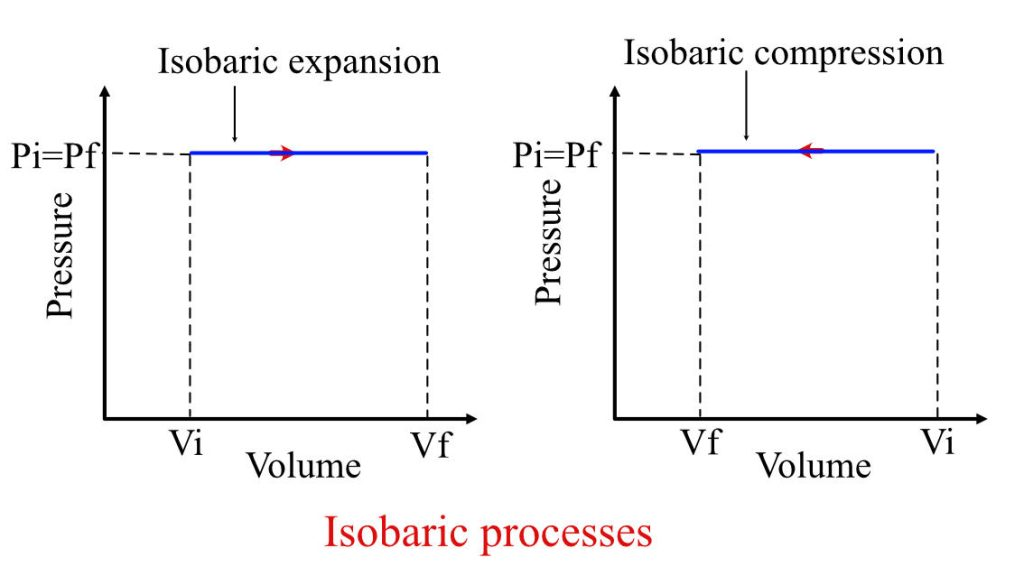
isobaric
constant pressure
- W = PΔV
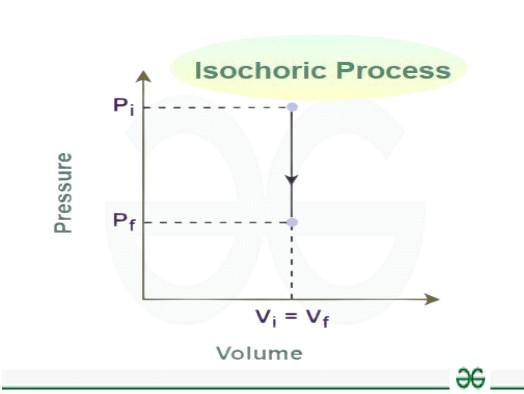
isochoric
constant volume
- ΔV=0
- W=0
- E(int) = Q
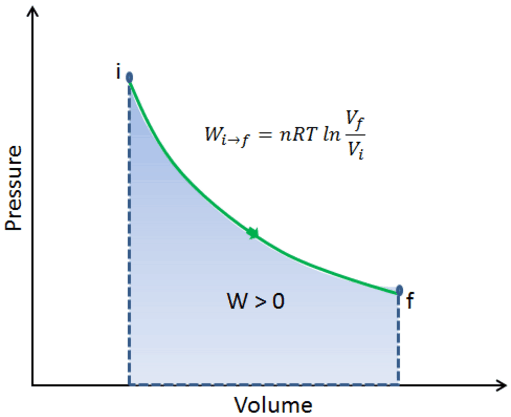
isothermal
constant temperature
- E(int) = 0
- Q=W
- Reversible
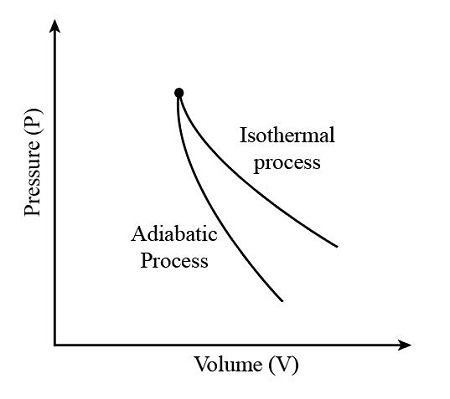
adiabatic
no heat transfer
- Q=0
- E(int)=-W
- Temp dec. for expansion opposite for compression
- Reversible
2nd law of thermodynamcis
heat transfer occurs spontaneously from higher to lower temperature bodies only
carnot cycle
only reversible processes are used, most efficient
macrostate
- overall property of a system, no details provided
- Ex: total number of heads vs. tails
microstate
- detailed description of every element of a system.
- ex: order of heads/tails
entropy
amount of disorder in the system
T2
should be hotter temp for positive Q according to given equations
lower
electric fields always point towards the ___ potential
perpendicular
electrical field lines are ___ to equipotential surfaces
dielectric strength
amount of charge it can hold without breaking down
in series
1/C vs. R
same charge on each
total voltage is the sum of individual voltages (total voltage is distributed across the chain, acts like a voltage divider)
current only has one path
parallel
C vs. 1/R
same voltage on each
total charge is the sum of individual charges (total charge distributed across them, like dividers)
requires junctions in a circuit
current
rate of flow of charge
motion of electrons is opposite the current
equal
power supplied by voltage must always ___ power dissipated by resistor
Direct Current
charge flowers in one direction
const. V and I
alternating current
charge periodically reverses direction
sinosoidal voltage sources
reduces power loss when used for energy transmission
root mean squared
value/sqrt(2)
can use equations with this to find average power
terminal voltage
voltage measured across a source’s terminals
larger I or R = smaller
junction rule
total current into a junction equals total current out
loop rule
in any closed loop, energy supplied by sources equals energy lost in resistors
EMF (-) → (+) = add
EMF (+) → (-) = subtract
resistors in same direction as current: -IR
resistor opposite in direction to current: +IR
Voltmeter
measures voltage
parallel with device
same potential diff. as device
ammeter
measures current
in series with device
measure same current as flows through the device
galvanometer
measures V or I
needle swivels with change
for V: large R in series
for I: small R in parallel
potentiometer
measures emf without current
wheatstone bridge
add unknown resistor to circuit with galvanometer and two known resistors to find unknown resistance
magents
like poles repel, unlike poles attract
when broken, becomes two smaller version of it (poles cannot be separated)
magnetism
caused by moving charges
angle
with flux: between magnetic field and the n (perp to surface)
no flux: between magnetic field and velocity or position of object
Right Hand Rule: straight wire
thumb: current
magnetic field: fingers curled around the wire
Force: away from palm
Right Hand Rule: Coil/rectangle
thumb: magnetic field
fingers: curled in direction of current
force: away from palm
perpendicular motion
magnetic force perpendicular to velocity (think palm versus thumb)
force between parallel current-carrying wires
attractive if same direction
repulsive if opposite direction
induced emf
produced by changing magnetic field or change in magnetic flux
increases when change occurs more rapidly
induced current
effect of induced emf
creates a magnetic field that opposes the change in flux
if flux dec, B in same direction as it (ex: A dec.)
if flux inc, B in opposite direction (ex: A inc.)
flux
amount of magnetic field passing through coil (changes with movement)
electric generators
produce electricity by rotating a coil of wire in a magnetic field
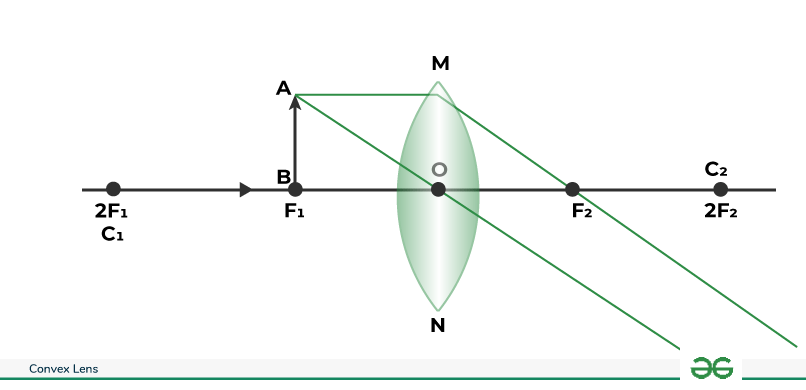
convex (converging) lens with object outside focal point
real (on opposite side of lens from object): can be projected onto screen
inverted image (upside down, negative magnification)
where lines cross on other side of lens is where image is
if object is between 1f and 2f, image is larger
if object is beyond 2f, image is smaller
convex lens with object inside focal point
virtual (on same side as object)
upright image (upright, positive magnification)
magnified (larger image always)
where lines cross on same side of lens as object is where image is
object is between image and lens
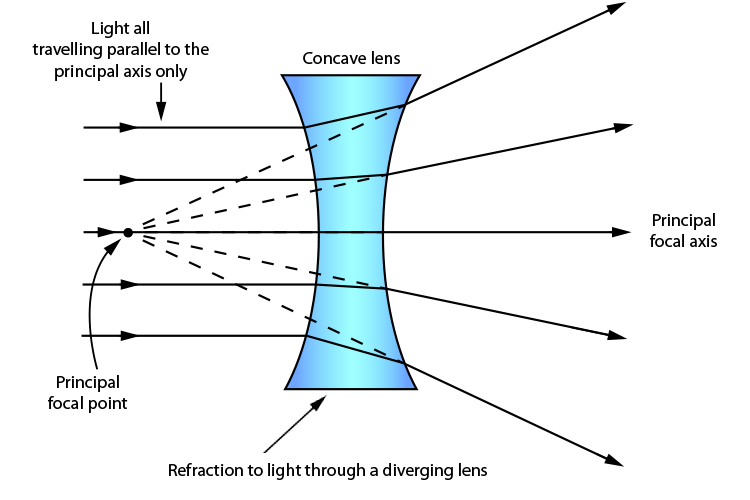
concave (diverging) lens with objet inside or outside focal length
virtual (on same side as object)
upright image (upright, positive magnification)
smaller image always
power and focal length negative
image is in between object and lens
lens to fix nearsightedness (can see close but not far)
concave
far objects blurry
rays cross in front of retina (need to move onto retina so behind where it is now)
power should be negative (for concave lens)
lens to fix farsightedness (can see far but not close)
convex
close objects blurry
rays cross behind retina (need to move onto retina so in front of where it is now)
power should be positive (for convex lens)
nearsighted far point
anything beyond this point is blurry
distance of this is measured from eye to point
farsighted near point
closest distance where you have clear vision
distance of this is measured from eye to point
magnification
m > 1: image larger than object
m < 1: image smaller than object
m = 1: image is the same size
when measuring an electric field, could we use a negative test charge instead of a positive one?
a) no, electric fields can only be measured using positive test charges
b) yes, and the direction of the measured electric field would be the same as the force on the negative test charge
c) no, using a negative test charge would neutralize the electric field
d) yes, but the direction of the measured electric field would be opposite to the force on the negative test charge
d) yes, but the direction of the measured electric field would be opposite to the force on the negative test charge
a constant-volume gas thermometer contains a fixed amount of gas. which property of the gas is measured to indicate its temperature?
a) volume
b) pressure
c) density
d) mass
b) pressure
what is the temperature of ice immediately after it is formed by freezing water?
a) 0 because water freezes at this temperature under standard pressure
b) -1 because the ice may cool slightly below freezing point as it forms
c) 1 because the water might not have fully solidified yet
d) -5 because ice usually forms at a colder temperature than 0
a) 0 because water freezes at this temperature under standard pressure
a gas expands rapidly and no heat is exchanged with the surrounding. Its temperature decreases during this expansion. which explanation is correct in terms of the first law of thermodynamics?
a) the gas does work on the surroundings (W > 0) and no heat enters (Q = 0), so its internal energy decreases, leading to a lower temperature
b) the gas absorbs heat from surroundings (Q > 0) while doing no work (W = 0), causing the temperature to drop
c) the gas neither does work nor exchanges heat (Q = 0, W = 0), but its temperature drops spontaneously due to expansion
d) the temperature decreases because the internal energy increases as the gas expands, and temperature is inversely proportional to internal energy
a) the gas does work on the surroundings (W > 0) and no heat enters (Q = 0), so its internal energy decreases, leading to a lower temperature
is a temperature difference necessary to operate a heat engine?
a) yes, because work can only be produced when the working substance itself undergoes a temperature change during the cycle
b) no, because a heat engine can produce work even if the temperature is uniform throughout the system
c) yes, because a heat engine converts heat into work and this requires heat to flow from a high-temperature to a low-temperature reservoir
d) no, because a heat engine can extract energy directly from internal energy without any temperature difference
c) yes, because a heat engine converts heat into work and this requires heat to flow from a high-temperature to a low-temperature reservoir
If you wish to store a large amount of energy in a capacitor bank, should capacitors be connected in series or in parallel?
a) series, because the equivalent capacitance decreases, allowing higher energy storage
b) series, because the charge stored on each capacitor increases
c) parallel, because the equivalent capacitance increases, allowing more energy to be stored at a given voltage
d) parallel, because the voltage across each capacitor decreases, increasing total energy storage
c) parallel, because the equivalent capacitance increases, allowing more energy to be stored at a given voltage
why are equipotential lines (or surfaces) always perpendicular to electric field lines?
a) because electric field lines can only exist where the potential is constant
b) because moving along an equipotential line requires no work, so the electric field has no component along that direction
c) because electric field lines always follow the shortest path between charges
d) because equipotential lines represent regions of zero electric field
b) because moving along an equipotential line requires no work, so the electric field has no component along that direction
how can the motion of a charged particle be used to distinguish between a magnetic field and an electric field?
a) a magnetic field changes the speed of the particle, while an electric field only changes its direction
b) an electric field changes the speed of the particle, while a magnetic field only changes its direction (if the velocity is perpendicular to the field)
c) both electric and magnetic fields always change the speed of the particle
d) neither electric nor magnetic fields affect the motion of a charged particle
b) an electric field changes the speed of the particle, while a magnetic field only changes its direction (if the velocity is perpendicular to the field)
how can the magnetic flux through a surface be zero even when the magnetic field is not zero?
a) because the magnetic field is too weak to produce any flux
b) because the magnetic field is perpendicular to the surface, giving zero flux
c) because magnetic flux is only defined when the magnetic field is zero
d) because the magnetic field is parallel to the surface, so no field lines pass through it
d) because the magnetic field is parallel to the surface, so no field lines pass through it
why can a null measurement be more accurate than one using standard voltmeters and ammeters, and what limits its accuracy?
a) because a null measurement uses a galvanometer to detect zero current, minimizing loading effects; its accuracy is limited by the sensitivity of the galvanometer and the precision of known standards
b) because a galvanometer in a null measurement allows large current to flow for better readings; accuracy is limited by heating effects
c) because a galvanometer directly measures voltage and current more precisely than meters; accuracy is limited only by calibration
d) because a galvanometer eliminates all measurement errors in a null condition; accuracy is not limited by practical factors
a) because a null measurement uses a galvanometer to detect zero current, minimizing loading effects; its accuracy is limited by the sensitivity of the galvanometer and the precision of known standards
changing magnetic flux
induces an emf
back emf opposes induced emf
transformer
converts AC voltage to what the device needs
AC in primary coil produces changing flux, inducing AC voltage in secondary coil
if voltage increases, current decreases
step up transformer
output voltage (Vs) larger than input voltage (Vp)
step down transformer
input voltage (Vp) larger than output voltage (Vs)
Gauss’s law for electricity (maxwell equation)
electric fields originate on positive charges and end on negative charges (charge moves from positive to negative)
Gauss’s law for magnetism (maxwell equation)
magnetic field lines are continuous (no magnetic monopoles)
if you split a magnet, there is still one N and one S end
Faraday’s law (maxwell equation)
changing magnetic fields produce electric fields
change in flux induces an emf
Ampere-Maxwell law (maxwell equation)
magnetic fields arise from moving charges and changing electric currents
changing electric fields induce magnetic fields and vice versa
electromagnetic waves
oscillating electric and magnetic fields propagate as transverse waves
wavelength depends on oscillation period
frequency and wavelength are inversely proportional
carry energy away from their source
electric and magnetic fields are always perpendicular and in phase:
when E = 0, B = 0
when E peaks, B peaks
E and B perpendicular to direction of propagation
reception
incoming EM waves accelerate electrons in antenna which is amplified and converted to images or sound
electromagnetic spectrum
Gamma: high E, short wavelength
can ionize things due to high E
Radio: low E, long wavelength
can only heat things due to low E
reflection
light bounces off
angle of reflection = angle of incidence
angled measured relative to the normal to the surface
smooth surface: specific angle to see
rough surface: see it from any angle
mirrors, water, telescopes
refraction
bending of light when it passes between different materials
refractive index: measures how a material refracts light
movement from high index to low index: bends away from normal
shorter wavelength (violet) bends more than longer wavelength (red)
lenses, prisms, optical fibers
critical angle
incident angle that produces theta2 = 90 degrees
if incident angle greater than critical angle: total internal reflection
no refraction occurs (reflects 100% intensity into denser medium than refracting into less dense medium)
travels from high index medium to lower index medium
lens
bends light rays due to refraction when light enters and leaves the material
axis of a lens: line passing through the center of the lens perpendicular to its surface
focal point
the point where the bent light rays from a converging/convex lens meet
focal length: distance from the center of the lens to the focal point
shorter focal length, higher the power
image distance
positive for real images and negative for virtual images
Myopia (nearsightedness)
eye too long
lens too strong
need diverging lens
(-) power
create virtual image closer to eye within distance they can see
hyperopia (farsightedness)
lens too weak
eye too short
need converging lens
(+) power
create virtual image further from eye within the distance they can see
microscopes
two convex lenses:
objective lens (further from eye): forms small real image
long focal length higher magnification
eyepiece (closer to eye): magnifies small real image
image formed by objective becomes object for eyepiece
short focal length higher magnification
telescopes
collect more light than the human eye
two designs:
convex objective and concave eyepiece (upright image)
two convex lenses (common astronomical telescope)
distant objects
object distance is infinity (image forms at focal length of objective)
Chromatic aberration
occurs because different wavelengths focus at different points; can be reduced using multi-lens systems
white light hits lens and reflected colors have different refractive index so different colors bend differently so they hit at different areas
Huygen’s principle
every point on a wavefront acts as a source of wavelets
wavelets spread forward at the same speed as the wave
the new wavefront is tangent to these wavelets
explains reflection and refraction