All - Disease Dilemmas
 Call Kai
 Learn
Learn Practice Test
 Spaced Repetition
 Match
Match Flashcards
 Knowt Play
1/163

There's no tags or description
Looks like no tags are added yet.
Name | Mastery | Learn | Test | Matching | Spaced | Call with Kai | Chat |
|---|
No analytics yet
Send a link to your students to track their progress
164 Terms
Define infectious?
A disease caused by pathogenic microorganisms (bacteria, viruses, parasites, fungi)
This can be spread through direct or indirect contact
Define non-infectious?
A disease caused by hereditary conditions or e.g, dietary deficiencies
Define communicable?
An infectious disease caused by direct contact with an affected individual, their bodily fluids or by indirect means e.g, vector
Define non-communicable?
A chronic disease caused by sedentary lifestyles, lasting for longer durations and are degenerative
Define contagious?
An infectious disease caused by direct or indirect contact
Define non-contagious?
Non-infectious, cannot be spread from one person to another via indirect or direct means
Define epidemic?
An increase in the number of cases of a disease above what is expected in that population of that area
Define endemic?
A disease that exists permanently in a geographical area
Define pandemic?
A disease that has spread over several countries or continents, affecting a larger number of people
How many people are affected by malaria globally?
2024 - 282 million cases, 610,000 deaths in 80 countries
How is malaria spread?
The vector, the Anopheles mosquito
Which areas and groups are affected by malaria?
Warm and humid environments
Particularly concentrated in areas such as Sub-Saharan Africa and Latin America - Africa has 95% of malaria cases and deaths
Which areas are immune to malaria?
Cool and dry environments (e.g, deserts, mountains and plateaux)
How many people are affected by HIV/AIDS globally?
2024 - 40.8 million cases, 630,000 deaths
How is HIV/AIDS spread?
Human bodily fluids such as blood and semen
Which areas and groups are affected by HIV/AIDS?
The global distribution is highly uneven - countries in Sub-Saharan Africa have the highest number of infections
Which areas are immune to HIV/AIDS?
Europe and Australasia are generally HIV/AIDS free - a low level of cases in North and South America
How many people are affected by tuberculosis globally?
2024 - 10.7 million cases, 1.23 million deaths
How is tuberculosis spread?
Associated with poverty and overcrowded living conditions
Which areas and groups are affected by tuberculosis?
Sub-Saharan Africa has the highest concentration of cases, as well as South-East Asia.
Which areas are immune to tuberculosis?
Tuberculosis is present everywhere - crowded areas have a higher chance of contraction
How many people are affected by diabetes globally?
830 million cases, 2021 - 1.6 million deaths
How is diabetes caused?
An insulin deficiency, a hormone secreted by the pancreas
Type 1 develops in childhood and is genetic
Type 2 occurs in adulthood and is linked to sedentary lifestyles
Which areas and groups are affected by diabetes?
Widespread in both developed and less developed countries - strongly concentrated in North America, East and South Asia
Which areas are immune to diabetes?
All areas are affected
How many people are affected by cardiovascular diseases globally?
2023 - ~626 million cases
19.8 million deaths (85% heart attack and stroke)
How are cardiovascular diseases caused?
Sedentary lifestyles, ageing population
Which areas and groups are affected by cardiovascular diseases?
Russia, Sub-Saharan Africa and Arabian Peninsula
Which areas are immune to cardiovascular diseases?
All areas are affected
What is disease diffusion?
Diseases spreading outwards from the place of origin and across space
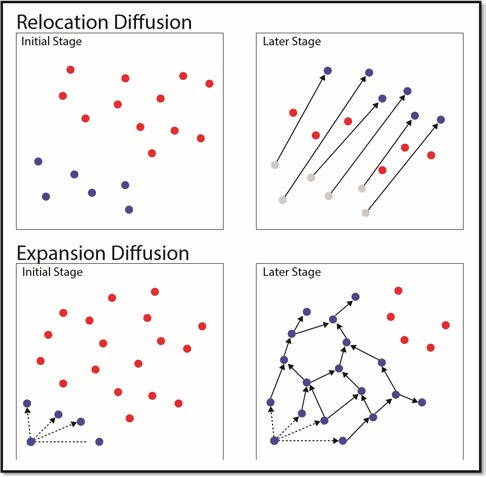
Define expansion diffusion?
A disease having a source which spreads outwards into new areas (tuberculosis)
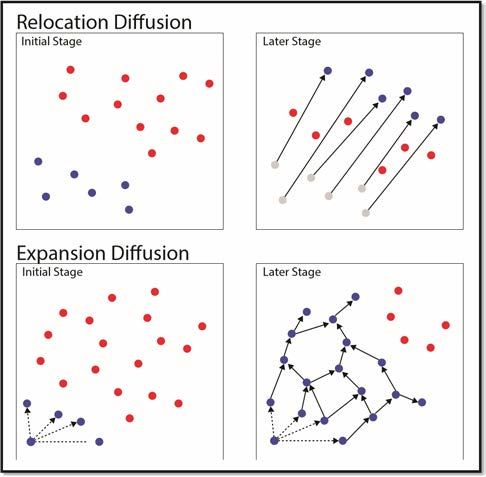
Define relocation diffusion?
A disease leaves the area of origin and moves into a new area (cholera in Haiti)
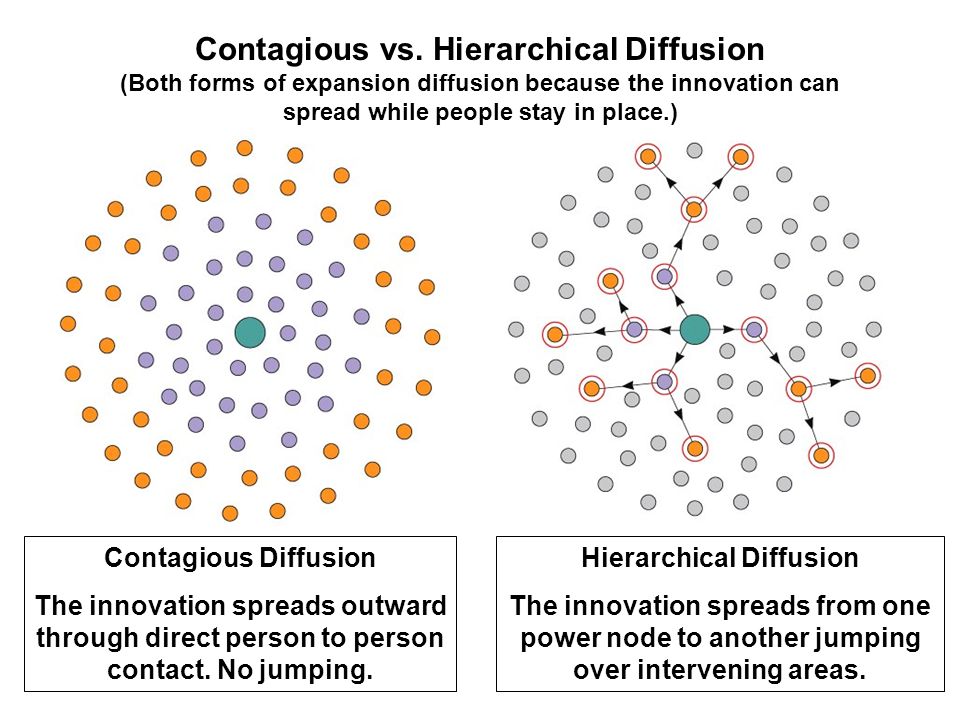
Define contagious diffusion?
A disease spreading through direct contact with a carrier (Ebola)
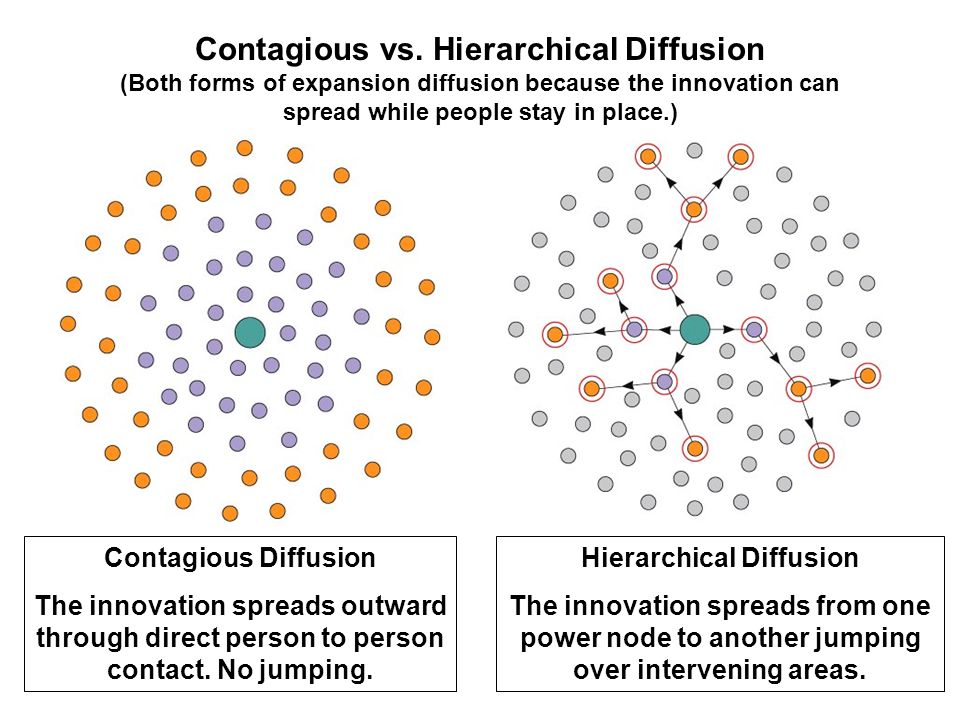
Define hierarchical diffusion?
A disease spreading through an ordered sequence of places, from the largest centres to smaller centres
What is the Hägerstrand model used for?
Simulating the spread of contagious diseases
What kind of model is the Hägerstrand model?
A probabilistic model (rather than deterministic) as it relies on probability distributions to model how disease spread
Explain the neighbourhood effect - the Hägerstrand model?
Probability of contact with a carrier is determined by the number of people living in each 5×5 km grid square
People living in proximity have a greater chance of contracting the disease with this distance-decay function
Explain the s-shaped curve on the Hägerstrand model?
The number of people infected are slow at the beginning, it starts to accelerate and finally levels out, until the susceptible population has been infected
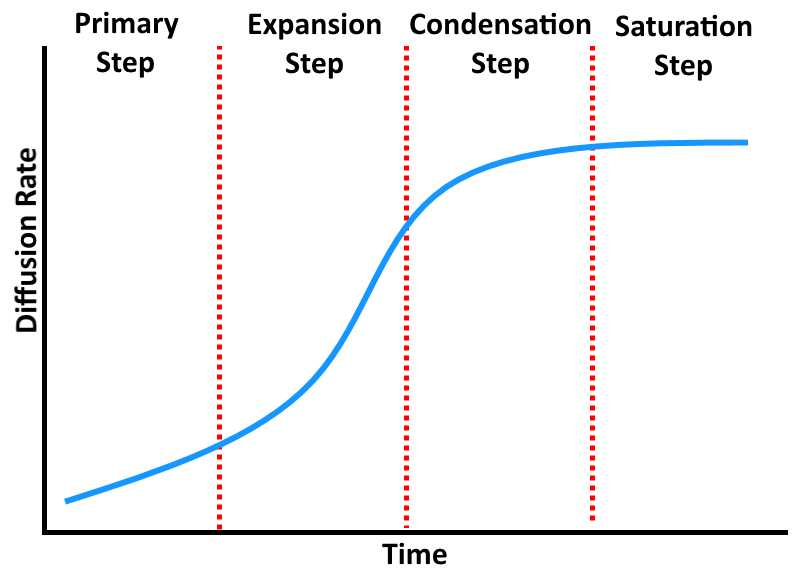
How are deserts physical barriers?
Extreme temperatures - preventing the movement carriers and non-carriers, limiting migration
Disease vectors are unable to survive
Doesn’t prevent the spread of disease in a community
How are uninhabited areas positive physical barriers?
Contagious diffusion is unable to take place
People could still travel on or around it
How are oceans physical barriers?
Relocation diffusion is unable to take place
Rise in sea levels results to an increase in flooding and natural disasters
Coastal areas are susceptible to water-borne diseases
How are vaccination programmes socio-economic barriers?
It decreases the number of susceptible individuals of a disease
‘Herd immunity’ - if a high percentage of people in an area are vaccinated, the majority are protected
Expensive - large scale vaccination is rare in deprived countries
How is health education socio-economic barriers?
Conscious decisions for sanitation, conception and lifestyle
Prevents the spread of disease, teaches people to take action
Limitations - allows individuals to protect themselves only
How are quarantine regulations socio-economic barriers?
Restricting the movement of the infected population
Remain in an enclosed space for a long period
How are no or minimal migration socio-economic barriers?
Relocation diffusion is unable to take place
Government is able to quarantine the people in an area
Restricted travel
How are obligatory blood tests socio-economic barriers?
Disease can be determined earlier
Limited number of equipment
Sanitation as an issue
How does temperature affect the pattern of diseases?
Warmer temperature could influence the rate of vector development and replication
Name some diseases which are endemic to lower-income countries with warmer temperatures?
Malaria
Dengue Fever
Yellow Fever
How does precipitation affect the pattern of diseases?
Rain and humidity creates breeding grounds for disease vectors (stagnant pools)
How does relief affect the pattern of diseases?
Relief (the height and shape of the land’s surface) affects the altitude of the land, altering the climate and disease habitats
Name an example of how relief affects the pattern of disease?
Ethiopia - malaria is concentrated in the warmer, humid lowlands but it is less frequent in the cooler, dry highlands
How do water sources affect the spread of disease?
In deprived countries, millions of people rely on water from unsanitary sources such as wells or sewage-contaminated areas
Name an example of how water sources affects the pattern of disease?
West Africa - copepod vectors replicate in water sources which spreads the parasite Guinea worm
What are physical factors?
Temperature, weather and urbanisation
What are disease vectors?
A living organism that carries and transmits an infectious pathogen
Name an example of physical factors which can influence vectors of disease?
Dengue fever in the tropics - climate (32-34c°) controls the dengue fever epidemiology and the life cycle for the Aede mosquito
What is seasonal bias?
A data sample containing disproportionately more data from 1 season
How does seasonal variations affect the spread of influenza and the flu?
Temperate regions in the northern hemisphere - epidemics of influenza peak during the winter, increased rate of transmission at lower temperatures (<5°c)
How does seasonal variations affect the spread of vector-borne diseases?
Tropics/Subtropic regions - epidemics of vector-borne diseases peak during the rainy season
Name an example of a vector-borne disease which is affected by droughts?
Bilharzia - trematode flatworm hosted by freshwater snails
Name an example of a vector-borne disease which is affected by monsoon rains?
Diarrheal disease
What does climate change do to the environment?
Increases global temperature, rainfall and humidity
Stimulated the transmission of vector-borne diseases and extended their geographic range
How does the impact vary for climate change?
Geographical location
Socio-economic status
What conditions does climate change provide?
Warmer and wetter conditions which has increased the prevalence of vector-borne infectious diseases
How is the West Nile Virus affected by climate change?
Culex mosquito, with birds as the host
Global disease, but prevalent in regions with higher temperatures (Africa, N/S America, Australia)
How is African trypanosomiasis affected by climate change?
Tsetse fly
Endemic in 36 Sub-Saharan countries (20.7-26.1°c)
As global temperatures rise, the disease is likely to spread to Southern Africa (the larvae may die from the heat)
How are tick seasons affected by climate change?
Lyme disease
Thrives in hot and humid climates (some mild winters allow ticks to survive and stay active for a longer time)
Lyme disease is likely to spread northwards to Canada from the USA
What are zoonotic diseases?
Infectious diseases that are spread from animals to humans (domestic and wild)
Which conditions do zoonotic diseases need to spread?
If the movement of infected wild animals are unrestricted by physical barriers
Vaccination of pets and domestic livestock is sparse
Limited control within urban areas of feral animals
Poor hygiene and sanitation
How does bird flu spread?
Influenza A viruses
Contact with secretions or droppings
Respiratory issues
Preventable through hygiene and sanitation
How does rabies spread?
Lyssavirus genus
Bites or scratches
Affects the nervous system
Preventable through vaccination of pets and post-exposure treatment
What is Omran’s model of epidemiological transition?
It describes the relationship between development, changing patterns of population age distribution, mortality, fertility, life expectancy and causes of death
What happens as a country develops economically?
Improvements in healthcare, standards of living and the quality of environment
What is the age of pestilence and famine (pre-industrial societies)?
Mortality rate is high - people are susceptible to infectious diseases
Life expectancy is low - factors such as poor sanitation, contaminated drinking water and low standards of living
Population growth is slow
What is the age of receding pandemics (industrial societies)?
Life expectancy rises - factors such as medical technology, diet and hygiene
Population growth increases
Shift from infectious diseases to chronic and degenerative diseases
What is the age of degenerative and man-made diseases (post-industrial societies)?
Mortality related to infectious disease is rare
Degenerative disease becomes the main cause of mortality
Man-made diseases associated with environmental change is prevalent
What is the potential 4th phase of Omran’s model?
The age of delayed degenerative diseases
Medical advances delay the onset of degenerative CVD
Obesity and diabetes rates increases
Which kind of non-communicable diseases do LIDC’s face?
Animal-borne
Water-borne - malaria, bilharzia and cholera
Food-borne
Malnutrition - kwashiorkor, marasmus, rickets, scurvy, pellagra
What is the main cause of communicable diseases in LIDC’s?
Lack of health-care services and nutrition
Poor environmental and living conditions
Location
Why does undernutrition/malnutrition increase the risks of disease in LIDC’s?
Undernutrition - insufficient food intake to maintain body weight
Malnutrition - an unbalanced diet
Weakens the immune system, bacterial and viral infections
Why do environmental conditions increase the risks of disease in LIDC’s?
Water pollution - lack of sanitation and hygiene - wells and surface streams
Poor drainage - breeding sites for disease vectors
Informal housing and overcrowded
Why does location increase the risks of disease in LIDC’s?
Tropics and subtropics - high temperatures and abundant rainfall (ideal epidemiology)
Which kind of non-communicable diseases do AC’s face?
CVD, diabetes and cancer dominate mortality rates
Why have communicable diseases been eliminated by AC’s?
Advancements in medical diagnosis and treatment, high standards of living, proper sanitation, clean water supplies and diet
What is the life expectancy like in AC’s?
Prolonged life expectancies - increases the proportion of deaths connected to degenerative diseases and old age
What is the main cause of non-communicable diseases in AC’s?
Sedentary lifestyles - overnutrition, increases the likelihood of CVD, type-2 diabetes, hypertension and cancers
Obesity and inactivity are apparent in younger age groups
Who is the WHO?
World Health Organisation (1948) - directing authority on international health within the UN system
Who does the WHO work with?
International organisations such as UNICEF, the World Bank and NGOs such as the International Red Cross and the Red Crescent Movement
What kind of jobs are the WHO responsible for?
Gathering health data and problems
Leadership and identifying priority areas
Supporting UN states to devise health strategies
What does WHO do with the data?
Data from 194 of the member states are published them into the World Health Statistics
What does the data collected by WHO show?
Insight into health risks, mortality from communicable diseases, government spending on healthcare
How can the data collected by WHO be unreliable?
WHO receives cause of mortality data from only 100 member states, globally, 2/3 of the deaths aren’t registered
What kind of health issues are the WHO researching about?
Mainly influenza, tropical diseases, mental health and vaccines
Collaborating with the multi-agency Stop TB partnership (aims to eradicate TB by 2050)
What kind of leading roles does the WHO take?
Increasing awareness and the outbreaks of new diseases
E.g, Zika virus, combating diseases such as HIV/AIDS, malaria and TB
Research into new drugs/insecticides, emergency health services
Where did H1N1 first originate from?
Mexico - from pigs (zoonotic disease)
What did WHO announce about H1N1?
April 2009 - WHO declared H1N1 an international public health emergency
June 2009 - H1N1 declared as a pandemic
Describe the growth of H1N1?
June 2009 - peaked in the 2nd half, cases doubled every 15 days
H1N1 infected the Northern Hemisphere in 2 waves
Subsided in late Autumn, declined in May 2010
How many deaths were caused by H1N1?
18,000 deaths (lab-estimated - gross underestimate)
Total mortality rates by the end of 2010 - 151,700 to 575,400
Half of the deaths were reported in Africa and South-East Asia (cases ranged from 43-89 million)
How is relief a positive physical barrier towards disease mitigation?
Climate prevents the spread of vectors
Vector restriction - highland areas act as a barrier for breeding sites
How is relief a negative physical barrier towards disease mitigation?
Prevents access to healthcare and aid
Infrastructure limitations - no transport