Ch. 13: Quantity Discounts
 Call Kai
 Learn
Learn Practice Test
 Spaced Repetition
 Match
Match Flashcards
 Knowt Play
1/12

There's no tags or description
Looks like no tags are added yet.
Name | Mastery | Learn | Test | Matching | Spaced | Call with Kai |
|---|
No analytics yet
Send a link to your students to track their progress
13 Terms
Discount
Incentive that encourage larger orders through price reduction
Minimize annual holding costs
Improve relationships with sellers and buyers
: Tiered, bulk
Lot Based Discount
Given to specific single order quantity
Volume Based Discount
Applied to the total quantity purchased over a defined period
All-Units Quantity Discount
Applied to every unit until order quantity exceeds a threshold.
Incremental Quantity Discount
Applied only to the units exceeding the threshold
Incremental Quantity Discount
Applied only to the units exceeding the threshold
All-Unit Quantity Discounts
Pricing Schedule has specified quantity break points
If an order is placed that is at least as large as qi but smaller than qi+1, then each unit has an average unit cost of Ci
Unit cost decreases as the quantity increases
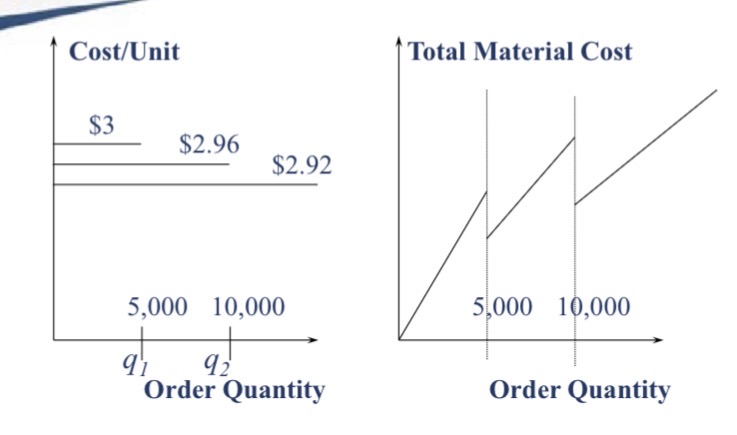
Two Part Tariff
Part 1: Manufacturer recovers cost
Part 2: Fixed
Manufacturer sells each unit at $unit price but adds a fixed charge of $ price to do business with the retailer
Only makes money from fixed charge
Inventory Model with Quantity Discount
Analysis to determine if the order quantity will min. Total cost
= procurement cost+carrying cost+material cost
Total Cost Formulation
= Purchase Cost (PD)+Ordering Cost(S D/Q) +Holding Cost (H Q/2)
D: Annual demand
Q: Order Quantity
C: Price per unit
S: Cost per order
H: Holding
Ic: % of unit cost
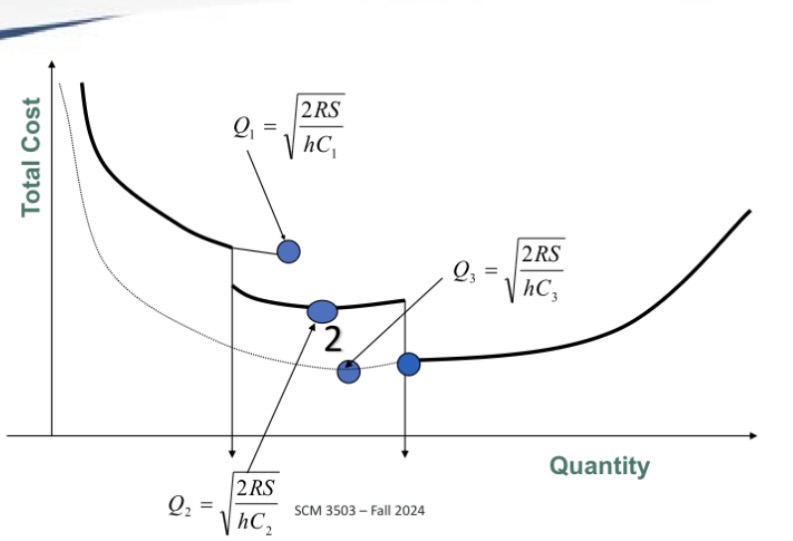
Total cost based on Quantity Discount
Calculate EOQ for each price level
Adjust for lowest feasibility quantity in that pice bracket
Calculate TC with each Q
Select with provides lowest TC
Trade Promotions
Discourage retailer to forward buyer in the supply chain
Counter measures
EDLP (everyday low pricing
Scan based promotion
Customer coupons
Cycle Inventory Reduction
Reduce transportation production lot sizes
Aggregate the fixed costs across multiple products, supply points, or delivery points