Fluid, electrolyte, acid base balance
 Call Kai
 Learn
Learn Practice Test
 Spaced Repetition
 Match
Match Flashcards
 Knowt Play
1/70

There's no tags or description
Looks like no tags are added yet.
Name | Mastery | Learn | Test | Matching | Spaced | Call with Kai | Chat |
|---|
No analytics yet
Send a link to your students to track their progress
71 Terms
body water content
infants are 73% more water (low body mass, low bone mass)
adults males are ~60% water
adult females are ~50% water (higher fat content, less skeletal muscle mass(
adipose tissue is least hydrated of all
total body water in adults averages ~40L
water content declines to ~45% in old age
intracellular fluid compartment
fluid inside cells accounts for 2/3 of total body fluid, about 25L of 40L total
extracellular fluid compartment
fluid in two main compartments outside cells accounts for one-third of total body fluid:
→ plasma
→ interstitial fluid
plasma
extracellular fluid compartment
→ accounts for 3L of total body fluid
interstitial fluid
extracellular fluid compartment
→ accounts for 12L of total body fluids in spaces between cells
what is water?
the universal solvent
solutes
substances dissolved in water
what are solutes classified as?
nonelectrolytes and electrolytes
nonelectrolytes
most are organic molecules
do not dissociate in water
examples: glucose, lipids, creatinine, and urea
no charged particles are created
electrolytes
disassociate into ions in water
examples: inorganic salts, all acids and bases, some proteins
ions conduct electrical current
greater osmotic power than nonelectrolytes
greater ability to cause fluid shifts due to ability to dissociate into two or more ions
comparing extracellular and intracellular fluids
each fluid compartment has a different pattern of electrolytes
ECF: electrolyte contents are all similar except for higher protein, lower Cl- content of plasma; major cation is Na+ major anion is Cl-
ICF: contains more soluble proteins than plasma; low Na+ and Cl-, major cation is K+, major anion is (HPO4)2- (hydrogen phosphate)
How much space dissolved solutes take
90% in plasma
60% in IF
97% in ICF
metabolic water
(water of oxidation); water produced by cellular metabolism
insensible water loss
water that is lost through skin and lungs
obligatory water lossess
unavoidable output of certain amounts of water; why we cannot live without water for very long
dehydration
extracellular fluid compartment water loss due to hemorrhage, severe burns prolonged vomiting or diarrhea, profuse sweating, water deprivation, dieretic abuse, endocrine disturbances
signs and symptoms include sticky oral mucous, thirst, dry skin, less urine
may lead to weight loss, fever, confusion
hypotonic hydration
cellular over hydration, or water intoxication
occurs with renal insufficiency or rapid excess water ingestion
ECF osmolarity decreases, causing hyponatremia
hyponatremia
results in net osmosis of water into tissue cells and swelling of cells
symptoms include severe metabolic disturbances, nausea, vomiting, muscular cramping, cerebral edema, and possible death
edema
atypical accumulation of IF, resulting in tissue swelling (not cell swelling)
can impair tissue function by increasing distance for diffusion of oxygen and nutrients from blood into cells
electrolyte balance
usually refers only to salt balance even though electrolytes also include acids, bases, and some proteins
salts control fluid movements, provide minerals for excitability, secretory activity and membrane permeability
salts enter body by ingestion and metabolisn and are lost via perspiration, feces, urine and vomit
sodium concentration vs. sodium content
concentration of Na+
determines osmolality of ECF and influences excitability of neurons and muscles
content of Na+
total body content determines ECF volume and therefore blood pressure
what hormone is the main regulator of sodium in the kidneys?
aldosterone
how much Na+ is always reabsorbed no matter what
65% in proximal tubules
25% in nephron loops
(Na+ is never secreted)
what happens when aldosterone levels are high?
more Na+ reabsorbed in distal convoluted tubule and collecting duct → water follows, higher ECF volume
what happens when aldosterone levels are low?
less Na+ reabsorbed → more Na+ and water lost in urine
what is the main trigger for aldosterone release?
renin-angiotensin-aldosterone system
what does renin do?
converts precursors into angiotensin II, which causes aldosterone release
what does aldosterone do overall?
increases Na+ reabsorption (and water follows)
influence of atrial natriuretic peptide on sodium balance
released by atrial cells in response to stretch caused by increased blood pressure
it decreases blood pressure and blood volume, increases excretion of Na+ and water
estrogen - female sex hormone
increases NaCl reabsorption (like aldosterone); leads to H2O storage during menstrual cycle and pregnancy
progesterone - female sex hormone
decreases Na+ reabsorption (blocks aldosterone), promotes Na+ and H2O loss
glococoriticoids
increase Na+ reabsorption and promotes edema
cardiovascular baroreceptors
alert brain to increase in blood volume and pressure
sympathetic nervous system impulses to kidneys decline, causing:
→ afferent arterioles to filate
→ GFR increases
→ increases Na+ and water output
→ reduced blood volume and pressure
hyperkalemia
increases in ECF (K+) cause decreased resting membrane potential, causing depolarization, followed by reduced excitability
hypokalemia
decreases in ECF (K+) cause hyper polarization and non-responsiveness
where is potassium (K+) regulated in the nephron?
distal convoluted tube (DCT) and collecting duct
how do kidneys control K+ balance
by changing how much K+ is secreted into the filtrate
what happens when ECF K+ is high?
principal cells increase K+ secretion into filtrate
what happens when ECF K+ is low
principal cells reduce K+ secretion to a minimum
which cells can reabsorb leftover K+
Type A intercalated cells
influence of plasma potassium concentration
most important factor affecting K+ secretion is its concentration in ECF
high K+ diet leads to increased K+ content of ECF
→ K+ entry into principal cells leads to increased K+ secretion
influence of aldosterone on potassium balance
aldosterone stimulates K+ secretion (and Na+ reabsorption) by principal cells
increased K+ in adrenal cortex causes release of aldosterone
what regulates calcium levels in the body
parathyroid hormone (PTH)
what does parathyroid hormone do
increases blood calcium levels
how does parathyroid hormone raise calcium
kidneys break down down to release calcium
kidneys raise calcium reabsorption
small intestine increase calcium absorption
what regulates phosphate reabsoprtion
mostly parathyroid hormone, also insulin and glucagon
alkalosis or alkalemia
arterial pH is more than 7.45
acidosis or acidemia
arterial pH is less than 7.35
three mechanisms for hydrogen ion regulation
chemical buffer systems
brain stem respiratory centers
renal mechanisms
chemical buffer systems
rapid, first line of defense for acid-base balance
brain step respiratory centers
acid-base balance that acts within 1-3 minutes
renal mechanisms
acid-base balance that is most powerful but requires hours to days to effect pH changes
chemical buffer
is a system of one or more compounds that act to resist pH changes when strong acid or base is added
three systems:
bicarbonate buffer system
phosphate buffer system
protein buffer system
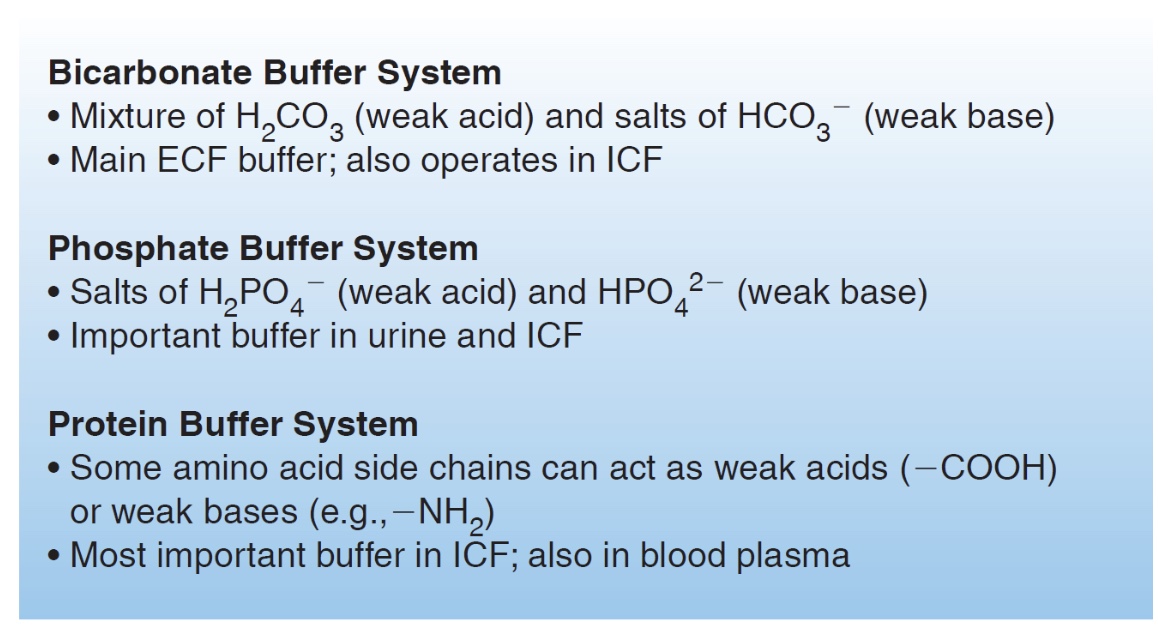
bicarbonate buffer system
It uses carbonic acid (H₂CO₃) (weak acid) and sodium bicarbonate (NaHCO₃⁻) (weak base) to control pH.
It works in both ICF and ECF, but is the main buffer in the ECF.
When a strong acid is added, bicarbonate (HCO₃⁻) grabs the extra H⁺, turning it into carbonic acid (H₂CO₃).
This prevents a big drop in pH. pH only falls a little unless all the bicarbonate is used up.
The kidneys control bicarbonate levels, keeping the system working.
phosphate buffer system
action nearly identical to bicarbonate buffer
components are sodium salts of: dihydrogen phosphate (a weak acid) and monohydrogen phophate (a weak base)
effective buffer in urine in ICF, where phosphate concentrations are high
protein buffer system
protein molecules are amphoteric (can function as both weak acid and weak base)
most important buffer in ICF; also in blood plasma
hypoventilation
causes carbon dioxide maintenence and respiratory acidosis
hyperventilation
causes carbon dioxide elimination and respiratory alkalosis
volatile
lungs eliminated ______ carbonic acid by eliminating CO2
nonvolatile
kidneys eliminate _______ (fixed) acids produced by cellular metabolism to prevent metabolic acidosis
two mechanisms in proximal convoluted tubule (PCT) and type A intercalated cells generate a new HCO3- by ridding body of new H+
via excretion of buffered H+
via NH4+ excretion
excretion of buffered H+
most important urine buffer is phosphate buffer system
intercalated cells actively secrete H+ into urine, which is buffered by phosphates (monohydrogen phosphates) and excreted in urine
new HCO3- is generated in process and moves into interstitial space
NH4+ excretion
more important mechanism for excreting acid
involves metabolism of glutamine in PCT cells
each glutamine produced 2NH4+ and 2 new HCO3-
HCO3- moves to blood and NH4+ is excreted in urine
respiratory acidosis and alkalosis
caused by failure of respiratory system to perform pH-balancing role
single most important indicator is blood Pco2
metabolic acidosis and alkalosis
all abnormalities other than those caused by Pco2 levels in blood
indicated by abnormal HCO3- levels
respiratory acidosis
PCO2 above 45 mmHg
respiratory alkalosis
PCO2 below 35mmHG → common result of hyperventilation
metabolic acidosis
low blood pH and HCO3
metabolic alkalosis
rising blood pH and HCO3-
respiratory compensation
lungs try to compensate for metabolic pH problems by changing respiratory rate and depth
renal compensation
kidneys try to compensate for pH problems caused by lungs by adjusting bicarbonate levels