Conceptual Development
 Call Kai
 Learn
Learn Practice Test
 Spaced Repetition
 Match
Match Flashcards
 Knowt Play
1/34

There's no tags or description
Looks like no tags are added yet.
Name | Mastery | Learn | Test | Matching | Spaced | Call with Kai |
|---|
No analytics yet
Send a link to your students to track their progress
35 Terms
What are concepts?
Mental rep that groups or categorises shared features of related objects, events or other stimuli
Formed by noticing similarities among objects + events experienced daily
What do concepts reflect?
Summaries + theories
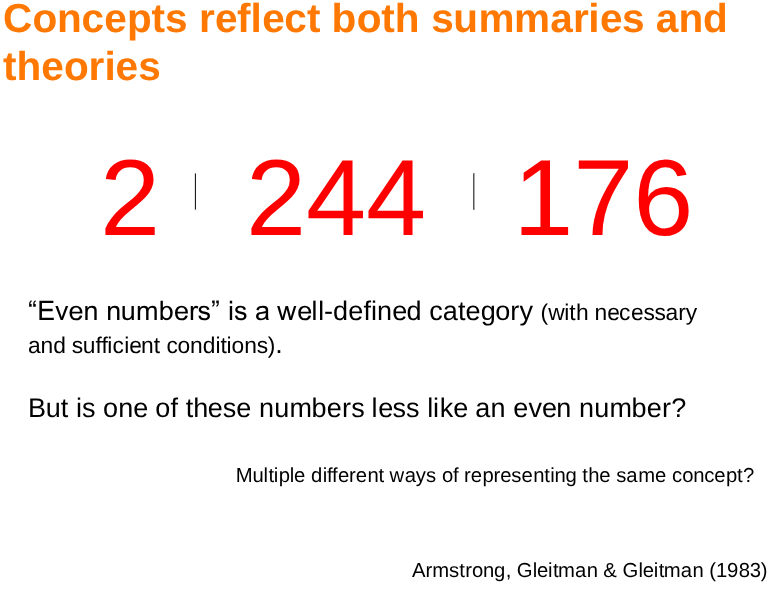
What were the early assumptions of what concepts looked like in adults?
Bruner (1950s) = combination of necessary + sufficient features
BUT difficult to specify with any accuracy (e.g. birds which can't fly)
Statistical summary of perceivable features (e.g. birds most likely have beaks) OR prototypical concepts
BUT which features are most important → need knowledge of features that aren't perceivable + how they explain perceivable features (intuitive theory)
How did Quinn (1993, 96) contribute to understanding of conceptual development?
Habituation to cats + then shown a dog → 3mos prefer to gaze at the novel animal (building a perceptual category or summary rep from what they have just seen)
In 3-year-olds, what is there a sensitivity to?
Theory-laden knowledge (history)
Gelman + Bloom (2000) → aren't just responding based on what they see they the sort of history of the object + the intention of the person shaping it → have some theory like understanding of how things should be classified
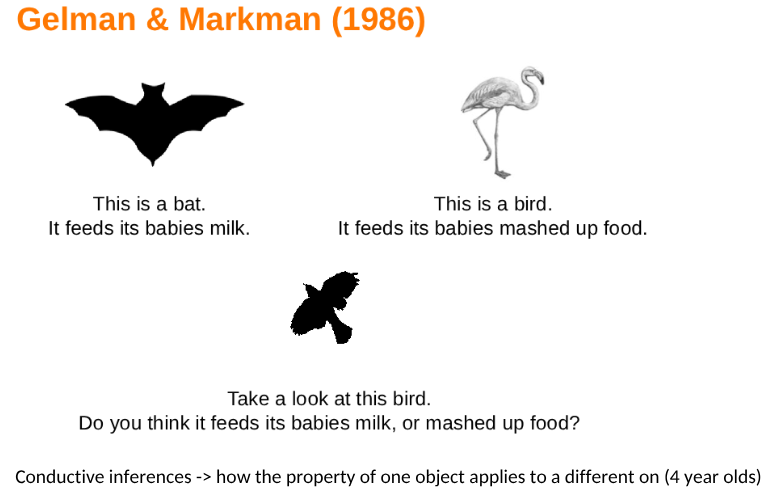
What did Gelman and Markman (1986) argue about inferences in 4-year-olds?
Knowledge, not surface features, underlies 4-year olds inferences
85% of children choose the visually different, same category property
Suggests children are sensitive to non-observable properties by 4
What is number?
Culturally + linguistically constructed concepts
Babylonian base 60 system
Oksapmin (Papua New Guinea) use a body part based system
A mechanism for moving from core knowledge to adult knowledge
Integrating core knowledge with language
Evidence:
Hallmarks of core knowledge in number word learning
Reliance on core knowledge when language lacks number terms
Which two early-developing systems are used to represent numerosity?
Analogue magnitude = an ability to perceive the approximate magnitude of some/almost any stimulus (e.g. length of time, amount of redness)
NOT number → can't precisely distinguish quantities
Established using judgement tasks -> shows it is present in infants (+ primates, goldfish etc)
Parallel individuation
Attentional tracking → can attend to about ¾ objects at a time
Present in young kids
Precise reps of small numbers of objects
Rep system breaks when too many objects need to be tracked
Also present in apes, monkeys etc
There is a core knowledge of number present around 12 months
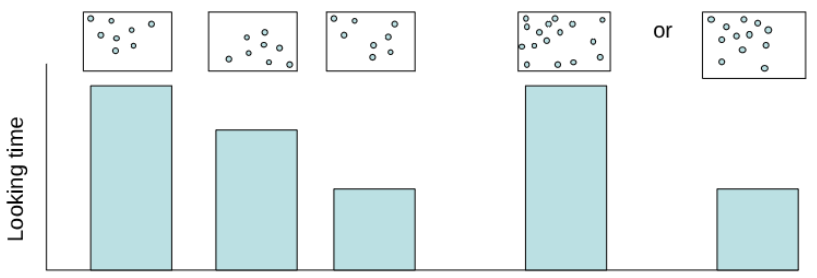
What evidence is there of analogue magnitude estimation being present in infants?
Xu + Spelke (2000) → if you habituate 6mos to an array of 8 dots, they won’t dishabituation to 12 dots BUT will for 16 dots
Infants represent number but representation is noisy
Can only distinguish doubling
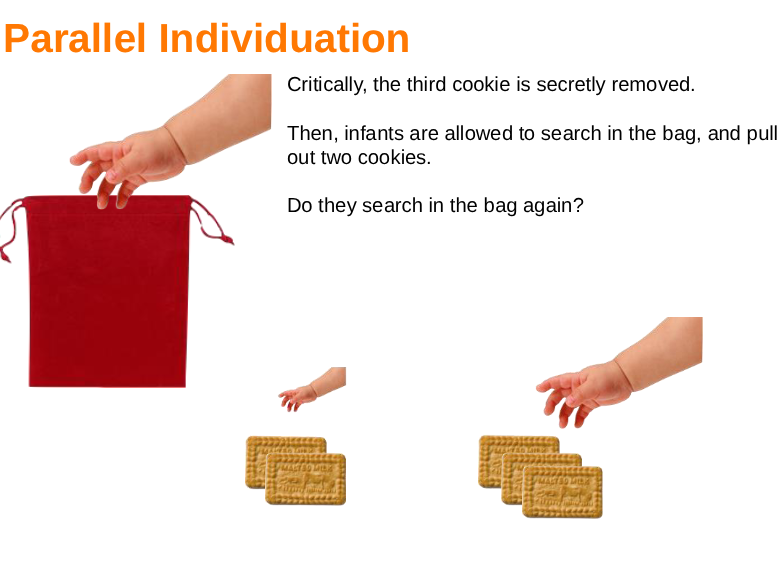
How so Feigenson and Carey (2005) support parallel individuation?
Adults can track from 1-4 objects simultaneously without major difficulties
Infants (14mos) appear to have a similar capacity
Can track 2 vs 3 (do search in the bag again) BUT can't track 4 cookies going into the bag
What is Gelman and Bloom’s (2000) material vs function test?
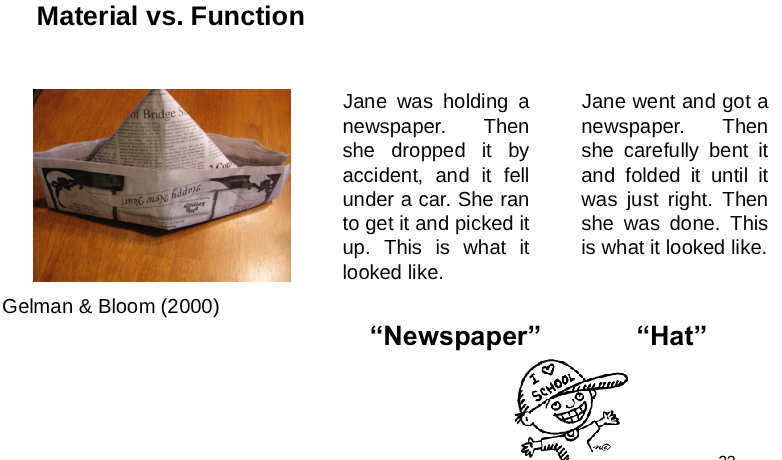
How do children learn number words?
Inaccurate “analogue” measure of number
Precise-but-limited tracking of individual objects
Map the words One, Two, Three onto mental reps used to track sets of individual objects
Then learn to map number words onto “analogue” number line
Children learning number (3 - 3.5 yearss)
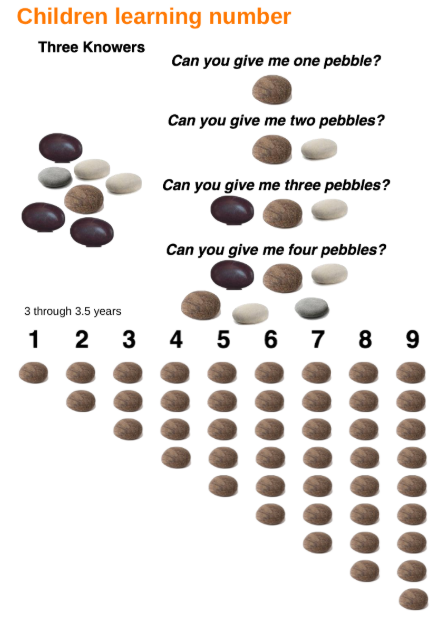
What does language learning enable? What is the evidence of this?
Allows you to build these complex numerical systems
Piraha have difficulty putting sets of objects into precise 1:1 correspondence unless they can do so visually
The mistakes they make have the hallmark of the analogue magnitude system → bigger errors for bigger numbers
What is the cardinal principle?
Knowing that the last number word counted represents the total quantity of a set
What was Wynn’s (1990) give-a-number task?
Used to assess a child's understanding of counting and the cardinal principle
Task
Child is presented with a set of small counters (e.g., a bowl of 15 toy apples) + empty plate/container
Asked to give a specific number of items
Findings
Don’t learn the meaning of all number words at once but progress through stage-like knower-levels
Subset knowers = first learn the exact cardinal meanings of small numbers one at a time
CP knowers = after learning 1-4, typically grasp logic of counting system
Strategies used when fulfilling larger requests
Grabbers = don’t count them out, grab random amount
Counters = mastered CP, count until reach requested quantity
What is the Sapir-Whorf hypothesis?
Language is a means of expressing thought
What are the 2 subsets of the Sapir-Whorf hypothesis?
Linguistic determinism hypothesis
Linguistic relativity hypothesis
What is the linguistic determinism hypothesis?
Language may influence the way we thinking + perceive
E.g. English + Himba children became better at distinguishing colours after learning more colour names
What evidence supports the Sapir-Whorf hypothesis?
Sex difference in spatial skills (men outperform women) may be due to language children are exposed to
Boroditsky (2011) → spatial terms to describe time with Chinese + English speakers
Language + numerical cognition → different number systems (conceptualisation + expression)
BUT relates to performance not thought processes
Thought abilities can be severely impaired whilst language abilities are relatively spared + vice versa
What are the elements of human language (complex organisation)?
Phonemes
Morphemes
Phrases
Sentences
Constructed + understood through grammatical rules
Children seem bio predisposed to process language + extract grammatical rules from this (neurological specialisation)
How do humans differ from non-human primates?
Non-human primates can learn new vocab +n construct simple sentences BUT limits to these + their grammatical complexity
How does speech compare with reading and writing?
Reading + writing were invented by humans (not speech) -> require education
What is a category-specific deficit?
An inability to recognise objects that belong to a particular category while leaving the ability to recognise objects outside the category undisturbed
Can occur when brain trauma occurs after birth (Farah + Rabinowitz, 2003) -> brain is pre-wired to organise perceptual + sensory inputs into broad-based categories (e.g. loving vs non-living things)
What does a category-specific deficit depend on?
Location of brain damage
Deficits usually result when a person has a stroke or sustains other trauma to areas in the left hemisphere of the cerebral cortex
Front of left temporal lobe → difficulty recognising humans
Lower left temporal lobe → difficult identifying animals
Region where temporal + occipital + parietal lobes mean → can't remember names of tools
What is the evidence for category-specific deficits?
Warrington + McCarthy (1983) → patient couldn't recognise a variety of human made objects or retrieve info about them but knowledge of living things/foods was fine
Warrington + Shallice (1984) → opposite results
What is a necessary condition?
Must be true for it to belong to a category
E.g. mammal
BUT not easily defined
What is a sufficient condition?
If true of the object, proves that it belongs to the category
E.g. German shepherd
BUT not easily defined
What is Rosch’s family resemblance?
Members of a category have features that appear to be characteristic of category members but may not be possessed by every member
What is Rosch’s prototype theory?
Psych categorisation is organised around the properties of the most typical member of the category
Possesses most/all of the most characteristic features of the category
Make category judgements by comparing new instances to the category's prototype
Rosch + Mervis (1975) → list attributes of several category members + rate how typical of the category each member was → highly correlated with FR scores
Our concepts are organised according to typicality + shared features (not rules defining necessary/sufficient conditions)
What is exemplar theory?
We make category judgements by comparing a new instance with stored memories of other instances of the category
Recall not just a prototypical category but a specific category → can account for certain aspects of categorisation
What does neuroimaging use?
Prototypes + exemplars
What does the visual cortex form?
Prototypes → mWhore holistic process involving image processing
What are the prefrontal cortex and basal ganglia involved in?
Learning exemplars → exemplar-based learning involves analysis + decision making
What did Marsolek (1995) argue about prototypes in visual fields?
PPTs classified prototypes faster when the stimuli were presented to the RVF (LH received input first) BUT classified previously seen exemplars faster when images presented to LVF