DAT Biology 2.8
 Call Kai
 Learn
Learn Practice Test
 Spaced Repetition
 Match
Match Flashcards
 Knowt Play
1/21

There's no tags or description
Looks like no tags are added yet.
Name | Mastery | Learn | Test | Matching | Spaced | Call with Kai |
|---|
No analytics yet
Send a link to your students to track their progress
22 Terms
Refer to both DNA & RNA, which are both polymers composed of nucleotides
nucleic acids
nucleic acids Function
store, transmit, and express genetic information
nucleic acids are made of this monomer and bonds via?
nucleotides, phosphodiester bonds
what additional bond other than the phosphodiester bonds connecting the adjacent nucleotides exist in DNA?
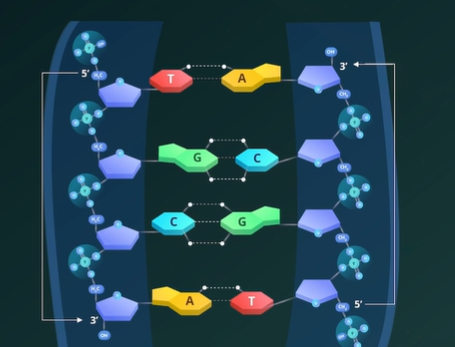
base pairing through hydrogen bonds on nucleotides of opposite strands
nucleotide structure in RNA vs DNA?
in general, phosphate group, nitrogenous base, 5-carbon sugar
RNA: single stranded, nitrogenous bases= A,C,G,U and 5-carbon sugar is ribose
DNA: double stranded, nitrogenous bases= A,C,G,T and 5-carbon sugar is deoxyribose
why is DNA deoxyribose?
on Carbon 2 of the 5 carbon ring, it lacks a oxygen.
what are the purines?
adenine, guanine (think PURe as silver Ag)
2 rings
what are the pyrimidines?
cytosine, uracil, thymine (CUT the PYe)
single ring
what is the orientation in which two nucleotides connect via phosphodiester bond?
between the phosphate group of one nucleotide at the 5’ carbon and the hydroxyl group on 3’ carbon of the 5-carbon sugar of an adjacent nucleotide
how many hydrogen bonds between different base pairs?
2 H bonds between A + T
3 H bonds between G + C
why use higher temperature to break DNA with more G-C bonds?
DNA with more G-C bonds have a higher melting temperature since they have more bonds that need to be broken to separate the two strands (3 H bonds per base pair instead of 2 H bonds)
Both strands runs 5’ → 3’ but in _____ directions
opposite (its antiparallel)
If the left strand runs 5’ to 3’ bottom to top, then the strand it is base paired with runs 5’ to 3’ from ____.
top to bottom
The two strands in DNA being A to T and G to C is called them being ____to each other
complementary
What does 5’ to 3’ mean?
They are the terminal ends of the DNA strands
5th C has the phosphate group attached to it while 3rd C have the OH group attached to it.
5’ end begins the strand with a phosphate group attached to the 5th carbon on the first nucleotide and 3’ end terminates the strand with OH group attached to the 3rd carbon of the last nucleotide
what is the chargaff’s rule?
The total number of purines is always equal to the number of pyrimidines in a double stranded nucleic acid
A + G = T + C
meaning, adenine and thymine should always be in equal amounts in DNA. same with guanine and cytosine
If a sample of DNA has 15% Adenine, then what percentage of cytosine does it have?
35%
Thymine =15%
so A+T would be 30% of sample DNA
we have remaining 70% for guanine and cytosine, divide by 2 = 35%
what is the difference between a nucleoside and nucleotide? how does a nitrogenous base connect to it?
a molecule with a nitrogen atom that acts as a base is a nitrogenous base.
A nucleotide consists of a nitrogenous base, phosphate group and 5-carbon sugar while nucleoside is same it is missing the phosphate group.
difference between a ribonucleoside and deoxyribonucleoside. give examples too
ribonucleoside- no phosphate group, just 5-carbon sugar (ribose) and nitrogenous base
ex: adenosine
deoxyribonucleoside- no phosphate group, just 5 -carbon sugar (deoxyribose), nitrogenous base and lack an OH group
ex: deoxyadenosine
how can a nucleoside become a nucleotide?
add a phosphate group to the nucleoside.
ATP= adenosine triphosphate is a nucleotide
adenosine is a nucleoside + 3 phosphate groups attached = ATP is a nucleotide
what type of bond is a phosphodiester bond?
covalent bond , it forms through a dehydration synthesis, releasing water