WGU D845 General Physics
 Call Kai
 Learn
Learn Practice Test
 Spaced Repetition
 Match
Match Flashcards
 Knowt Play
1/57

Earn XP
Description and Tags
Based on course material and Pre-Assessment (PJUO)
Name | Mastery | Learn | Test | Matching | Spaced | Call with Kai |
|---|
No analytics yet
Send a link to your students to track their progress
58 Terms
Newton’s First Law of Motion
an object in motion will stay in motion; an object at rest will stay at rest
inertia
property of an object that makes it resist changes to how it is moving
force
push or pull that can cause an object to move, stop, or change direction
equilibrium
when forces acting on an object are balanced, therefore no overall force is changing it’s motion
static equilibrium
object stays at rest
dynamic equalibrium
object moving at a constant speed in a straight line
Newton’s Second Law of Motion
acceleration of an object has a direct relationship with the amount of force applied and an inverse relationship to its mass
acceleration
occurs when an object is speeding up, slowing down, or changing direction; the rate at which velocity changes

distance formula
[disregard (vi x t +) when object starts at rest]
Newton’s Third Law of Motion
for every action, there is an equal opposite reaction [forces always come in pairs]

What does g represent in this equation?
acceleration due to gravity [= 9.8 m/s2]
Newton’s Law of Universal Gravitation
every object in the universe pulls on every other object through gravitational force
electromagnetic force
forces that act between two charged objects
point charge
an electric charge that is concentrated at a single point in space and does not have any physical size
strong nuclear force
acts between quarks, holding them tightly together to form protons and neutrons
weak nuclear force
controls processes like radioactive decay and allows quarks to change from one type to another [turns protons into neutrons]
inverse squared law
if you increase a value that is squared in its equation by x, then the inverse is decreases by a factor of 1/x2
Coulomb’s Law
describes the force (electrostatic) that charged particles (point charges) experience
Faraday’s Law
describes the current produced in a coil that is moved across a magnetic field; magnetic flux
momentum
how hard it is to stop or change the motion of an object [ p = mv ]
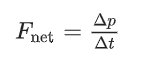
net force equals change in momentum divided by change in time
impulse
change in momentum; the result of the force you apply and the amount of time you apply it
Law of Conservation of Momentum
in an isolated system, total momentum is always conserved over time (includes elastic and inelastic collisions)
work
when a force makes an object move in the direction of that force
power
rate at which work is done or energy is transferred
positive work
energy is being added to the system (external force in same direction as motion)
negative work
energy is being removed from the system (external force is in opposite direction from the motion)
work
force x distance
power
work / time
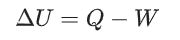
First Law of Thermodynamics
[change in system’s internal energy] = [heat added to system] - [work done by system onto surroundings]
W = Qh - Qc
work = heat input [from hot reservoir] - heat output [to cold source]
Second Law of Thermodynamics
in an isolated system, total entropy will never decrease over time —> overall increase in disorder
isobaric process
volume changes, pressure remains constant
isochoric process
pressure changes while volume remains constant
isothermal process
volume and pressure changes, temperature remains constatn
adiabatic process
volume and pressure changes rapidly and no heat exchanged
conduction
transfer of heat through direct contact between molecules in solid material
natural convection
heat transfer where fluid movement is driven by difference in temperature and density - no external force
forced convection
heat transfer that occurs due to an external force moving the fluid
radiation
heat/energy transfer in the form of electro magnetic waves, which can occur without any contact between heat source & object (like the sun)
high emissivity traits
non-reflective, matte, rough, dark colors
low emissivity traits
reflective, shiny, smooth, light colors
high specific heat capacity
requires more energy to warm up or cool down
low specific heat capacity
requires less energy to warm up or cool down
positive; away
_________ charges have field lines going ____ from them
negative; into
_________ charges have field lines coming ____ them
cross each other/ intersect
What should electric field lines NEVER do?
Ohm’s law equation
V = IR ; voltage = current (in amps) * resistance (in ohms)
capacitor
filters out voltage spikes and smooths fluctuations in voltage; determine timing intervals
inductor
slows down how quickly current can change in a circuit
resistor
limits current by providing resistance; creates voltage drops within a circuit
permanent magnet
has its own magnetic field (like bar magnets)
induced magnet
only shows magnetism when exposed to a pre-existing magnetic fieldh
hard magnet
materials that hold onto their magnetism for a long time (like steel)s
soft magnet
materials that lose their magnetism quickly (like nickel, iron)
Ampere’s Law
describes how a magnetic field surrounding a wire changes as the path of the wire changes
Lenz’s Law
describes how the direction of an induced electric current always opposes the change in magnetic flux that produced it
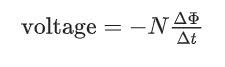
Lenz’s law equation
negative [number of turns in coil] x ([change in magnetic flux] / [change in time])