The Biological Approach
 Call Kai
 Learn
Learn Practice Test
 Spaced Repetition
 Match
Match Flashcards
 Knowt Play
1/44

There's no tags or description
Looks like no tags are added yet.
Name | Mastery | Learn | Test | Matching | Spaced | Call with Kai |
|---|
No analytics yet
Send a link to your students to track their progress
45 Terms
Biological Appraoch?
a perspective that emphasises the importance of physical process in the body such as genetic inheritance and neural function
Assumptions: what should psychology be seen as?
a science
Assumptions: what can behaviour be explained in terms of?
biology (e.g. genes/hormones).
Assumptions: what will most behaviour have?
an adaptive or evolutionary purpose
The influence of genes on behaviour: Heredity?
the passing of genes from parents to their children
The influence of genes on behaviour: what do genes do?
make up chromosomes and consist of DNA which codes for particular characteristics
The influence of genes on behaviour: what does how the characteristic develops depend on (2)?
How the gene interacts with other genes and the influence of the environment
The influence of genes on behaviour: Genotype?
the genetic code that’s written in the DNA of an individual’s cells - the particular set of genes that a person possesses
The influence of genes on behaviour: what is the genotype made up of?
the genes we inherit from our parents
The influence of genes on behaviour: what does the genotype determine?
only determines the potential for characteristics
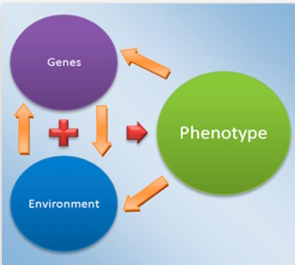
The influence of genes on behaviour: phenotype?
the observable (physical) results from inherited information
The influence of genes on behaviour: what guides the development of the phenotype?
the genotype - but isn’t solely responsible
The influence of genes on behaviour: what else has an impact on the phenotype?
environmental factors
The influence of genes on behaviour: therefore, what is the phenotype made up of?
our genes and our environment combined
The influence of genes on behaviour: Heritability?
the amount of variability, within a trait in a population, which can be attributed to genetic differences between individuals within that population
The influence of genes on behaviour: who can you study to see the infulence of genes on behaviour?
study identical (monozygotic or MZ) twins - they will share 100%of the same genes, but can have different phenotypes
Evolution?
the changes in inherited characteristics in a biological population over successive generations
Darwin - Evolution: Natural selection?
over thousands of years, humans become adapted to our environment through biological evolution
Darwin - Evolution: due to natural selection what do humans inherit?
characteristics that help them survive
Darwin - Evolution: natural selection - what do individuals compete for?
resources (food, mates)
Darwin - Evolution: natural selection - what do those who survive go on to do?
reproduce, passing on their genes and behaviours
Darwin - Evolution: natural selection - what won’t those who don’t survive do?
will not pass on their genes and behaviours
Darwin - Evolution: what research shows evidence of this throy today
When did Buss carry out his research?
1989
Buss (1989): what research method was used?
questionnaire
Buss (1989): how many cultures did the questionnaire take place across?
37
Buss (1989): what did they find unniversal similarities in?
human mate preferences i.e. the characteristics they prioritised
Buss (1989): what did women prioritise?
mates with res
Buss (1989): what did men prioritise?
young, physically attractive women
Strength - P: what method of investigation is used?
a scientific method of investigation
Strength - Ex: key features of experimental studies?
take place in highly controlled environments or with highly controlled procedures
Strength - Ev: for example, how was Buss’ study (1989) of relationships performed?
performed via a questionnaire with a fixed list of characteristics that all the sample had to rate using the same scale
Strength - L: what does this give the supportive research high level of?
a high level of reliability - because such standardised procedures mean that other researchers can replicate the research under the same conditions easily
Strength - P: key strength of the research into the Biological Approach?
has real life applications
Strength - Ex: what does understanding biological processes allows psychologists to see?
the causes for certain mental disorders, and then in turn how to treat them
Strength - Ev: for example, due to those who suffer from OCD being likely to have lower levels of serotonin, how can they be treated?
given medication to help with their OCD
Strength - L: therefore, what can the Biological Approach be used to treat?
mental disorders
Weakness - P: key issue?
The biological approach is reductionist
Weakness - Ex: why can the approach be argued to be an over-simplification?
the approach looks at complex behaviours, explaining them through genes, evolution and biological processes - it ignores the influence of environmental factors
Weakness - Ev: for example, what could a mental disorder, such as depression, be caused by?
the environment, instead of serotonin levels
Weakness - L: therefore, what would this mean may not help the patient?
medical treatments for mental disorders may not help the patient - as they would not be treating the cause
Weakness - P: what don’t evolutionary explanations not account for?
all types of behaviour
Weakness - Ex: what do critics of the Evolutionary explanation argue?
that many behaviours that have become established have no obvious survival value
Weakness - Ev: an example of a behaviour that may have been useful for survival thousands of years ago, but isn’t now?
aggression may have been useful for survival thousands of years ago, but now there are far fewer (if any) evolutionary benefits for aggression
Weakness - L: therefore, what may explain aggression better?
other theories - such as Social Learning Theory