Alevel Edexcel Politics Revision - Electoral systems simplified.
 Call Kai
 Learn
Learn Practice Test
 Spaced Repetition
 Match
Match Flashcards
 Knowt Play
1/105

There's no tags or description
Looks like no tags are added yet.
Name | Mastery | Learn | Test | Matching | Spaced | Call with Kai |
|---|
No analytics yet
Send a link to your students to track their progress
106 Terms
What is the electoral system used to elect MPs to the UK House of Commons?
First Past the Post (FPTP).
What is the definition of a 'plurality system' in the context of FPTP?
The winning candidate only needs one more vote than their nearest rival; they do not need an absolute majority (over 50%) of the vote.
How many seats must a party win to form a majority government in the UK?
326 or more.
What happens if no party reaches the 326-seat threshold in a UK general election?
A coalition or minority government may be formed.
What is meant by the 'winner's bonus' in FPTP?
The winning party in each constituency receives the seat regardless of their total vote share, often leading to disproportionate results where seat share exceeds vote share.
What is a 'wasted vote' in the context of FPTP?
A vote for a losing candidate or an excess vote for a winning candidate that does not influence the final result.
Why is FPTP often associated with stable governments?
It typically produces majority administrations that are less likely to collapse during a parliamentary term.
What is a 'constituency link' in the UK electoral system?
The clear relationship between voters and their specific MP, who represents their local area in the House of Commons.
What is 'tactical voting' and why does it occur under FPTP?
It is when voters support a candidate they think can win rather than their genuine first choice, often to prevent a less preferred candidate from winning.
Why does FPTP make it difficult for smaller parties to win seats?
Because they often lack the concentrated geographical support required to win individual constituencies.
What are 'safe seats' and how do they affect voter engagement?
Seats where one party is almost certain to win; they can reduce voter turnout and political engagement as the outcome feels predetermined.
What was notable about the Labour Party's 2024 General Election victory regarding vote share?
They won a landslide majority of 411 seats with only 34% of the vote, the lowest vote share ever to produce a majority government.
How did the 2024 election demonstrate the impact of FPTP on Reform UK?
Reform UK won 14% of the national vote but only 5 seats, illustrating how FPTP penalises parties with support spread thinly across the country.
Why did the Liberal Democrats perform well in the 2024 election compared to other smaller parties?
They achieved 72 seats with 12% of the vote due to concentrated regional support and targeted campaigning.
How many constituencies are there in the UK for general elections?
650.
How does the SNP benefit from the FPTP system?
Their support is highly concentrated in Scotland, allowing them to win constituencies even with a small share of the total UK-wide vote.
What are the main arguments in favour of keeping FPTP?
It provides simplicity, clarity, stability, and a clear constituency link.
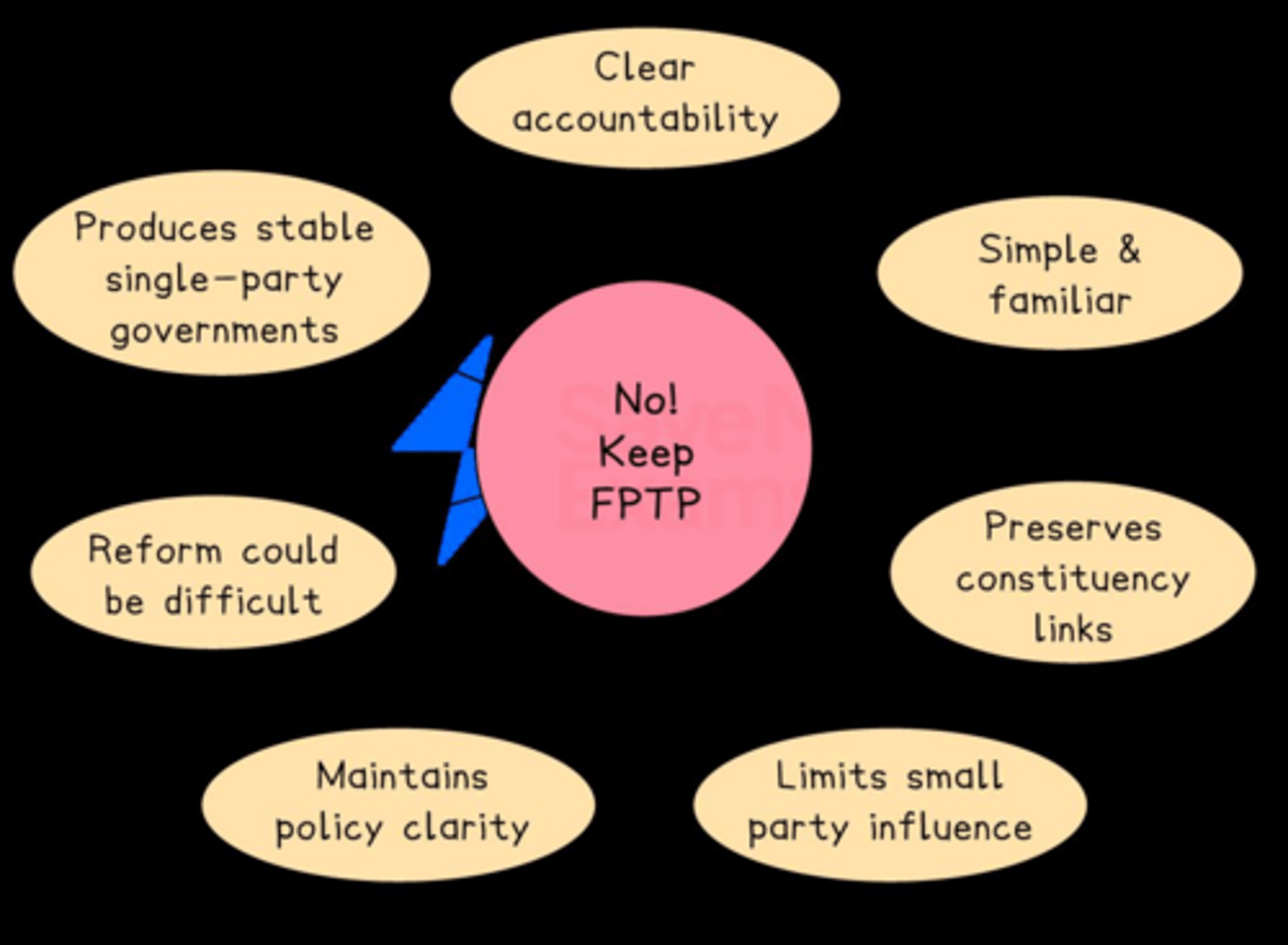
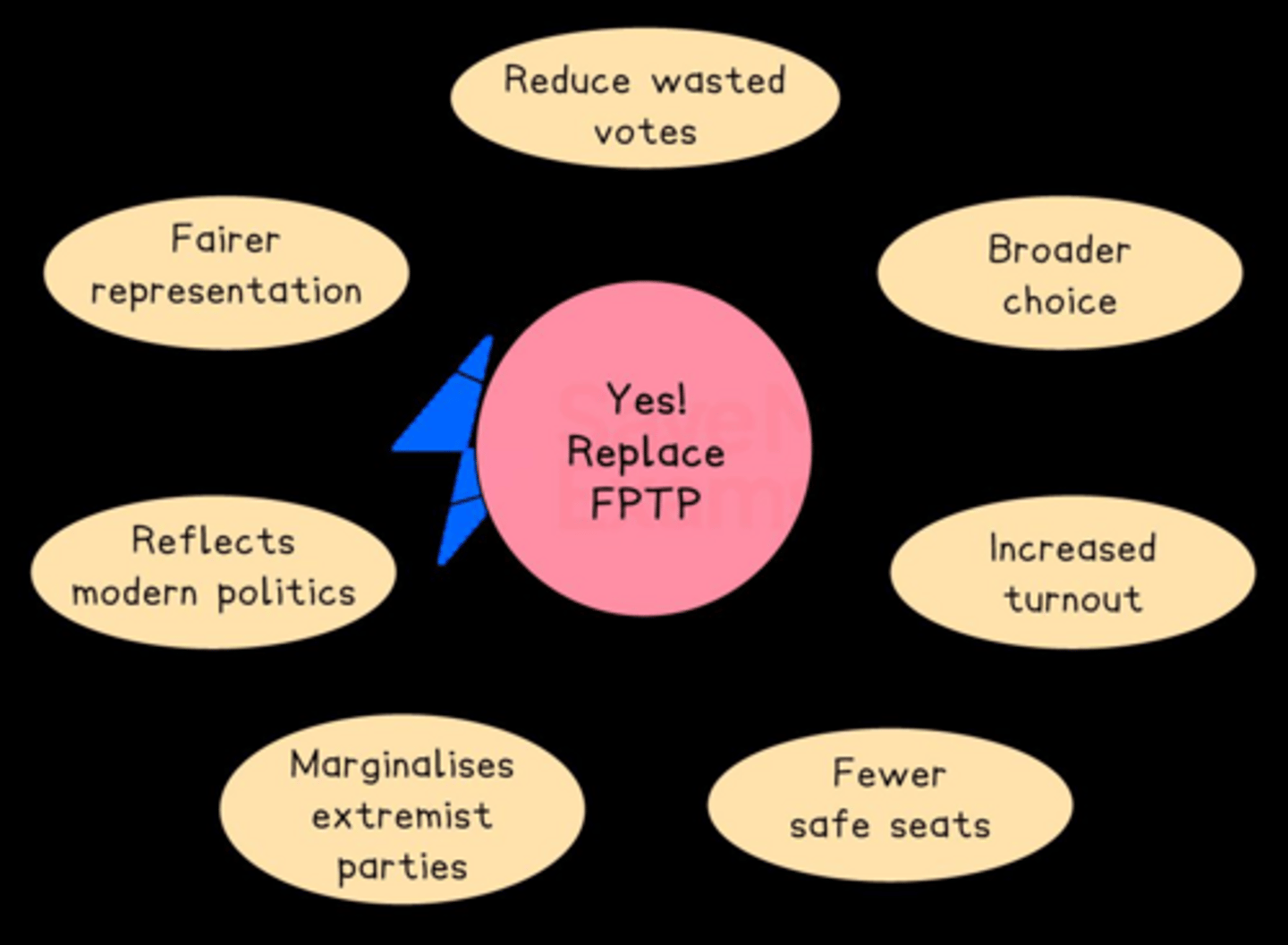
What are the main arguments for replacing FPTP?
Critics argue it distorts public preferences, is unrepresentative, leads to wasted votes, and undermines fairness.
How does FPTP provide accountability?
Voters know exactly which party is responsible for governing and can reward or punish them at the next election.
Why does FPTP make it difficult for extremist parties to gain representation?
Because they rarely have the concentrated geographical support necessary to win a plurality in a constituency.
What is the typical speed of results under FPTP?
Results are usually announced quickly because constituency counts are completed overnight.
What is the primary criticism regarding the proportionality of FPTP?
It often produces highly disproportionate results where the percentage of seats won does not reflect the percentage of votes cast.
How does FPTP affect regional representation?
It can lead to regional distortions where parties with concentrated support are over-represented, while those with evenly spread support are under-represented.
What does the 2024 election suggest about the legitimacy of FPTP?
It raises questions about fairness when millions of voters see their party gain few or no seats despite receiving a significant share of the national vote.
What is the primary advantage of proportional systems regarding seat allocation?
They convert votes into seats more accurately, ensuring the government better reflects public preferences.
How do proportional systems address the issue of 'wasted votes'?
They minimize wasted ballots by allocating seats more accurately or redistributing votes based on voter preferences.
Why might proportional systems lead to increased voter turnout?
Turnout tends to be higher when voters feel their vote has a greater impact on the final outcome.
How do proportional systems affect the prevalence of 'safe seats'?
They reduce the dominance of safe seats, which increases electoral competitiveness and voter influence.
What impact does coalition politics have on extremist parties?
Coalition politics encourages moderation, making it more difficult for extremist parties to gain significant influence.
What is a major argument in favor of the First-Past-the-Post (FPTP) system regarding government stability?
FPTP often produces decisive outcomes and stable single-party governments, which can strengthen government action.
How does FPTP facilitate political accountability?
Voters know exactly which party to reward or punish for government performance, as there is no ambiguity about who is in power.
What is a key benefit of the constituency link in FPTP?
Each MP represents a defined geographic area, which improves accountability and helps constituents feel directly represented.
What is a common criticism of coalition agreements in terms of policy clarity?
Coalition agreements can dilute or contradict original manifesto pledges, reducing transparency for voters.
What was the outcome of the 2011 AV referendum in the UK?
The referendum rejected electoral reform with 67.9% voting 'No' on a 42% turnout, suggesting limited public support for change.
What is the Additional Member System (AMS)?
A mixed electoral system that combines First-Past-the-Post (FPTP) with proportional representation.
How many votes does a voter cast under the AMS system?
Two votes: one for a constituency representative and one for a regional party list.
Which formula is used to allocate regional seats in AMS?
The d'Hondt formula.
How does the d'hondt Formula work?
each party's total votes are counted. for each seat allocation round, a party's vote total is divided by the number of seats it has already won plus one. The party with the highest total wins the next seat. After winning a seat, the party's vote total is divided by the updated divisor for the next round. This process repeats until all seats are allocated.
What is a primary disadvantage of AMS regarding the legitimacy of representatives?
It creates two types of representatives (constituency and regional), which can lead to perceptions of unequal legitimacy.
Why is AMS considered 'not fully proportional'?
The constituency element of the system still favors larger parties, preventing perfect proportionality.
What is the Single Transferable Vote (STV)?
A highly proportional system where voters rank candidates in order of preference within multi-member constituencies.
What is the purpose of the Droop quota in STV?
It determines the minimum number of votes a candidate needs to be elected in a multi-member constituency.
What happens to surplus votes in an STV election?
They are transferred to the voters' next-ranked preferences.
What is a key advantage of STV for the voter?
It gives voters control over both party and candidate choice through ordinal ranking.
What is a common feature of the government structure in Northern Ireland?
It requires a power-sharing government between unionist and republican parties.
How does AMS affect the influence of party leaders?
Party leaders often have considerable control over regional lists, which increases their internal influence.
What is a potential drawback of the complexity of proportional systems like AMS?
They are more complex than simple plurality systems, which may discourage some voters from participating.
What was the significance of the 2021 Scottish Parliament election regarding AMS?
It demonstrated the proportional nature of AMS, resulting in a coalition-style agreement (Bute House Agreement) and high turnout.
Why might FPTP be considered 'simple and familiar'?
It is easy for voters to understand and provides quick, clear results that are widely recognized and trusted.
What is a primary advantage of the Single Transferable Vote (STV) system?
It is highly proportional, allowing seat shares to closely match vote shares.
What is a common criticism regarding the constituency link in STV?
It weakens the local constituency link because representatives cover larger geographical areas.
How does STV affect voter choice compared to other systems?
It gives voters more choice by allowing them to rank multiple candidates, including several from the same party.
Why is STV considered effective at minimizing wasted votes?
Votes can be transferred to help elect another preferred candidate if the first choice is already elected or eliminated.
What is a potential negative impact of STV on government stability?
It often leads to coalition governments, which can make decision-making slower.
How does STV impact the number of safe seats in an election?
It reduces the number of safe seats, making elections more competitive.
What is a disadvantage of STV regarding the counting process?
Counting takes longer due to the requirement for multiple rounds of transfers.
How does STV affect intra-party dynamics?
It encourages intra-party competition, which reduces the control held by party leadership.
What was a significant outcome of the 2022 Northern Ireland Assembly election under STV?
Sinn Féin became the largest party in Stormont for the first time.
What is the Supplementary Vote (SV) system?
A majoritarian system where voters mark a first and second preference, used for single-office elections.
What is the threshold for a candidate to win outright in the SV system?
A candidate must secure over 50% of the first-preference votes.
What happens in the SV system if no candidate reaches 50% in the first round?
All but the top two candidates are eliminated, and second-preference votes from the eliminated candidates are redistributed to the top two.
What is a key advantage of SV regarding voter simplicity?
It is relatively simple because voters only need to make two choices.
What is a major criticism of SV regarding the two-party system?
It often reinforces a two-party system because only the top two candidates remain in the final round.
Why is SV considered disproportionate?
Because it is a majoritarian system where only one candidate can win the office, regardless of the total vote distribution.
What is a referendum in the context of UK politics?
A form of direct democracy where voters decide on a single specific issue by choosing 'yes' or 'no'.
Are referendum results in the UK legally binding?
No, they are not legally binding, meaning Parliament is not required by law to implement the outcome.
Why are referendum results considered 'politically binding'?
Because of the strong political pressure created by a public vote, governments almost always follow the outcome.
Who has the authority to call a referendum in the UK?
Only the UK government or Parliament.
What is the role of the Electoral Commission in a referendum?
To review and approve the wording of the referendum question to ensure it is understandable and unbiased.
What was the outcome of the 2011 UK referendum on electoral reform?
The public voted to maintain First Past the Post (FPTP) for general elections.
What was the result of the 2014 Scottish independence referendum?
55% voted 'No', meaning Scotland remained in the UK.
Which 1998 referendum established power-sharing institutions at Stormont?
The Northern Ireland referendum on the Good Friday Agreement.
What was the impact of the 2004 North East England referendum?
78% voted 'No', ending plans for elected regional assemblies in England.
How does the complexity of STV affect voters?
It may require more education for voters to feel confident and can make informed ranking difficult.
What is a primary argument in favor of using referendums in the UK?
They provide democratic legitimacy to major constitutional decisions and boost public participation.
What is a common criticism regarding the use of referendums?
They can oversimplify complex issues into binary yes/no questions and fuel populism.
How do referendums potentially affect representative democracy?
Critics argue they undermine the role of elected MPs who are tasked with making informed decisions.
What is the main purpose of the First Past the Post (FPTP) system?
To elect representatives in single-member constituencies, typically favoring strong single-party governments.
Which electoral system is used for Northern Ireland Assembly elections?
Single Transferable Vote (STV).
Why is STV considered highly proportional?
It uses multi-member constituencies to allow a wider range of parties and independents to gain representation.
What is the primary benefit of the Additional Member System (AMS)?
It combines constituency seats with proportional top-up seats to better reflect the will of the voters.
Which electoral system was used for London Mayor elections until 2022?
Supplementary Vote (SV).
What is the main goal of the Supplementary Vote (SV) system?
To ensure the winner has an outright majority (over 50%) by considering second-preference votes.
How does FPTP impact the UK party system?
It tends to encourage a two-party system and makes it difficult for smaller parties to win seats unless their support is geographically concentrated.
What is a major drawback of FPTP regarding government representation?
Governments can win large majorities with less than 50% of the national vote, potentially weakening representation.
What is a potential disadvantage of the STV system in terms of governance?
Decision-making can be slower because it often leads to coalition governments requiring multi-party agreement.
How does AMS provide voters with more meaningful choice?
It allows voters to 'split' their vote between a constituency candidate and a different party list.
What is the effect of the 'top-up' seats in the AMS system?
They correct distortions from the constituency stage, allowing smaller parties to gain representation.
Why might voters engage in tactical voting under FPTP?
To avoid 'wasting' their vote on a candidate with no chance of winning, they may choose a 'less-worse' viable candidate.
What is a key advantage of STV regarding voter choice?
Voters can rank as many or as few candidates as they wish, reducing the number of wasted votes.
How does the Supplementary Vote (SV) influence campaign strategies?
Candidates are encouraged to appeal beyond their core supporters to attract second-preference votes.
What is a risk of 'winner takes all' outcomes in referendums?
They can ignore or harm the views of the minority.
Why are referendums sometimes criticized as being politically manipulated?
Governments may call them when it benefits their political agenda rather than the public interest.
What is the status of referendums in the UK regarding legal binding?
They are technically non-binding, though in practice, governments rarely ignore the results.
How does FPTP benefit parties like the SNP?
Because their support is geographically concentrated, they can win many seats despite a smaller national vote share.
What is a common criticism of the Supplementary Vote (SV) regarding smaller parties?
Smaller parties rarely reach the final round, as only the top two candidates proceed.
What is the primary function of the 'list' stage in AMS?
To increase the proportionality of the legislature by allocating seats based on the total party vote share.
How does STV contribute to power-sharing in Northern Ireland?
It ensures that different communities are represented, which is a requirement of the Good Friday Agreement.
What is a potential negative consequence of coalition governments formed under proportional systems?
Executive deadlock or slower decision-making due to the need for compromise.
What change occurred regarding the London Mayor election system in 2022?
The system was changed from Supplementary Vote (SV) to First Past the Post (FPTP).