Lauren Bates - Intro to Psych: Exam 2 (Units 5-8)
 Call Kai
 Learn
Learn Practice Test
 Spaced Repetition
 Match
Match Flashcards
 Knowt Play
1/125

There's no tags or description
Looks like no tags are added yet.
Name | Mastery | Learn | Test | Matching | Spaced | Call with Kai |
|---|
No analytics yet
Send a link to your students to track their progress
126 Terms
Differentiate: Encoding, Storage, Retrieval
- Encoding: Getting info in (input)
- Storage: Keeping info
- Retrieval: Getting info out (output)
Processing Theory: 2 Types
Shallow Processing: Rehearse info based on superficial characteristics
Deep Processing:
Rehearse info based on meaningful characteristics (deeper retention)
Encoding: Self-Reference Effect
- YOU make the information meaningful to YOU
- Ex: When studying for an exam, make crucial information meaningful for improved retention
Atkinson-Shiffrin Model: Identify Elements
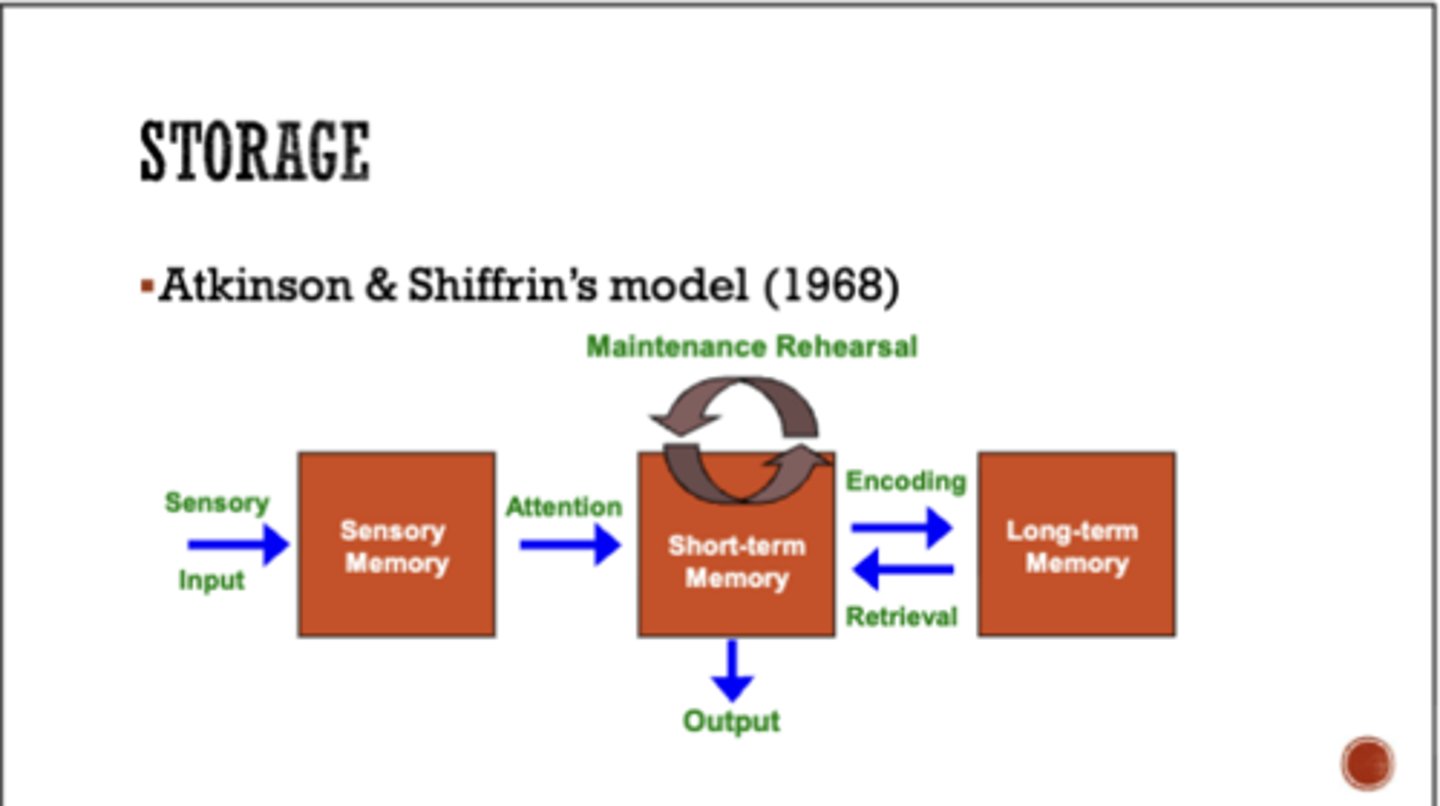
Sensory Memory
- Brief retention of sensory simulation
- Capacity = Large
- Duration = Short
Short-Term Memory: "Chunking"
Short-term memory has a limited capacity and a short duration, so grouping individual pieces of information into "chunks" can improve retention
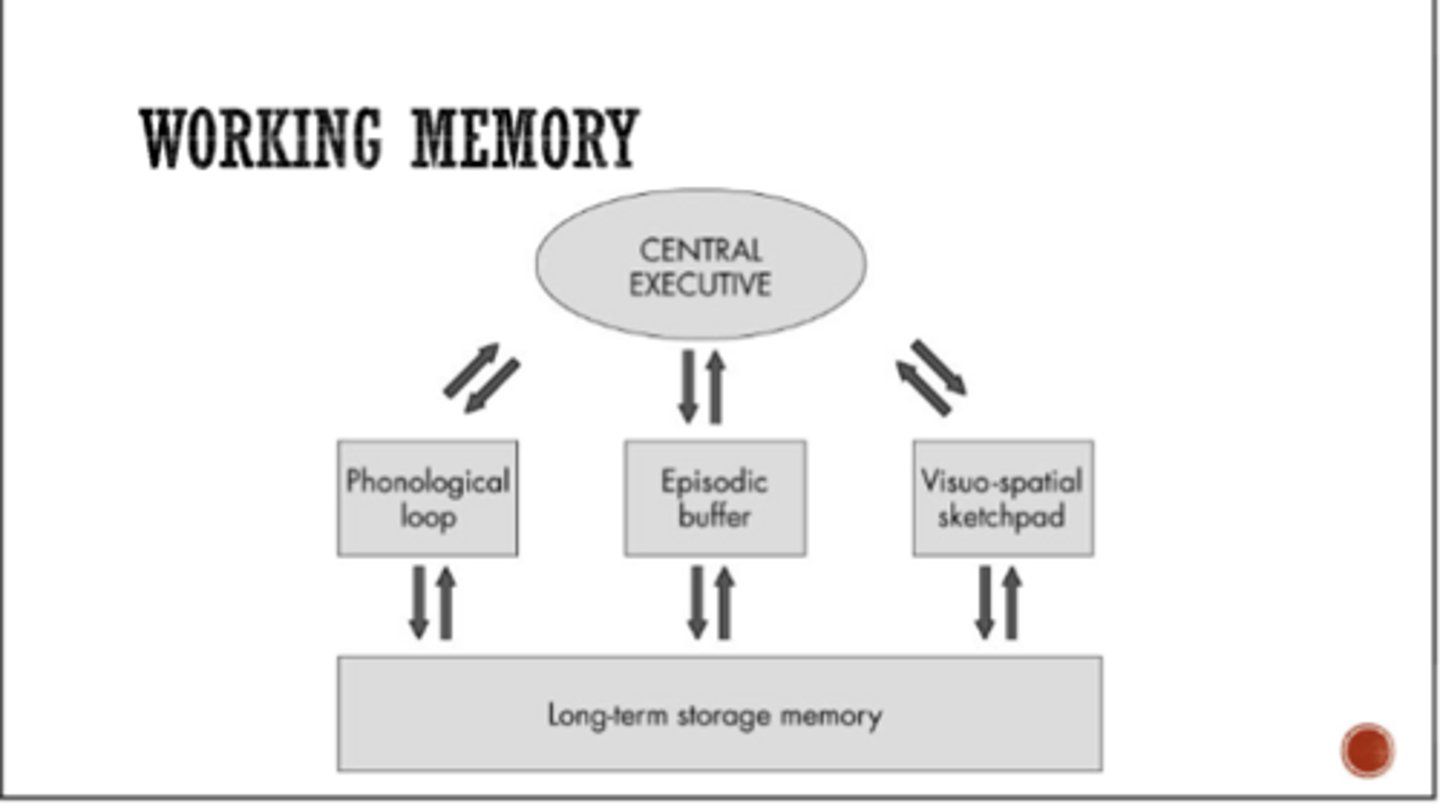
Working Memory
A newer understanding of short-term memory that involves conscious, active processing of incoming auditory and visual-spatial information, and of information retrieved from long-term memory.
Working Memory: Chart
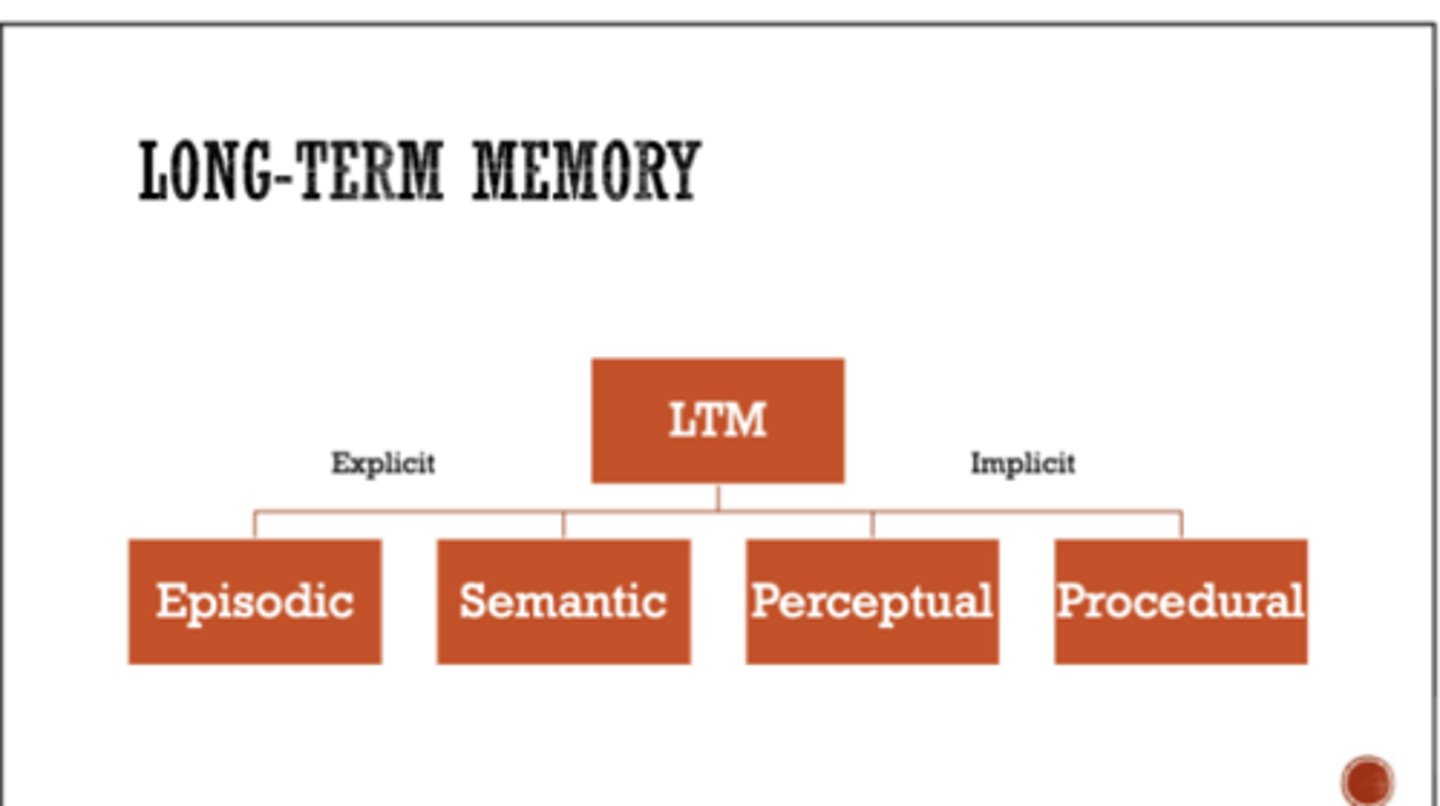
Long Term Memory: Chart
Measuring Retrieval: Recall, Recognition, and Relearning
- Recall = Producing the answer yourself
- Recognition = Identifying the correct answer
- Relearning = Measure how much faster you learn information the second time
Karl Lashley
Found that memory is not stored in just one place in the brain
Equipotentiality Hypothesis
If a brain area involving memory is damaged, another part of the SAME area takes over the memory function
Amygdala
- "Emotional computer"
- Organ in the limbic system
- Processes emotion and strengthens emotional memories
Hippocampus: Case of H.M.
- Lost both left and right hippocampi, removed in attempt to control seizures
-Declarative memory was significantly affected and he couldn't form new memories, but retained prior events to the surgery
Flashbulb Memories
- Clear emotional recollection of an event and surrounding details
- Recalled more accurately than everyday memories
- Ex. Tragedy of (9/11)
Why are both types of amnesia incomplete?
Memory loss is partial and selective, people do not lose ALL their memories or total ability to learn
Retrograde Amnesia
Cannot remember events prior to damage
Anterograde Amnesia
Cannot remember events that occur after damage
Loftus and Palmer Study
A car crash study, which demonstrates that memory is not like a video recording of events; it is reconstructive
Source Amnesia
When someone remembers information, but forgets where or how they learned it.
The content of the memory is retained, but the source of the memory is lost.
What does this mean? "Memory is reconstructive, not reproductive."
We construct our memories to align with personal expectations, beliefs, and general knowledge
Retrieval Failure: Proactive Interference
Old information interferes
Retrieval Failure: Retroactive Interference
New information interferes
Mnemonic Devices
Memory techniques for remembering large quantities of info (ex. PEMDAS)
Spacing Effect
Spacing out studying appears to provide learners with more accurate feedback on how they're doing
Spacing Effect: Massed Practice
Produces speedy short-term learning and can cause the illusion of familiarity
Testing Effect
Practice tests are way more effective than rereading the same information multiple times
Encoding Failure
Information is never stored because it wasn't properly encoded initially
Storage Decay
Unused information/memories fading with the passage of time
Motivated Forgetting
- People can intentionally suppress or forget information
- Freud's idea of repression: Traumatic memories are unconsciously pushed out of awareness
Associative Learning
Learning that certain events occur together. The events may be two stimuli (as in classical conditioning) or a response and its consequences (as in operant conditioning).
Classical Conditioning: Unconditioned Stimulus (US)
Naturally triggers a response (no learning needed)
Classical Conditioning: Unconditioned Response (UR)
Automatic response to unconditioned stimulus
Classical Conditioning: Conditioned Stimulus
A former neutral stimulus that, after association with the unconditioned stimulus, triggers a response.
Classical Conditioning: Conditioned Response (CR)
Learned response to conditioned stimulus
Classical Conditioning: Neutral Stimulus (NS)
Initially produces no specific response
What is classical conditioning?
Learning through association
Classical Conditioning: Acquisition
Initial learning of an association; research shows stronger learning when CS comes before US, and the pairing of the US and CS is close in time
Positive Reinforcement
Increases likelihood of a response by adding something desirable
Negative Reinforcement
Increases likelihood of a response by removing something undesirable
Positive Punishment
Decreases the likelihood of a response by adding something undesirable
Negative Punishment
Decreases the likelihood of a response by removing something desirable
Similarities in Classical and Operant Conditioning
- Both examples of associative learning
- Both involve acquisition, extinction, spontaneous recover, generalization, and discrimination
Differences in Classical and Operant Conditioning
Classical = Associating two stimuli
Operant = Associating a behavior with its consequence
Cognition: Tolman's Research
Hypothesized that rats made cognitive maps of the maze he experimented with
Thorndike's Law of Effect
Actions that lead to rewards are strengthened; actions that lead to discomfort are weakened
Primary Reinforcer
Satisfies a basic biological need and is naturally rewarding (food, water, etc.)
Secondary/Conditioned Reinforcer
Something that is learned to be rewarding (money, grades, etc.)
Skinner Box
- Controlled experimental apparatus developed by B. F. Skinner
- Studies operant conditioning,
allows researchers to measure how consequences shape voluntary behavior
Shaping
Reinforcing small steps toward a desired behavior (rewarding a dog first for sitting, then for lying down, and eventually for rolling over)
How do excessive rewards affect intrinsic motivation?
Too many external rewards can reduce intrinsic motivation (overjustification effect), making a person less interested in the activity itself.
Observational Learning
Learning by watching others
Observational Learning: Modeling
The act of imitating the behavior that was observed
Modeling: Bobo Doll Experiment
Children watched an adult either act aggressively toward a Bobo doll or behave calmly. The children were placed in a room with the doll.
Results: Children who observed the aggressive model were more likely to imitate the aggressive behaviors.
The study showed that children learn behaviors through observational learning and modeling.
Learning: Extinction
The weakening of a learned response when reinforcement or the unconditioned stimulus is removed
Learning: Spontaneous Recovery
The reappearance of a previously extinguished response after a rest period
Learning: Generalization
Responding similarly to stimuli that are similar to the original conditioned stimulus
Learning: Discrimination
The ability to distinguish between the conditioned stimulus and other similar stimuli
What is the link between violent media and violent behavior?
Research shows a correlation between violent media exposure and increased aggression, but causation is not fully established
Schedules of Reinforcement: Chart
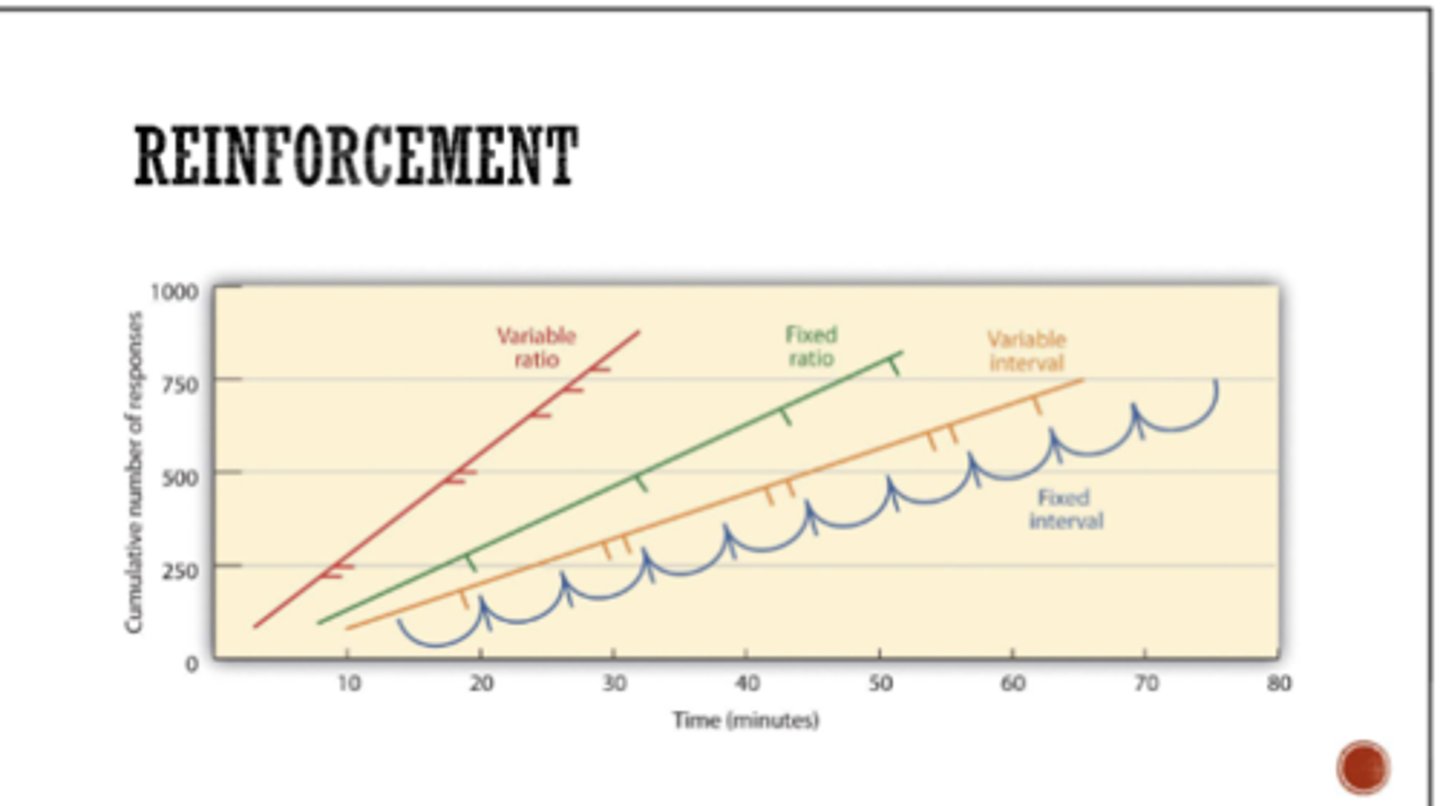
Schedules of Reinforcement: Fixed Interval
Reinforcement is delivered at predictable time intervals = Moderate response rate with significant pauses after reinforcement (student receives paycheck every 2 weeks)
Schedules of Reinforcement: Variable Interval
Reinforcement is delivered at unpredictable time intervals = Moderate yet steady response rate (checking social media)
Schedules of Reinforcement: Fixed Ratio
Reinforcement is delivered after a predictable number of responses = High response rate with pauses after reinforcement (getting paid x amount per item)
Schedules of Reinforcement: Variable Ratio
Reinforcement is delivered after an unpredictable number of responses = High and steady response rate (gambling)
Sensation
the physical process of sensory receptors and detects raw environmental stimuli converting them into neural signals.
Perception
the psychological process of organizing and interpreting these signals in the brain to make them meaningful.
Example to explain the differences in sensation and perception
The ear drums vibrate from sound waves (sensation) the brain interprets the noise as a fire alarm (perception)
Sensory Adaptation
the reduction in sensitivity to a stimulus after constant, unchanging exposure, allowing the nervous system to filter out background noise and focus on new or significant changes
When we are exposed to a stimulus
repeatedly, the nerve cells fire less frequently
What is transduction?
The process by which sensory information receptors convert physical energy or chemical signals from the environment into electrical impulses that the nervous system can understand.
How is sensory information is detected by the sensory systems and then processed in the brain?
Detect the stimuli -> transduction (stimulus opens/closes ion channels changing the receptors membrane potential) -> transmission (the electrical signal travels along afferent neurons to the central nervous system) -> processing (information passes through the thalamus and acts as a relay station)
Bottom-up Processing
the data-driven sensory based interpretation of stimuli from the environment
Top-down Processing
conceptually driven using prior knowledge, memories, and expectations to interpret sensory information
What is psychophysics?
The scientific study of the relationship between physical stimuli and the sensations or perceptions they produce in the human mind
What was Fechner's key contribution to psychology?
He introduced classic methods for detecting sensory thresholds (just-noticeable differences, or JNDs). He defined "psychophysics" as an exact science mapping the relationship between mind and body.
Absolute Threshold
the minimum intensity of a stimulation required for a person to detect it 50% of the time.
Difference Threshold
the minimum change in intensity required to perceive a difference between two stimuli.
What is signal detection theory?
a statistical framework for measuring how individuals make decisions under uncertainty, specifically how they distinguish between meaningful information (signal) and random background interference (noise)
Wavelength (light wave)
refers to the physical distance between two consecutive peaks (or troughs) of a light wave
psychological property of hue, or color
Amplitude (light wave)
refers to the height of a light wave, measured from the center line (resting position) to the peak or trough
psychological property of brightness or intensity
Iris (part of eye)
Colored part of the eye that controls the size of the pupil and the amount of light entering.
Proximity (Gestalt Principle)
Elements that are close together are perceived as a single, related group.
Similarity or Grouping (Gestalt Principle)
Elements that share similar characteristics (color, shape, size) are perceived as part of the same group
Closure (Gestalt Principle)
The brain fills in missing or incomplete parts of a shape to perceive a complete, whole object
Continuity (Gestalt Principle)
Elements arranged in a line or curve are perceived as related, following a smooth path rather than a broken one
Gestalt Principles
Gestalt principles explain how humans naturally organize visual elements into groups or a unified whole.
Bioncular Cues
Binocular depth cues require both eyes to perceive 3D structure through retinal disparity and convergence, excel at close range, and rely on stereopsis
Monocular Depth Cues
occlusion, relative height, relative size, linear perspective, lighting and shadow
Depth Perception
enables us to estimate
an object's distance from us
Perceptual Constancy
the cognitive ability to perceive familiar objects as having constant, unchanging properties
Color Constancy
The tendency to perceive an object as having a consistent color regardless of the lighting conditions
Shape Constancy
The perception of an object's shape as stable, even though the image it casts on the retina changes as the viewing angle shifts
Size Constancy
The ability to perceive an object as having a constant size, regardless of its distance from the observer, even though its retinal image grows or shrinks
Frequency (Sound Wave)
Frequency is the rate of vibration of a sound wave
corresponds to the psychological property of pitch
What is the human range of hearing?
From 20 Hz to 20,000 Hz
Experience Outside of Range of Hearing
Above this range = ultrasound
Below this range = infrasound
May be experienced as vibration rather than sound
Cortical Magnification
Cortical magnification is the disproportionately large representation of specialized sensory areas (like the fovea in vision or fingertips in touch) in the cerebral cortex compared to their small physical size on the sensory receptor surface
Pinna (Outer Ear)
The visible, cartilaginous part on the side of the head that collects sound waves
Vestibular System (Inner Ear)
Responsible for balance and detecting head movement.
Auditory Nerve (Inner Ear)
Transmits electrical signals from the cochlea to the brain
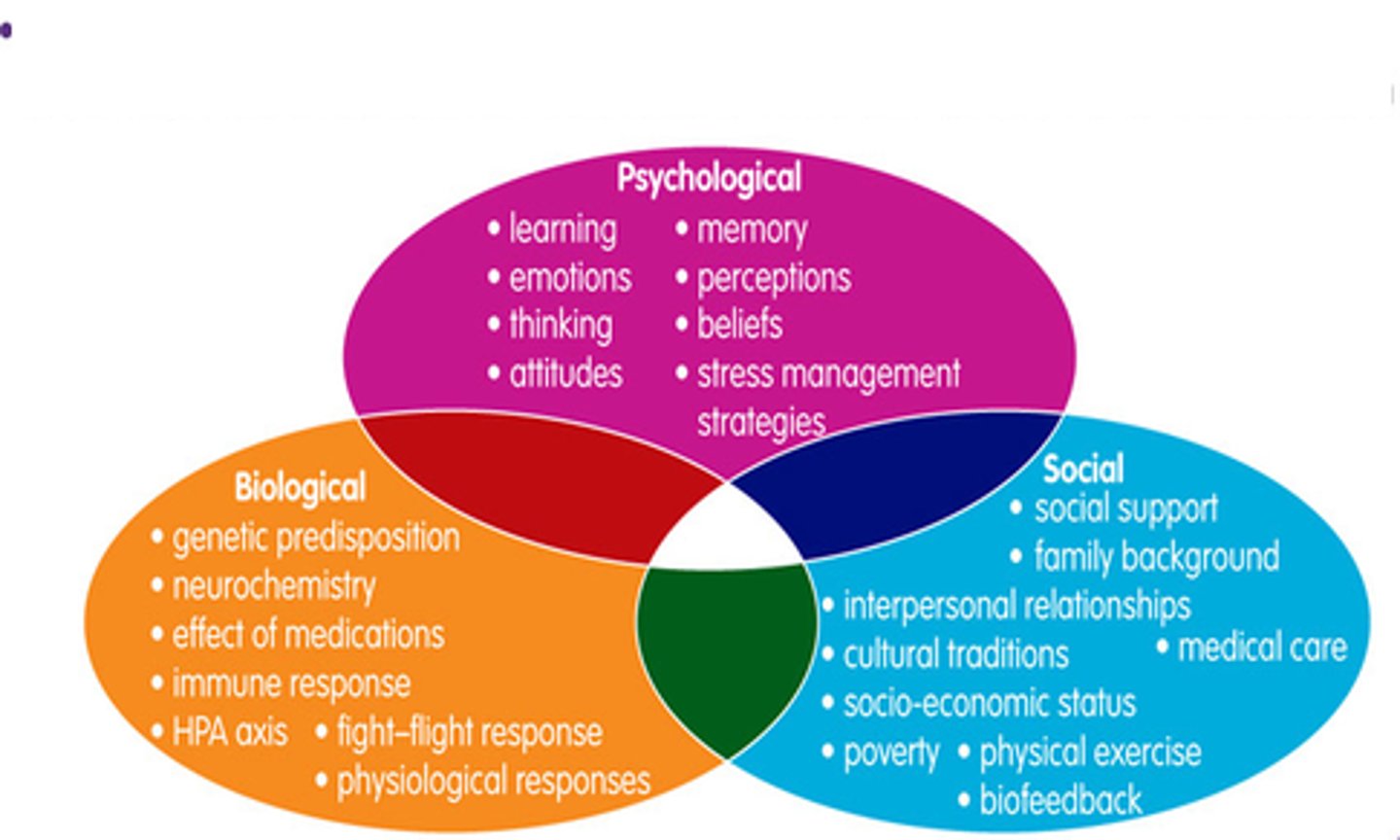
Biopsychosocial Model
physical damage (biological) initiates pain, emotions/thoughts (psychological) and environment (social) shape its intensity and duration