Stats One-way Between-subjects ANOVA
 Call Kai
 Learn
Learn Practice Test
 Spaced Repetition
 Match
Match Flashcards
 Knowt Play
1/8

There's no tags or description
Looks like no tags are added yet.
Name | Mastery | Learn | Test | Matching | Spaced | Call with Kai |
|---|
No analytics yet
Send a link to your students to track their progress
9 Terms
ANOVA recipe book
Choose one IV and the DV
Calculate how many independent t-tests you need to run (Number of t-tests = k(k-1) / 2
Problem with testing the same ingredient multiple times: Capitalising on chance (increase risk of Type I error as a result of running many statistical tests on the same data)
Give one specific type of Type I error that could occur if multiple independent t-tests were run
Calculate the cumulative probability: P (at least one Type I error) = 1 - (1 - a)n Where n = number of independent-samples t-tests
Based on the cumulative probability of making at least one Type I error, explain what this value means (e.g. there is a 14.3% chance this is significant by chance
Between-groups variance = between between groups (treatment + error) / Within-groups variance = variance WITHIN the same group (error)
Assumptions of one-way between-subjects ANOVA
Levels of measurement = continuous DV
Independence = Each observation is independent of the others (each score should come from a different participant)
Normality of residuals = Normally distributed residuals along the reference line of a QQ plot
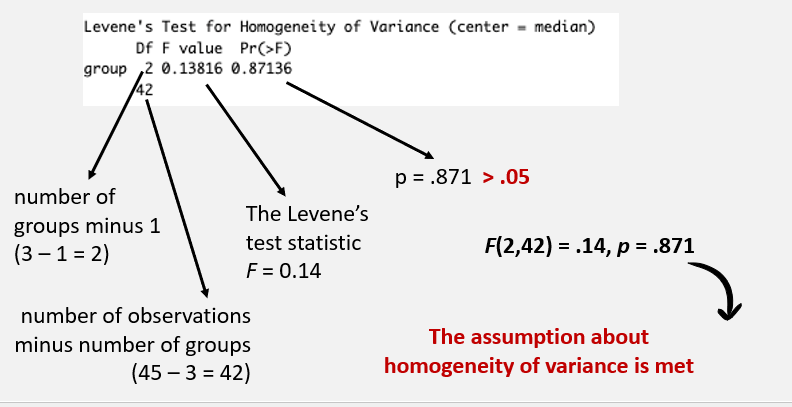
Homogeneity of variance = All groups being compared have equal variability / The spread of scores around the mean is approximately the same across both groups
Boxplot
Residuals vs Fitted plot (flat red line)
Levene’s Test → F = .xx, p = .xxx
What happens if the assumptions are violated? (Non-parametric test)
Kruskal-Wallis test for non-parametric test
If groups have equal sample sizes and the effect sizes are relatively large, you can proceed with ANOVA despite violations of assumptions
“Heterogeneity of variances is always a problem in ANOVA, even in the moderate heterogeneity cases. Welch's method is most popular procedure to analyse the data with different variance values. However, this method performs better solution in the assumption of normality like other traditional methods"
Eta squared
ANOVA’s effect size - Ranges from 0 to 1
For one-way between-subjects designs, partial eta squared is equaivalent to eta squared
Eta squared links to total variance, partial eta squared links to variance related to the treatment
Eta squared = 0.01 indicates a small effect
Eta squared = 0.06 indicates a medium effect
Eta squared = 0.14 indicates a large effect
Write up
A one-way between-subjects ANOVA was conducted to examine whether learning motivation differed across study-with-me conditions
The analysis revealed a significant effect of condition on learning motivation, F(2, 42) = 15.17, p < .001, [partial eta squared] = 0.42, indicating that learning motivation differed significantly across the three conditions
F(x, xx) = x.xx, p < .xx, [partial eta squared] = x.xx
Omnibus test definition
Omnibus test (e.g. ANOVA) - Tests for the significance and acts as a global check (e.g., ANOVA, regression -test) - detects if one group mean differences from the other (variance) without saying which groups are specifically different
Post-hoc test definition
Post-hoc tests are conducted only after a ANOVA test shows a statistically significant result
Post-hoc tests are used to identify group differences by comparing every group in the study against all other groups
Popular post-hoc tests are Tukey, Bonferroni and Scheffé
Keeps the alpha level consistent at 0.5 AND can be used for multiple comparisons (avoiding capitalising on chance)
Post-hoc test for one-way between-subjects ANOVA
Tukey’s Honestly Significant Difference (HSD)
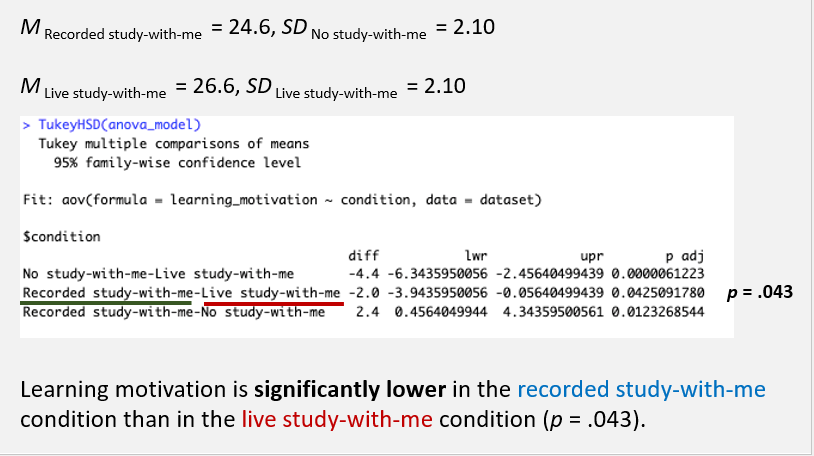
TukeyHSD(anova_model)
Look at p adj and see if the significance is lower than .05 (or your chosen significance score). Which mean score of the IV was lower than the other?
In this example, because Mean Recorded study-with-me was lower than the Mean Live study-with-me AND the p-value was lower than .05, learning motivation in recorded study-with-me is therefore SIGNIFICANTLY LOWER than live study-with-me
Write up: Post-hoc comparisons using Tukey’s HSD test revealed that learning motivation was significantly higher in the live study-with-me condition than in both the recorded study-with-me (p = .043) and no study-with-me conditions (p < .001). In addition, learning motivation was significantly higher in the recorded study-with-me condition than in the no study-with-me condition (p = .012)
p = .xxx
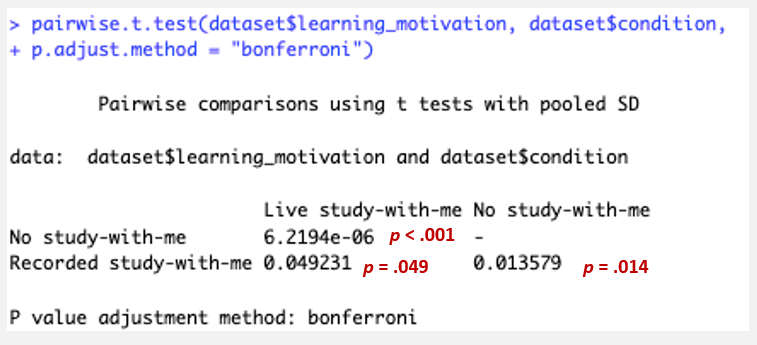
Bonferroni: Another post-hoc test
There are two effect sizes for ANOVA: Eta-equared and Cohen’s d for pairwise comparison
pairwise.t.test(x$x, x$x, p.adjust.method = "bonferrroni")
Write up: Post-hoc comparisons using Tukey’s HSD test revealed that learning motivation was significantly higher in the live study-with-me condition than in both the recorded study-with-me (p = .043, Cohen’s d = 0.95) and no study-with-me conditions (p < .001, Cohen’s d = 1.97). In addition, learning motivation was significantly higher in the recorded study-with-me condition than in the no study-with-me condition (p = .012, Cohen’s d = 1.07)
p = .xxx, Cohen’s d = x.xx
