Chapter 14: Social Influences (14.1 & 14.2 of Textbook)
 Call Kai
 Learn
Learn Practice Test
 Spaced Repetition
 Match
Match Flashcards
 Knowt Play
1/16

There's no tags or description
Looks like no tags are added yet.
Name | Mastery | Learn | Test | Matching | Spaced | Call with Kai |
|---|
No analytics yet
Send a link to your students to track their progress
17 Terms
Parental Behaviour
Direct Instruction
Observing: imitation, counterimitation
Feedback
What is direct instruction?
Telling children what to do, when & why
Providing explanations helps children develop social & emotional skills
E.g, explaining why sharing is positive
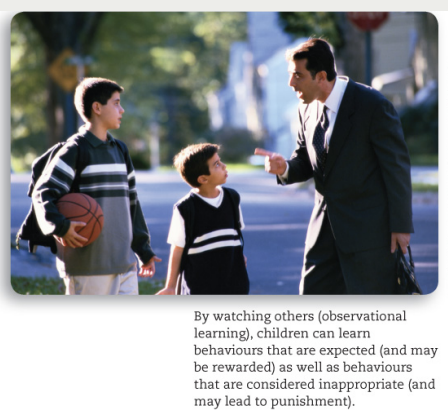
What is Observing?
Children learn from watching others
Imitation: performing actions they see are rewarding (e.g., doing chores)
Counterimitation: learning what should not be done
E.g., Learning to not skip school when older sibling is punished for doing so
What is Feedback?
Reinforcement or punishment to increase or decrease behaviour, respectively
Parents often unwittingly reinforce behaviours they want to prevent
Negative reinforcement trap: When parents fail to enforce a rule because they “give in” to a child’s negative behaviours
E.g., Letting a child stay up past bedtime because they are whining
To be effective, punishment needs to be…
Administered promptly and consistently
Administered by a person with whom the child has a warm affectionate relationship
Accompanied by an explanation and suggestions for future ways of behaving
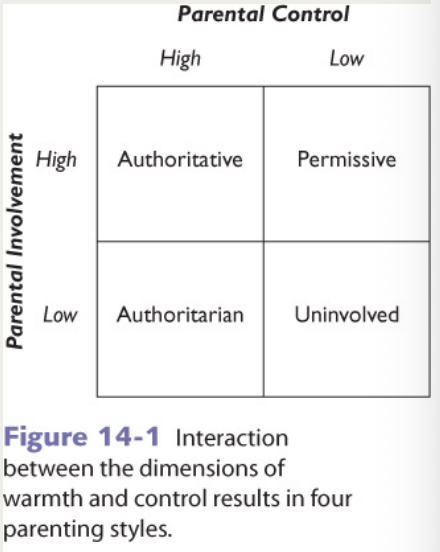
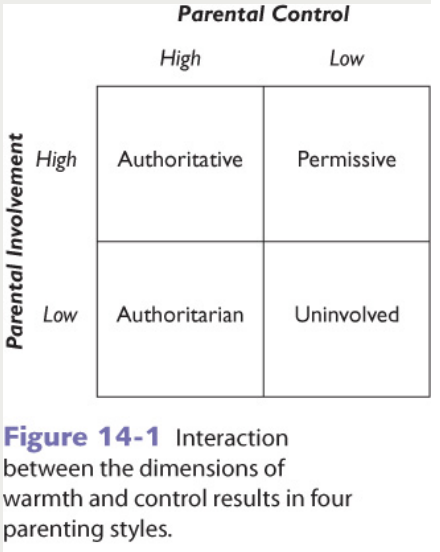
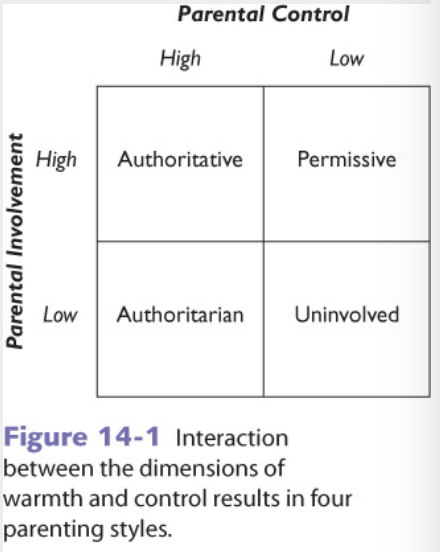
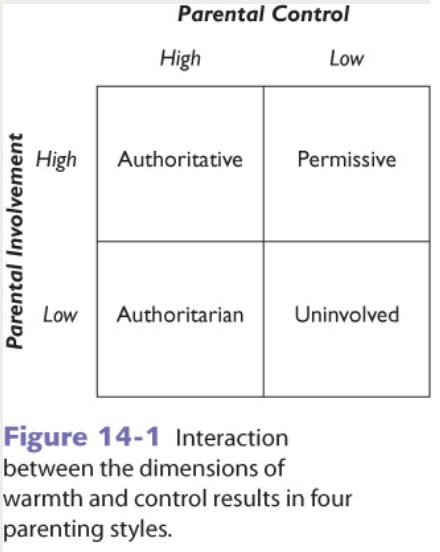
What are the 4 styles of parenting?
Authoritarian
Authoritative
Permissive
Uninvolved
What is Authoritarian Parenting Style? What is the influence of this parenting style on children?
High control, little warmth
Enforce rules with little discussion, little give and take with children
What is Authoritative Parenting Style? What is the influence of this parenting style on children?
High control, high warmth
Explain rules with discussion
Responsible, self-reliant, friendly, higher academic performance
What is Permissive Parenting Style? What are its influence on the child?
Low control, high warmth
Accept child’s behaviour with little/infrequent punishment
Impulsive, little self-control
What is Uninvolved Parenting Style?
Low control, low warmth
Provide for basic physical & emotional needs but little else & limited emotional involvement
Poor school performance, often aggressive
What are some Variations in Parenting Style Associated with Socioeconomic Status and Culture?
Socioeconomic status
Higher SES parents are often more authoritative & lower SES parents more authoritarian
Perhaps due to educational differences leading to a more nuanced view of development & the need for a child centered approach
Could also be related to increased stress among lower SES parents
Culture
East-Asian culture emphasizes role of parent as ‘teacher’ & the need for emotional restraint for group harmony
Development of Peer Interactions
Developmental sequence…
Nonsocial
Play alone or watch others
Parallel
Play alone but interested in what others are doing
Associative
Engage in similar activities, talk or smile at one another & offer each other toys
Cooperative
Organize play around a theme & take on specialized role depending on the theme
Becomes the norm by approx. 3.5 years
Make- Believe
Make-believe play is facilitated by advances in language, memory, reasoning & understanding others thoughts, beliefs & feelings
In play therapy, psychologists use make-believe play as a ‘window’ on internal psychological conflicts & the childs attempt to understand their world
What are Parental Roles in Preschoolers Play?
Playmate
Scaffold & help make play more sophisticated (e.g., suggest new activities such as demonstrating how to wash dishes while pretending to play kitchen)
Social director
facilitate interactions with peers (e.g., play dates; organized activities)
Coach
Help children gain skills related to interacting with peers (e.g., initiating play, making joint decisions
Mediator
Help resolve conflicts between peers during play by offering solutions, leading to more prolonged play interactions
Peer Interactions in Elementary School-Aged Children
In Elementary School…
Peer networks expand
Interactions are structured by adults (e.g., in the classroom)
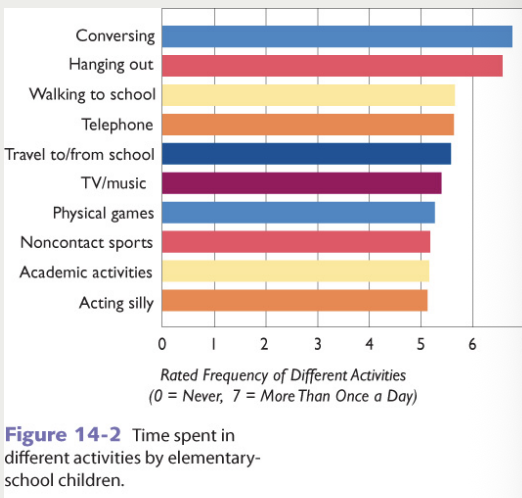
Interactions are also unstructured without adult supervision (e.g., playground at recess)
Advances in cognition lead to…
Increased capacity to maintain play and resolve conflict
Increased variety in activities engaged in with peers
Friendships
Friendships become more complex with age
Age 4-5: Like each other and enjoy playing together
Age 8-11: Trust and assistance
Adolescence: Intimacy and loyalty, making friends significant social and emotional supports
Who becomes friends?
Propinquity: People in closer proximity are more likely to be friends
Similarity in age, sex, attitudes, values, and ethnicity
Inter-ethnic friendships more common where the opportunity exists (e.g., GTA)
Groups
Most groups have a dominance hierarchy
A leader to whom other group members defer
Among boys, usually most physically intimidating
Among girls and older boys, leaders have high self-esteem, good peer relations, and useful skills
Peer pressure can be …
Negative : When it involves antisocial elements (e.g., stealing)
Positive : When it encourages prosocial activities (e.g., involvement in community projects)