Social Studies
 Call Kai
 Learn
Learn Practice Test
 Spaced Repetition
 Match
Match Flashcards
 Knowt Play
1/170

There's no tags or description
Looks like no tags are added yet.
Name | Mastery | Learn | Test | Matching | Spaced | Call with Kai |
|---|
No analytics yet
Send a link to your students to track their progress
171 Terms
What was the convoy system designed to do?
a. protect merchant ships from U-boats
b. present a line of destroyers to attack German ships
c. create a line of flying aces
d. all the above
a. protect merchant ships from U-boats
How did the US citizens help with the war effort at home?
a. they planted victory gardens so more food could go to soldiers
b. they collected tin cans, paper, and toothpaste tubes
c. they sold and purchased war bonds
d. all of the above
d. all of the above
What made the allies’ need for the US to enter the war more urgent?
a. communism threatened to spread to England
b. Russia made peace with Germany
c. Influence spread throughout France
d. Germany was developing a new bomb that would destroy the allies
b. Russia made peace with Germany
What was NOT true of African Americans during WW1?
a. many moved north in the great migration
b. AA soldiers were honored by France for their valor
c. AA and whites received equal treatment in the US army
d. AA filled wartime jobs in the north
c. AA and whites received equal treatment in the US army
How did the federal government control the nation’s economy during the war?
a. it regulated production and set prices
b. it settled conflicts between workers and employers
c. it limited people’s ability to buy and use certain items
d. all the above
d. all the above
Which was NOT one of President Wilson’s Fourteen Points?
a. an association of nations to peacefully settle disputes
b. free trade and freedom of the seas
c. the punishment of Germany
d. two separate nations for the people of Austria-Hungary
c. the punishment of Germany
Which was NOT true of the government’s propaganda campaign during the war?
a. it tried to increase patriotism and weaken the opposition to the war
b. it helped people to overcome their prejudice against the German culture
c. it stirred up enthusiasm among the public to buy war bonds
d. it was managed by the Committee on Public Information
b. it helped people to overcome their prejudice against the German culture
The tanks, poison gas, and other technology that was used for the first time in WW1 are evidence of which underlying cause of the war?
a. militarism
b. nationalism
c. imperialism
d. alliances
a. militarism
Why did the Zimmermann telegram anger Americans?
a. it said Germany would resume unrestricted submarine warfare
b. it withdrew the German promise not to sink merchant ships
c. it offered Mexico German help in reclaiming land lost to the US
d. it offered the United States help in conquering Mexico
c. it offered Mexico German help in reclaiming land lost to the US
The Senate refused to ratify the treaty ending WW1 because_______.
a. Americans were afraid of more foreign commitments
b. President Wilson said the treaty was too easy on Germany
c. the American public wanted Germany to be punished for the war
d. the US was being asked to pay reparations for war damages
a. Americans were afraid of more foreign commitments
What issue raised tensions in Europe in the decades before WW1?
a. Germans were angry about the territory they lost in Franco-Prussian war
b. Germans believed that France wanted German border regions to secede and become part of France
c. The British feared that Communists were causing unrest in London
d. Germany felt that it was losing the competition for colonies with Britain
d. Germany felt that it was losing the competition for colonies with Britain
Which event is an example of nationalism as an underlying cause of WW1?
a. Germany began to build up its army and navy to prepare for eventual war
b. Germany & Britain fought over control of a Pacific Island
c. A Serb assassinated Archduke Ferdinand of Austria-Hungary because he wanted Serbia to have its own country
d. Russia out its army on alert to defend its ally Serbia against Austria-Hungary
c. A Serb assassinated Archduke Ferdinand of Austria-Hungary because he wanted Serbia to have its own country
Which of the following was NOT a reason the US entered WW1?
a. the sinking of three US ships in March 1917
b. Germany’s unrestricted submarine warfare
c. Germany’s use of airplanes and poison gas
d. the discovery of the Zimmermann telegram
c. Germany’s use of airplanes and poison gas
How did the National War Labor Board aid the war effort?
a. it lengthened the workday to increase production
b. it prevented strikes by settling differences between employers and workers
c. it assigned workers to jobs that were important to war production
d. it made sure that the US army in Europe had enough supplies
b. it prevented strikes by settling differences between employers and workers
Which of the following did NOT put limits on US free speech during wartime?
a. the committee on public information
b. the espionage act
c. the sedition act
d. Oliver Wendell Holmes
a. the committee on public information
Which contribution was a woman least likely to make during WW1?
a. work in a clerical job at a government agency
b. serve as a Red Cross nurse in Europe
c. work in war industries factory
d. serve in the US armed forces
d. serve in the US armed forces
Why did the allied leaders not share Wilson’s vision of a “peace without victory”?
a. they thought the US Senate wouldn’t approve such a treaty
b. they wanted Germany punished for its part in the war
c. they did not want Wilson to get the credit for writing the treaty
d. they wanted to make Wilson look bad to the American people
b. they wanted Germany punished for its part in the war
Which of the following was the long-term effect of WW1?
a. the death of millions of people from the flu epidemic
b. the creation of the nations of Yugoslavia and Czechoslovakia
c. the US joining the League of Nations
d. women working in factory jobs
b. the creation of the nations of Yugoslavia and Czechoslovakia
Which of the following planted seeds of resentment that led to WWII?
a. Europeans opposed US participation in the League of Nations
b. US officials arrested many European immigrants for sedition
c. Germans were angry about reparations in the treaty of Versailles
d. Germans couldn’t forgive Russia for its withdrawal from WWI
c. Germans were angry about reparations in the treaty of Versailles
Which of the following statements is true about WWI?
a. technological advances had made warfare much more deadly
b. trench warfare was the best strategy for gaining ground quickly
c. Cavalry on horseback maneuvered better than tanks
d. poison gas was not an effective method for killing enemy troops
a. technological advances had made warfare much more deadly
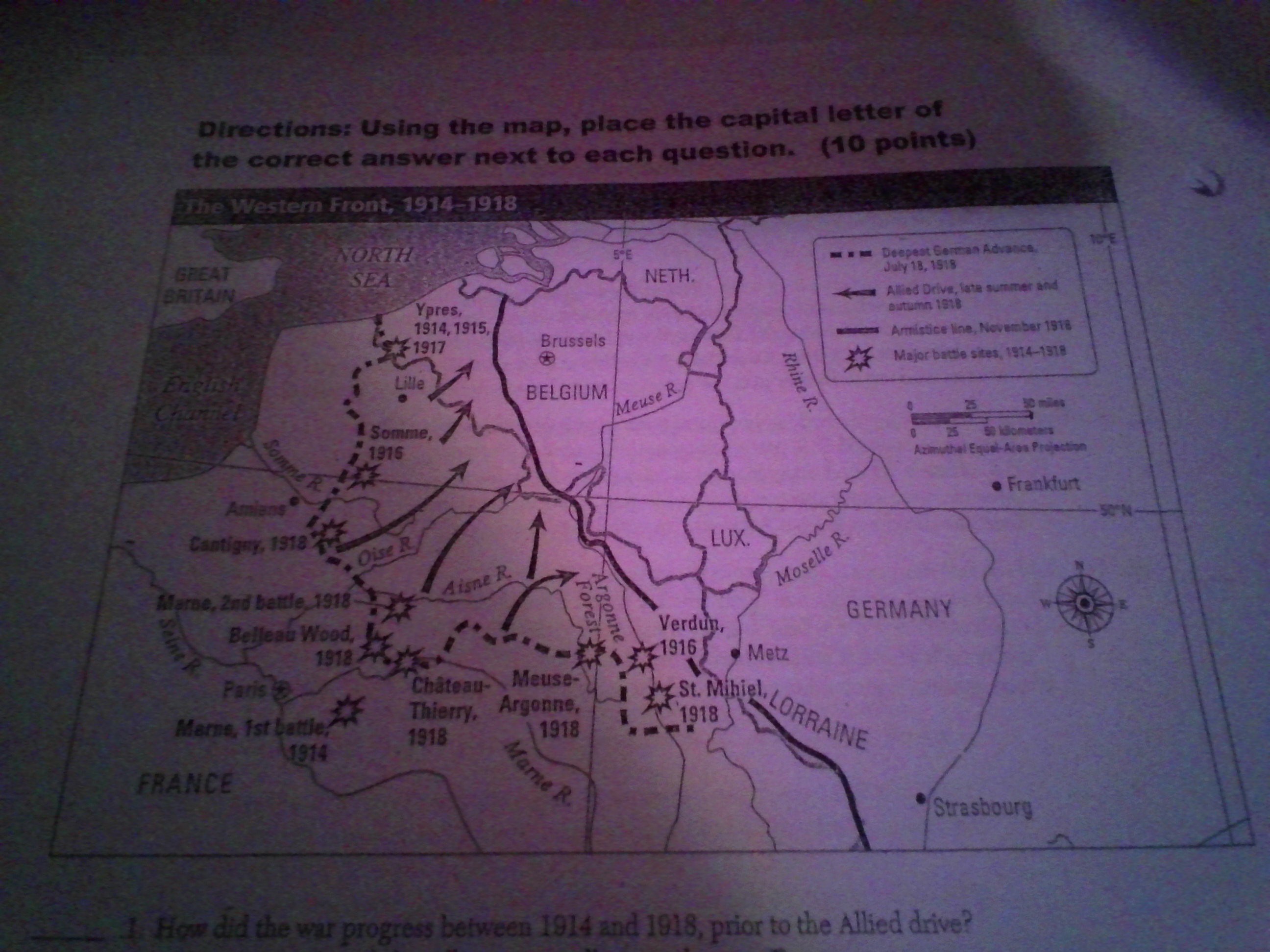
How did the war progress between 1914 and 1918, prior to the Allied drive?
a. Germany and the Allies repeatedly moved across France
b. France almost drove the Germans away only to be recaptured
c. it was a stalemate with very little movement
d. Germany crossed France to the English Channel
c. it was a stalemate with very little movement
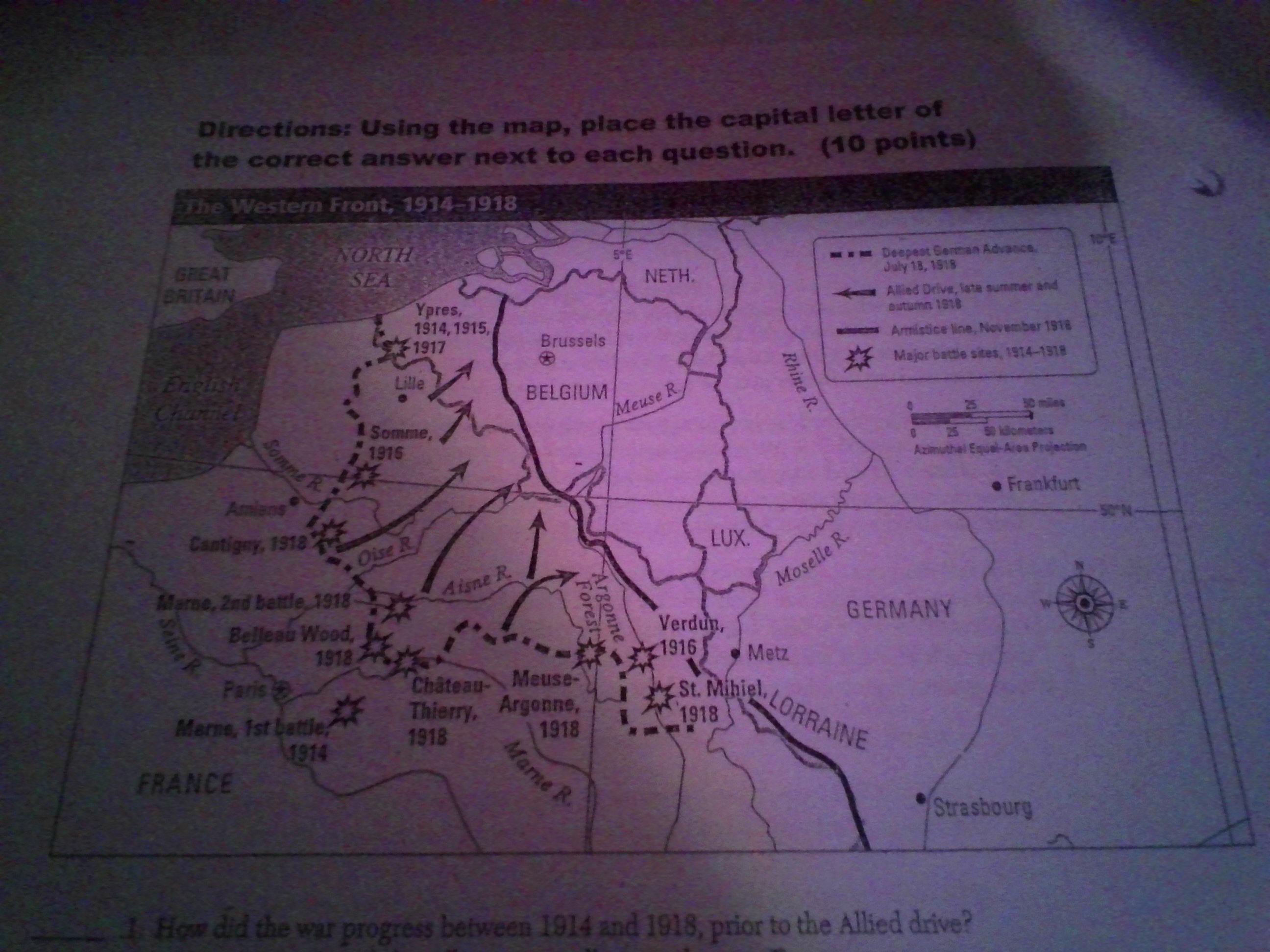
How far from the Armistice Line was the deepest German advance?
a. about 125 miles
b. about 200 miles
c. about 240 miles
d. about 300 miles
a. about 125 miles
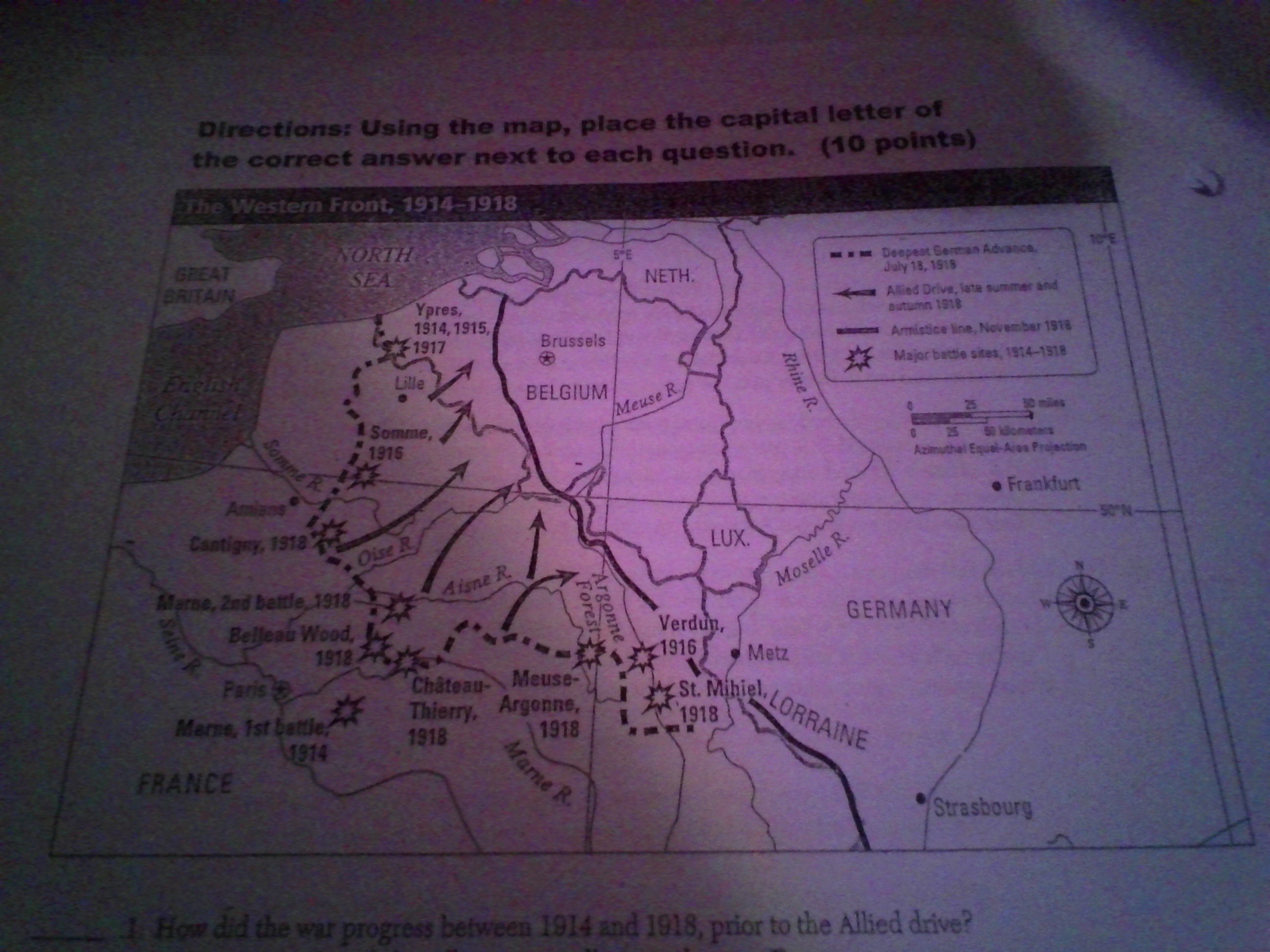
In which year was the French capital of Paris most threatened?
a. 1914
b. 1915
c. 1916
d. 1917
a. 1914
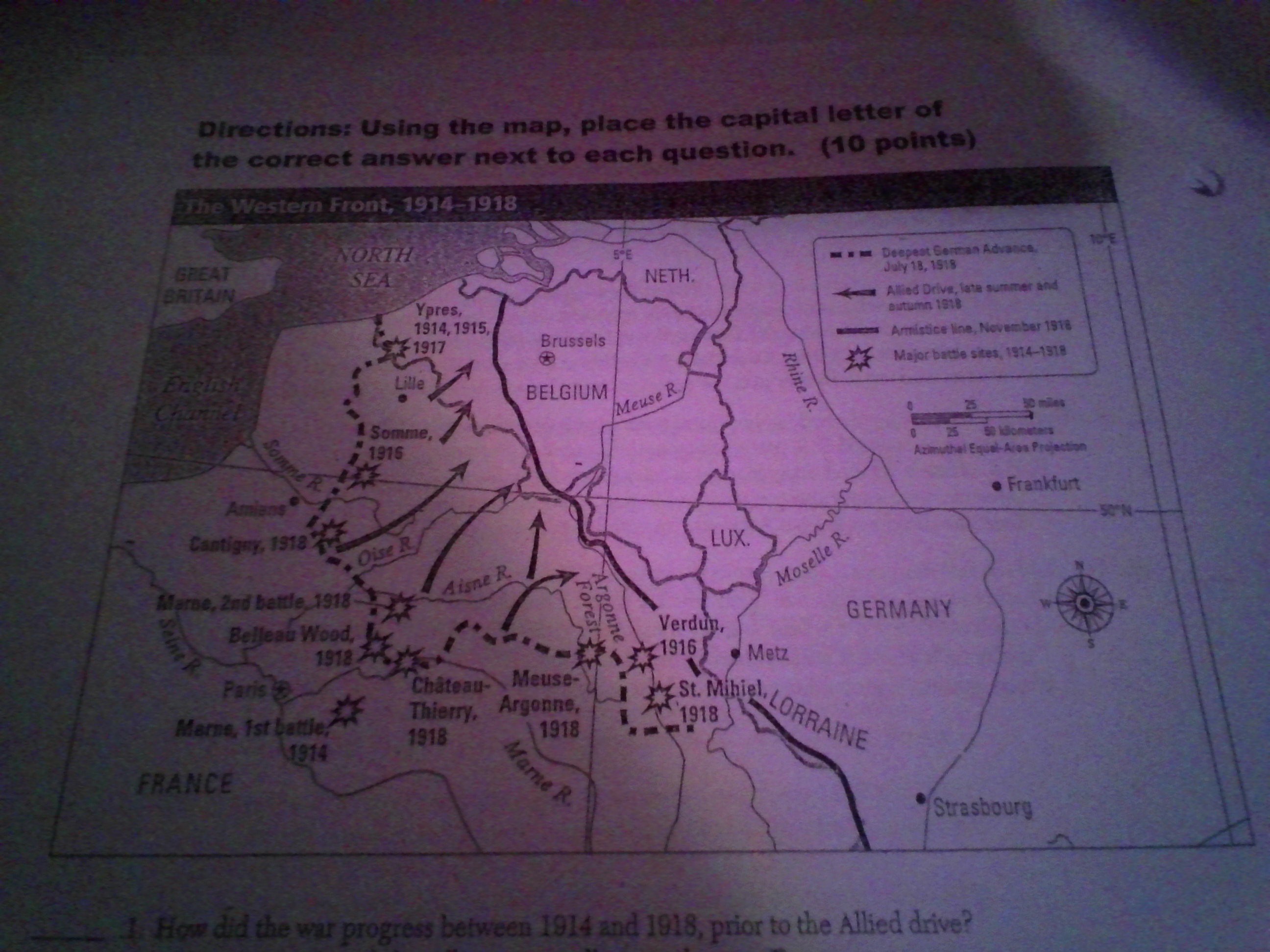
What was the only major battle site NOT in France?
a. Meuse-Argonne
b. First Battle of the Marne
c. Somme
d. Ypres
d. Ypres
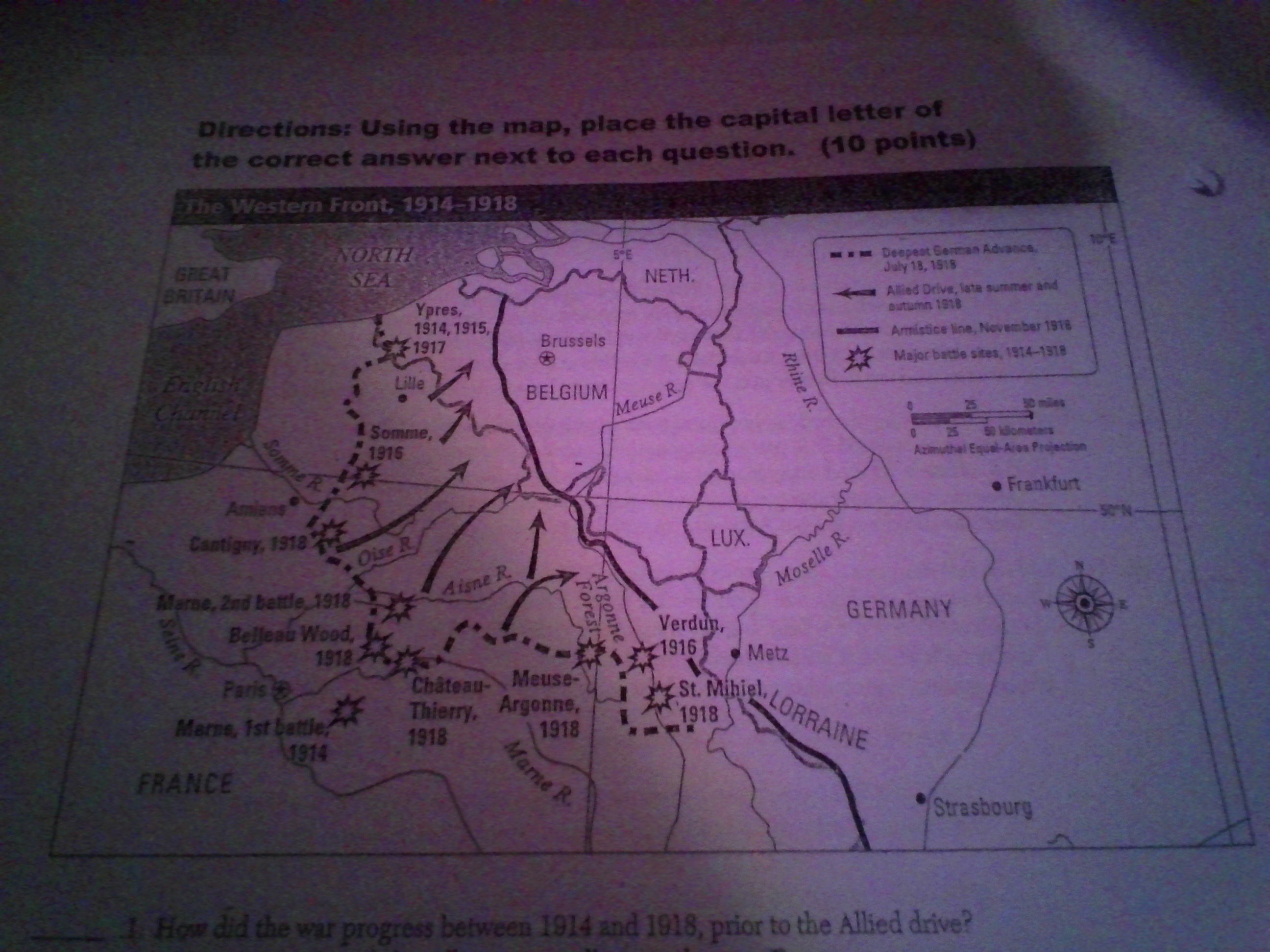
What geographic feature made the Meuse-Argonne offensive difficult?
a. English Channel
b. Argonne Forest
c. Meuse River
d. Aisne River
b. Argonne Forest
Why did Wilson feel he had to support the League of Nations?
He did not want another world war to happen.
What did Lodge feel was the world’s best hope for peace?
He felt that the United States was the best hope in the world peace.
What did the laissez faire economic theory state?
a. if business was left unregulated, it would act to benefit the nation
b. higher tariffs on foreign goods should help American companies
c. the United States should stay out of other nations affairs
d. the middle class should be most concerned about owning a home
a. if business was left unregulated, it would act to benefit the nation
Which is NOT true of both Harding and Coolidge as president?
a. both presidents were isolationists
b. both appointed corrupt officials who made illegal business deals
c. the US economy and Americans’ standard of living grew under both
d. both kept government regulations on business to a minimum
b. both appointed corrupt officials who made illegal business deals
which of the following was the most responsible for the growth organized crime?
a. prohibition
b. fundamentalism
c. immigration
d. civil rights
a. prohibition
which activity is most typical of a “flapper” in the 1920s?
a. going to church
b. getting a job
c. trying a new fad or fashion
d. running for public office
c. trying a new fad or fashion
which of the following best describes fundamentalists in the 1920?
a. they called for the teaching of evolution in all public schools
b. many were members of organized crime
c. they were divided over the issue of prohibiton
d. their movement gained public recognition and political power
d. their movement gained public recognition and political power
Which development contributed to the economic prosperity of the 1920s?
a. petroleum and electricity were widely available cheap fuel sources
b. the assembly line and other technological advances allowed businesses to produce more and make less expensive goods
c. new job opportunities for women gave families more money to spend
d. all of the above
d. all of the above
What two types of mass media became popular in the 1920s?
a. television and newspapers
b. commercials and sports
c. radios and movies
d. talkies and posters
c. radios and movies
Who helped to spread Jazz from his New Orleans birthplace and make it popular throughout America?
a. Duke Ellington
b. Babe Ruth
c. Louis Armstrong
d. Langston Hughes
c. Louis Armstrong
Which of the following was NOT an influence of New York City on American culture?
a. Harlem Renaissance writing
b. the Cotton Club and jazz music
c. Babe Ruth and the Yankees
d. primary site of movie production
d. primary site of movie production
The Lost Generation was made up of what type of people?
a. African Americans who were migrating North and fighting equal rights
b. flappers who were eager to try new dances, fashion, and behavior
c. immigrants who came to the US in search of better jobs
d. artists who felt the postwar years were not a time for celebration
d. artists who felt the postwar years were not a time for celebration
What was the worst scandal that involved one of the President Harding’s cabinet members?
a. the Wyoming scandal
b. the Ohio gang scandal
c. the teapot dome scandal
d. the mellon oil scandal
c. the teapot dome scandal
How was Henry Ford able to build a car people could afford?
a. he used cheaper parts
b. he used robots to build the cars
c. he built cars faster using an assembly line
d. he built cars powered by electricity
c. he built cars faster using an assembly line
What did the NAACP try to protect?
a. the teaching of evolution in public schools
b. the Constitutional rights of African Americans
c. the right of African Americans to return to Africa
d. the movement known as the Great Migration
b. the Constitutional rights of African Americans
What was the intended purpose of Prohibition?
a. to promote morality and good health
b. to make flappers popular
c. to have people brew their own liquor
d. all of the above
a. to promote morality and good health
this included African American writers, scholars, artists, and musicians
famous writers Langston Hughes and Zora Neale Hurston were part of this
the Harlem Renaissance
these people are citizens of one country who live in another country
expatriates
this included sports, dances, fashions, and slang expressions
the movies helped this spread to Europe
popular culture
members of this group criticized the new American values and lifestyles that developed in the 1920s
famous writers Ernest Hemingway, F. Scott Fitzgerald, and Sinclair Lewis were part of this
the lost generation
this spread to other parts of the country from New Orleans
jazz
radio, newspapers, and the movies were included in this
mass media
this president refused to buy farmers’ crops to raise the prices
Coolidge
this secretary of the interior took bribes to let private companies drill for oil on government land
Fall
this person called for African Americans to return to Africa to form a separate nation
Garvey
This person said, “The uncertainties of 1919 were over. America was going on the greatest, gaudiest spree in history.”
Fitzgerald
This pilot was the first to fly nonstop alone across the Atlantic.
Lindbergh
What was the Harlem Renaissance?
the harlem renaissance is a burst of cultural black creativity. black writers, poets, and singers came out of Harlem during this time
explain the kellogg-briand pact.
The Kellogg-Briand Pact is when 15 nations pledged to not start war on each other unless in self-defense.
True or False
Many of Roosevelt’s main programs to help the country recover the Depression were called the New Deal.
true
True or False
One of Roosevelt’s programs declared unconstitutional by the Supreme Court was the AAA.
true
True or False
First Lady Eleanor Roosevelt held regular press conferences at which she emphasized the contributions that women were making to the New Deal.
true
True or False
By allowing women and minorities to join labor unions, the American Federation of Labor increased the power of workers in the nation’s economy
false
True or False
The New Deal programs ended the Great Depression.
false
True or False
A liberal in politics wants to keep the government out of the economy
false
True or False
Roosevelt supported the Anti-lynching bill.
false
True or False
Under the National Recovery Administration, workers draw a pension after they retire, become disabled, or loose their jobs
false
True or False
The Dust Bowl cause many farmers to move east in search of jobs.
false
True or False
Investors who borrowed most of the money for a stock purchase were engaged in buying on margin.
true
Which description is true of FDR?
a. he had a disability and used braces and/or a wheelchair
b. his friendly and informative manner inspired people’s confidence in him
c. some Americans disliked him and his programs
d. all of the above
d. all of the above
Which was NOT a result of the New Deal that is in effect today?
a. a national pension system funded by taxes on workers and employees
b. Government support for the rights of workers and labor unions
c. increased federal government support for the civil rights of minorities
d. government regulation of the stock market and companies that sell stock
c. increased federal government support for the civil rights of minorities
How did the Depression affect the relationship between government and the people?
a. state governments gained power by running the New Deal programs
b. the Depression overwhelmed private and state resources, causing people to turn to the federal government to protect their welfare
c. most direct aid to people in need came through the state governments
d. state governments became more influential than the federal government
b. the Depression overwhelmed private and state resources, causing people to turn to the federal government to protect their welfare
How did US involvement in WWII help bring the Depression to an end?
a. the war’s threat to the nation caused people to forget about their economic troubles
b. Americans became more concerned about restoring democracy to Europe than in restoring jobs in America
c. Factories began operating at full production again to make weapons, supplies, and other goods needed to fight the war
d. the war gave unemployed Americans jobs in the military
c. Factories began operating at full production again to make weapons, supplies, and other goods needed to fight the war
How did buying on margin contribute to the stock market crash?
a. when stock prices fell, people who had borrowed money to buy stock had to sell it for less than they paid for it off their loans
b. by trying to sell their stock, people who had bought on margin drove stock prices up
c. the lower stock prices dropped, the more people bought on margin
d. all of the above
a. when stock prices fell, people who had borrowed money to buy stock had to sell it for less than they paid for it off their loans
Which action damaged FDR’s popularity with the American people?
a. he closed the nation’s banks and ordered a “bank holiday”
b. he gave fireside chats to encourage Americans
c. he tried to increase the number of justices on Supreme court
d. all of the above
c. he tried to increase the number of justices on Supreme court
Which of the following is NOT true of the Social Security Act?
a. it met the New Deal’s goal of recovery as well as its goal of relief by providing certain groups with money to buy the things they needed that day
b. Francis Townshend, one of the New Deal’s major cities, proposed this law
c. FDR tried to pack the court to prevent this law from being declared unconstitutional
d. the law provided pension for the retired the benefits for the unemployed workers
b. Francis Townshend, one of the New Deal’s major cities, proposed this law
What contribution did First Lady Eleanor Roosevelt make to government during the Roosevelt administration?
a. she ran the New Deal while the president was disabled
b. she convinced the president to support the anti-lynching law
c. she stressed the importance of women as government leaders
d. all of the above
c. she stressed the importance of women as government leaders
What was the main purpose of public works projects during the Great Depression?
a. to provide public parks and recreation areas
b. to feed the poor and hungry
c. to give people jobs
d. to keep the unemployed busy
c. to give people jobs
This person headed the National Youth Administration.
a. Richard Wright
b. Marian Anderson
c. Mary McLeod Bethune
d. Frances Perkins
c. Mary McLeod Bethune
Why and How did the political loyalties of most African Americans change during the Great Depression?
African Americans went from Republican to Democrats because FDR gave efforts to help the poor.
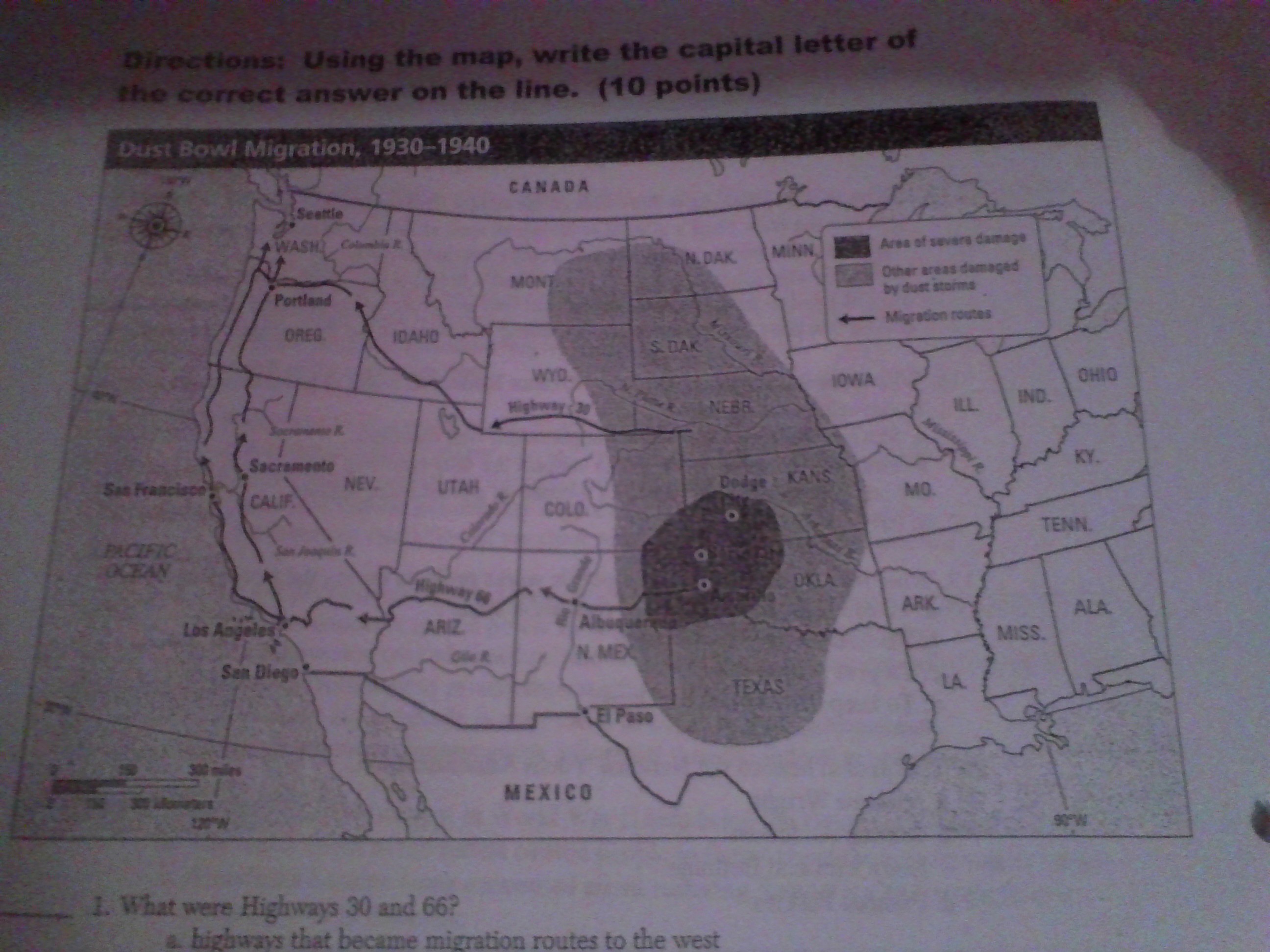
What were Highways 30 and 66?
a. highways that became migration routes to the west
b. highways that followed waterways
c. highways through the mountains where people settled
d. tourist routes that went through the Midwest
a. highways that became migration routes to the west
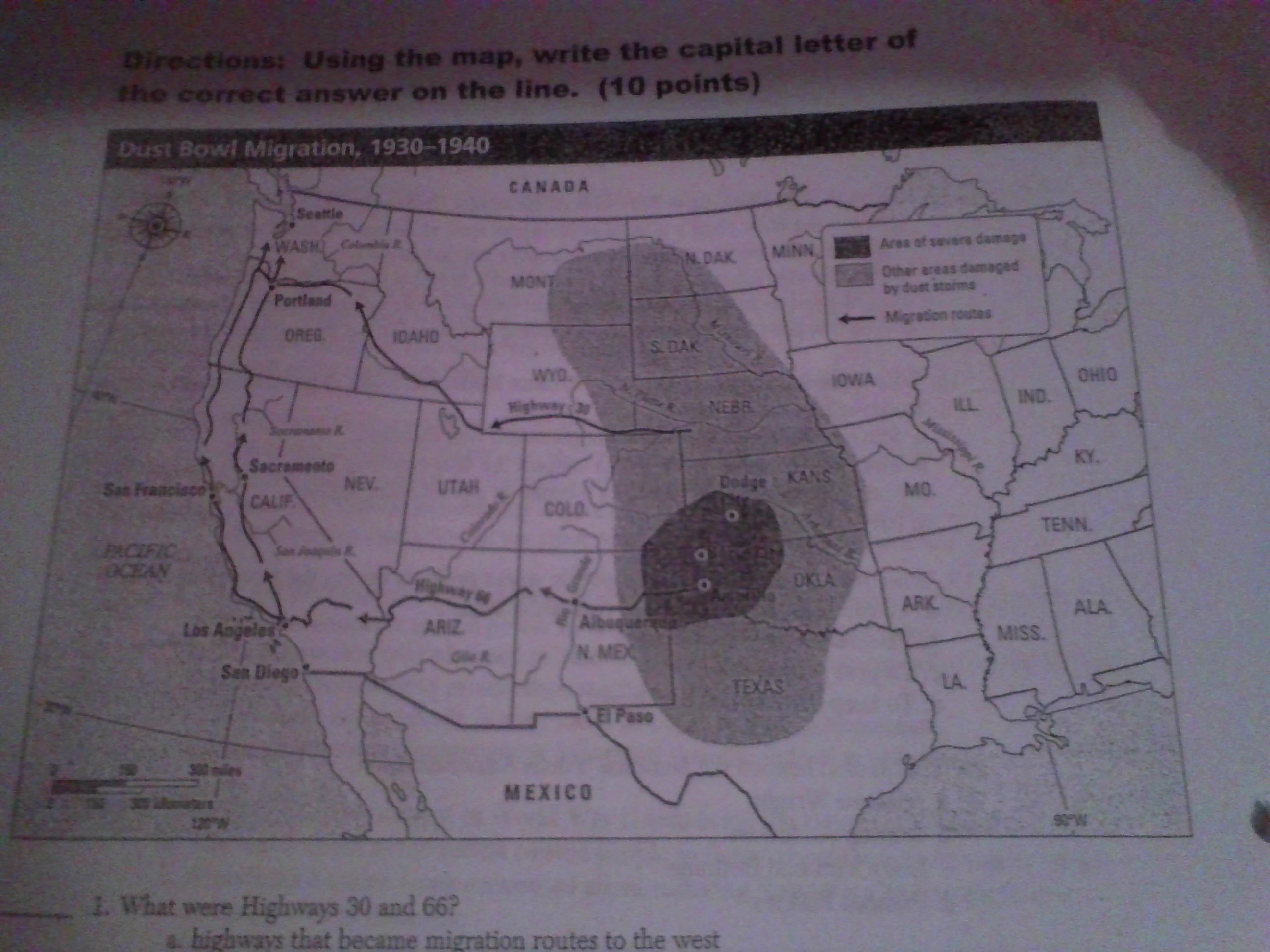
Which states were most affected by the dust storms?
a. kansas, California, montana, arizona, texas
b. Colorado, Kansas, Oklahoma, Texas, New Mexico
c. Oklahoma, Arkansas, North Dakota, South Dakota, Minnesota
d. Utah, Colorado, Wyoming, Montana, Iowa
b. Colorado, Kansas, Oklahoma, Texas, New Mexico
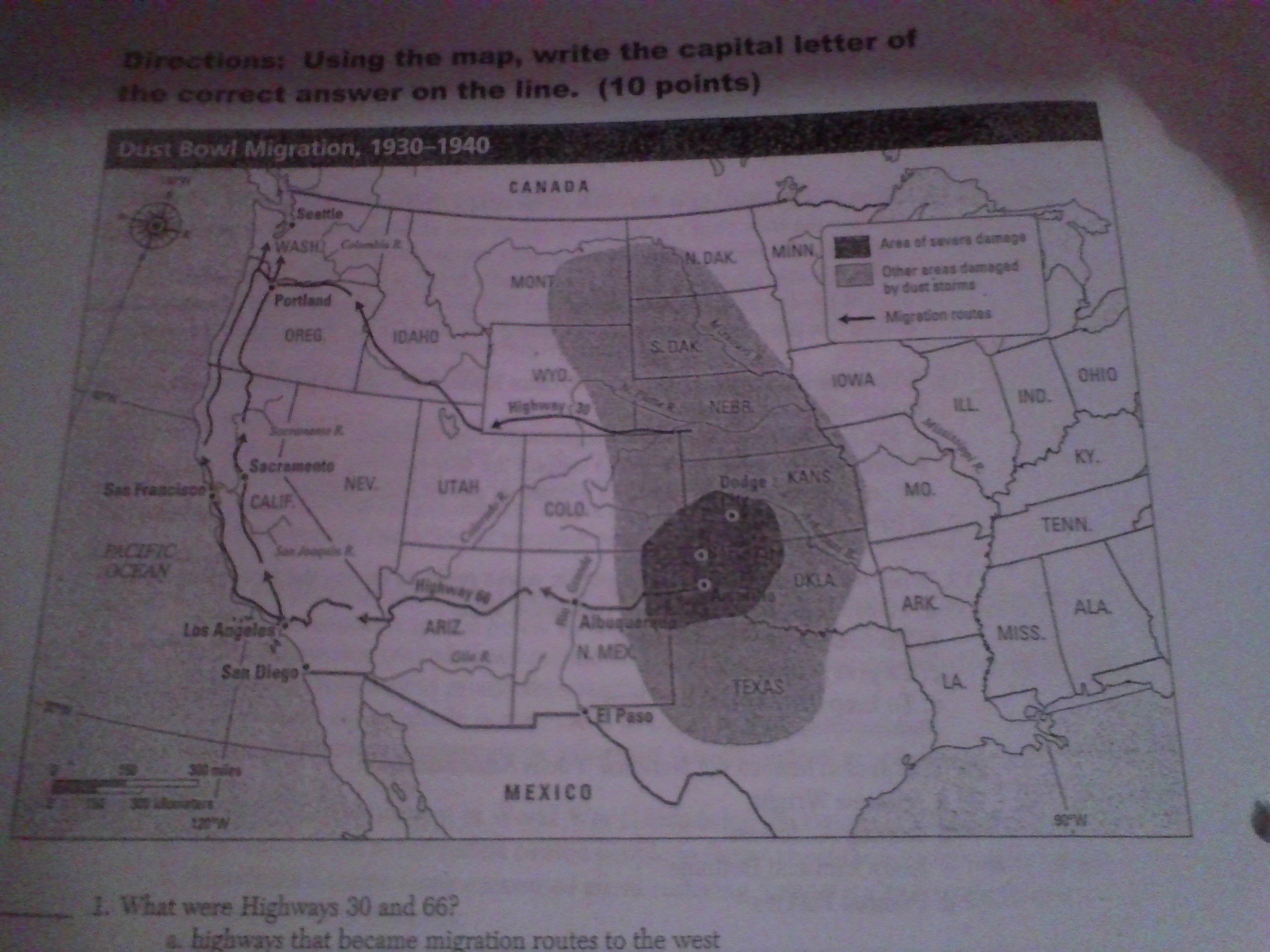
Which states did people travel to in search of new jobs?
a. California, Utah, Nevada
b. Idaho, Wyoming, Washington
c. New Mexico, Arizona, Nevada
d. California, Oregon, Washington
d. California, Oregon, Washington
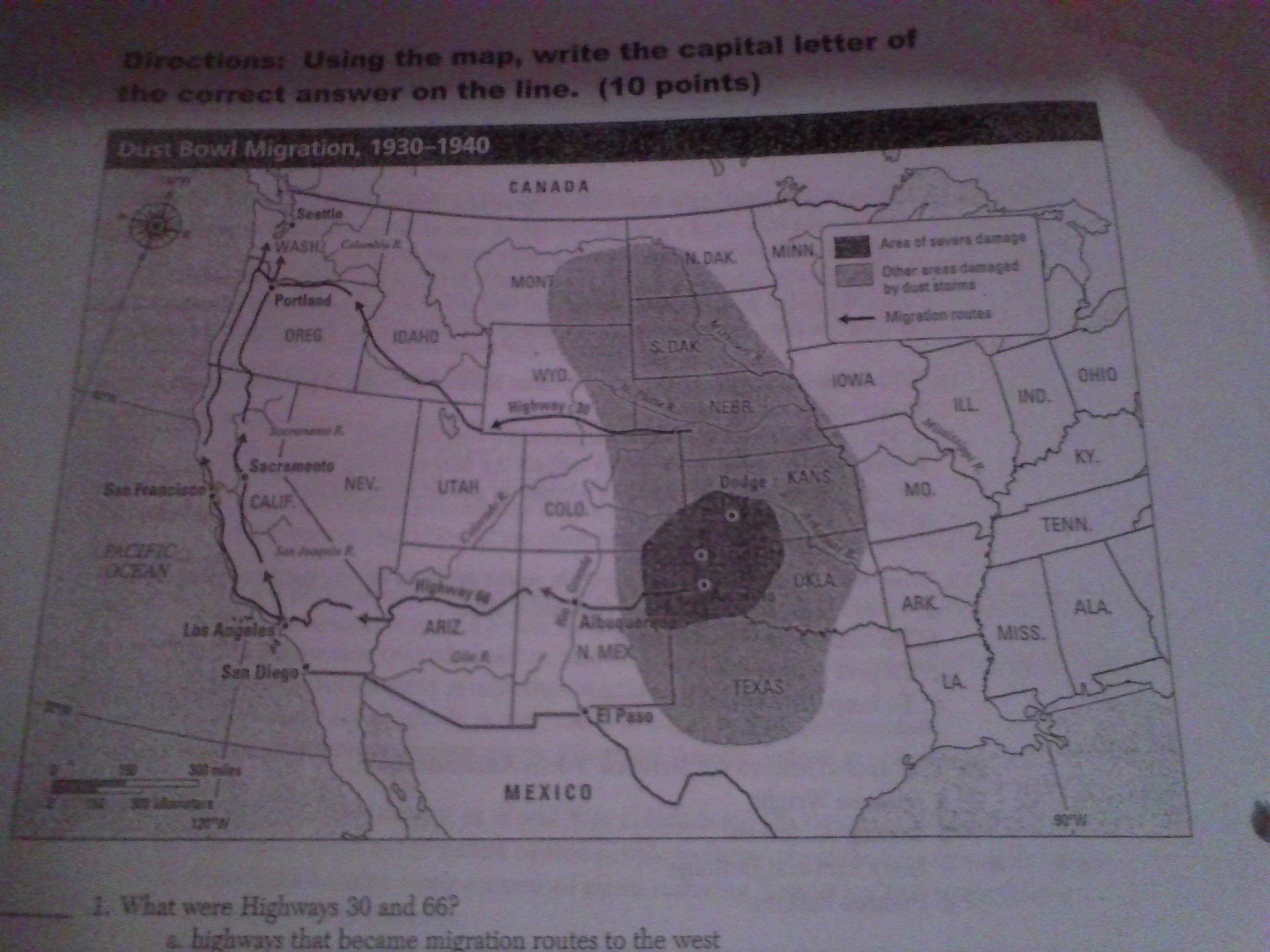
What was the northernmost state that was damaged by the dust storms?
a. Nebraska
b. Minnesota
c. North Dakota
d. Wyoming
c. North Dakota
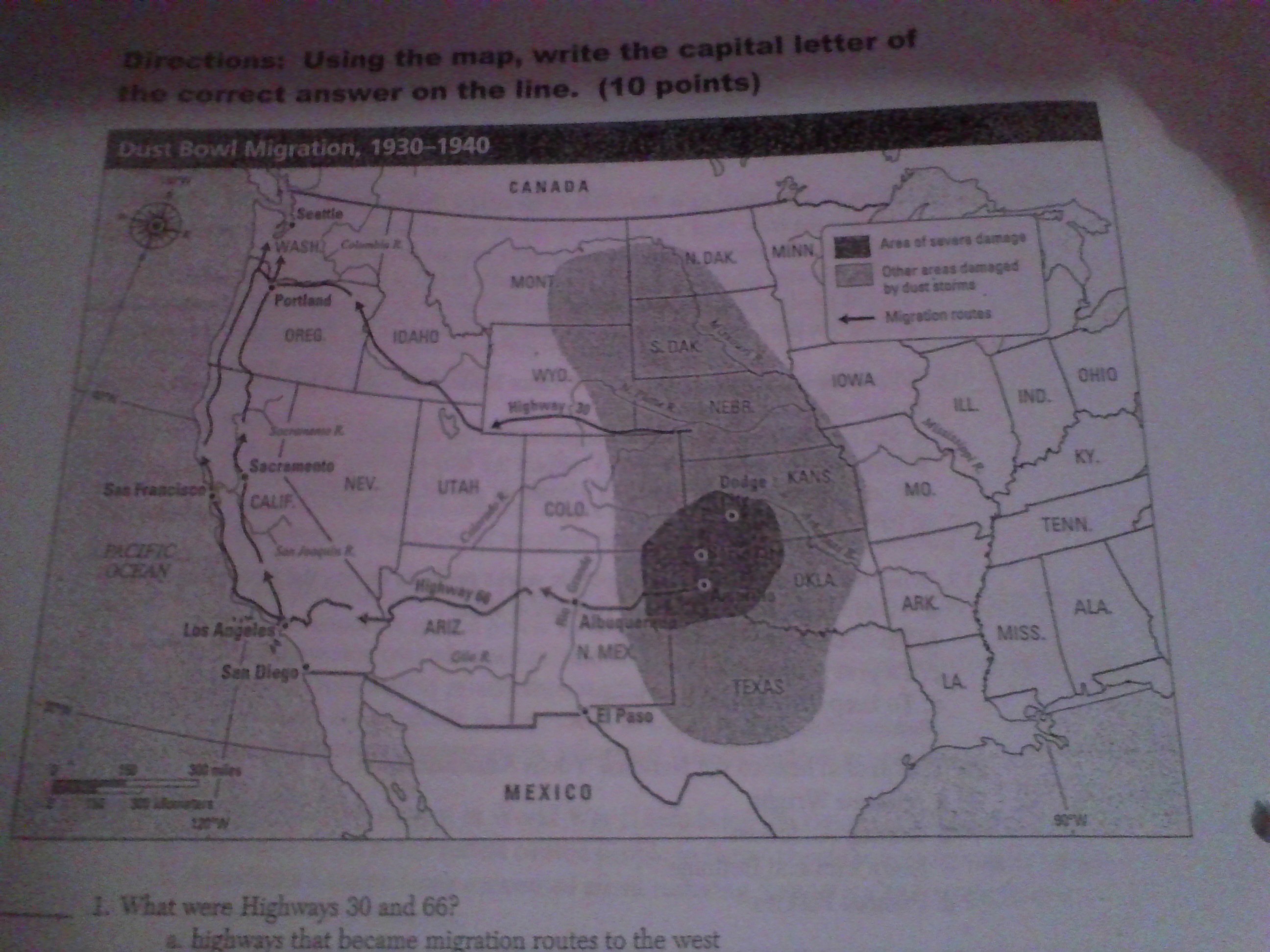
Which city was in the area of severe damage?
a. El Paso
b. Dodge City
c. Albuquerque
d. Sacramento
b. Dodge City
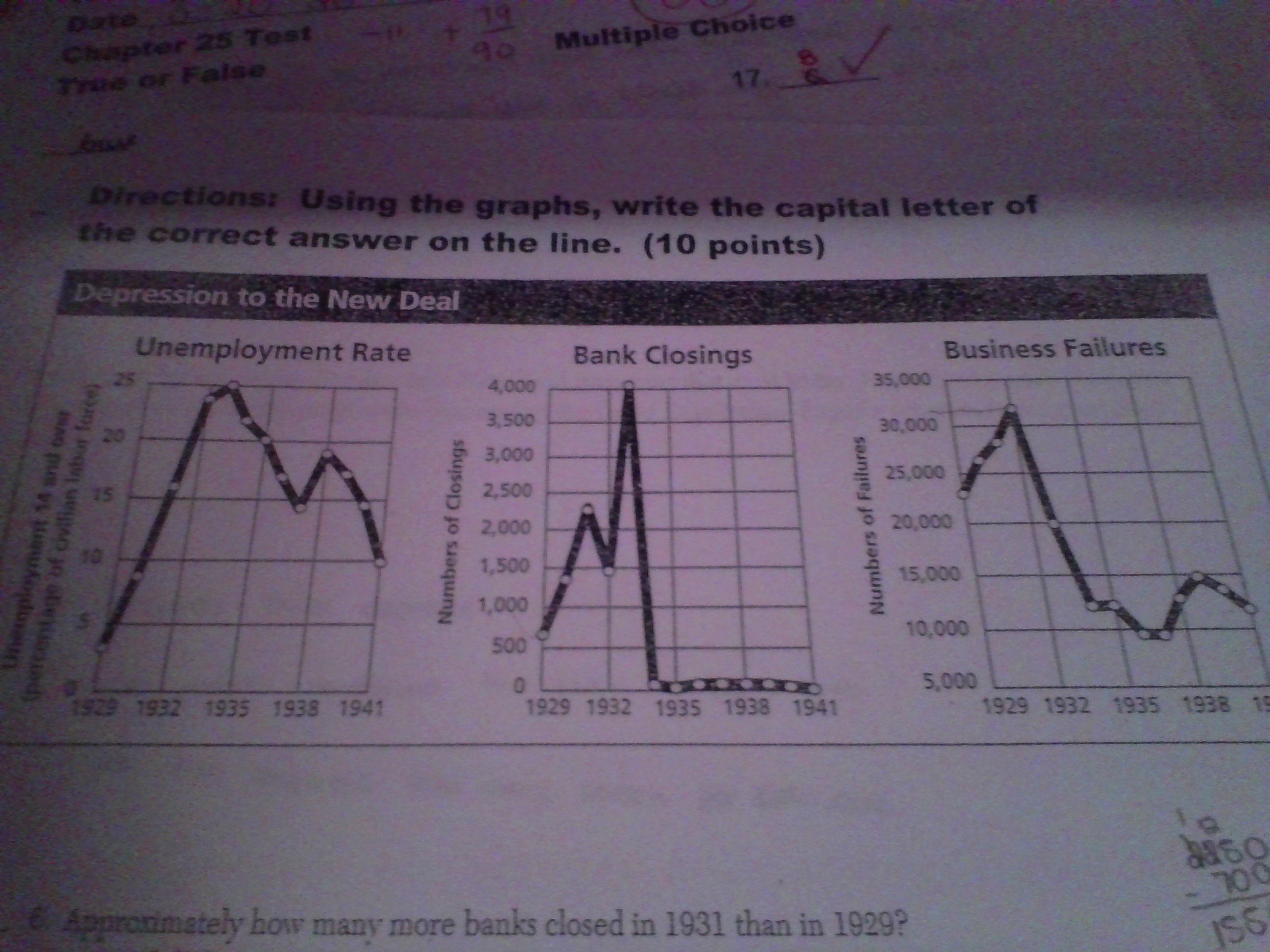
Approximately how many more banks closed in 1931 than in 1929?
a. 1650
b. 900
c. 2100
d. 450
a. 1650
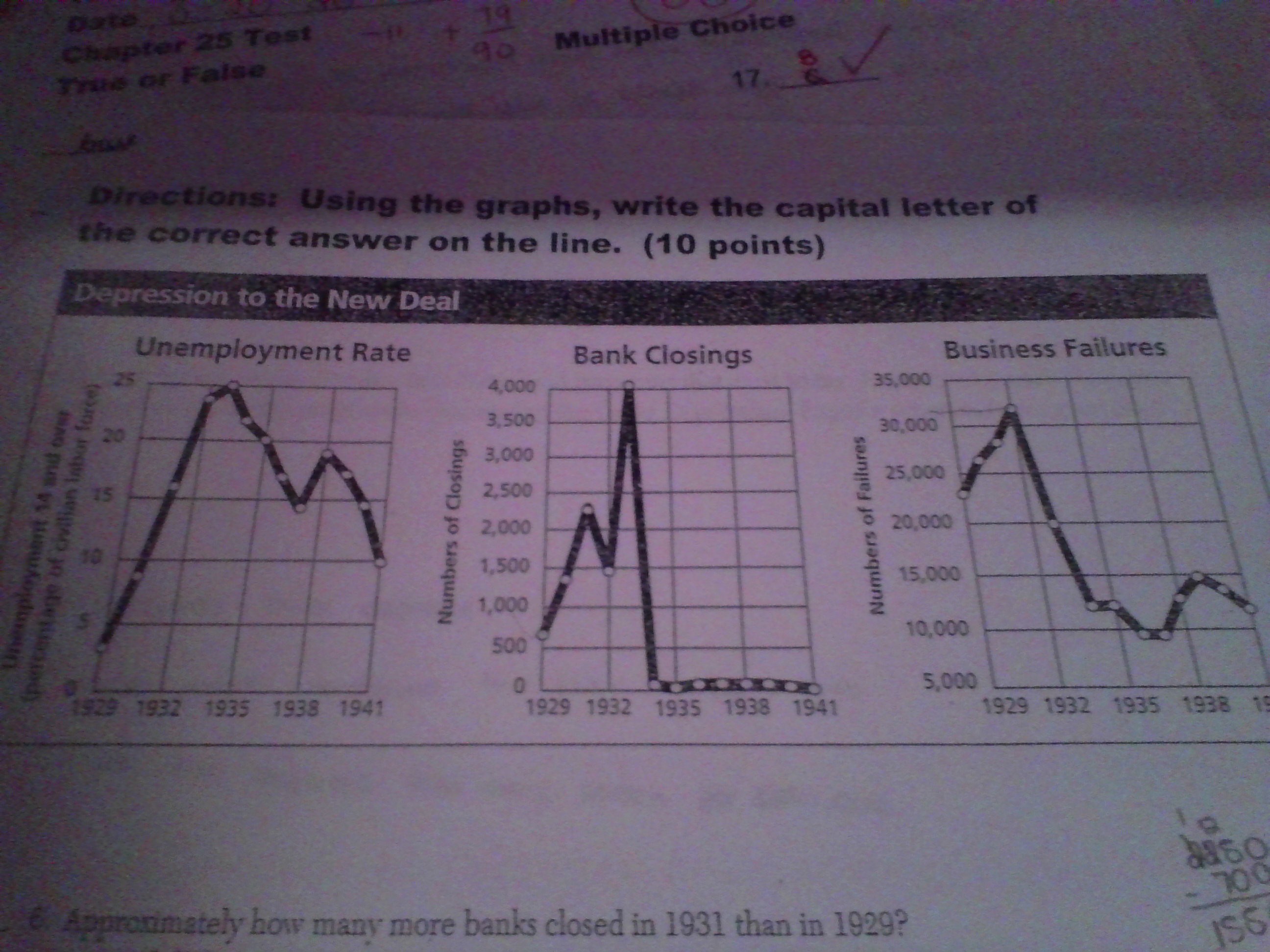
According to these graphs, what year was the worst year of the Great Depression?
a. 1935
b. 1939
c. 1933
d. 1929
c. 1933
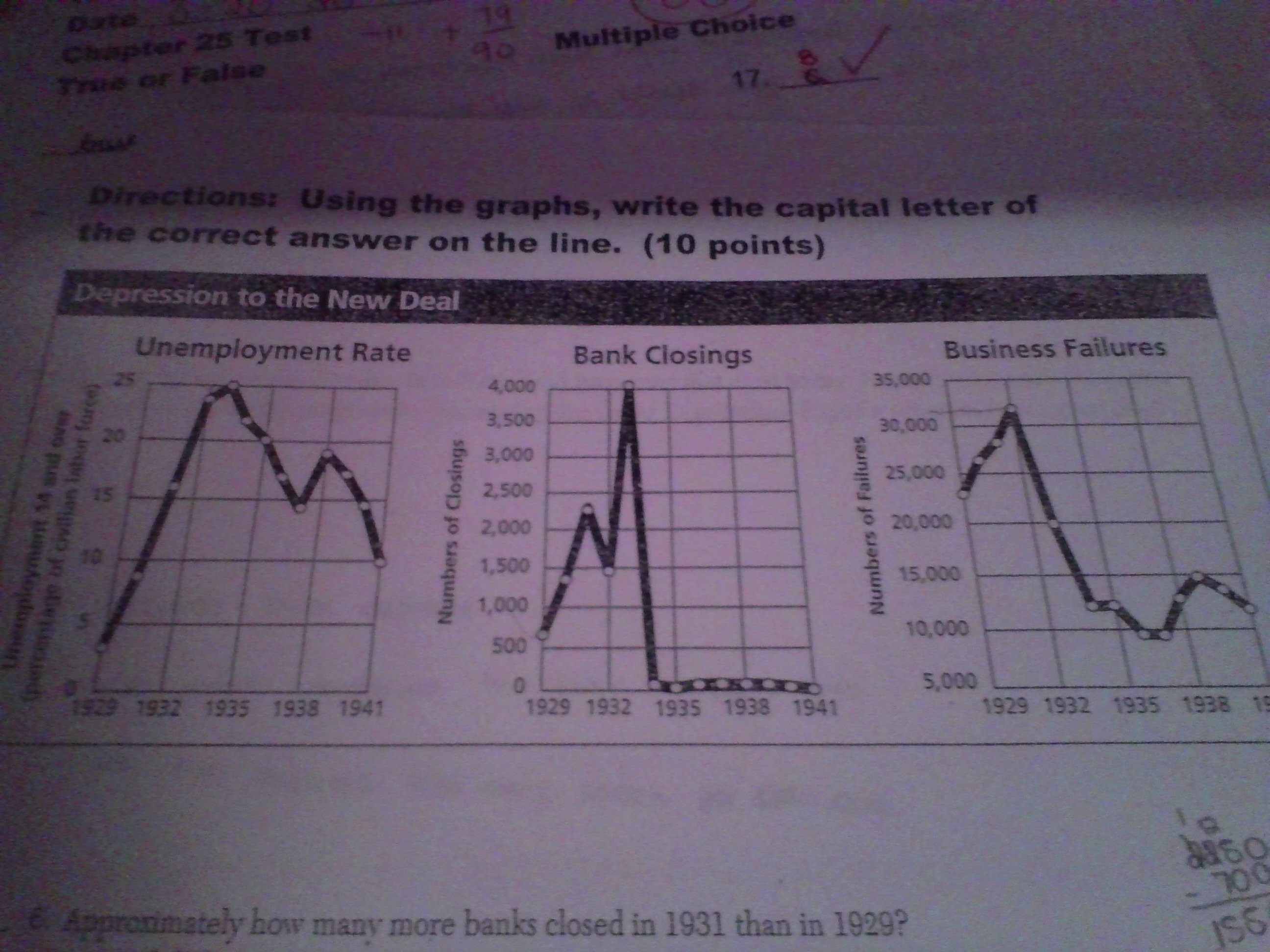
How do the graphs represent the worst year of the Depression?
a. the conditions reported on the graphs were at or close to the lowest for this year
b. the conditions reported on the graphs were at or close to the worst for this year
c. this is the year of the great stock market crash and black tuesday
d. this is the year the New Deal begins to take effect
b. the conditions reported on the graphs were at or close to the worst for this year
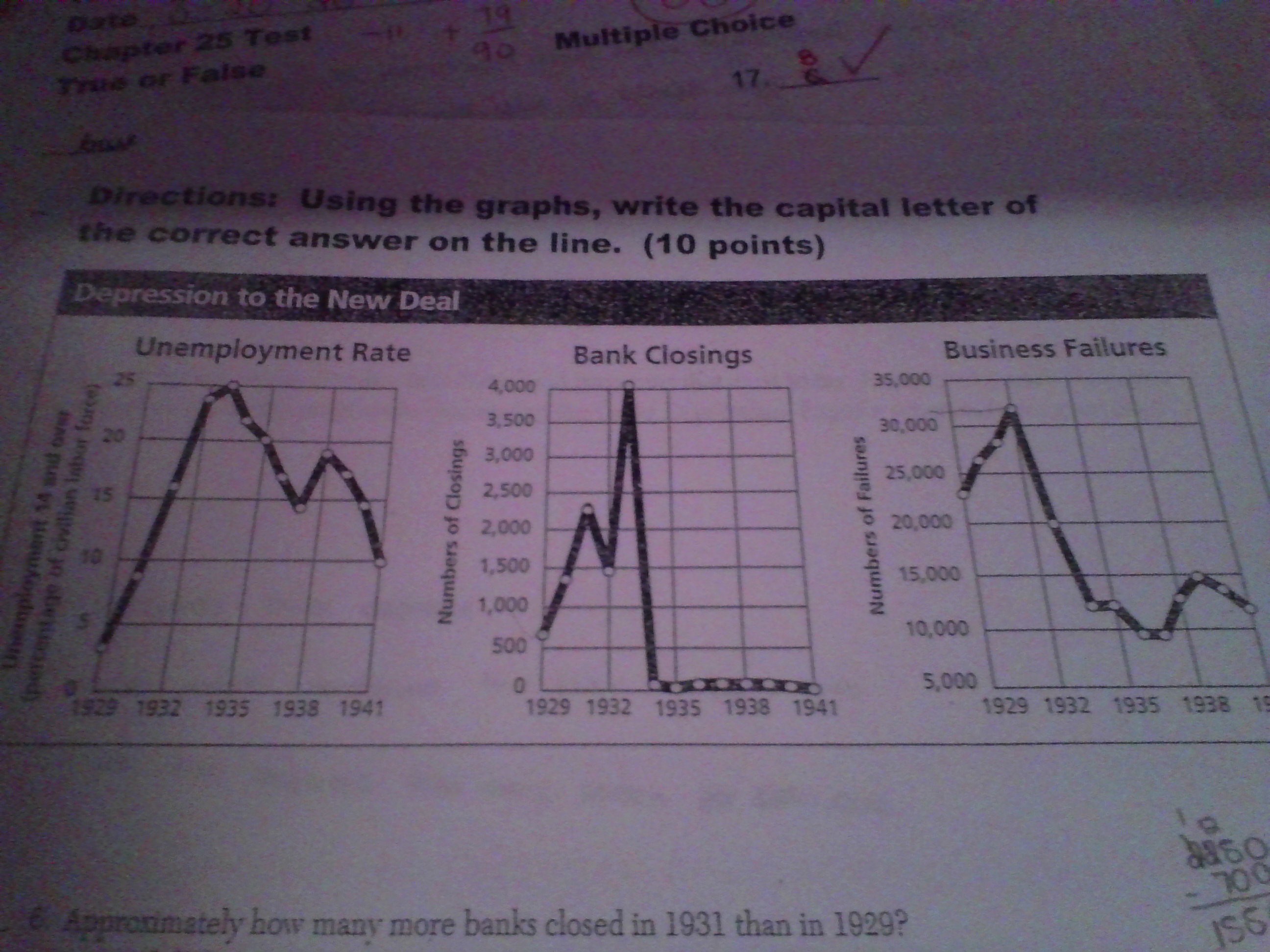
Approximately how many more businesses failed in 1932 than in 1929?
a. 2000
b. 16000
c. 11000
d. 9000
d. 9000
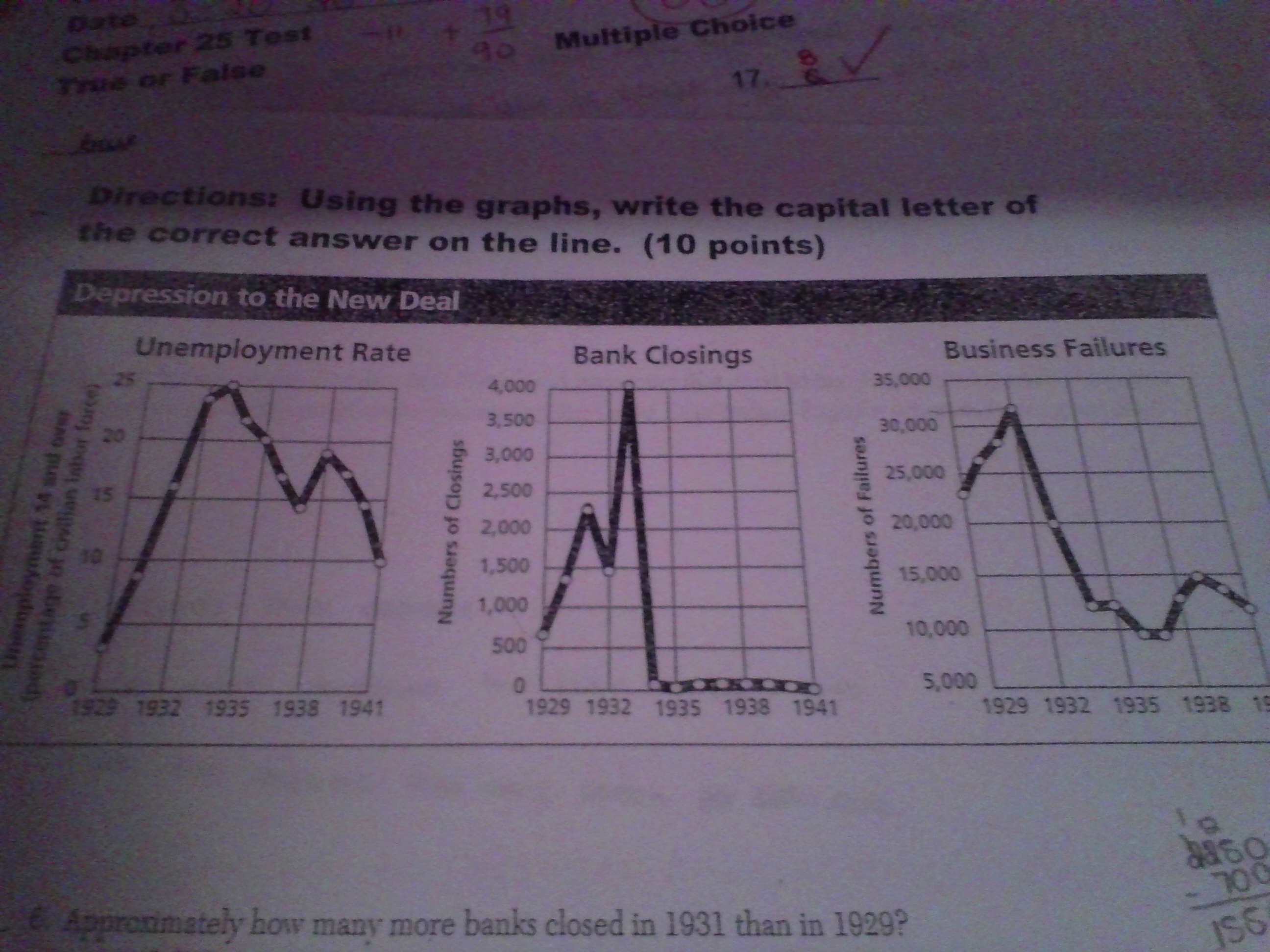
What evidence on these graphs helps explain why the unemployment rate shot up again in 1938?
a. the business failures graph shows a corresponding rise, which would lead to increased unemployment
b. the bank closings graph shows a large number of banks closing, which would lead to increased unemployment
c. the business failures graph shows a corresponding decline, which would lead to increased unemployment
d. the bank closings graph shows the fewest number of banks closing, which would lead to increased unemployment
a. the business failures graph shows a corresponding rise, which would lead to increased unemployment
This man led Italy during WWII.
Mussolini
After Pearl Harbor, the US declared war on this country
Japan
Germany invaded this country, causing Britain and France to declare war on Germany
Poland
The Munich Agreement was an example of this French and Britain policy
appeasement
This man became the dictator of Spain after their civil war
Franco
This nation joined the Axis Powers in 1940
Japan
True or False
The Neutrality Act allowed the president to send weapons to the Allies
false, Lend- Lease Act
True or False
Lenin was the head of the Soviet Union during WWII.
false, Stalin
Why did the rearming of Germany and the atrocities committed by that country go seemingly unnoticed by the US and the rest of the world?
It went unnoticed because of the Great Depression
What did Hitler promise to do when he was allowed to keep the Sudetenland?
He promised to not seek anymore land.
Who commanded the Allied forced that defeated the German army in North Africa?
a. George Patton
b. Erwin Rommel
c. John Pershing
d. Dwight D. Eisenhower
d. Dwight D. Eisenhower
What is significant about D-Day?
a. Germany surrendered to Allied Forces
b. the Soviet Army captured Berlin
c. Allied forced invaded France
d. German forces in northern Africa surrendered to the Allies
c. Allied forced invaded France
The largest group of victims murdered by the Nazis in the Holocaust were _______.
a. jews
b. gypsies
c. russians
d. poles
a. jews
What happened at the Yalta Conference?
a. German and allied leaders met to draw up the peace treaty ending the war in Europe
b. Roosevelt, Churchill, and Stalin made plans for ending the war and for the future of Europe
c. The “Big Three” Allied leaders made plans for invading Europe and defeating Germany
d. Churchill and Roosevelt drew up the Atlantic Charter, spelling out their hopes for a better world
b. Roosevelt, Churchill, and Stalin made plans for ending the war and for the future of Europe
What is significant about the Battle of the Bulge?
a. it marked the long-awaited Allied invasion of France
b. the Allies’ victory in this battle left to Italy’s surrender
c. the results of this battle convinced Germany to surrender
d. it was Germany’s last attempt to win the war in Europe
d. it was Germany’s last attempt to win the war in Europe