Introduction to Hazardous Drugs 2 (Kirk)
 Call Kai
 Learn
Learn Practice Test
 Spaced Repetition
 Match
Match Flashcards
 Knowt Play
1/22

There's no tags or description
Looks like no tags are added yet.
Name | Mastery | Learn | Test | Matching | Spaced | Call with Kai |
|---|
No analytics yet
Send a link to your students to track their progress
23 Terms
What is the primary purpose of administrative controls in the context of hazardous drugs?
To change how people work to prevent harm.
What are the key components of a Hazard Communication Plan for hazardous drugs?
Signage for preparation areas, Safety Data Sheets (SDS) for every drug, proper labeling on all packaging, and documented personnel training.
What specific documentation is required for personnel of reproductive capability handling hazardous drugs?
They must sign a document stating they have been informed of the risks associated with hazardous drugs.
How frequently must personnel receive training for handling hazardous drugs?
Prior to working with HDs, when new drugs or equipment are introduced, when SOPs change, and annually.
What is the required frequency for deactivating, decontaminating, and cleaning C-PECs?
At least daily, with any spill, and when the C-PEC is certified, moved, or shut off.
What are the essential components of a hazardous drug spill response plan?
Trained personnel, standard procedures, readily available spill kits, and mandatory documentation and evaluation.
How often must quality control for PPE be performed?
Initially and every 6 months.
What is the frequency requirement for changing gloves when handling hazardous drugs?
Change every 30 minutes.
What is the frequency requirement for changing gowns when handling hazardous drugs?
Change every 2-3 hours or immediately following a spill.
What are the PPE requirements for eye protection and masks when handling hazardous drugs?
Goggles with or without a face mask, and a fit-tested N95 respirator.
What is the rule regarding shoe covers for hazardous drug handling areas?
Double shoe covers must be worn, with the outside shoe cover reserved only for the HD area.
What is the purpose of using a CSTD or negative pressure method during hazardous drug preparation?
To safely remove the product from the vial and prevent exposure.
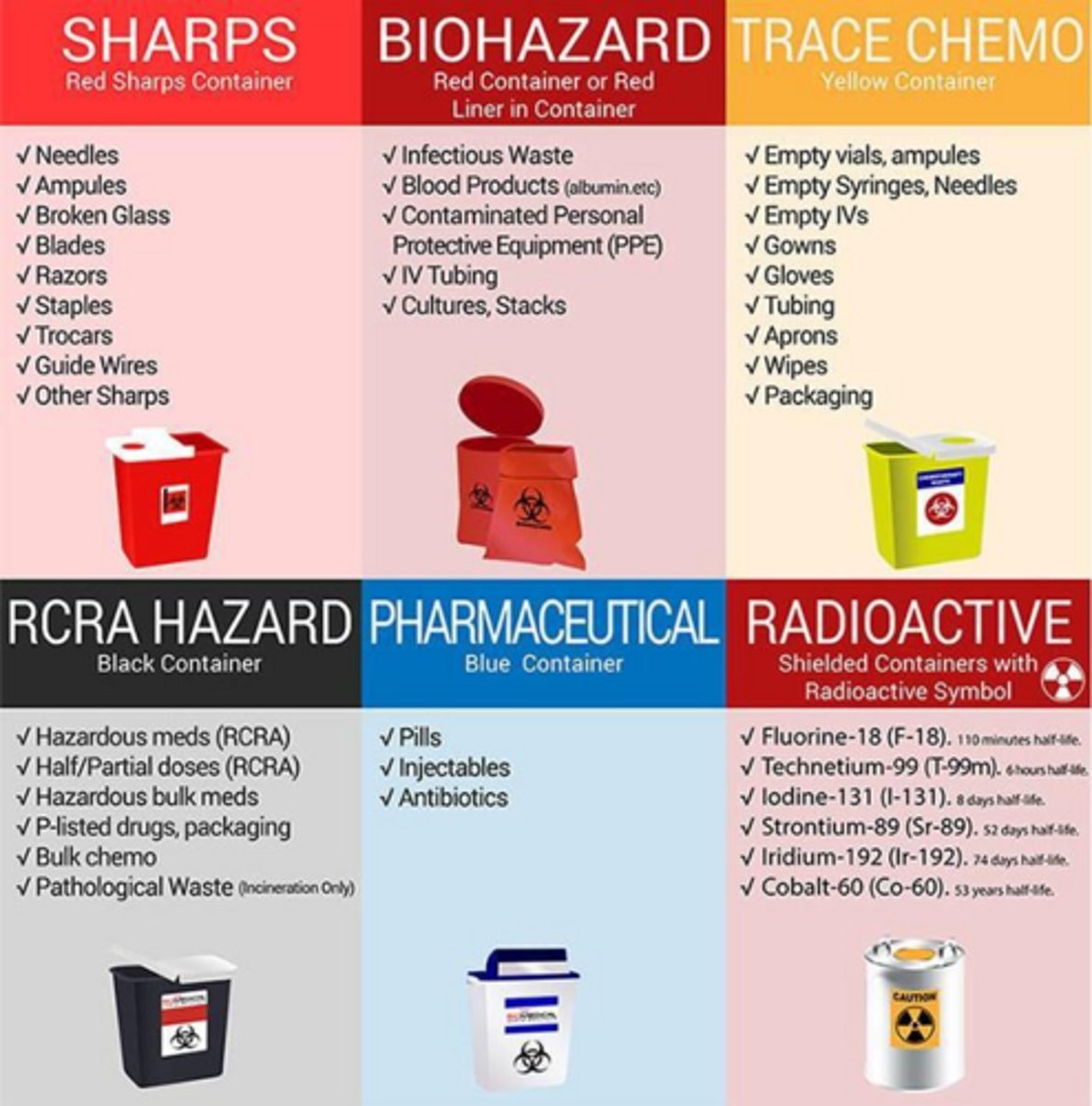
Which federal agency regulates medical waste disposal via the RCRA?
The Environmental Protection Agency (EPA).
Provide three examples of hazardous drugs classified as toxic waste.
Warfarin, nicotine, and cyclophosphamide (or mitomycin/mercury).
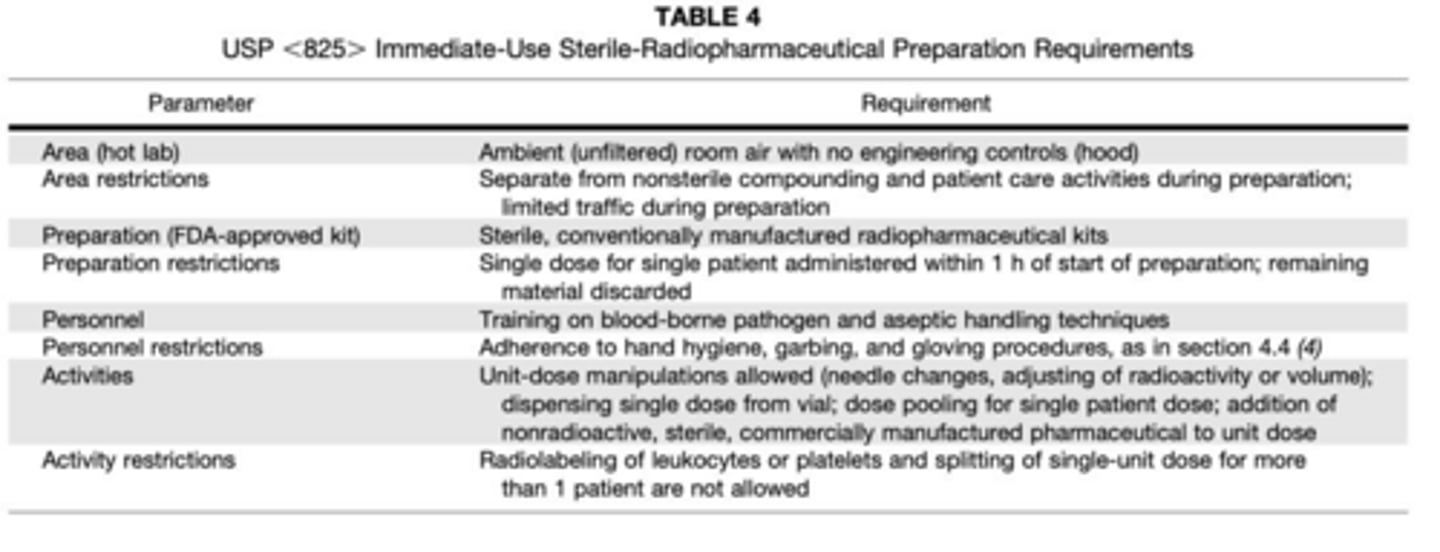
Which organization provides guidance for radiopharmaceuticals?
USP <825>.
Which federal agency regulates radiopharmaceuticals?
The Nuclear Regulatory Commission (NRC).
What is the Beyond-Use Date (BUD) for an 'immediate use' radiopharmaceutical?
1 hour.
What is the Beyond-Use Date (BUD) for a sterile radiopharmaceutical preparation?
24 hours.
What is the Beyond-Use Date (BUD) for radiolabeled blood products?
1 hour or 6 hours depending on the specific product.
What are the didactic training requirements for a nuclear pharmacist?
700 hours covering nuclear biology, chemistry, physics, calculations, radiation safety, and practical management.
What is the total internship/residency training requirement for a nuclear pharmacist?
4000 hours of training (up to 2000 hours of classroom training may be included).
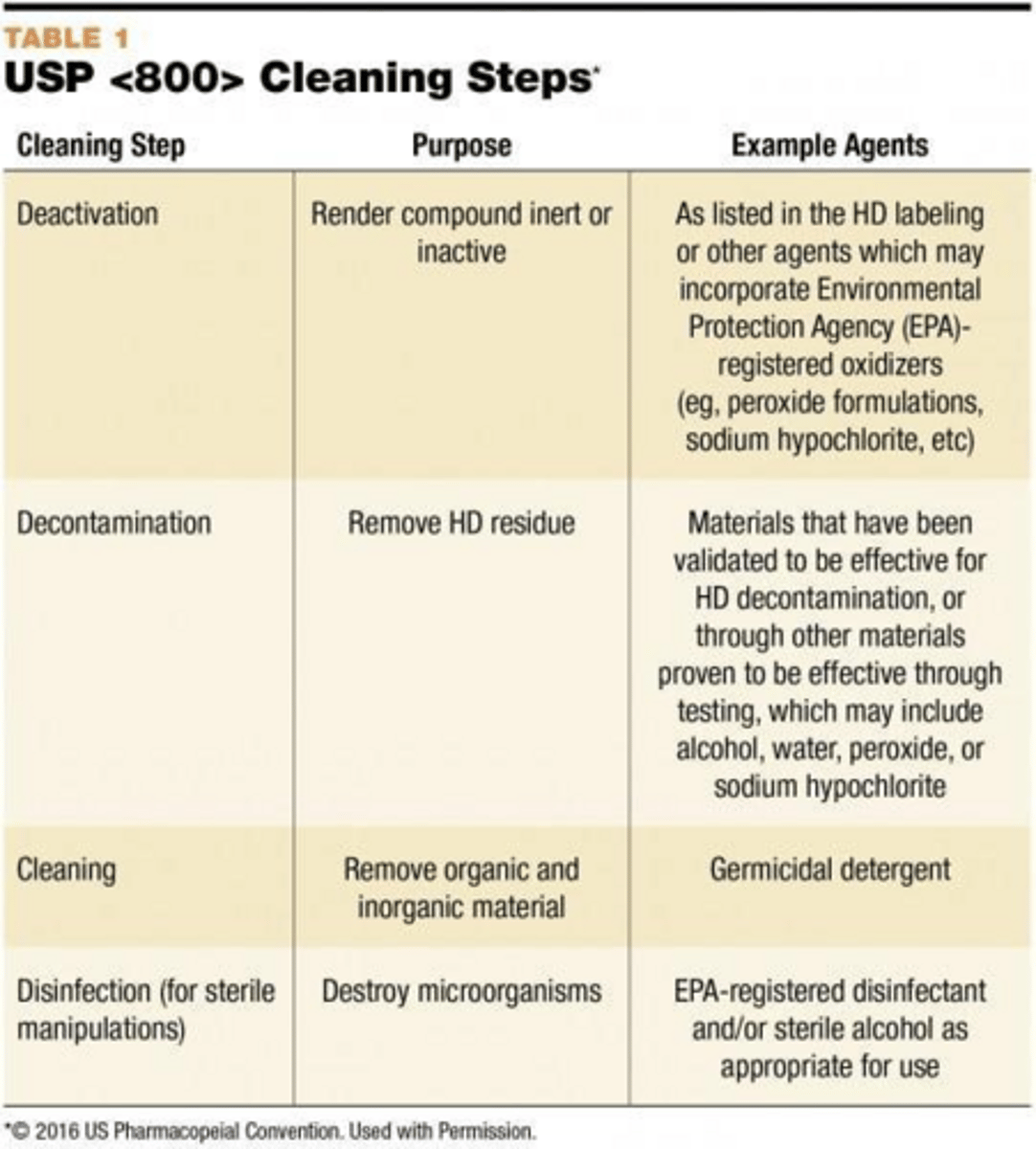
What is the primary difference between USP <797> and USP <800> regarding cleaning?
USP <800> requires specific deactivation and decontamination steps in addition to standard cleaning.
What is the Beyond-Use Date (BUD) for radiopharmaceutical direct infusion systems?
10 hours.