Unit 4: Cell Membrane Transport
 Call Kai
 Learn
Learn Practice Test
 Spaced Repetition
 Match
Match Flashcards
 Knowt Play
1/37

There's no tags or description
Looks like no tags are added yet.
Name | Mastery | Learn | Test | Matching | Spaced | Call with Kai |
|---|
No analytics yet
Send a link to your students to track their progress
38 Terms
Explain what the cell membrane is referred to as “Selectively permeable”
Selectively Permeable allows some substances through but not others
List which types of molecules can pass through and which cannot in the cell membrane
What can: Small molecules, O2, CO2, gasses
What cannot: Large molecules, ions, polar
Explain how the hydrophobic and hydrophilic properties of phospholipids help to maintain the structure of cell membranes
The cell membrane is amphipathic, consisting of hydrophilic (“water-loving”) phosphate head facing outward and two hydrophobic (“water-fearing”) fatty acid tails tucking inward allowing them to be stable in a watery environment.
Describe how the phospholipids orient themselves in the membrane and why
Phospholipids arrange themselves in a phospholipid bilayer. The heads point outward towards the extra-cellular fluid (hydrophilic) while the tails point inward towards the cytoplasm to avoid the water (hydrophobic)
Identify the difference between integral and peripheral protein
Integral proteins are “inside” the membrane.
Peripheral proteins are “attached” to the surface.
Diffusion
The movement of particles (solutes) from an area of higher concentration to an area of lower concentration
Osmosis
A specific type of diffusion (movement of water) across a selectively permeable membrane form an area of higher concentration to low water concentration.
Compare diffusion and osmosis by stating similarities and differences
Similarities: Passive transports, move from a concentration gradient (from high to low).
Differences: Osmosis is strictly for water, and always occurs across a selectively permeable membrane
Hypotonic
The solutions has a lower concentration of solutes than the cell (Water moves into the cell)
Isotonic
The solution has the same concentration of solutes as the cell (No net water movement)
Hypertonic
The solution has a higher concentration of solutes than the cell (Water moves out of the cell)
Animal cell reactions in hypo-,hyper-,iso- environments
Hypotonic: Water enters; the cell swells and may burst (LYSIS)
Isotonic: Water enters and leaves at the same rate; the cell stays normal
Hypertonic: Water leaves; the cell shrivels
Plant cell reactions in hypo-,hyper-,iso- environments
Hypotonic: Water enters; the cell becomes firm due to TURGOR PRESSURE. The cell wall prevents bursting.
Isotonic: No net movement; the cell becomes FLACCID (limp)
Hypertonic: Water leaves; the cell membrane pulls away from the cell wall (plasmolysis)
List three examples of passive transport
Simple diffusion:
Facilitated diffusion:
Osmosis: The movement of water
Simple diffusion process
Small, non polar molecules pass directly through the phospholipid bilayer
Facilitated diffusion process
Larger or charged molecules pass through the membrane with the help fo specific transport proteins (channels or carriers)
Compare and contrast simple diffusion and facilitated diffusion processes
Comparison: Both are passive transports, and move from a concentration gradient of high to low
Contrast: Simple diffusion happens directly through the lipids, while facilitated diffusion requires a “helper” protein.
Active transport
The movement of substances across a cel; membrane against their concentration gradient (from low to high) by using ATP.
Sodium-Potassium Pump
Moves Na+ out of the cell and K+ into the cell
Endocytosis
Taking in large particles or fluids by wrapping theme in a membrane bubble
Exocyosis
Releasing materials from the cell via vesicles
Explain how vesicles are used to transport materials within a cell between the rough ER, Golgi body, and plasma membrane
Vesicles bud off from the RER carrying proteins to the Golgi body. After fusion and medications within the Golgi, new vesicles bud off and travel to the plasma membrane, where they fuse to release contents of deliver membrane proteins
Describe how the fluidity of the membrane allows it to change shape, break, and reform during endocytosis and exocytosis
The membrane’s fluidity allows it to bend and flow. This flexibility enables the membrane to pinch off into vesicles during endocytosis and seamlessly fuse with vesicle during exocytosis with losing its integrity.
Phagocytosis
Cell eating: The process where a cell eats large, solid particles by wrapping pseudopodia around them
Pinocytosis
Cell drinking: The process where cell takes in drops of extracellular fluid containing dissolved solutes by folding the membrane inward
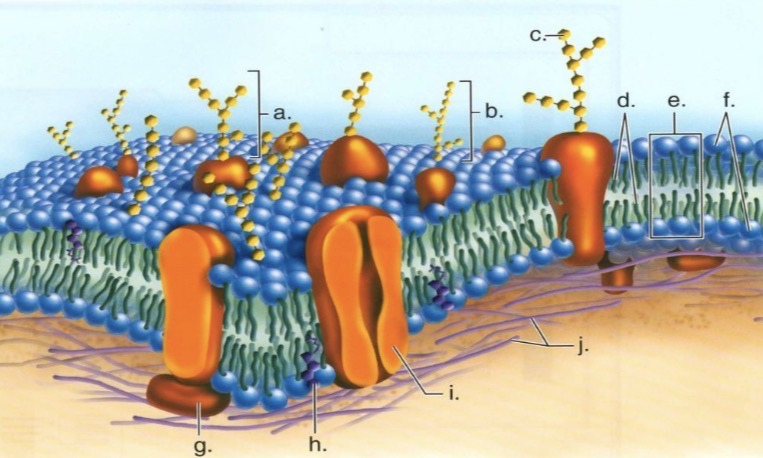
A shows?
Glycolipid
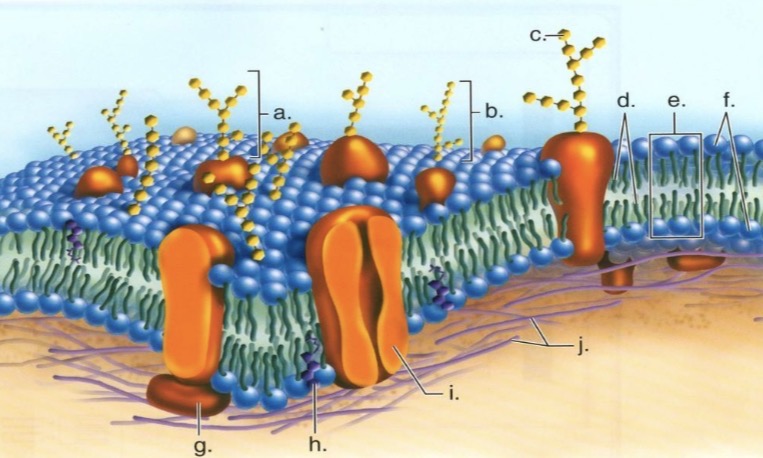
B shows?
Carbohydrate chain
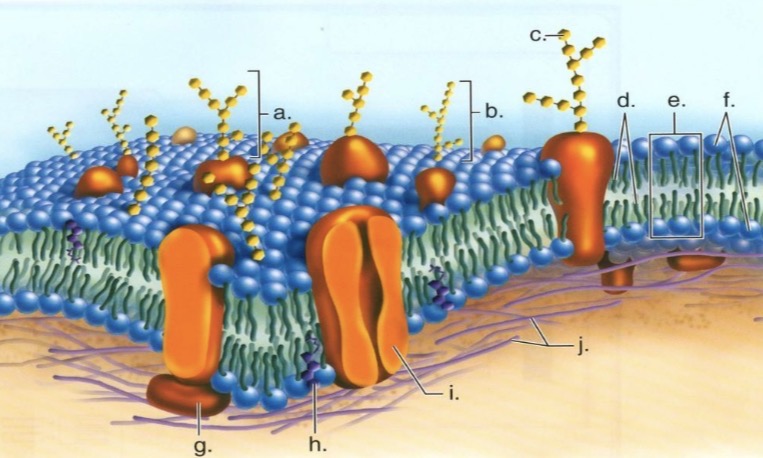
C shows?
Glycoprotein
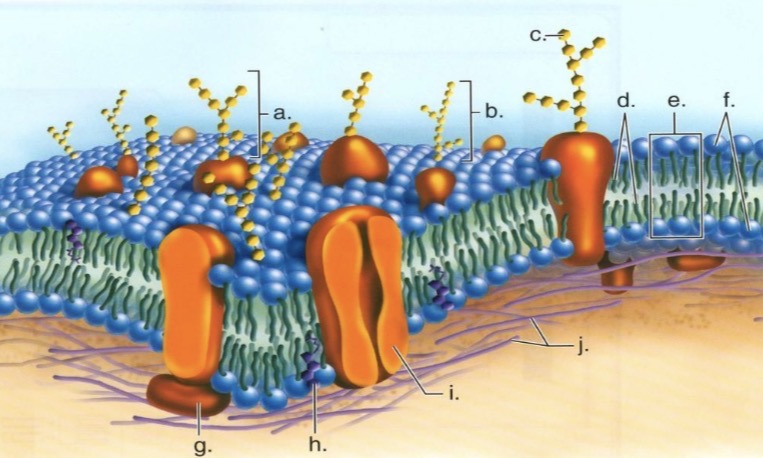
D shows?
Tails: Hydrophobic/nonpolar part of phospholipid bilayer
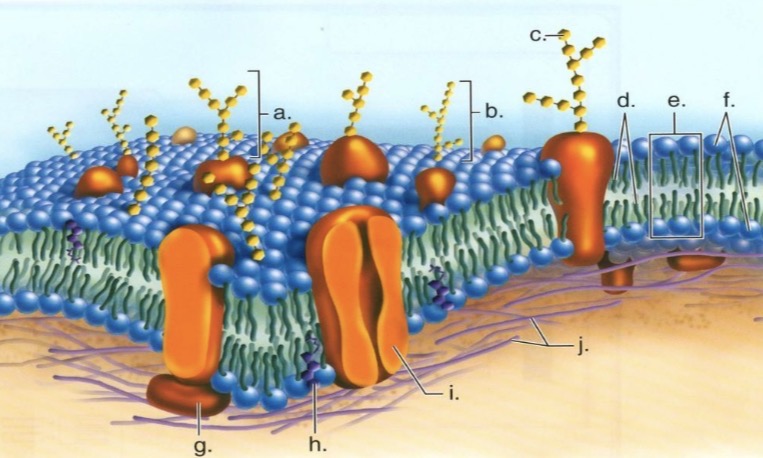
E shows?
Lipid bilayer
E shows?
Lipid bilayer
G shows?
Peripheral protein
H shows?
Cholesterol
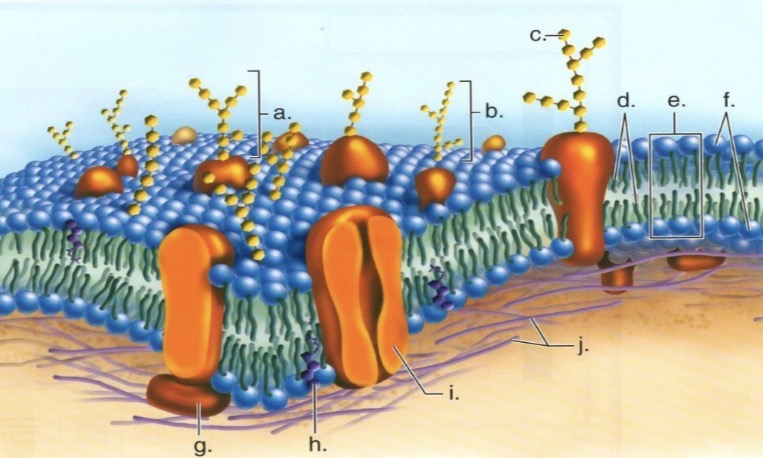
I shows?
Channel protein
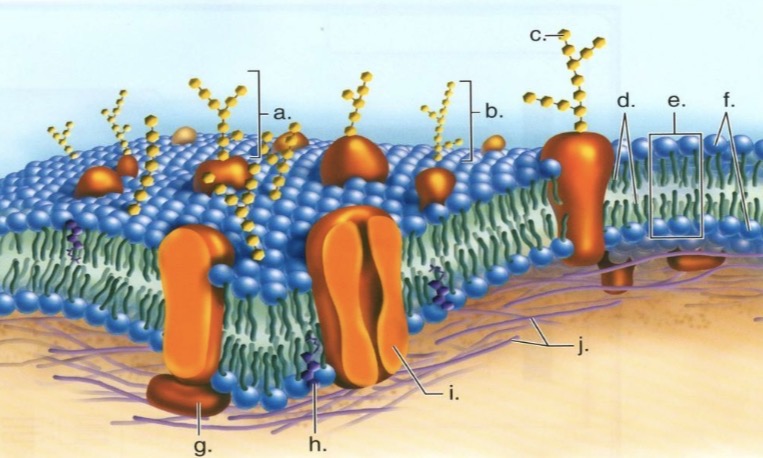
Which molecule is a steroid?
E. Cholesterol
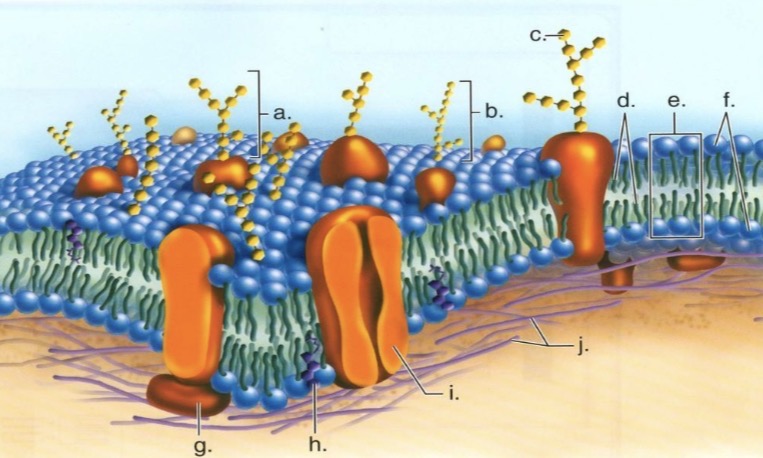
Which parts are amphipathic?
D. Tails
F. Heads
Solute
Substance being dissolved
Solvent
Does the dissolving
*WATER IS THE UNIVERSAL SOLVENT