LMECA2410 - Mechanics of Materials
 Call Kai
 Learn
Learn Practice Test
 Spaced Repetition
 Match
Match Flashcards
 Knowt Play
1/26

There's no tags or description
Looks like no tags are added yet.
Name | Mastery | Learn | Test | Matching | Spaced | Call with Kai |
|---|
No analytics yet
Send a link to your students to track their progress
27 Terms
• What do we call residual stresses?
• What are their characteristics?
• Under which conditions do they arise?
• Be able to draw accurately the internal stress fields in case of bending or torsion.
• What do we call principal stresses?
• What is the meaning of each location in a plot of Mohr circles?
• How can the Mohr circles be used to predict the onset of plastic yielding or brittle fracture?
• What is the orientation of brittle cracks? (Be able to address the examples which we treated together.)
• What is the meaning of the Tresca and von Mises yield criteria?
• How are they justified based on the physics?
• Which hypotheses are common to both approaches?
• Which materials do not comply to these criteria? (Be prepared to draw the yield loci of characteristic loading situations such as pressurized tanks.)
• What does it mean to separate the deviatoric and hydrostatic parts of a tensor? (Be able to apply this in an example.)
• What is the mathematical relationship between the deviatoric stress and strain (or strain rate) tensors in case of isotropic elasticity and plasticity?
• What do we call stress invariants?
• Give two examples which are useful in elasticity or in plasticity.
• What are the uniform strain and the utimate tensile stress in a uniaxial tensile test?
• What is called plastic strain localization and what is the link to strain hardening?
• How can we model strain hardening when the loading is multiaxial?
• What is a composite material?
• What is a cellular material?
• Give three examples of biological materials having composite and/or cellular microstructures.
• Explain what is the influence of such microstructures on the mechanical responses.
• Why are biological microstructures often heterogeneous?
• What is called a “RVE”?
• Explain three models allowing to predict the mechanical response of composite materials?
• Why should these predictions be considered approximate?
• How are they related to the real material response?
• Explain the hypotheses of the laminate theory for fibre reinforced composites.
• Be able to predict qualitatively the internal stresses and the macroscopic deformation induced by a temperature change.
• How is the “apparent” (=macroscopic) stiffness of a cellular material related to its density and to the dimensions of the cells?
• What is the deformation mode of the struts and walls forming the cells?
• Describe the resulting anisotropy.
• What is the macroscopic response of a cellular material when it is loaded, respectively, in tension and in compression?
• What causes the response to be non-linear?
• How is this used in engineering applications?
• What is the physical origin of the viscoelasticity of polymers?
• What happens during the glass transition?
• Describe the effects of temperature and strain rate on the viscoelastic response?
• Now can we use this to construct a “reference master curve” from experiments performed inside an “experimental window”?
• Describe the experiments called “stress relaxation”, “creep” and “strain recovery”.
• What is the difference between the responses of thermosets and thermoplastics during these experiments?
• What is a mechanical analog?
• How are the creep compliance and the relaxation modulus in the Boltzmann superposition principle?
• What are the “storage” and “loss” moduli of a polymer?
• Where do these names come from?
• How are they measured experimentally and what is the influence of temperature? (Be able to address the example which we treated together.)
• What are the principal stretches of a hyperelastic material?
• Why is it convenient to compute such stretches from the Green-Lagrange strain tensor?
• Explain why the infinitesimal strain tensor (symmetric part of the displacement gradient) is not a valid measure of finite strains.
• Which constitutive laws are called “hyperelastic”?
• Give an example of an isotropic hyperelastic law and show how the stress is computed.
• What does it mean to express a constitutive law in terms of “objective” tensors or “invariant” tensors?
• Show that the strain rate is objective.
• Why is the (hyper)elasticity of rubber said to have an entropic nature?
• Explain both the experiments and the thermodynamics equations leading to this statement.
• Explain how the random walk theory helps understanding the changes of entropy occurring inside elastomers stretched at constant temperature.
• How can we use such entropy changes in order to compute the mechanical response of rubber?
What are the different steps leading to the failure of a ductile material? Explain shortly each step.
Nucleation: Microscopic voids form at the interfaces of inclusions or second-phase particles.
Growth: These voids expand and elongate, driven by ongoing plastic strain and high stress triaxiality.
Coalescence: The intact material ligaments separating neighboring voids neck down and tear, merging the voids into a macroscopic continuous crack.
What does the fracture surface of a ductile aluminium alloy look like? Explain
Under microscopic observation, the surface exhibits a dimpled topography
These dimples are the the exposed halves of the micro-voids that teared apart during the coalescence phase
How can void coalescence be simply modelled? Make a schematic and provide/calculate the relevant relationship. Clarify on your schematic what is each parameter.
Model: (Brown and Embury criterion) : coalescence triggers when voids grow close enough that shear bands can form a 45° link.
Relationship: X= 2*sqrt(2)*R.
Schematic
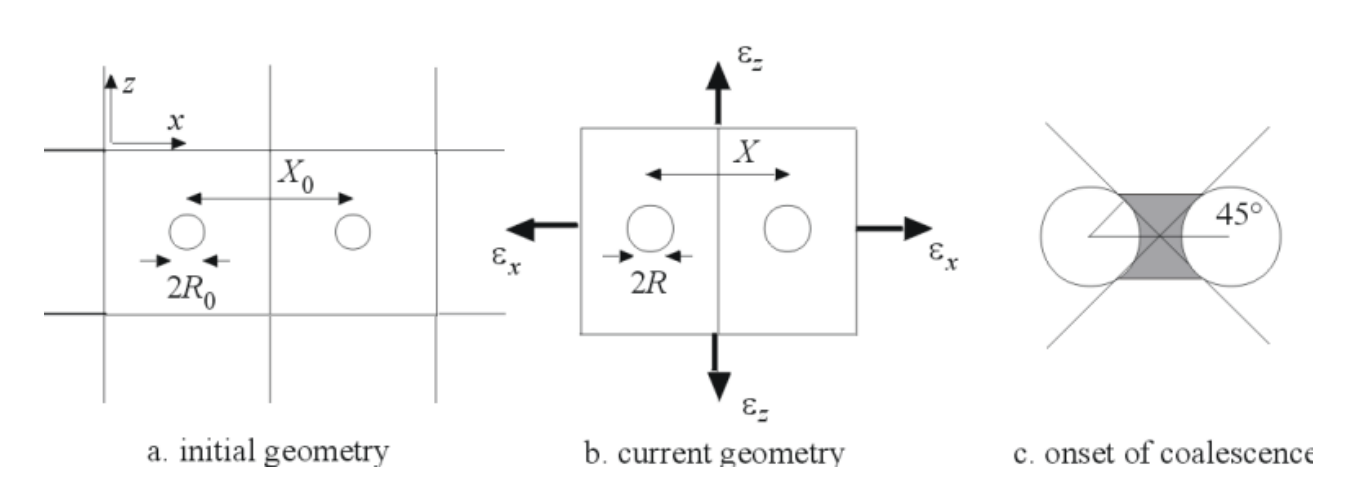
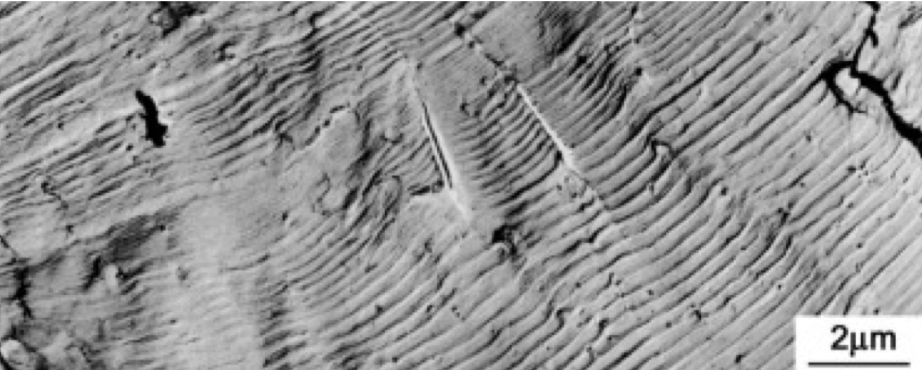
1. Analyze the fractography and identify the features
2. Explain the failure mechanism
3. What information can you extract from these waves?
1. Analyze the fractography and identify the features:
We observe microscopic (2μm) parallel, wave-like ridges, called fatigue striations
not macroscopic beach marks (which are visible to the naked eye and represent larger loading blocks or machine stops)
2. Explain the failure mechanism:
fatigue crack propagation :
These striations are produced by cyclic plastic deformation at the crack tip.
During each load cycle, the crack tip stretches out. Upon unloading, the crack closes and sharpens, effectively advancing the crack forward by a tiny step and leaving a permanent ridge (the striation) on the newly created fracture surface.
3. What information can you extract from these waves?
The distinct presence of these striations is definitive microscopic proof that the component failure mode is due to cyclic fatigue.
Local crack growth rate (da/dN) : by calculating the spacing between two striations (1 cycle = 1 striation)
Direction of Crack Propagation: perpendicular to the orientation of the striation lines
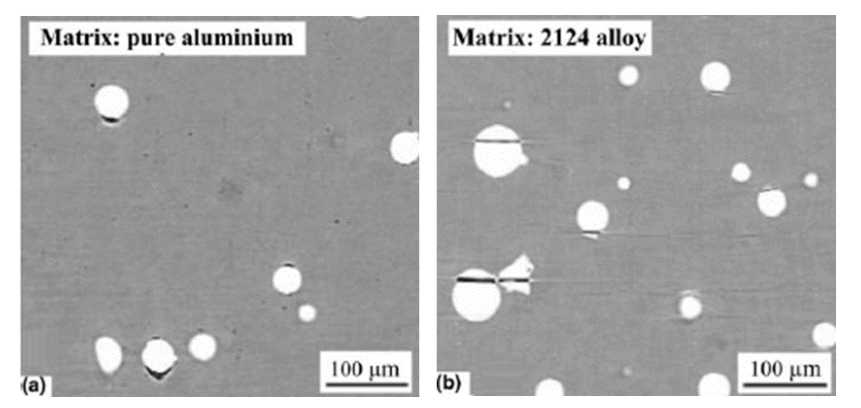
What is the difference in failure mechanisms between these two materials (pure aluminium and 2124 aluminium alloy)? Why is there a difference in this mechanism?
1. Difference in failure mechanisms and its cause
Pure Aluminium (a): Lacks alloying elements and second-phase particles. Because there are very few initiation sites, voids nucleate late. They undergo extensive plastic growth, becoming very large before finally coalescing. This results in high ductility.
2124 Alloy (b): Contains a high density of precipitates and inclusions. Voids nucleate early at these numerous particle-matrix interfaces. The short distance between these numerous voids causes premature coalescence, limiting overall growth and resulting in lower ductility
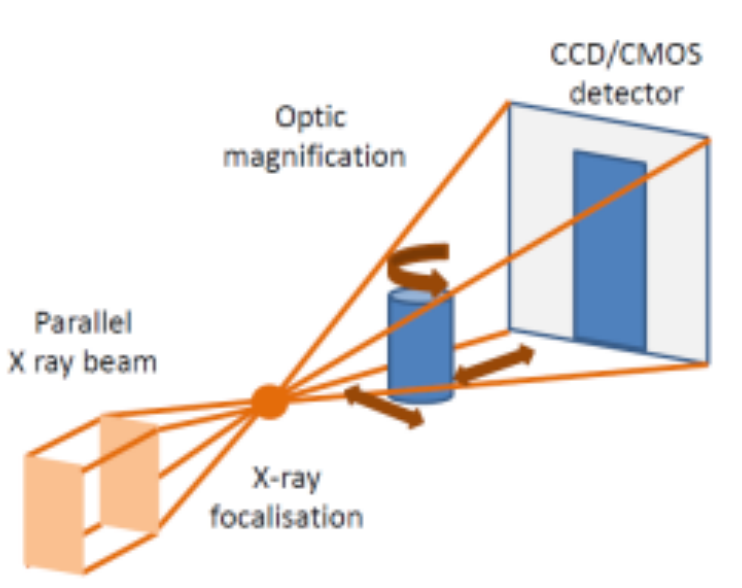
Technique to quantitatively characterize void growth while loading + schema
Technique: In-situ X-Ray Micro-Tomography (3D CT scanning).
A tensile testing stage is set directly inside an X-ray beam path.
As the sample is stretched, it rotates and gets shot by X-rays through it. Voids absorb fewer X-rays than the solid metal, creating 2D shadows.
Using stereology we deduce 3D volume fractions from 2D image slices.
Do the yield stress and the fatigue life depend on the size of specimens? Why?
Yield Stress: No. Yielding is a macroscopic property. It represents the average movement of dislocations across the entire cross-section of the material.
Fatigue Life: Yes.
Fatigue failure is a highly localized phenomenon.
Fatigue cracks usually nucleate at the surface. Because a larger specimen has a larger surface area and volume, it has a higher probability of containing a larger defect.
Give two very different solutions to improve the fatigue life of a given steel mechanical component loaded cyclically at room temperature under a standard environmental. Explain why this will improve the fatigue life.
Solution 1: Induce compressive residual stresses at the surface (via shot peening).
Fatigue cracks usually initiate at the surface due to tensile stresses opening micro-flaws. By bombarding the surface to create a layer of permanent compressive residual stress, we "clamp" the surface shut.
Solution 2: Improve the surface finish (machining).
Surface roughness features act as microscopic notches, possessing high local stress concentration factors (Kt), leading to early crack formation.
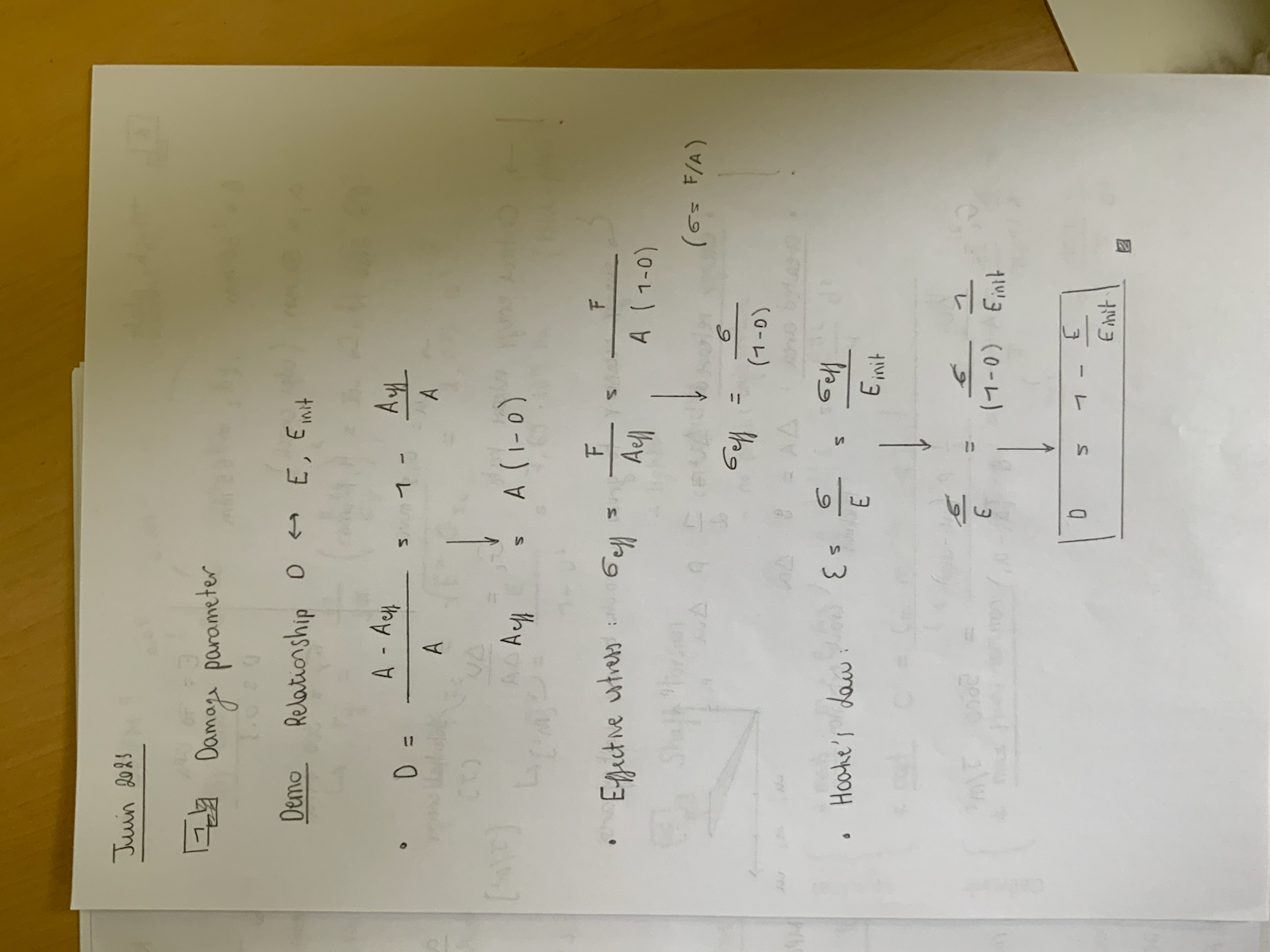
Demonstrate the relationship between damage parameter D and the Young’s modulus of an un-damaged (Einit) and a damaged uniaxial tensile sample (E).
(Juin 2023)
Why is the elongation at break not a good indicator of fracture?
What would then be a good indicator of fracture? Define it for a notched tensile bar of initial reduced diameter D0.
Explain in a few words why that indicator is still not ideal?
Ellongation depends entierly on the initial gauge length. Once a material begins to neck, the deformation becomes localized. Therefore a longer gauge would produce a lower overall ellongation.
The better indicator: The true fracture strain, defined for a notched tensile bar as $\varepsilon_f = 2 \ln\left(\frac{D_0}{D_f}\right)$
This indicator is highly dependent on the stress triaxiality T and the Lode variable, meaning the material will fail at different strain levels depending on the complex multi-axial stress states it experiences.