Topic 4 (Physical Layer_
 Call Kai
 Learn
Learn Practice Test
 Spaced Repetition
 Match
Match Flashcards
 Knowt Play
1/85

There's no tags or description
Looks like no tags are added yet.
Name | Mastery | Learn | Test | Matching | Spaced | Call with Kai |
|---|
No analytics yet
Send a link to your students to track their progress
86 Terms
encodes it as a series of signals
The physical layer accepts a complete frame from the Data Link Layer and _______________ that are transmitted to the local media
Physical Layer
Accepts a complete frame from the Data Link Layer and encodes it as a series of signals that are transmitted to the local media
Physical Layer
Transports bits across the network media
Physical Layer
The next device in the path to the destination receives the bits and re- encapsulates the frame, then decides what to do with it.
Physical Components, Encoding, Signaling
What are the three functional areas in the physical layer
Physical Components
hardware devices, media, and other connectors that transmit the signals.
Encoding
converts the stream of bits into a format recognizable by the next device in the network path.
The signaling method
is how the bit values, “1” and “0” are represented on the physical medium.
Bandwidth
the capacity at which a medium can carry data.
Latency
the amount of time, including delays, for data to travel from one given point
to another
Throughput
the measure of the transfer of bits across the media over a given
period of time
Overhead
the amount of data traffic required for establishing sessions,
acknowledgments, and encapsulation
Goodput
the measure of usable data transferred over a given period of time
Goodput = Throughput - Overhead
Goodput formula
Copper Cabling
is the most common type of cabling used in networks today. It is inexpensive, easy to install, and has low resistance to electrical current flow.
Attenuation, Electromagnetic interference and Radio Frequency Interference, Crosstalk
What are the limitations of copper cabling
Attenuation
the longer the electrical signals have to travel, the weaker they get.
Electromagnetic Interference and Radio Frequency Interference, Crosstalk
What are the two sources that is susceptible to interference:
Electromagnetic Interference (EMI) and Radio Frequency Interference (RFI)
• ________ signals can distort and corrupt the data signals being carried by copper media.
• Sources of _______ include fluorescent lights or electric motors.
to reduce attenuation.
Strict adherence to cable length limits ___________.
to reduce EMI and RFI
Using metallic shielding and grounding ____________.
to reduce crosstalk
Twisting opposing circuit pair wires together __________.
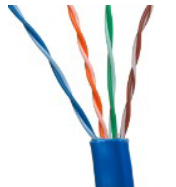
Unshielded Twisted-Pair Cable
Electromagnetic Interference
What does EMI stand for
Radio Frequency Interference
What does RFI stand for
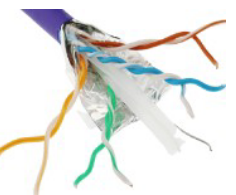
Shielded Twisted-Pair Cable
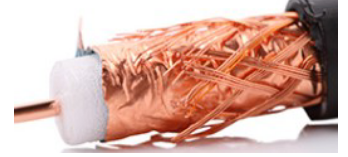
Coaxial Cable
Unshielded Twisted-Pair
What does UTP stand for
Shielded Twisted-Pair
What does STP stand for
UTP
is the most common networking media.
UTP and STP
Terminated with RJ-45 connectors
UTP and STP
Interconnects hosts with intermediary network devices
The outer jacket serves as a protective layer that shields the internal copper wiring from physical wear and environmental damage.
The twisting of the wire pairs is a design feature that cancels out electromagnetic interference to maintain signal integrity.
Each wire is encased in color-coded plastic insulation to prevent electrical contact between conductors and simplify identification.
Key Characteristics of UTP
STP
Better noise protection than UTP
STP
More expensive than UTP
STP
Harder to install than UTP
The outer jacket acts as a durable shield that prevents physical impact or environmental hazards from damaging the internal copper wiring.
The braided or foil layer serves as a primary barrier against external electromagnetic and radio frequency interference (EMI/RFI).
Individual foil wraps around each wire pair provide a second layer of protection to eliminate internal cross-talk between the pairs.
Color-coded plastic insulation prevents electrical shorts by isolating individual wires while making them easy to identify for termination.
Key Characteristics of STP
1. Outer cable jacket to prevent minor physical
damage
2. A woven copper braid, or metallic foil, acts as
the second wire in the circuit and as a shield
for the inner conductor.
3. A layer of flexible plastic insulation
4. A copper conductor is used to transmit the
electronic signals.
Coaxial Cable consists of what
BNC, N, F.
There are different types of connectors used
with coax cable: _________
Wireless installations
attach antennas to wireless devices
Cable internet installations
customer premises wiring
Cancellation and Varying the number of twists per wire pair
Because the UTP cable does not use shielding to counter the effects of EMI and RFI, the negative effect of crosstalk is reduced by:
Cancellation
The wires in a circuit are paired, so that the magnetic fields in a pair are exactly opposite of each other, cancelling each other and any outside EMI and RFI signals.
Varying the number of twists per wire pair
Each colored pair is twisted a different number of times.
• Cable Types and Lengths
• Connectors
• Cable Termination
• Testing Methods
Standards for UTP are established by the TIA/EIA.
TIA/EIA-568 standardizes elements like:
• Category 3
• Category 5 and 5e
• Category 6
Electrical standards for copper cabling are established by the IEEE, which rates cable according to its performance. Examples include:
RJ-45 Connector
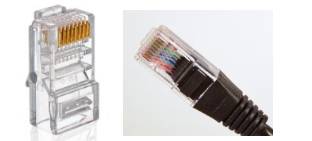
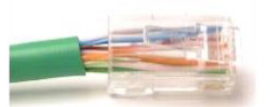
Poorly terminated UTP Cable
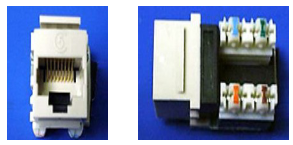
RJ-45 Socket
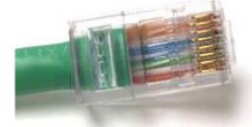
Properly Terminated UTP cable
Straight-through cable
between devices at different layers
Crossover cable
between devices at similar layers.
Rollover cable
for console connection to a router/switch port
Ethernet Straight-through
Host to Switch/Hub Switch to Router
Ethernet Crossover
Host to Host, Switch to Switch, Router to Router, Host to Router
Rollover
Host serial port to Router/Switch Console Port
Both ends T568A or T568B
What is the standard for the Ethernet Straight-through
One end T568A, other end T568B
What is the standard for the Ethernet Crossover
Cisco Proprietary
What is the standard for the rollover
• Very small core
• Uses expensive lasers
• Long-distance applications
Single-Mode Fiber
• Larger core
• Uses less expensive LEDs
• LEDs transmit at different angles
• Up to 10 Gbps over 550 meters
Multimode Fiber
greater
MMF has _____ dispersion than SMF
Enterprise Networks, Fiber-to-the-home (FTTH), Long-Haul Networks, Submarine Cable Networks
Fiber-optic cabling is now being used in four types of industry
Enterprise Networks
Used for backbone cabling applications and interconnecting infrastructure devices
Fiber-to-the-Home (FTTH)
Used to provide always-on broadband services to homes and small businesses
Long-Haul Networks
Used by service providers to connect countries and cities
Submarine Cable Networks
Used to provide reliable high-speed, high-capacity solutions capable of surviving in harsh undersea environments at up to transoceanic distances.
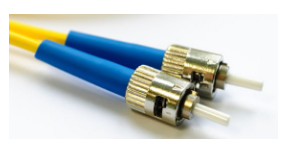
Straight-Tip(ST) Connectors
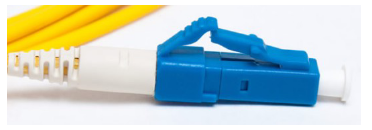
Lucent Connector(LC) Simplex Connectors
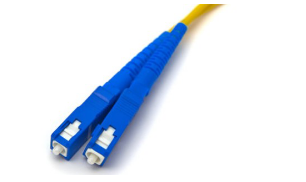
Subscriber Connector (SC)
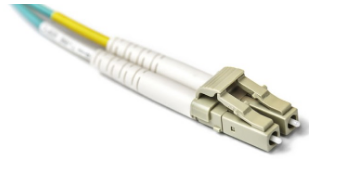
Duplex Multimode LC Connectors
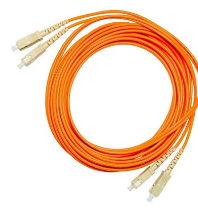
SC-SC MM Patch Cord
LC-LC SM Patch Cord
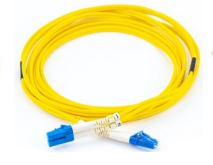
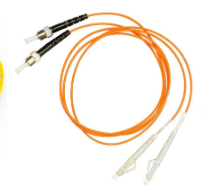
ST-LC MM Patch Cord
ST-SC SM Patch Cord
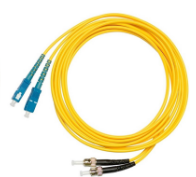
yellow jacket
A ___________ is for single-mode fiber cables and orange (or aqua) for multimode fiber cables
Wireless Media
It carries electromagnetic signals representing binary digits using radio or microwave frequencies. This provides the greatest mobility option.
Coverage area, Interference, Security, Shared medium
What are the limitations of wireless:
Coverage area
Effective coverage can be significantly impacted by the physical characteristics of the deployment location
Interference
Wireless is susceptible to interference and can be disrupted by many common devices
Security
Wireless communication coverage requires no access to a physical transmission media, so anyone can gain access to the transmission.
Shared medium
WLANs operate in half-duplex, which means only one device can send or receive at a time. Many users accessing the WLAN simultaneously results in reduced bandwidth for each user.
Wi-Fi
Wireless LAN (WLAN) technology
Bluetooth
Wireless Personal Area network (WPAN) standard
WiMAX
Uses a point-to-multipoint topology to provide broadband wireless access
Zigbee
Low data-rate, low power-consumption communications, primarily for Internet of Things (IoT) applications