Waves & Quantum
 Call Kai
 Learn
Learn Practice Test
 Spaced Repetition
 Match
Match Flashcards
 Knowt Play
1/26

There's no tags or description
Looks like no tags are added yet.
Name | Mastery | Learn | Test | Matching | Spaced | Call with Kai |
|---|
No analytics yet
Send a link to your students to track their progress
27 Terms
Longitudinal waves
Oscillations of the particles are parallel to the direction of the wave traveled
Transverse waves
Oscillations of the particles are perpendicular to the direction of the wave traveled
Polarisation
Restricting the oscillations of a transverse wave to one plane
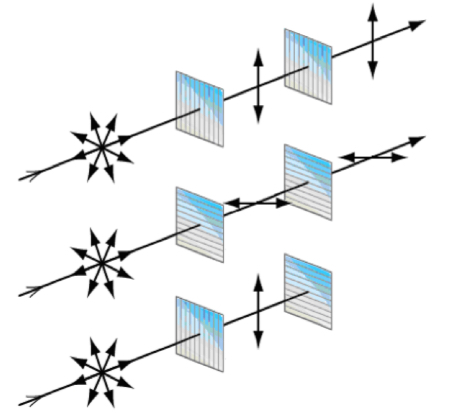
How is a stationary wave produced
A wave reaches the end of the string and reflects back creating a same wave travelling in the opposite direction
The two waves superpose which creates a standing wave
When they interfere constructively, positions of maximum amplitude are produced which are called antinodes
refractive index of light
Red light has a lower refractive index due to its larger wavelength
Blue light has a higher refractive index due to its smaller wavelength
Total Internal Reflection
When the incident ray hits the boundary at an angle greater than the critical angle all the light is reflected inside the material
Optical fibres
Three main components : an optically dense core, a lower optical density cladding and an outer sheath
Used in communication such as telephone and internet transmission, and medical imaging such as endoscopes
Purpose of outer sheath of optical fibres
Prevents physical damage to the fibre
Strengthens the fibre
Protects the fibre from scratches
Purpose of cladding in optical fibres
Protects core from damage
Prevents signal degradation through light escaping the core
Keeps core away from adjacent fibre cores to prevent crossover of information to other fibres
Provides the fibre with strength to prevent breakage as the core is very thin
Material dispersion
Occurs when white light is used because different wavelengths of light travel at different speeds
Red light travels faster than blue light due to a lower refractive index
Causes pulse broadening
Monochromatic light is used to prevent this
Modal dispersion
Occurs when the light rays in the core spread out due to different angles of incidence in the original pulse
Causes pulse broadening
The core needs to be very narrow to prevent this
Advantages of a narrow core in a optical fibre
Less light is lost by refraction out of the core
There is a smaller change in angle between each reflection
Less overlapping pulses hence reduction of modal dispersion
The signal will be transferred quicker leading to improved data and information transfer
The quality of the signal will be better and less distorted
Consequence of pulse braodening
Different pulses could merge resulting in a completely distorted final pulse
Absorption
Occurs when part of the signal’s energy is absorbed by the fibre
The signal is attenuated by the core
Reduces the amplitude of the signal which can lead to loss of information
Prevented by using optical fibres repeaters so the pulse is regenerated before significant absorption has taken place
Interference
Occurs when waves overlap and the resultant displacement is the sum of the displacement of each wave
Constructive interference has a path differences of nλ
Coherent waves
Have the same frequency
Have a constant phase difference
Path difference
The difference in distance travelled by two waves from their sources to the point where they meet
Double slit interference
sources of the observed wave must be monochromatic and coherent
Produce a bright central maximum and dimmer side maxima with constructive interference
Coloured interference pattern (white light source)
White central fringe as all wavelengths are in phase
All maxima will appear wider in a spread colour spectrum
Blue maximum will appear closest to the centre as blue light has the shortest wavelength
Red light with the longest wavelength will appear furthest from the centre
Diffraction
The spreading out of waves when they pass on an narrow slit
Single slit diffraction pattern
A central maximum with a high intensity
Subsidiary maxima equally spaced, successively smaller in intensity and half the width of the central maximum
Blue monochromatic light will produce narrower fringes than red light as it gets diffracted less
When the slit gets narrower, intensity decreases and finge spacing increases
Fluorescent tube’s mechanism
Electric current passed through the mercury vapour and its electrons are excited into a higher energy level
Electrons de-excites back to its original state and releases energy in the form of UV photons
The UV light excites the electrons in the phosphor coating
Visible light photons are releases when the electrons de-excites back to original energy level
Work function
The minimum energy required to release a photoelectron from the surface of a metal
Photoelectric Effect
Electron excites to a higher energy level
De-excites back to its original state and releases energy in the form of photon
A single photon interacts with a single electron (so no. of photoelectrons released depends on the light intensity)
Electron Diffraction
Bright rings occur when waves interfere in phase
The pattern in produced as electrons diffract
Particles would only produce a small spot of light
Stopping potential
Photoelectrons are released with a range of KE
KEmax = eVs
The potential difference that stops the fastest photoelectrons from crossing the gap, effectively stopping the current
Fluorescent Tubes
electric current pass through the vapour and the electrons in mercury are excited and move to a higher energy level
The electrons de-excites back to a lower energy level which release UV photons
UV light excites the electrons in the phosphor coating
Visible light photons are released when the electrons de-excites