L6 mock - Psychological factors effecting performance
 Call Kai
 Learn
Learn Practice Test
 Spaced Repetition
 Match
Match Flashcards
 Knowt Play
1/315

There's no tags or description
Looks like no tags are added yet.
Name | Mastery | Learn | Test | Matching | Spaced | Call with Kai |
|---|
No analytics yet
Send a link to your students to track their progress
316 Terms
define intrinsic feedback
a type of continuous feedback that comes from proprioceptors – nerve receptors found in muscles, ligaments and joints that pick up movement information.
define extrinsic feedback
feedback that comes from external sources – for example, from a teacher or a coach.
define positive feedback
reinforces skill learning and gives information about a successful outcome.
define negative feedback
information about unsuccessful outcome, which can be used to build more successful strategies.
define knowledge of results
a type of terminal feedback that gives the performer information about the end result of the response.
define knowledge of performance
information about how well the movement is being executed, rather than the end result.
Positives of intrinsic feedback and positive example
Quick
Usually done straight after action (during a game)
Good for elite athletes as they know by the kinaesthetic feel if they have done the skill correctly
e.g. A netball player shoots and knows the shot isn't going to go in due to how they flicked their wrist and released the ball
negatives of intrinsic feedback and a negative example
Performer may not have the right mental state and so may be over critical of performance (inaccurate perception)
Some performers may be able to feel and interpret the movements better than others
e.g. A netball player may give a bad pass and not know that they have as they haven't developed the kinaesthetic feel for a good pass yet.
positives of extrinsic feedback and positive example
A coach can give constructive feedback of things you may not have noticed, leading to improvement - as long as the information is accurate and relevant
e.g.A coach tells a netball shooter to bend their legs more when they shoot and so they get more goals in
negatives of extrinsic feedback and negative examples
Inaccurate feedback can affect performance negatively and may result in negative transfer
It can also cause players motivation to drop
e.g. A coach tells a player to keep straight legs when shooting which results in getting less shots in which then leads to demotivation
positives of positive feedback and positive example
Can lead to positive reinforcement and so strengthens the correct S-R bond
Can be very motivating, especially for cognitive stage learners
Build self-esteem and confidence
e.g. A coach praises a goal defence for a good interception so they do those type of interceptions more
negatives of positive feedback and negative example
If undeserved the performer may build inappropriate S-R bonds and so performance may deteriorate
Some performers may not respond well to praise and so may ignore the feedback, hindering performance and learning
e.g. a coach praises a player for contacting another in netball and so they do it more and they get more warnings and sent off more
positives of negative feedback and positive example
Some players are motivated by negative feedback and become more determined
It makes it clear to the performer of all the stuff they need to improve on
Most suited to autonomous players who require further refinement of their skills
e.g. A coach critiques how a netball player holds so they will change it so it becomes stronger and harder to intercept
negatives of negative feedback and negative example
Can be demotivating to the performer especially if cognitive stage of learning or don’t take criticism well
May be detrimental to the learning process if the feedback is inaccurate
A netball coach over critiques a beginner when they miss a shot, demotivating them
positives of knowledge of results and positive example
It is definite how it went - won or lost
Good for setting targets - like I want to come in the top 3 etc.
If it is good it can help build confidence
A netball player may win a match by over half helping them build confidence
negatives of knowledge of results and negative example
Easy to become demotivated if the performer doesn't win or meet target
Easy to become fixated on end result rather than individual performance and so performance may deteriorate
A netball player may lose even though they played well and may feel demotivated even though they played well
positives of knowledge of performance and positive example
Helps the performer focus on individual skills
Easier to improve specific skills
A netball player successfully getting a long shot in.
negatives of knowledge of performance and negative example
Performance may not be representative of final result
Performer may have an inaccurate perception of their skill/performance which may lead to demotivation
A netball player may think they did bad dodge because they are harsh on themselves and so they think they played bad leading to demotivation
why is giving effective feedback important?
Giving effective feedback is important to help the individual accept it and be able to use it to improve their performance and overall success.
For feedback to be effective, what 5 elements are needed?
type of feedback considered
a limited amount of information
immediacy
has the meaning for the individual
facilitates intrinsic feedback
define performance
a temporary measurement which can alter from time to time.
It differs from the term learning in that learning is relatively more permanent.
define grooved
a skill that is over learnt.
what are the 3 phases of learning?
cognitive
associative
autonomous
what is the cognitive stage like? (and example)
1st stage.
Lots of trial and error, meaning lots of mistakes.
Movement is jerky and inconsistent, lack of fluency and needs extrinsic input as lack of kinesthesis.
Practical example: a beginner netball may miss more shots then she would score as she doesn't know how to do it.
what is the associative stage like? (and example)
2nd stage.
Reduction in mistakes in trial and error.
Movement is becoming more fluent and consistent.
Performer is developing kinesthesis.
Tends to be the longest phase of learning and some will never leave it.
Practical example: there is less mistakes when the netballer takes shots and the movement is more fluent.
what is the autonomous stage like? (and example)
3rd stage.
Movement is fluent, accurate and habitual (don’t have to think about it and perform it in a range of environments).
Little to no conscious thought about the movement, instead attention can be given to tactics and adaptions.
Performer does not have to be professional.
Practical example: the netballer has very accurate shooting and doesn't have to think about it but can instead also think about other adaptions like standing on one foot.
what might a coach use to help get between stages of learning?
Positive feedback or reinforcement.
Allowing lots of time to practice.
Helping performer to understand what went wrong by identifying aspects of the performance that they need to improve and helping them to be able feel this themselves (intrinsic feedback).
Giving lots of verbal guidance to highlight key parts of the skill.
Physically supporting them through the skill to reduce the aspects of fear
what are the 4 types of guidance?
verbal
visual
manual
mechanical
define verbal guidance (and example)
Telling a performer how to perform a skill.
e.g. Telling a performer how to do a dodge or giving technical advice.
define visual guidance (and example)
Showing/demonstrating a performer how to perform a skill
e.g. a coach demonstrating a cartwheel
define manual guidance (and example)
Using physical support from another person such as a coach
e.g. dance teacher moves student into the correct position
define mechanical guidance (and example)
Using aids or equipment to perform a skill
e.g. Using a harness when learning to front flip on a trampoline
Advantages of verbal guidance
More effective for autonomous / associative learners
Questioning techniques can lead to effective learning
Can be motivational + give confidence
Improves understanding of skill
Quick
disadvantages of verbal guidance
Inaccurate guidance can lead to incorrect performance
Information overload for beginners = overwhelmed
Can be boring + confusing
advantages of visual guidance
Helps the performer create a mental image
Coach can cue the performer in
Encourages observational learning
Gives a better understanding of the skill
Is more effective if done by a role model
disadvantages of visual guidance
The demonstration could be incorrect or aimed at the wrong level of performance
It may be too quick for the performer to process
Static images don’t show how the movement is produced
Demonstration could be unclear to the performer
advantages of manual guidance
Can reduce fear
Can improve confidence and motivation
Can give a clearer understanding of how to perform a skill
Can be used to practice or isolate a particular part of the skill to improve
Can promote kinesthesis
disadvantages of manual guidance
Can lead to a false sense of kinesthesis or intrinsic feedback could be incorrect
Performer can become too reliant on the support and not fully participate in performing the skill when practicing it which could reduce motivation
advantages of mechanical guidance
Can reduce fear
Can help the performer to carry out the skill in the beginning building confidence and motivation
It can be used to isolate a particular part of the skill to practice or develop
Can be useful on all levels
disadvantages of mechanical guidance
Performer can become too reliant and not develop the ability to perform the skill independently
Can lead to a false sense of kinesthesis
Can restrict the performer so that they are not able to fully perform the skill.
what type of learners use visual guidance?
cognitive
associative
what type of learners use verbal guidance?
associative
autonomous
what type of learners use manual guidance?
cognitive
what type of learners use mechanical guidance?
cognitive
associative
what is cognitive theory of learning?
a Gestaltist view of learning which suggests the skill should be learnt in its entirety using whole practice.
what does this cognitive theory of learning theory encourage?
thinking and problem solving to gain understanding and ability rather than trial and error in a more fixed environment.
what are the 2 key concepts of cognitive theory of learning?
insight learning
intervening variable
what is insight learning? (and example)
This is using problem solving and using memory of effective experiences to solve a new challenge.
e.g. being told to always pass with the ball high over your head in netball.
what is an intervening variable? (and example)
Factors that cause the mental processes involved in decision making.
e.g. in netball you may need to do a drop ball or bounce pass into the circle due to where defenders arms are.
what are some advantages of cognitive learning theory?
performers can become more independent and self correct during a game
performers can adapt better to different situations
performers can make quick progress
performers can develop kinesthesis
what are some disadvantages of the cognitive learning theory?
using whole practice might be a problem if the skill is too difficult or dangerous if the performer is a beginner
learning could be slower if the performer doesn’t understand what to do and therefore might lose motivation.
performers might not have any past experiences to draw on
what is a simple definition of operant conditioning?
learning using trial and error
conditioning the most effective response through practice.
what happens if a performer is rewarded?
they are more likely to do it again
what is reinforcement?
anything that increases the likelihood that a response will occur.
It is defined by the effect that it has on behaviour – it increases or strengthens the response.
what are behaviourist theories?
These are theories that explain how our actions are linked to certain stimuli.
Based on idea that all behaviours are acquired through conditioning.
Conditioning occurs through interaction with the environment.
Our responses to environment shape our actions.
is operant conditioning a behaviourist theory? why?
yes
it links stimulus to response
who was the main psychologist who conducted the development of operant conditioning?
Skinner
what was the development of operant conditioning?
Based on 1948 work of behavioural psychologist B.F. Skinner, which is it is sometimes referred to as Skinnerian conditioning.
Skinner was interested in how consequences of people's actions influenced their behaviour.
Skinner used the word operant to refer to any 'active behaviour that operates upon the environment to generate consequences'.
Discovery came from his work observing rats in a 'skinner box'.
When rats touched a bar food was given and they learnt to press the bar.
define a satisfier
an action that gives a pleasant feeling so that response is likely to be repeated.
define an annoyer
an action that creates disappointment and unease, meaning that the incorrect response is avoided in the future.
what are the 3 things used for operant conditioning?
Based on trial and error
Uses reinforcement
Environment can be manipulated to encourage the correct response
how does operant conditioning work?
It strengthens the bond between the stimulus and response bond (S-R bond)
Linking the stimulus to the response using operant conditioning involves positive reinforcement, negative reinforcement and punishment.
These all aid the shaping of behaviour.
what is positive reinforcement and a sporting example?
Involves an additional, pleasant stimulus after the correct response.
Sporting example: a coach giving sweets to a tennis player when there serve lands in.
what is negative reinforcement and a sporting example?
The removal of a negative or unpleasant stimulus after the correct response in order to strengthen a behaviour.
Sporting example: taking away negative criticism when a skill is performed correctly, like the coach stopping shouting when instructions at a player when they make a successful cross.
what is punishment and a sporting example?
Presenting an unpleasant stimulus to weaken behaviour and prevent the incorrect action occurring again.
Sporting example: a coach makes a player sprint when he makes a bad pass.
what is the difference between negative reinforcement and punishment?
negative reinforcement is taking away something and punishment is adding something even if it is negative (e.g. a red card)
what is mental practice?
anything that involves practising a skill or technique in the mind, like visualization or imagery.
what are Thorndike’s 3 laws?
law of exercise
law of effect
law of readiness
what is the law of exercise? (and example)
skills improve through training so you train with more focus.
e.g. A goal defence repeatedly practises chest passes and shoulder passes in training. Through constant repetition, the correct passing technique becomes automatic, improving accuracy during a match.
what is the law of effect? (and example)
positive outcome or satisfaction from practice makes you continue.
e.g. A centre successfully intercepts a pass and receives praise from the coach. This positive reinforcement increases the likelihood that the player will attempt similar interceptions again in future games.
what is the law of readiness? (and example)
you need to be physically and mentally strong enough to do the skill you are practicing or learning.
A wing defence who understands defensive positioning and is fully warmed up is ready to learn a new zone defence strategy. As a result, they pick up the tactic quickly and apply it effectively in a game.
advantages of operant conditioning
Encourages learning through rewards
Increases motivation and confidence
Effective for beginners
Clear feedback shows what is right or wrong
Helps reduce incorrect behaviour
disadvantages of operant conditioning
Performer may become dependent on rewards
Learning may stop if rewards are removed
Limited understanding and decision-making
Less effective for open skills
Punishment can increase anxiety and reduce confidence
Ignores intervening variables (e.g. emotions)
who was social learning theory developed by?
Bandura (a psychologist)
what is social learning theory?
It is based on watching and copying behaviour and social interaction from significant others.
define significant others
these are people who are role models to us.
they are important to us and therefore we are more likely to pay attention to them and copy their behaviour.
for the theory to be effective the modelling is important.
what are Bandura’s 4 processes?
attention
retention
motor reproduction
motivation
what is the attention stage in social learning theory? (and example)
the performer must be paying attention to the demonstration.
e.g. watching a netball player demonstrate a dodge.
what is the retention stage in social learning theory? (and example)
the performer must be able to remember the demonstration.
e.g. the performer is able to remember how the demonstrator did the dodge.
what is the motor reproduction stage in the social theory of learning? (and examples)
the performer must be physically and mentally able to carry out the skill being demonstrated.
e.g. the performer practices dodging.
what is the motivation stage in the social theory of learning? (and example)
the performer needs to want to carry out the skill.
e.g. they have seen the dodge carried out successfully so they are motivated to also be able to do that.
what is cueing in the social theory of learning?
identifying important cues or stimuli
for example, watching the arm of your opponent when receiving a serve in tennis.
what factors may effect successful modelling in the social theory of learning?
If the model is the same or similar to you in terms of age/gender/sport
If they are significant or someone we look up to
If their behaviour is reinforced/praised
If the demonstration is high standard/successful
If the model is friendly or attractive
If the demonstration is clear/repeated
If the observer is focused on the relevant cues and can remember what they have seen
If the observer is motivated
what is selective attention?
focus on relevant information and discard irrelevant information
what is encoding and decoding?
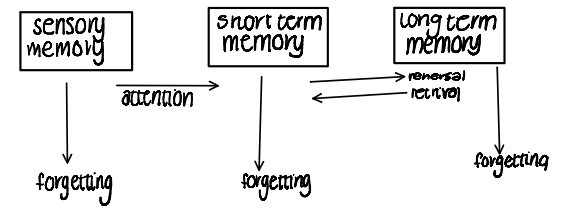
information is passed into the long term memory through a process of encoding and sent back to STM via decoding
what is the sensory memory?
Selective attention happens here
Capacity of this store is large
Only filters information for up to 1 second
what is the short term memory?
This is the workspace of memory as info is processed
Can only store 5-9 pieces of information
Stores it for up to 30 seconds
Information is organised (chunking) and processed
Comparison is made with LTM and response is selected to put into action via a motor programme
characteristics of long term memory?
Limitless capacity
Hold information for long periods of time
Meaningless info not stored in LTM, only stores info that has meaning and is rehearsed
Info is encoded to store in LTM and decoded to send back to STM for action
If the skill is more rehearsed it becomes more recognisable and automatic
give an example of sensory store, STM and LTM (rounders)
Based on a fielder in Rounders catching a ball and see if you can do that yourself using your own example from sport.
Sensory Store: the brain perceives the environment e.g.- where the fielders are, where the batter is moving, the position of the ball, the wind and ground surface condition etc. The performer focuses on the ball and ignores everything else.
STM: incoming information is interpreted about the ball including the speed, the direction and the distance away from you. Information is encoded and the flight of the ball is remembered. Info is chunked / organised e.g. he batter's position, the flight of the ball and the speed of the ball are organized in the brain. Encoded info is sent to LTM.
LTM: comparison is made with info stored about previous experiences and learned movement patterns e.g. the way the player has caught the ball successfully before- Encoded information from STM is recognised, relevant performances remembered. This is decoded and sent to the STM to carry out the response of catching the ball.
what is the memory store model called?
Atkinson and Shiffren’s multi store memory model
fill in the gaps of Atkinson and Shiffren’s multi-store memory model
what is Craik and Lockhart’s level of processing?
Examines how memory works and consider what we do with the information and how we process it (opposed to how we store it)
The deeper the information is processed, the more likely we are to remember it
This model was originally developed looking at how students memorise information for exams
if we want information to be deeply processed and therefore remembered what 3 things must it be?
Considered
Understood
Have meaning
what does the information need to be for it to be deeply processed? (2)
Detailed
Correct
what are the 2 memory models we learn about?
Craik and Lockhart’s levels of processing
Atkinson and Shiffren’s multi-store memory model
what are the 3 different levels of processing?
semantic
phonetic
structural
what is semantic level of processing?
this considers the actual meaning of the information and the deepest form of processing
what is phonetic level of processing?
this level is processing the way words sound and is a deeper level of processing than structural
what is structural level of processing?
this is paying attention to what the words look like and is a shallow level of processing
the deeper the information is processed….
….the longer the memory trace will last