#25: Mutations and DNA Repair
 Call Kai
 Learn
Learn Practice Test
 Spaced Repetition
 Match
Match Flashcards
 Knowt Play
1/30

There's no tags or description
Looks like no tags are added yet.
Name | Mastery | Learn | Test | Matching | Spaced | Call with Kai |
|---|
No analytics yet
Send a link to your students to track their progress
31 Terms
missense mutations
changes in a SINGLE base (or 3 bases) that lead to a change in both the resulting mRNA codon AND the AA in the protein product
nonsense mutations
changes in a single base that change a codon for an AA into a STOP CODON → translation stops early → primary sequence of the protein product is only a fraction of its normal length
silent mutations
changes in a single base that lead to a change in the resulting mRNA codon but NO CHANGE in the resulting AA
occur b/c of redundancy in the genetic code
frameshift mutations
changes in one or more bases that lead to a change in the reading frame of codons read by the ribosome during translation → all of the codons downstream (in the 3’ direction) and every AA past the mutation is likely to change
errors in DNA replication can cause
missense, nonsense, silent, and/or frameshift mutations
if UV wavelengths in sunlight strike a segment of DNA w/ adjacent _________ in its sequence, the amt of energy absorbed can be enough to alter the normal phosphodiester bonds between the nucleotides and create a “________”
thymines (Ts)
thymine dimer
what is the result of a thymine dimer?
lead to a bulge in the DNA double helix → prevents DNA replication and transcription by stopping the polymerase at the dimer location
“double-strand breaks”
it’s common for radiation energy or damaging chemicals to break BOTH strands of the double helix → can result in rearrangements of ENTIRE chromosome segments
chromosome pieces may flip 180 degrees and reattach to each other, separate completely, or get stuck to the ends of other chromosomes
mistakes that occur as chromosomes are being distributed to daughter cells during mitosis and meiosis cause changes in DNA at the level of ?
whole chromosomes, or even entire haploid or diploid sets of chromosomes
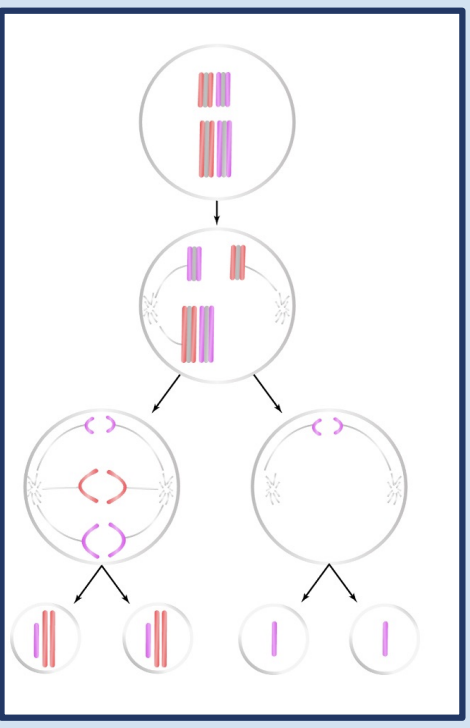
can cellular metabolism also be a source of errors / mutations?
YES — reactive oxygen species during metabolism can damage DNA
mutations are RANDOM w/ respect to their
location
nature (ex: which AA replaces another when a missense mutation occurs or which homolog fails to pull apart at the end of meiosis)
effect on fitness
how does a deleterious mutation affect fitness?
reduces
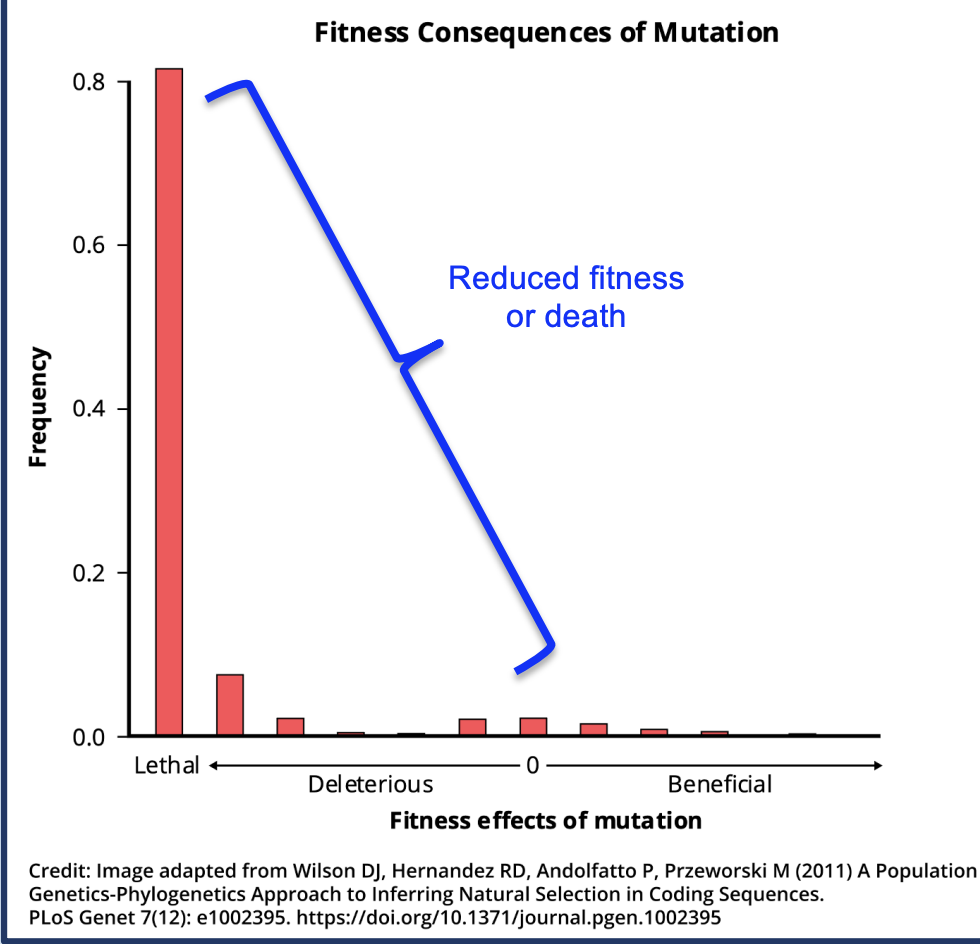
a value of 0 on the x-axis indicates a neutral mutation — what effect does this have on fitness?
NO measurable effect
DNA polymerase adds ____ nucleotides / sec in humans
100
wrong base added only 1 out of every 100,000 bases added
3 billion base pairs in the human genome….30,000 errors!
DNA polymerase error rate is decreased by:
proofreading (100x improvement)
mismatch repair (100x improvement)
polymerization and proofreading are tightly coordinated, and the 2 rxns are carried out by _______ catalytic domains in the ________ polymerase molecule
DIFFERENT; SAME
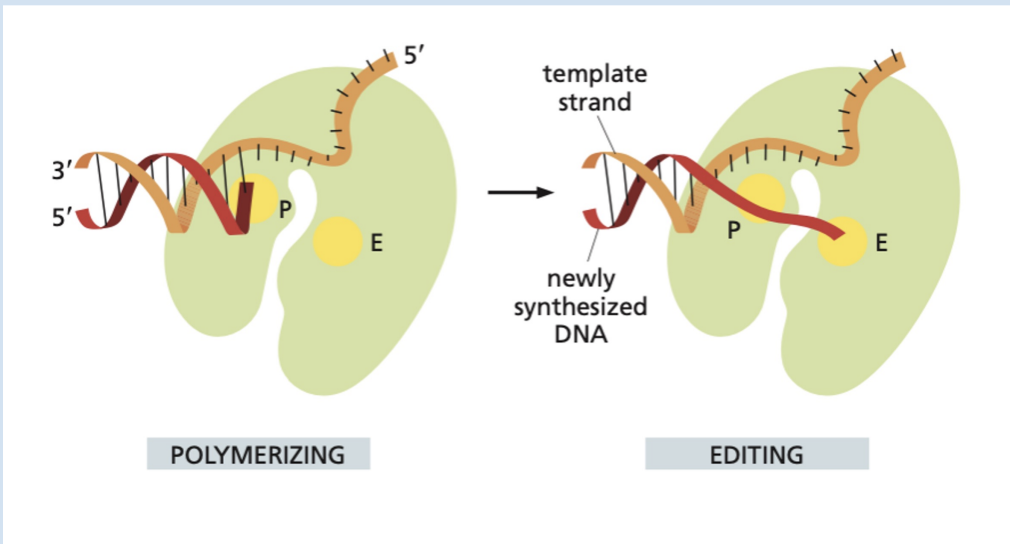
DNA polymerase has ________ activity
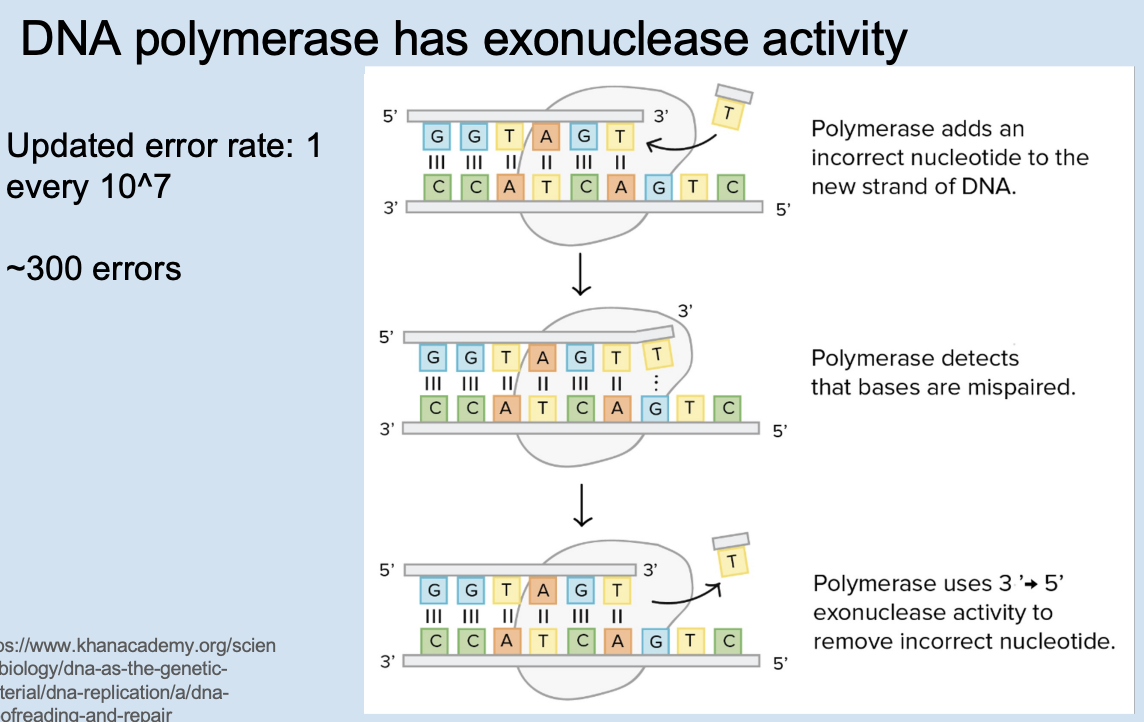
exonuclease = ability to remove nucleotides one at a time from the ends of nucleic acid chains by breaking phosphodiester bonds (“proofreaders”)
what happens when the polymerase adds an incorrect nucleotide?
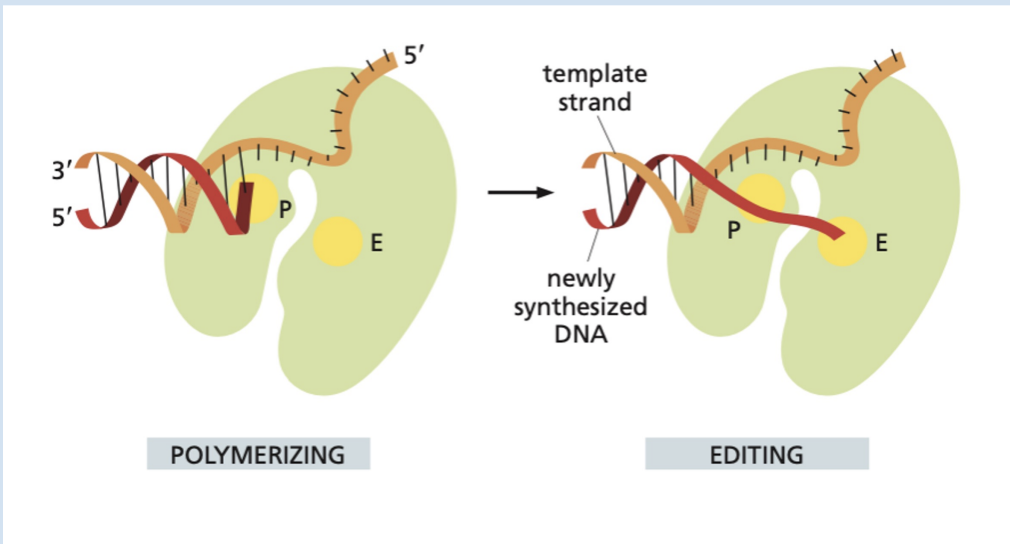
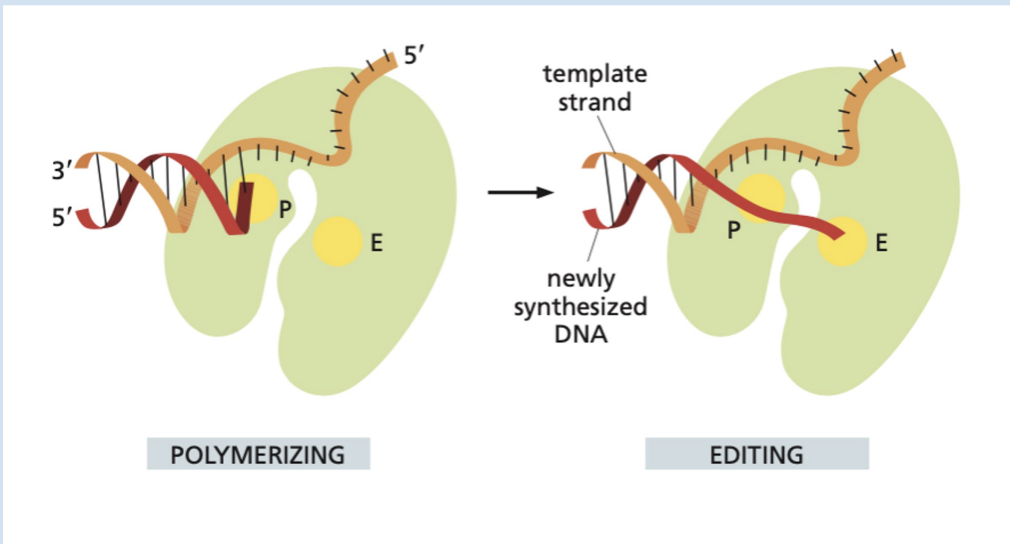
the newly synthesized DNA strand (red) TRANSIENTLY UNPAIRS from the template strand (orange) → its 3’ end moves into the editing site (E) to allow the incorrect nucleotide to be removed
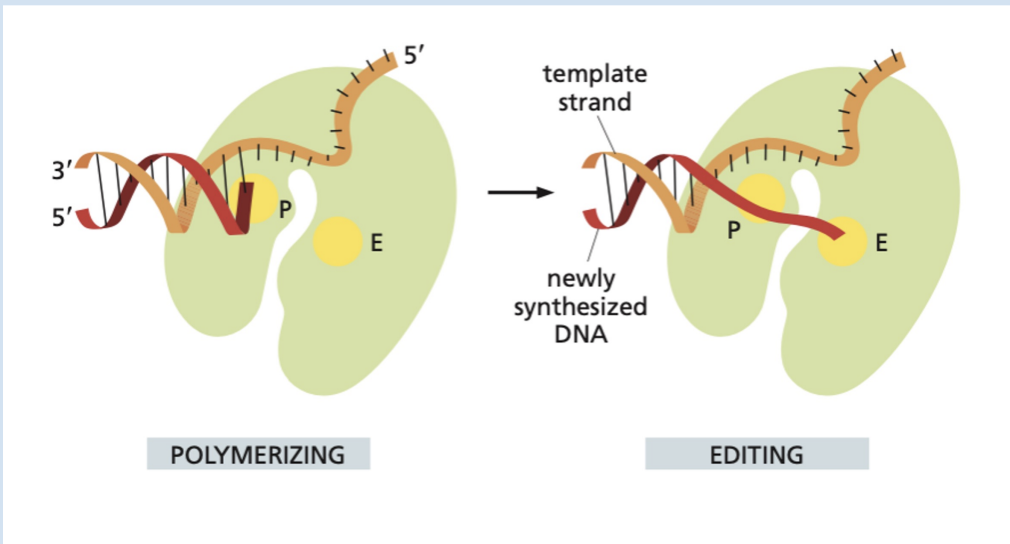
ALL DNA polymerases possess ONLY ____’→ ___’ exonuclease activity
3’ → 5’
clips off nucleotides from the 3’ end of a nucleotide chain
proofreading can only be performed in what direction?
5’ → 3’ direction
takes place at the SAME time as DNA synthesis — before the enzyme adds the next nucleotide to a growing DNA strand, it checks whether the previously added nucleotide is correctly base-paired to the template strand
what happens when polymerase enzyme checks whether previously added nucleotide is correctly base-paired to the template strand?
if so → polymerase adds next nucleotide
if not → polymerase clips off the mispaired nucleotide and tries again
how does polymerase detect that a wrong base was added?
due to disruption / kink in the sugar phosphate backbone
exonuclease
cuts DNA at the end of the strand
what scan DNA after replication?
other enzymes (DNA mismatch repair)
can be excision of a single base or multiple (up to around 10)
DNA mismatch repair occurs when?
AFTER replication has been completed
in DNA mismatch repair, what continually scan the genome for DNA damage and fix it when it occurs?
a variety of protein machines
steps of DNA mismatch repair
excision
resynthesis
ligation
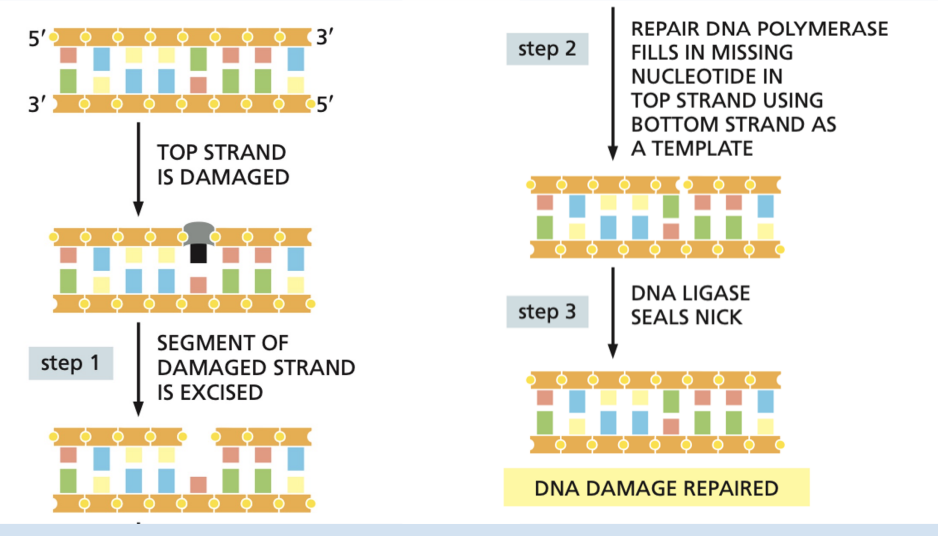
in step 1 (excision) of DNA mismatch repair, the damage is cut out by one of a series of _________, each specialized for a certain type of DNA damage
nucleases (endonucleases that cleave DNA internally by cutting the phosphodiester backbone)
can be excision of a single base or multiple (up to around 10)
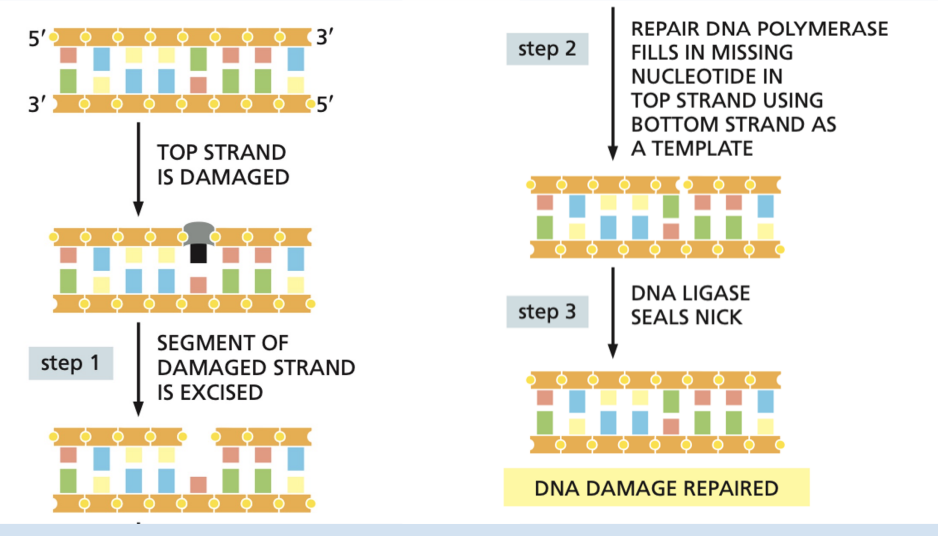
in step 2 (resynthesis) of DNA mismatch repair, the original DNA sequence is restored by ?
a repair DNA polymerase — fills the gap created by the excision events
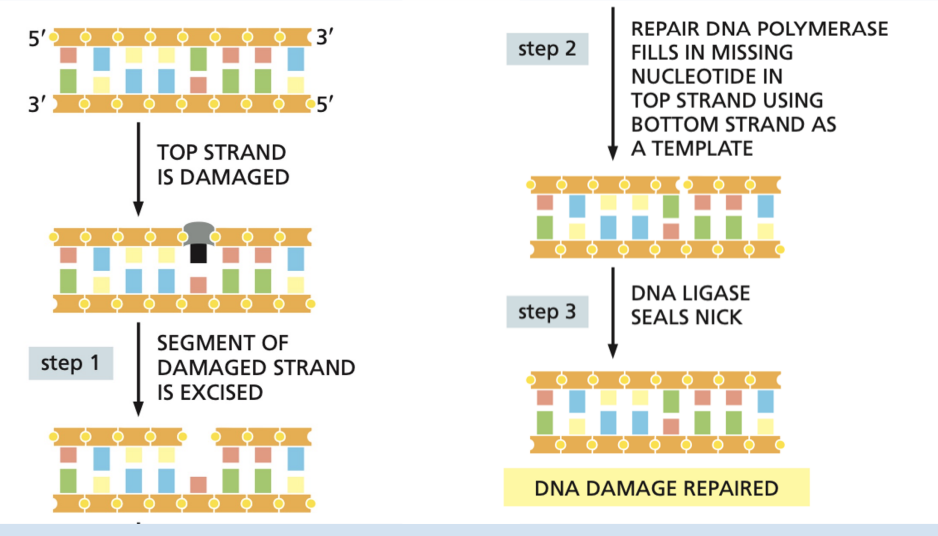
in step 3 (ligation) of DNA mismatch repair, ________ seals the nick left in the sugar-phosphate backbone of the repaired strand.
requires energy from ?
DNA ligase
energy from ATP hydrolysis
remakes the broken phosphodiester bond between the adjacent nucleotides
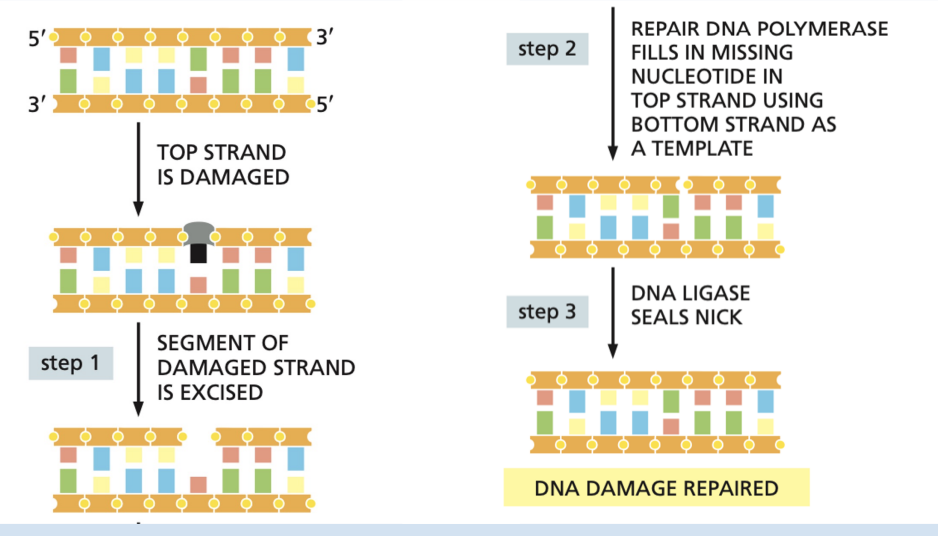
updated error rate for DNA mismatch repair
1 every 109