envr 1000 - unit 8, ecotoxicology, pt 2
 Call Kai
 Learn
Learn Practice Test
 Spaced Repetition
 Match
Match Flashcards
 Knowt Play
1/20

There's no tags or description
Looks like no tags are added yet.
Name | Mastery | Learn | Test | Matching | Spaced | Call with Kai |
|---|
No analytics yet
Send a link to your students to track their progress
21 Terms
determining health effects of pollutants
The toxicity of a pollutant is determined by the dose at which adverse health effects are produced
dose
the amount of a toxicant that enters the body of an exposed
organism
- Measured by quantity of toxicant absorbed (mass or volume) and time (duration of exposure)
- Weight (mass) of the exposed individual is also important
response
the type and amount of damage due to exposure to a particular dose
- Lethal dose: Causes death
- Sub-lethal dose: Causes harm
children and chemical exposure
Children are more susceptible to the effects of chemicals than adults
- Weigh less than adults
- Interact more with their environment
- Undergoing rapid internal changes as they grow
- Less aware of potential risks from chemical exposures
how to determine acute toxicity?
administer different sized doses to populations of laboratory animals
- Responses to dosing are then measured and used to predict effects on humans
Lethal dose-50 percent (LD 50)
Dose that is lethal to 50% of a population of test animals
- Usually noted as milligrams of chemical per kilogram of body weight
- The smaller the LD50, the more toxic the chemical
- The greater the LD50, the less toxic the chemical
• Generally, a chemical with a low LD50 in several animal species will also
be very toxic in humans
• LD50 for a given chemical will be lower for children than for adults
Effective dose–50 percent (ED50)
the dose at which 50% of a population will exhibit the biological response under study
threshold level
The maximum dose at which the toxicant has no measurable
effect – or put another way, the minimum dose at which the toxicant does produce a measurable effect
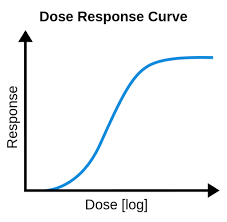
Dose-response curve
a graph that shows the effects of different doses on a population of test organisms
- Doses lower than threshold level are often, but not always, considered safe
dose response curves
For certain toxicants, there is no safe dose
- A threshold does not exist for these chemicals
- Even the smallest amount causes a measurable response
risk assessment of chemical mixtures
• Humans are exposed to combinations of chemical compounds in the
environment (air, food and water)
• But most studies are done on single chemicals in isolation
• Mixtures of chemicals increase the level of complexity in risk assessment
- Too many chemical mixtures exist to evaluate
chemical mixtures interact by one of three ways
additivity, synergy, or antagonism
additivity
the individual effects of each chemical add together to create a total effect that is equal to the expected combined effect of the chemicals involved
- Scales up linearly (simply add them together)
- If no toxicological studies exist for a given chemical mixture, toxicologists use this to assign an estimated risk to chemical mixtures
synergy
the combined effect of the chemicals is greater than the expected effects of the individual chemicals added together
- Scales up nonlinearly
antagonism
the combined effect of the chemicals is smaller than the expected effects of the individual chemicals added together
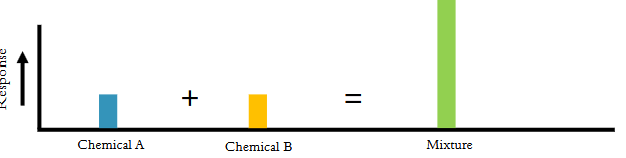
Identify the different interactions.
additivity
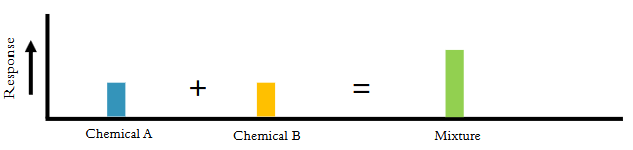
Identify the different interactions.
synergy
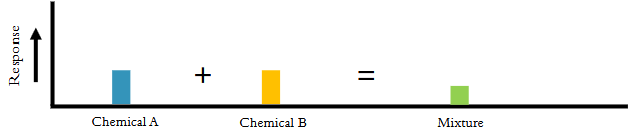
Identify the different interactions.
anatagonism
The precautionary principle
the idea that we should not adopt a new technology, practice, or material until it is demonstrated that:
- The risks are small
- The benefits outweigh the risks
• Puts the burden of proof onto the developers of the new technology
- As mentioned in the “Forever Chemicals” video we watched
• A proactive approach: “An ounce of prevention is worth a pound of cure”
contrast of the precautionary principle
“innocent-until-proven- guilty” approach
- Limited testing
- Most products end up being brought to market – some are recalled if deemed unsafe
- A reactive approach
precautionary principle: examples
• The EU banned beef from U.S. and Canada because of the use of hormones to make cattle grow faster
• EU also uses precautionary principle with respect to GMOs (genetically modified
organisms)
• The idea of reducing fossil fuel emissions in the 1970s and 1980s to mitigate climate change is another example of the precautionary principle – but it was not put into practice!