PSYC 3822: Drugs & Behaviour (Chapter 4)
 Call Kai
 Learn
Learn Practice Test
 Spaced Repetition
 Match
Match Flashcards
 Knowt Play
1/52

There's no tags or description
Looks like no tags are added yet.
Name | Mastery | Learn | Test | Matching | Spaced | Call with Kai |
|---|
No analytics yet
Send a link to your students to track their progress
53 Terms
Pharmacokinetics
Refers to how drugs pass through and are eliminated from the body. The 4 steps are:
Absorption, Distribution, Metabolism (biotransformation) and Elimination
Absorption
Refers to passage of a drug into the bloodstream.
- In most cases, drug must pass through cell membrane(s)
- Depends on route of administration
- e.g., intravenous goes into blood directly, oral must pass through mucous membranes in mouth or wall of intestines
Common Routes of Administration (Absorption)
- Inhalation
-Intramuscular
- Intravenous
- Oral
- Nasal and mucosal membrane
- Subcutaneous and Sublingual
- Transdermal
Route of Administration affects
1. how much drug reaches blood stream
2. speed of absorption (may contribute to abuse)
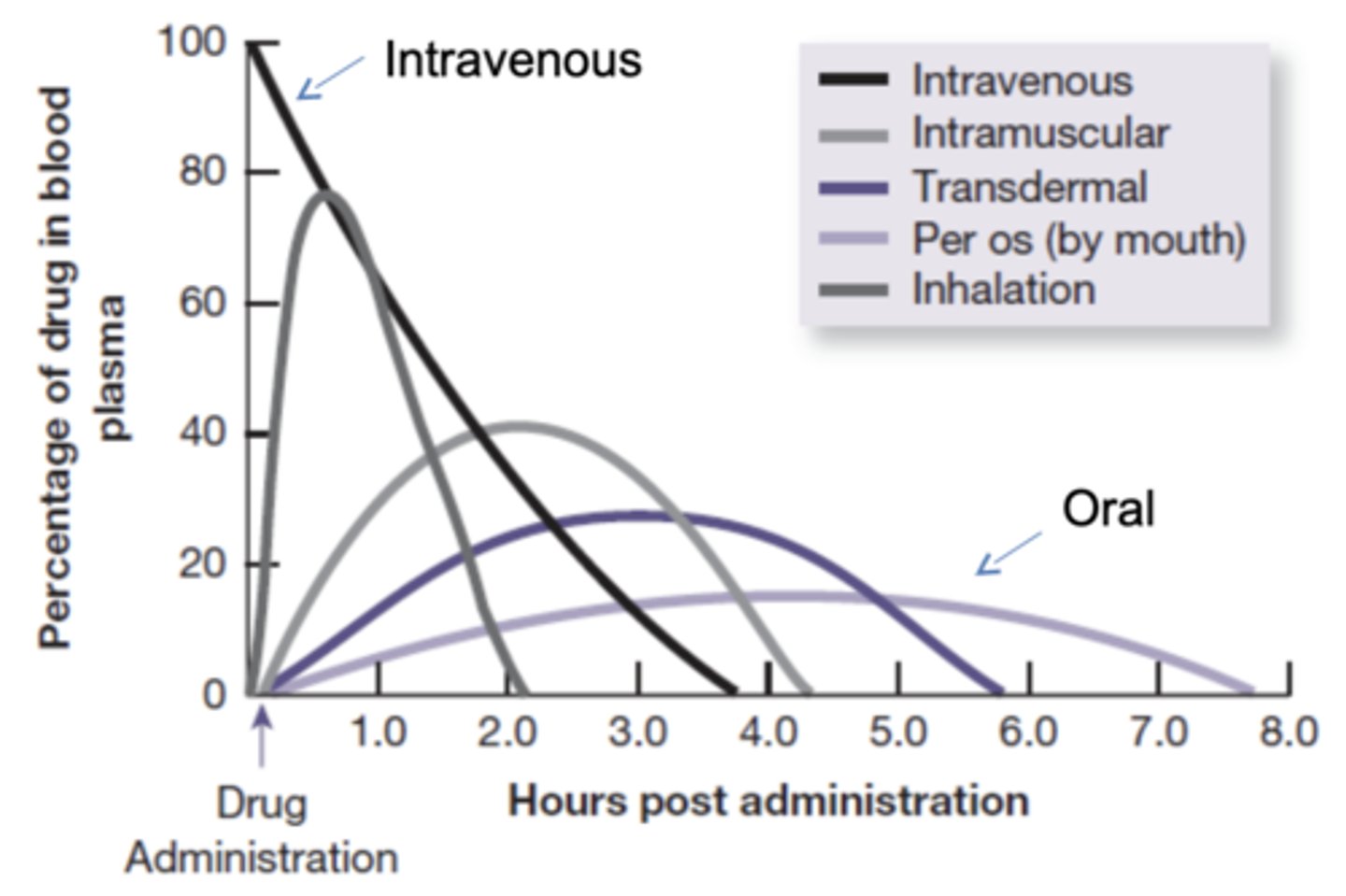
Inhalation
-Form: Inhaled into lungs
-Absorption amount & time: High rate of absorption and Rapid time
-Other: Convenient for patients and common for many drugs of abuse
Intramuscular
-Form: Injection into skeletal muscle
-Absorption amount & time: More stable than oral adminstration and quick time, but not as rapid as intravenous injections
-Other: Not convenient/common for drug abusers
Intravenous
-Form: Injection into vein
-Absorption amount & time: 100% absorption and immediate time
-Other: Unlikely for patients to administer themselves
Oral
-Form: Pill
-Absorption amount & time: Variable, affected by food in stomach & digestive rates. Several minutes in time to work
-Other: Convenient and common. Most preferred by patients
Nasal and mucosal membrane
-Form: Absorbed through membranes in nasal passage or mouth
-Absorption amount & time: More stable and quicker than oral in time, but not as rapid as intravenous injection
-Other: Convenient and common for drug abuse
Subcutaneous
-Form: Injection under skin
-Absorption amount & time: More stable and quicker than oral in time, but not as rapid as intravenous injection
-Other: Individuals can administer themselves, not convenient to so
Sublingual
-Form: Dissolved under tongue
-Absorption amount & time: More stable and quicker than oral in time, but not as rapid as intravenous injection
-Other: Can be used for those who may not want to take a medication or patients with schizophrenia
Transdermal
-Form: Absorbed through skin by skin patch
-Absorption amount & time: More stable and quicker than oral in time, but not as rapid as intravenous injection
-Other: Convenient, providing an even, sustain release of drug into blood stream
Henderson-Hasselbalch equation
The closer the pKa and pH, the more non-ionized particles (better diffusion into blood stream)
- e.g., pKa = 3, better absorbed in stomach (pH = 1) than intestine(pH = 7).
Liberation
The process of drug molecules separating from the pill or solution it was delivered in.
- Many orally administered drugs are designed to be liberated in small intestines (drug must be protected from stomach acid)
- Generally, most drug absorption occurs in the small intestine (may take 15-30 min)
- Slow release capsules designed to release drug over longer period of time (to prolong drug levels in bloodstream)
Distribution
After absorption (into blood stream), passage of drug from bloodstream to intended body sites (e.g. brain)
Bioavailability
Ability of a drug to reach its intended target (site of action).
Blood-Brain Barrier
Protective layer of cells surrounding blood capillaries in brain that prevent many substances in blood from entering brain.
- Comprised of tightly fitted endothelial cells
- Nutrients and some molecules can penetrate BBB
- Either through Passive Diffusion or Active Transport
Passive Diffusion
Drugs (chemical) that have the following properties may diffuse across the blood brain barrier (and reach brain targets):
1. Lipid (or fat) soluble
2. Neutral charge
3. Small in size
Active Transport
Consists of membrane channels or transporters that facilitate passage of chemicals through cell membranes.
- Examples: Glucose transporter & Large amino-acid transporters
Non-specific binding
Drugs sometimes bind to other (unintended targets) which reduces amount delivered to intended targets
Protein Binding
Drug may bind to proteins in bloodstream (not free to cross blood-brain barrier)
Depot Binding
Drug may bind to other tissues which reduces amount in blood available to intended target (e.g., THC in fatty tissues).
Metabolism (Biotransformation)
Process of converting a drug unto one or more metabolites
Metabolites
Products resulting from transformation of a drug via enzymes.
- mostly smaller molecules
- water soluble (increases excretion)
- may be active or inactive
- Metabolism occurs mostly in liver
Phase I biotransformation
Metabolites are small, water soluble (easily excreted, e.g. urine).
- often occurs in liver (CYP cytochrome p450 enzymes)
- may produce active metabolites (e.g., heroin -> morphine)
Phase II biotransformation
Metabolites from Phase I may be modified via conjugation (attachment of another molecule) to produce a larger metabolite.
- usually results in less diffusion through BBB
- more likely to be excreted (usually more water soluble)
- May produce active metabolites (e.g., L-Dopa is changed to Dopamine)
Rapid Metabolizers
Decreases amount of drug (have to use higher dose or use different class of drugs).
- More metabolic enzymes
Poor Metabolizers
Prolongs drug life-span (stronger effects)
- Fewer metabolic enzymes
Personalized medicine
Prescribe treatments based onpatient's unique biological make-up
Elimination
Process by which drug leaves the body (final stage of pharmacokinetics). Several channels:
- Urine, Sweat , Breath (e.g. alcohol)
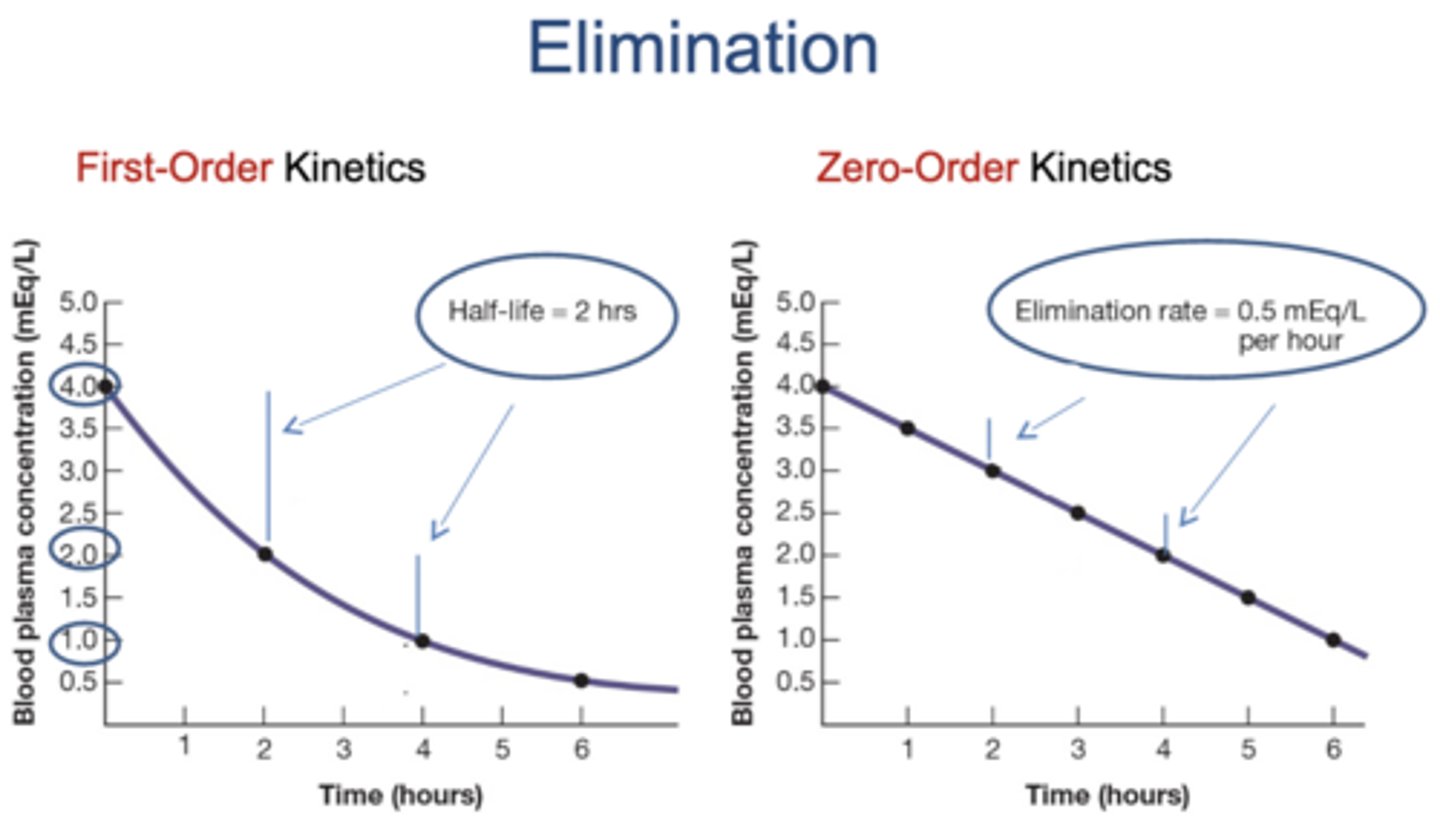
Elimination Rate
The amount of drug eliminated from the body over time.
Half-life
Amount of time required to eliminate half of the amount of a drug (used if drugs follows first-order kinetics).
- amount eliminated (in a given time) is proportional to the amount of drug.
- amount eliminated per unit time varies (e.g., 50 mg in first hour, 25 in next hour etc)
- can vary considerably
- determines dosing frequency
Zero-order kinetics
The drug is eliminated at a fixed amount per unit time.
- Alcohol is eliminated at about 10-14 mg per hour
Pharmacodynamics
Mechanisms of action for drug which accounts for its (psychological) effects.
Binding affinity
The drug's strength of binding to a receptor
Receptor efficacy
The drug's ability to activate a receptor
Agonist
Binds to a receptor and exerts actions similar to the neurotransmitter
Partial Agonist
Binds to the same receptor that the neurotransmitterbinds to but has a weaker effect than the neurotransmitter (so functionally reduces the action of the neurotransmitter)
Antagonist
Binds to a receptor and blocks the action of a neurotransmitter
Competitive antagonist
Binds to the same receptor that the neurotransmitter binds to and blocks the action of the NT (direct competition for receptor)
Non-competitive antagonist
Binds to a different receptor than the NT (usually on a complex) and blocks action of NT
Allosteric regulators
Bind to a receptor other than neurotransmitter and affects action of NT.
- usually receptor for drug is part of a larger receptor complex
Positive modulator
Drug enhances the action of the NT
Negative modulator
Drug decreases the action of the NT
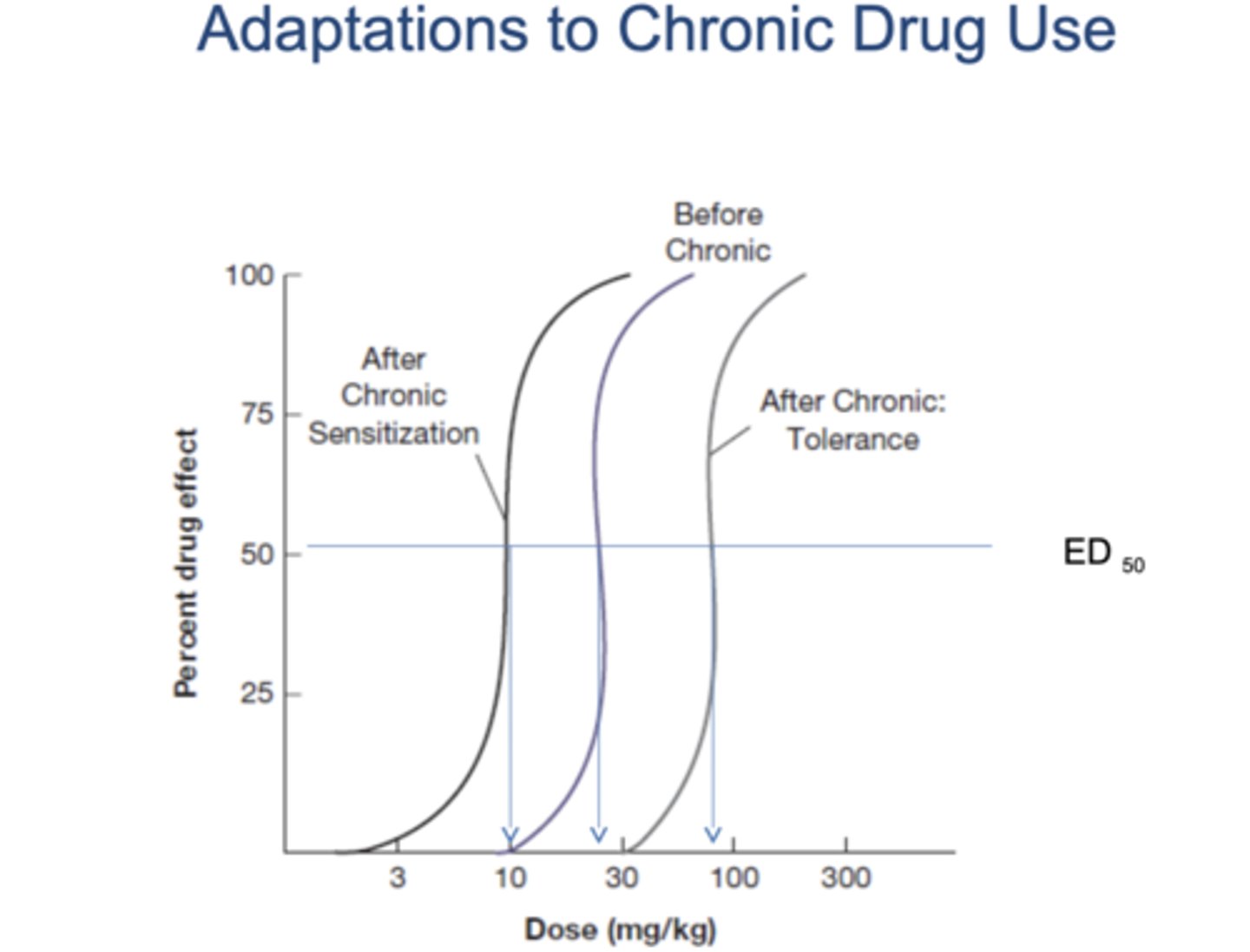
Repeated, usually daily, use of a drug may lead to either...
1. Sensitization: Increased effects of drug
- lower dose necessary for a given level of effect
- dose-response curve shifted to the “left”
2. Tolerance: Decreased effect of a drug
- larger dose necessary for a given level of effect
- dose-response curve shifted to the “right"
Pharmacokinetic tolerance (drug dispositional tolerance)
Reduction in the amount of drug reaching target
- e.g., increased production of metabolic enzymes (as in alcohol dehydrogenase)
Pharmacodynamic tolerance
Changes in the number of neurotransmitter receptors
Behavioural tolerance
Decreased behavioural response (learn to perform tasks better under effects of drug
Conditioned (or contingent) tolerance
Tolerance due to conditioned physiological responses that counteract the drug effects.
- Stimuli associated with drug use may active a pharmacokinetic response that reduces drug's effect
- In presence of CS, drug effect decreases
- However, in absence of CS, drug effect is much stronger (may overdose)
Cross tolerance
Tolerance to one drug may result in tolerance to another drug.
- Someone with high tolerance to heroin may be tolerant to methadone (require higher dose)
Withdrawal syndrome
Collection of responses that occur when a drugis no longer administered.
Physical effects
Severity depends on length and/or amount of use(usually opposite to drug's effects).
- Alcohol withdrawal can lead to seizures (even death)
- Heroin withdrawal often involves intense stomach cramps
Psychological effects
Commonly include drug cravings or mood changes.
- Usually diminish with time (but may re-appear in some contexts)