organic chem (whole)
 Call Kai
 Learn
Learn Practice Test
 Spaced Repetition
 Match
Match Flashcards
 Knowt Play
1/90

There's no tags or description
Looks like no tags are added yet.
Name | Mastery | Learn | Test | Matching | Spaced | Call with Kai |
|---|
No analytics yet
Send a link to your students to track their progress
91 Terms
Hydrocarbon definition
Compound containing ONLY hydrogen and carbon
Difference between saturated and unsaturated hydrocarbon
Saturated - single bonds ONLY
Unsaturated - double / triple carbon bonds
Definition of a homologous series
A series of organic compounds having the same functional group but with each successive member differing by CH2
Definition of a functional group
The part of the molecule that is largely responsible for the molecule's chemical properties
Steps to name a structure using IUPAC rules
1. Find longest chain
2. Find side chains
3. Find other substituents
How to separate numbers and letters when naming
To separate numbers from numbers, use COMMAS: 1,1,2
To separate numbers from letters, use DASHES: 1,1,2-trimethylpentane
Names for number of carbons for longest chain (1 - 10)
1 - meth
2- eth
3 - prop
4 - but
5 - pent
6 - hex
7 - hept
8 - oct
9 - non
10 - dec
How to name side chains
Add on -yl onto the number of carbons on the side chain, eg: methyl, ethyl, propyl, etc
Then add di-, tri-, if there are 2 or 3 side groups
Order of priority of substituents
1. Carboxylic Acids (-oic acid)
2. Aldehydes (-al) / Ketones (oxo- for lower priority OR -one for higher priority)
3. Alcohols (hydroxy- for lower priority OR -ol for higher priority)
4. Halogens (add onto the start, eg. bromo-, chloro-, etc)
5. Alkenes (-ene)
6. Alkyl
If a carbon structure is in a ring, what prefix do we use
Cyclo-
Molecular formula
Shows number and elements of atoms in a molecule (eg. C2H6) - 'normal' formula
Empirical formula
The simplest whole number ratio of atoms of each element present in a compound (eg. C2H6 would become CH3 in empirical formula)
General formula
The simplest algebraic formula of a member of a homologous series (eg. alkanes = Cn H2n+2)
Displayed formula
A formula showing the relative positioning of all the atoms in a molecule and the bonds between them - you draw out the bonds
Structural formula
A formula that shows the arrangement of atoms in the molecule of a compound (eg. C2H6 = CH3CH3 in structural formula)
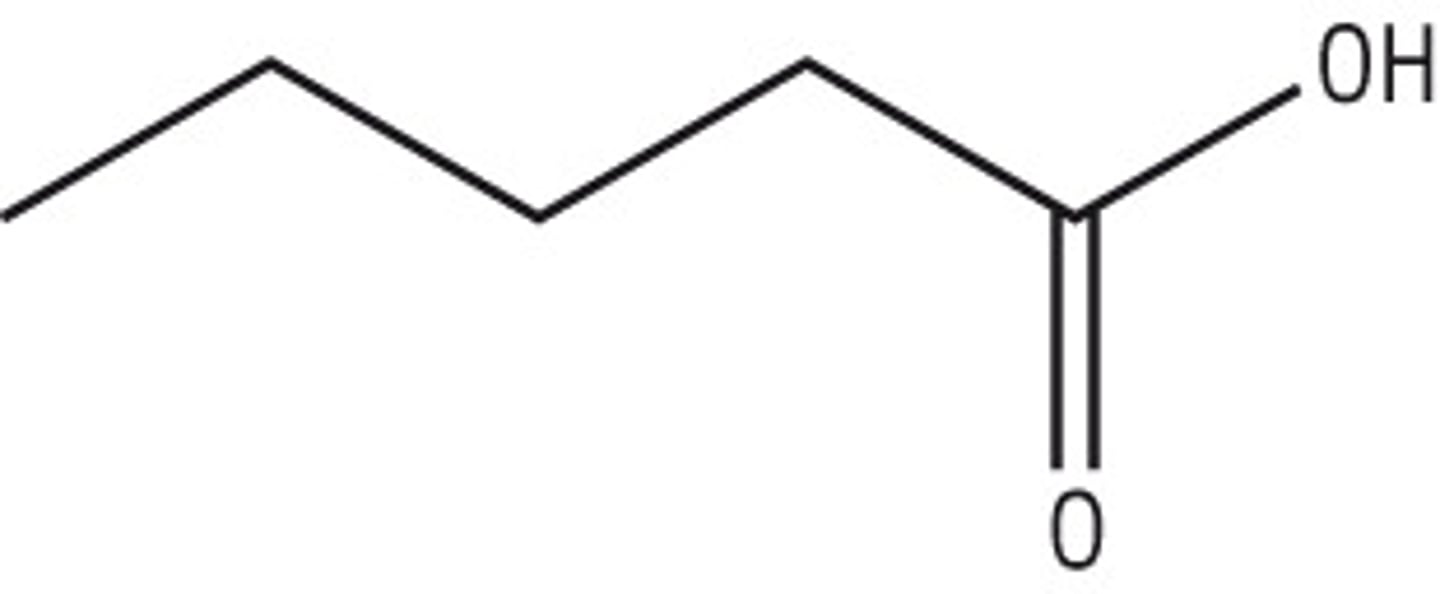
Skeletal formula
A simplified organic formula, with hydrogen atoms removed from alkyl chains, leaving just a carbon skeleton and associated functional groups
Structural isomer
Same molecular formula
Different structural formula
Different spatial arrangement of atoms
Eg: 1-chloropropane and 2-chloropropane are structural isomers, they both have a molecular formula of C4H7Cl, but have a different structure
What are the 2 ways that a covalent bond can be broken?
Heterolytic fission
Homolytic fission
What is heterolytic fission?
When one atom takes the pair of electrons, and becomes a negative ion, and the other atom becomes a positive ion.
What is homolytic fission?
When each atom in the bond takes 1 electron each, forming radicals
What is a radical?
A species with an unpaired electron
How do you use curly arrows in reaction mechanisms?
Doubled headed arrow = the atom takes both of the electrons
Single headed arrow = the atom takes one of the electrons in the pair
What are the 3 types of reaction?
Addition
Substitution
Elimination
What happens in an addition reaction?
Two reactants join together to form one product
What happens in an substitution reaction?
Two reactants react to form 2 different products
What happens in an elimination reaction?
Removal of a small molecule from a larger one. One reactant molecule forms two products
What is the general formula of an alkane?
CnH2n+2
Are alkanes saturated or unsaturated + what does this mean about the bonding?
Saturated - all bonds are single bonds
What type of covalent bond are present in alkanes?
Sigma (σ) Bonds
What are Sigma (σ) Bonds?
The result of the head on overlap of 2 orbitals, one from each bonding atom, and as each orbital has 1 electron, the sigma bond has 2 electrons.
What kind of arrangement is caused by the repulsion of electrons around each carbon atom?
3D tetrahedral arrangement, with a bond angle of 109.5 degrees
Does boiling point of alkanes increase or decrease as chain length increases and why?
It increases
Increased chain length = greater surface area = greater surface contact between molecules = stronger London dispersion forces = more energy required to break the forces
Does boiling point of alkanes increase or decrease as the number of branches on an alkane increase and why?
It decreases
More branches = lower surface area = lower surface contact between molecules = weaker London dispersion forces = less energy required to break the forces
How do you separate crude oil and how does it work?
Fractional distillation
Boil the crude oil
Elements with lower boiling points (shorter chains) rise to the top and vice versa for longer chains
Why are alkanes largely unreactive?
C-C and C-H σ bonds are strong
C-C bonds are non polar
C-H bonds are considered non polar
What is needed for alkanes to react with halogens?
UV light
What are the 3 steps in halogenation?
1. Initiation
2. Propagation
3. Termination
Initiation
The halogen is split by homolytic fission, forming 2 radicals (eg. Br2 > 2Br·)
Propagation
2 steps making a chain reaction, where the radical reacts with the alkane to form a different radical, eg:
1. Br· + CH4 > CH3· + HBr
2. CH3· + Br2 > CH3Br + Br·
Termination
2 radicals collide with each other, forming stable molecules, ending the chain reaction, eg:
2Br· > Br2
2CH3· > C2H6
CH3· + Br· > CH3Br
What limitations are there to radical substitutions?
Further substitution can occur: after the first radical substitution, more substitution can occur, forming new products, eg: CH2Br2, CHBr3, and CBr4.
With longer carbon chains, substitutions can occur in different places, which forms structural isomers of products.
Are alkenes saturated or unsaturated? Why?
Unsaturated: they have a C=C bond
What is the general formula of an alkene?
CnH2n
What are the nature of the carbon bonds in an alkene?
3 of the bonds are sigma bonds
1 of the bonds is a pi bond
What is a pi bond?
The sideways overlap of p orbitals of carbon atoms in a double / triple bond. Each orbital has 1 electron, so the bond has 2 electrons and each carbon contributes 1 electron
Pi bonds do NOT allow rotation
What is the shape around each carbon atom in a double bond?
Trigonal planar, bond angle: 120 degrees
Stereoisomer
Molecules with the same molecular and structural formulas but different (3D) spatial arrangements of atoms
What TWO conditions are needed for E/Z isomerism to be satisfied?
A C=C double bond
Each carbon in the double bond MUST have 2 different groups attached to it
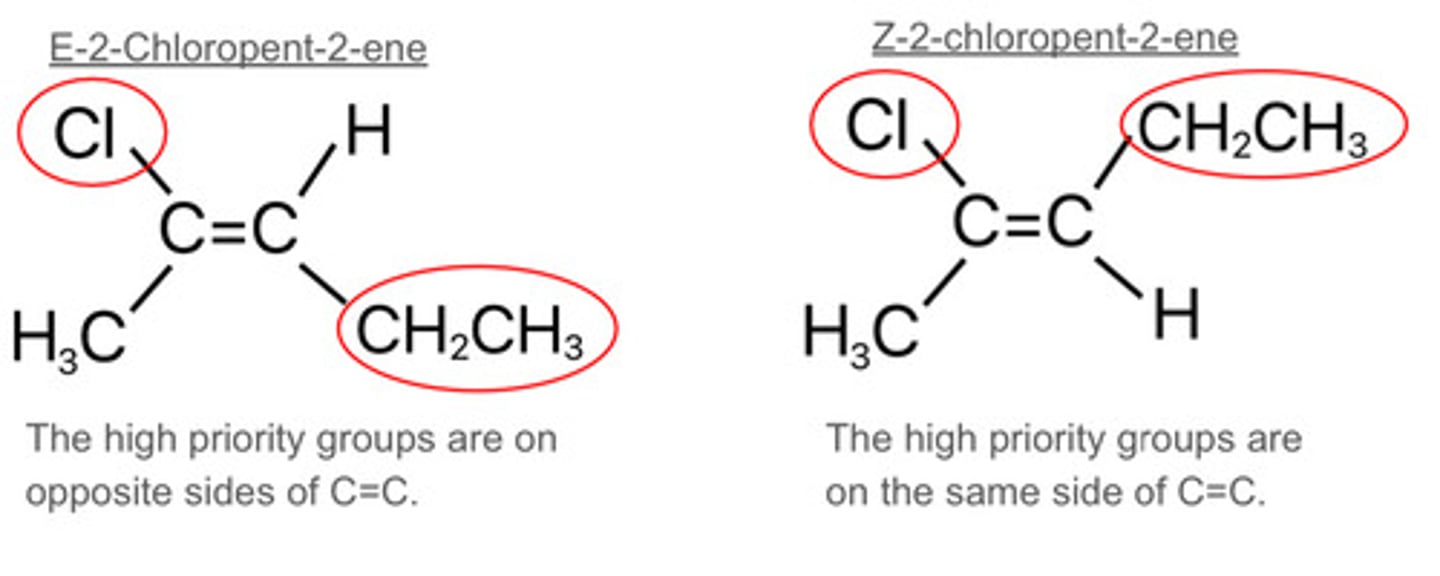
What is E and Z isomerism?
E: the groups with the highest priority are on different sides
Z: the groups with the highest priority are on the same sides
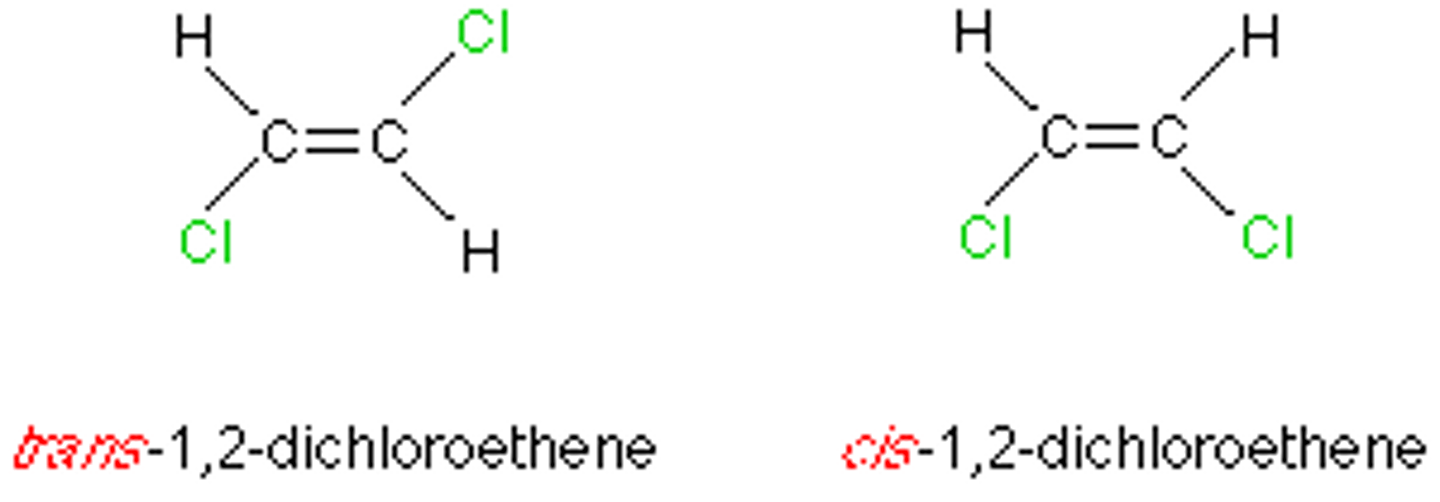
What condition needs to be met so that cis/trans isomerism can be satisfied?
One group on each carbon needs to be the same, while following the rules of E/Z isomerism
Cis = Z
Trans = E
How is priority decided of groups?
Go along the order of atoms of the groups, and compare to the other group. Once there is a point of difference, compare atomic number. The one with the higher atomic number, their group has priority.
Electrophile definition
An electron pair acceptor
Nucleophile definition
An electron pair donor
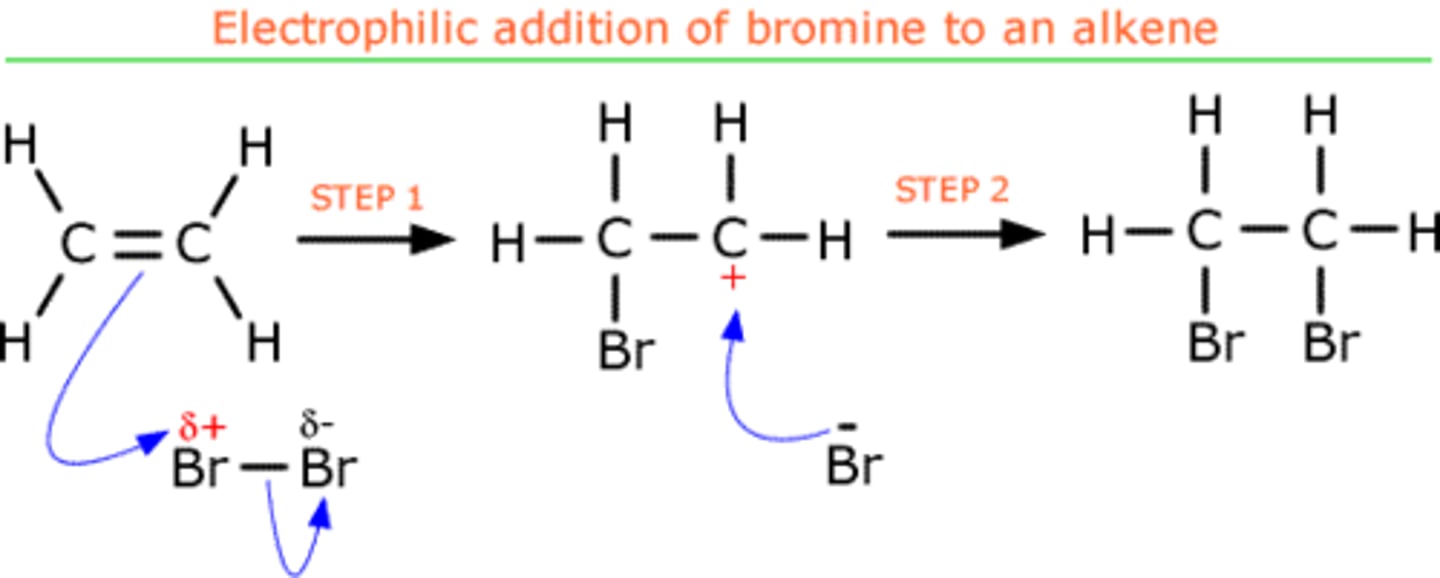
Mechanism for electrophilic addition (example: ethene + bromine)
1. a dipole is formed as the bromine approaches the electrons in the carbon double bond (which repels the electrons in the bromine bond, causing an induced dipole)
2. the electron pair in the pi bond is attracted to the positive bromine, and so breaks the pi bond and forms a bond with one of the carbons and a bromine
3. this leaves a carbocation (+ charge) and a negatively charged bromine ion, and the carbocation attracts the bromine ion
4. the bromine ion bonds with the carbocation, forming 1,2-dibromopropane
What is a primary, secondary, and tertiary carbocation?
Primary - carbon bonded to ONE alkyl group
Secondary - carbon bonded to TWO other alkyl groups
Tertiary - carbon bonded to THREE other alkyl groups
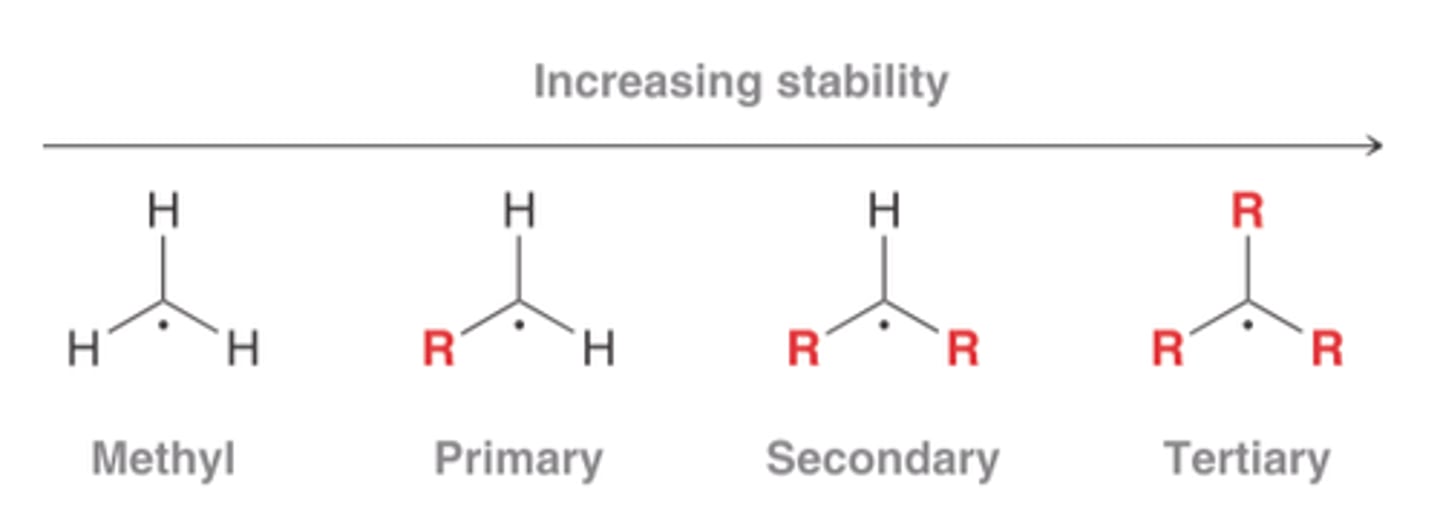
What is the most stable molecule, one with a group on a primary, secondary, or tertiary carbocation?
Tertiary > Secondary > Primary
This means that molecules with a tertiary carbocation are the most MAJOR products compared to secondary and primary
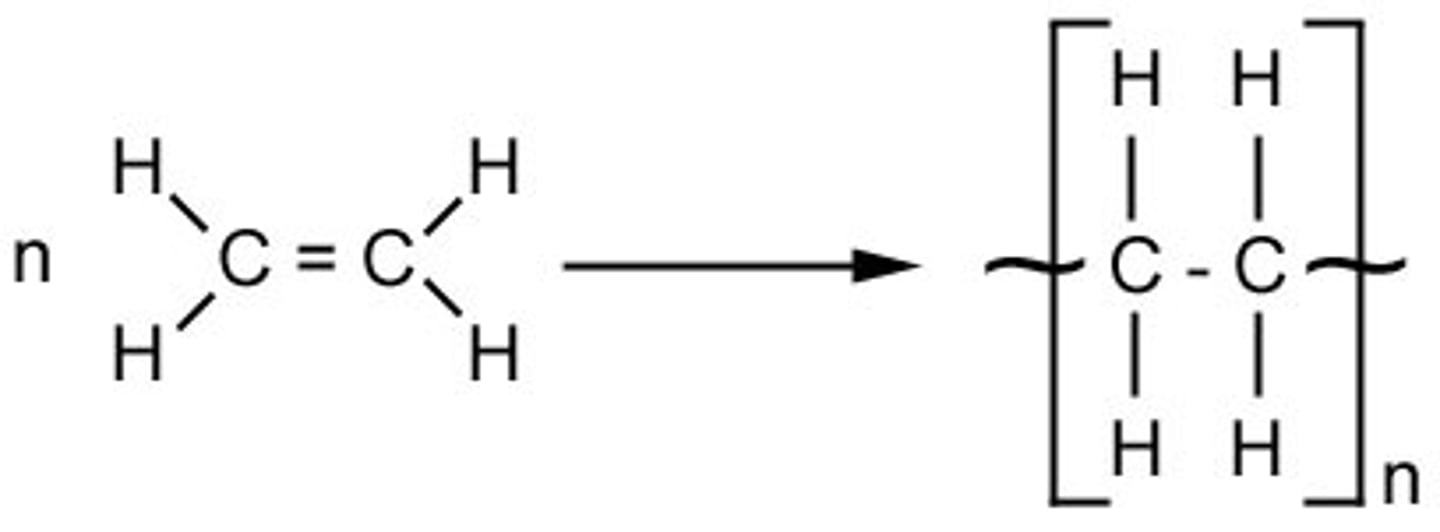
What is the difference between a monomer unit and a repeat unit?
Monomer unit is an ALKENE with an 'n' in front of it
Repeat unit is an ALKANE, with brackets and bonds going outside of the brackets, with the 'n' at the bottom of the brackets.
What are the ways to dispose of waste polymers?
Recycling
Using it as fuel
Feedstock recycling
Advantages of biodegradable polymers
Conserves oil reserves
Leave no visible or toxic residue
Are broken down by microorganisms
What type of molecule are alcohols and why?
They are polar
Caused by the difference in electronegativity between O and H (the O-H bond is polar)
This leads to strong hydrogen bonds between alcohols
Name the key properties of alcohols
Low volatility
High melting / boiling point
Soluble in water (due to hydrogen bond between polar OH bond and water)
How do you classify between primary, secondary, and tertiary alcohols?
Look at the carbon with the hydroxyl group, and see how many carbon atoms are attached to it (1: primary, etc.)
Only exception is methanol, which is a primary alcohol
What does the combustion of alcohols produce?
CO2 and H2O
It is an exothermic reaction
Which alcohols can be oxidised?
Primary and secondary only
Tertiary CANNOT be oxidised
What does oxidising a primary alcohol produce?
Aldehyde OR Carboxylic Acid
Depends on the conditions (distillation / reflux)
How can you ensure you produce an aldehyde / carboxylic acid?
For aldehyde: heat under distillation > prevents any further reaction with acidified potassium dichromate
For carboxylic acid: heat under reflux + excess acidified potassium dichromate: recycles the aldehyde back into the reaction + ensures it all reacts
What does oxidising a secondary alcohol produce?
Ketone
What is the oxidising agent for alcohols?
Acidified Potassium Dichromate (K2Cr2O7/H+)
Acidified with sulfuric acid (H2SO4)
If an alcohol is oxidised, what is the colour change that undergoes + what ions are responsible for this?
Orange to green
Dichromate (VI) ions to Chromium (III) ions
(Cr2O7)2+ > Cr3+
What is produced when you dehydrate an alcohol?
An alkene + water
What is needed to dehydrate an alcohol?
An acid catalyst (such as H3PO4 / H2SO4) + heated under reflux
What is produced in a substitution reaction with alcohols and hydrogen halides?
A haloalkane
What is reacted with the alcohol to produce a haloalkane?
A sodium halide
H2SO4
Reflux reaction
How do you name haloalkanes?
Halogen is the prefix
If there are 2 or more halogens, list them in alphabetical order
What are the prefixes for each halogen?
F: fluoro-
Cl: chloro-
Br: bromo-
I: iodo-
What kinds of molecules are haloalkanes and why?
Polar - due to the polar carbon - halogen bond present (the halogen is more electronegative)
What is a nucleophile?
An electron pair donor
Is a haloalkane a nucleophile or electrophile and why?
Electrophile - the carbon has a slight positive charge due to the halogen, which attracts nucleophiles
What is the reaction between a haloalkane and a nucleophile called?
Nucleophilic substitution
Hydrolysis of haloalkanes
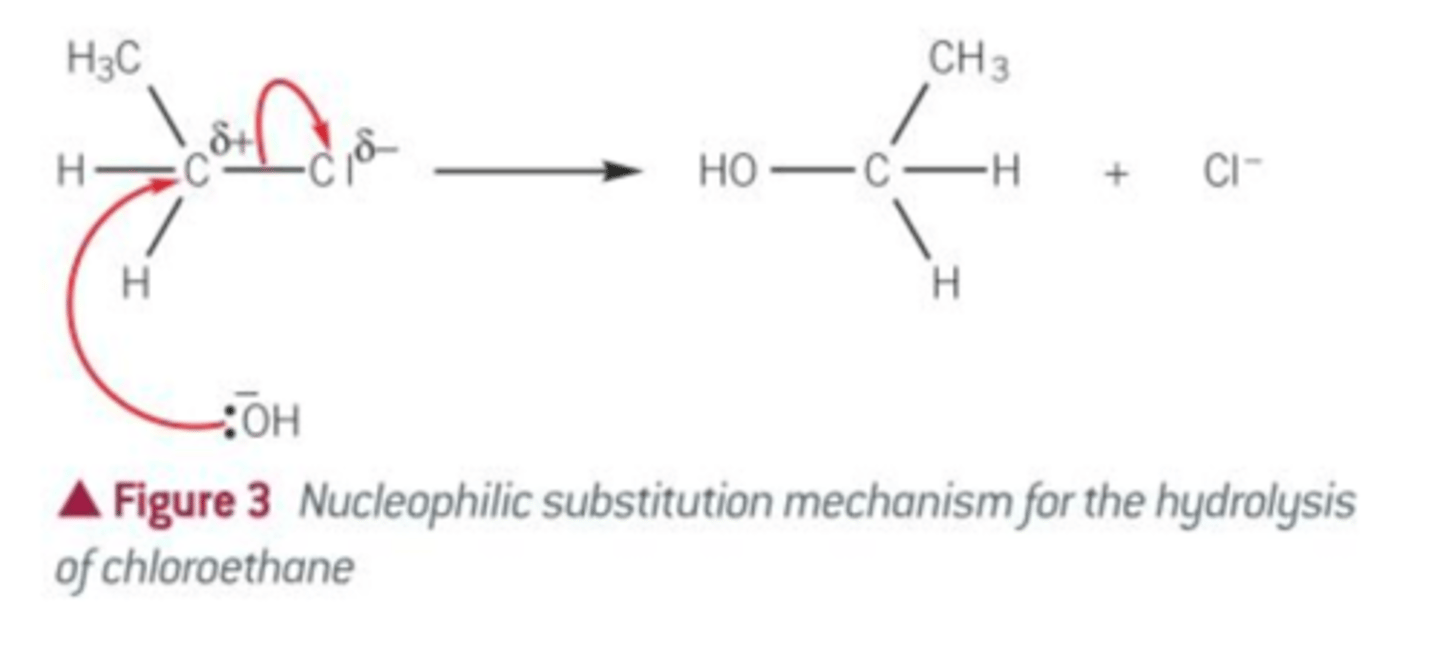
How can you make an alcohol from a haloalkane?
Heat under reflux with aqueous sodium hydroxide (NaOH)
Which carbon - halogen bonds are strongest?
C-F > C-Cl > C-Br > C-I
C-F takes the most energy to break the bonds and are mainly unreactive
Which haloalkane reacts the fastest?
Iodoalkanes > Bromoalkanes > Chloroalkanes
How can you test the rates of hydrolysis of haloalkanes?
By reacting haloalkanes with water in the presence of silver nitrate. A silver halide should form.
Also add ETHANOL to ensure the haloalkane and water mix properly
What should you observe in the rates of hydrolysis of haloalkanes?
Cl: White precipitate forms slowly
Br: Cream precipitate forms slower then Cl, but quicker then I
I: Yellow precipitate forms the quickest
What is an organohalogen?
Molecules that contain at least one halogen atom joined to a carbon atom
What are CFCs?
Chlorofluorocarbons: compounds that react with sunlight and destroy the ozone layer
How do CFCs break down the ozone layer?
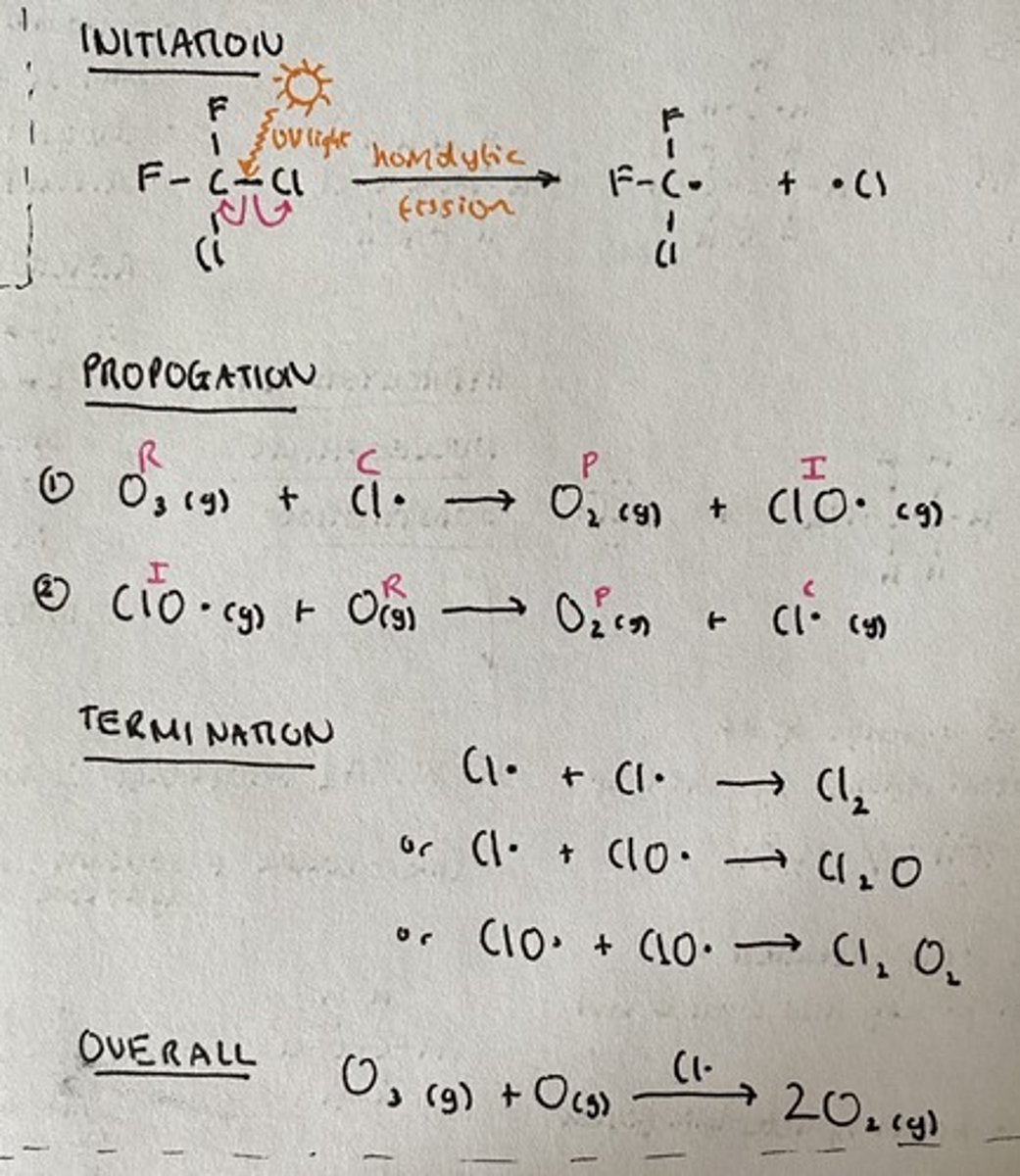
When they reach the stratosphere, they break down, which forms chlorine radicals, which catalyse the break down of the ozone layer.
Properties of CFCs
Stable
Volatile (low boiling point)
Non-flammable
Non-toxic
Radical substitution of CFCs (use the example of CF2Cl2)
- Chlorine radical formed during initiation (also known as photodissociation / photolysis)
Are CFCs the sole cause of ozone depletion?
No; any radical can catalyse the breakdown of ozone