Physio Final
 Call Kai
 Learn
Learn Practice Test
 Spaced Repetition
 Match
Match Flashcards
 Knowt Play
1/88

There's no tags or description
Looks like no tags are added yet.
Name | Mastery | Learn | Test | Matching | Spaced | Call with Kai |
|---|
No analytics yet
Send a link to your students to track their progress
89 Terms
Which of the following is an example of negative feedback?
a. Blood platelets release chemicals that attract more blood platelets when they plug a wound.
b. The concentration of the products of a chemical reaction increases and slows the rate of the reaction.
c. The enzyme a cell uses to produce an amino acid is inhibited by the amino acid
d. None of the above
The enzyme a cell uses to produce an amino acid is inhibited by the amino acid
Organs are composed of a single cell type.
a. True b. False
False
Which of the following is an example of a reflex?
a. While standing still, individuals unconsciously sway slightly. When leaning forward the soleus muscle is stretched. Stretch receptors in the muscle are activated. A afferent neuron synapses on an efferent neuron that travels back to the soleus, causes the soleus to contract, bringing the individual back to the upright position.
b. After a meal, blood glucose rises. Beta cells in the pancreas sense the elevated blood glucose and release insulin into the blood. Insulin binds receptors on liver cell membranes and prompt the liver to take up glucose from the blood. Blood glucose levels fall back into the normal range.
c. Both
d. Neither
Both
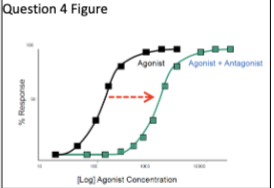
The antagonist causing the shift in the dose-response curve is most likely a:
a. Competitive antagonist
b. Non-competitive antagonist
c. Partial agonist
d. Allosteric regulator
e. None
Competitive antagonist
The main advantage of having second messenger systems coupled to receptors is to
a. Provide signal amplification
b. Limit the number and type of targets activated by the first messenger
c. Limit the duration of signal produced by the first messenger
d. None of the above
Provide signal amplification
Second messenger pathways are strictly linear, that is they do not interact with each other.
a. True b. False
False
Both water- and lipid-soluble signaling molecules can:
a. Bind intracellular receptors
b. Signal through G proteins
c. Alter gene transcription
d. Diffuse through membrane
e. All
Alter gene transcription
Which of the following is true of steroid hormones?
a. Bind intracellular receptors
b. Lipid soluble
c. From cholesterol
d. Coupled synthesis/release
e. All
All of the above
Two neurons, A and B synapse onto a third neuron, C. Neurotransmitter released from neuron A opens ligand-gated ion channels in neuron C that are permeable to sodium and potassium. Neurotransmitter released from neuron B opens ligand-gated ion channels in neuron C that are permeable to chloride. Which of the following statements is true?
a. An action potential in neuron A will cause a depolarizing excitatory post-synaptic potential (EPSP) in neuron C.
b. An action potential in neuron B will cause a hyperpolarizing inhibitory post-synaptic potential (IPSP) in neuron C.
c. Simultaneous action potentials in neurons A and B will cause less depolarization in neuron C than if only A fired an action potential.
d. All of the above.
e. None of the above.
All of the above
Which of the following is the main Ca2+ -binding protein used for signaling in mammalian cells?
a. Phosphokinase A
b. Calcium-dependent protein kinase
c. Calmodulin
d. Phospholipase C
e. None of the above
Calmodulin
Which is incorrect?
a. Diffusion through a membrane is significantly faster than diffusion through a water layer of the same
thickness.
b. Lipid-soluble solutes diffuse through a cell membrane more readily than water-soluble solutes.
c. The rate of facilitated diffusion is limited by the number of transporters in the membrane at a given time.
d. None of the above are incorrect.
e. All of the above are incorrect.
None of the above are incorrect
Assume the intracellular fluid contains 300 milliOsmol/liter nonpenetrating solute. If the extracellular fluid contains 200 milliOsmol/liter nonpenetrating solute and 100 milliOsmol/liter penetrating solute, the cell will
a. Shrink
b. Swell
c. Not change volume
d. Not enough information provided to make a conclusion.
Swell
Which of the following are characteristics of electrotonic potentials?
a. They are the charging or discharging of the membrane capacitor
b. They decay as they travel away from the site where they originate
c. They spread in all directions over the cell membrane
d. All of the above
e. None of the above
All of the above
In a typical neuron, how would decreasing the concentration of extracellular potassium change the potassium
equilibrium potential (EK)?
a. It would become more negative
b. It would become less negative
c. It would not change
It would become more negative
Which of the following best describes an afferent neuron.
a. The cell body is in the central nervous system and the axon terminal is in skeletal muscle.
b. The cell body is in the dorsal root ganglion and the axon enters the spinal cord.
c. The cell body is in the ventral horn of the spinal cord and the axon terminal is in the brain.
d. The cell body is in the dorsal root ganglion and the axon terminal is in skeletal muscle
Cell body in dorsal root ganglion, axon enters spinal cord
Suppose a hypothetical ion (X) has an equilibrium potential more negative than the resting membrane potential. Opening channels that allow the flow of ion X will produce
a. An Excitatory Post-Synaptic Potential
b. An Inhibitory Post-Synaptic Potential
c. An Action Potential
d. Not alter the membrane potential
Inhibitory post-synaptic potential
The action potential velocity decreases as it spreads from the point of origin.
a. True
b. False
False
What would preventing calcium entry into the axon terminal do to neurotransmitter release?
a. It would decrease transmitter release
b. It would increase transmitter release
c. It would have no effect
It would decrease transmitter release
The electroencephalogram records action potentials that occur deep within the brain.
a. True
b. False
False
Which of the following is true in regards to lateral inhibition with sensory systems?
a. It requires inhibitory interneurons
b. It enhances contrast between the center and periphery of a stimulated region
c. Afferent neurons with receptors at the edge of the stimulated area are strongly inhibited compared to
afferent neurons at the center of the stimulated area
d. All of the above
e. None of the above
All of the above
Recalling your high school graduation is an example of which type of memory?
a. Declarative Memory
b. Non-declarative memory
c. Implicit memory
d. Memory consolidation
e. None of the above
Declarative memory
Cyclic nucleotide gated channel in photoreceptor cells open in response to
a. light
b. darkness
c. glutamate binding
d. none of the above
Darkness
Mechanical deformation of hair cells underlies sensory transduction in which systems
a. auditory and olfactory
b. taste and vestibular
c. olfactory and taste
d. auditory and vestibular
e. None of the above
Auditory and vestibular
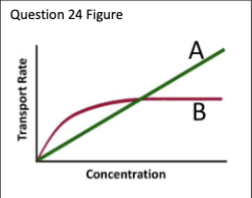
Which line in the figure best represents the concentration
dependence of glucose transport into cells? A or B
B
Compared to electrical synapses, chemical synapses
a. Can produce more variable signals
b. Are slower
c. Are more common in the brain
d. All of the above
e. None of the above
All of the above
Which of the following is/are true of channels and carriers
a. They have at least one gate
b. Their transport rates are about the same
c. They require ATP hydrolysis to transport substrate
d. All of the above
e. None of the above
They have at least one gate
Which of the following is/are true of Secondary Active Transporters?
a. They do not require an energy source.
b. They use ATP as an energy source to move a solute against its electrochemical gradient.
c. They use energy derived from movement of one solute down its electrochemical gradient to move
another solute against its electrochemical gradient.
d. They use ATP as an energy source to move a solute down its electrochemical gradient.
They use energy derived from movement of one solute down its electrochemical gradient to move
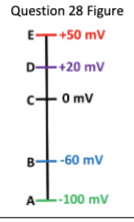
In the figure below, which value is the best estimate of the sodium equilibrium potential (ENa) in a neuron?
~ +60 mV
The sodium concentration inside our cells is maintained at a consistent concentration by the sodium-potassium
ATPase. Thus, the intracellular sodium is in a which of the following conditions?
a. Equilibrium
b. Steady State
c. Unsteady State
d. Homeostasis
Steady state
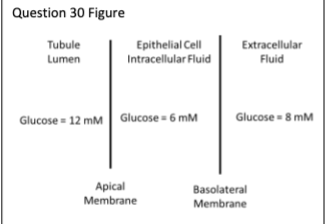
Glucose must be moved from a tubule lumen through an epithelial cell layer and into the extracellular fluid
where it will then enter a capillary. The relevant glucose concentrations are shown in the figure.
To move glucose from the lumen side of the epithelium to the capillary side of the epithelium, the apical
membrane should use __________________ and the basolateral membrane should use _________________.
a. Facilitated diffusion/Facilitated diffusion
b. Activate transport/Active transport
c. Activate transport/Facilitated diffusion
d. Facilitated diffusion/Activate transport
Facilitated diffusion/Activate transport
Which is a true statement about memory?
a. Consolidation converts non-declarative memories into declarative memories.
b. Short-term memory stores information for years, perhaps indefinitely.
c. In retrograde amnesia, the ability to form new memories is lost.
d. The cerebellum is an important site for storage of declarative memory.
e. Destruction of the hippocampus impairs consolidation of short-term memory into long-term memory
Destruction of the hippocampus impairs consolidation of short-term memory into long-term memory
Which of the following correctly describes a step in auditory signal transduction?
a. Displacement of the tympanic membrane with respect to the tectorial membrane stimulates stereocilia on hair cells.
b. Pressure waves on the oval window cause vibrations of the malleus, which is transferred to the stapes to the round window.
c. Oscillations of the stapes against the oval window sets up pressure waves in the semicircular canals.
d. None of the above
None of the above
A neurotransmitter may bind to an ionotropic receptor at synapses in one neuron and to a metabotropic receptor in synapses in a different neuron.
a. True
b. False
True
Receptor specificity refers which of the following.
a. The degree to which the receptors are occupied by the messenger.
b. The strength with which a chemical messenger binds to its receptor
c. The ability of a receptor to bind only one type or a limited number of structurally related types of chemical messengers.
d. The increased responsiveness of a target cell to a given messenger.
e. None of the above.
The ability of a receptor to bind only one type or a limited number of structurally related types of chemical messengers.
The selective suppression of pain without effects on consciousness or other sensation is which of the following?
a. Coma
b. Placebo effect
c. Hyperalgesia
d. Analgesia
e. Anesthesia
Analgesia
During concentric muscular contraction, there is shortening of the following components:
a. Muscle fiber
b. Actin
c. Myosin
d. Sarcomere
e. B and C
f. A and D
Muscle fiber and sarcomere (A and D)
A sarcomere contains all of the following EXCEPT--
a. A band
b. M line
c. L channel
d. H zone
e. All of these are in a sarcomere
L channel
In skeletal muscle, Ca2+ binds _________ which allows ____________ to dissociate from ____________ and the cross-bridge cycle to occur.
a. Tropomyosin; troponin; myosin
b. Tropomyosin; troponin; actin
c. Troponin; tropomyosin myosin
d. Troponin; tropomyosin; actin
e. T-tubule; troponin; actin
Troponin; tropomyosin; actin
Excitation-contraction in skeletal muscle requires a “triad.” In skeletal muscle, the triad contains the following:
a. Two T-tubules and one sarcoplasmic reticulum
b. One T-tubule and two sarcoplasmic reticula
c. One T-tubule, one sarcoplasmic reticulum, and one sarcolemma
d. One DHP receptor and two RyR receptors
e. None of the above
One T-tubule and two sarcoplasmic reticula
What is the smallest unit of skeletal muscle contraction that can be activated under physiological conditions?
a. Sarcomere
b. Muscle Fibril
c. Muscle Fiber
d. Motor Unit
Motor unit
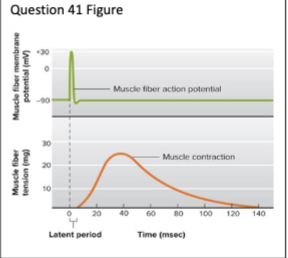
After an action potential fires at the neuromuscular junction of a skeletal muscle fiber, there is a latency period
before tension generation (fiber contraction; see the figure). What accounts for this latency period?
a. Cross bridge-cycling
b. ATP hydrolysis
c. Excitation-contraction coupling
d. Isometric contraction
e. A and D
Excitation-contraction coupling
________ is the force exerted by muscle on an object while ___________ is the force exerted by an object on
the muscle.
a. Load; Tension
b. Work; Load
c. Contraction; Tension
d. Load; Contraction
e. Tension; Load
Tension; Load
Ca2+ is essential for muscle contraction. How is it utilized in smooth muscle?
a. Binds troponin to release tropomyosin, allowing myosin to bind actin
b. Binds tropomyosin to release troponin, allowing myosin to bind actin
c. Initiates signaling cascade for myosin hydrolysis
d. Initiates signaling cascade for myosin phosphorylation
Initiates signaling cascade for myosin phosphorylation
In excitation-contraction of cardiac muscle…
a. DHPR mechanically couples with RyR for Ca2+ release sufficient for contraction.
b. Voltage gated Ca2+ channels create strong inward current of Ca2+ sufficient for contraction.
c. Calcium-induced calcium release (CICR) increases cytosolic Ca2+ sufficient for contraction.
d. CaCaMK phosphorylates myosin sufficient for contraction.
Calcium-induced calcium release (CICR) increases cytosolic Ca2+ sufficient for contraction.
Sam is a third-year medical student doing an emergency medicine rotation. A patient Ms. B. is brought into the emergency room showing signs of dehydration but is unable to drink. Sam administers 1 liter of sterile distilled water intravenously (I.V.) but Ms.B. gets much worse. Sam tells the attending physician what happened. The doctor draws a blood sample and centrifuges it. The red blood cells sink to the bottom of the tube. The liquid plasma, rather than it’s typical clear gold color, appears pink due the presence of hemoglobin. Hemoglobin is normally contained inside the red blood cells. The attending then administers 1 liter of sucrose solution by I.V. and Ms. B. slowly improves. (5 points)
What did the infusion of distilled water do the osmolarity of Ms. B’s blood?
The osmolarity decreased.
Sam is a third-year medical student doing an emergency medicine rotation. A patient Ms. B. is brought into the emergency room showing signs of dehydration but is unable to drink. Sam administers 1 liter of sterile distilled water intravenously (I.V.) but Ms.B. gets much worse. Sam tells the attending physician what happened. The doctor draws a blood sample and centrifuges it. The red blood cells sink to the bottom of the tube. The liquid plasma, rather than it’s typical clear gold color, appears pink due the presence of hemoglobin. Hemoglobin is normally contained inside the red blood cells. The attending then administers 1 liter of sucrose solution by I.V. and Ms. B. slowly improves.
Did the water make the plasma hypertonic, isotonic or hypotonic compared to the intracellular fluid of the red blood cells?
hypotonic
Sam is a third-year medical student doing an emergency medicine rotation. A patient Ms. B. is brought into the emergency room showing signs of dehydration but is unable to drink. Sam administers 1 liter of sterile distilled water intravenously (I.V.) but Ms.B. gets much worse. Sam tells the attending physician what happened. The doctor draws a blood sample and centrifuges it. The red blood cells sink to the bottom of the tube. The liquid plasma, rather than it’s typical clear gold color, appears pink due the presence of hemoglobin. Hemoglobin is normally contained inside the red blood cells. The attending then administers 1 liter of sucrose solution by I.V. and Ms. B. slowly improves.
How did the pure water I.V. lead to hemoglobin appearing in the plasma?
Water moved into the RBC. (1 pt)
The RBCs swelled then burst, releasing hemoglobin into the plasma. (1 pt)
Sam is a third-year medical student doing an emergency medicine rotation. A patient Ms. B. is brought into the emergency room showing signs of dehydration but is unable to drink. Sam administers 1 liter of sterile distilled water intravenously (I.V.) but Ms.B. gets much worse. Sam tells the attending physician what happened. The doctor draws a blood sample and centrifuges it. The red blood cells sink to the bottom of the tube. The liquid plasma, rather than it’s typical clear gold color, appears pink due the presence of hemoglobin. Hemoglobin is normally contained inside the red blood cells. The attending then administers 1 liter of sucrose solution by I.V. and Ms. B. slowly improves.
Why did the attending physician give Ms B. an I.V. sucrose solution (sucrose cannot cross the red blood cell membrane)?
Sucrose increased the plasma tonicity and stopped the red blood cell swelling.
Glucose transport across the kidney tubule epithelium is depends on the sodium-glucose co-transporter. Why does inhibiting the sodium-potassium ATPase cause glucose transport to slow down and eventually stop?.
Glucose is moved against its concentration gradient (1pt) using the energy from sodium moving down its electrochemical gradient. (1 pt)
Inhibiting the sodium-potassium ATPase will reduce (eventually abolish) the sodium electrochemical gradient. (1 pt)
Without energy from sodium gradient, glucose cannot be moved against its concentration gradient
An action potential has led to increased cytosolic Ca2+ in a skeletal muscle cell.
List/describe the steps of the cross-bridge cycle that occur starting with the rest state. (hint: 4 states, 4 points) (3-5 sentences)
Rest state: troponin and tropomyosin bound to actin, ADP-Pi bound to myosin.
2. Ca2+ binds troponin; troponin-tropomyosin complex moves, allowing actin and myosin to bind
3. Release of ADP-Pi → conformational change of myosin (power stroke)
4. ATP binds myosin → detachment of myosin from actin. ATP hydrolysis by myosin ATPase.
Which of the following sensory receptors is sensitive to changes in muscle length
a. Golgi tendon organs
b. Paciniform corpuscles
c. Muscle spindles
d. Ruffini receptors
Co-activation of alpha- and gamma-motor neurons is important to do which of the following
a. maintain sensitivity of the golgi tendon organs
b. maintain sensitivity of the muscle spindles
c. prevent overstretch of the golgi tendon organs
d. sense muscle tension
When standing upright individuals tend to sway unconsciously forward and backward. The forward sway initiates a reflex contraction of the soleus and gastrocnemius muscles and brings the body back to vertical. This is an example of which reflex
a. the righting reflex
b. the crossed-extensor reflex
c. the stretch reflex
d. the inverse myotatic reflex
Corticospinal neurons that originate in the right sensorimotor cortex control muscle on mainly which side of the body?
a. Right
b. Left
c. Both
Sympathetic ganglia are ______ the spinal cord and ________ the effector organ.
Parasympathetic ganglia are _______ the spinal cord and _______ the effector organ.
a. Far from…close to; close to…far from
b. Far from…far from; close to…close to
c. Close to…far from; far from…close to
d. Close to…close to; far from…far from
Close to…far from; far from…close to
Sympathetic ganglia are ______ the spinal cord and ________ the effector organ. Parasympathetic ganglia are _______ the spinal cord and _______ the effector organ.
a. Far from…close to; close to…far from
b. Far from…far from; close to…close to
c. Close to…far from; far from…close to
d. Close to…close to; far from…far from
c. Close to…far from; far from…close to
Which of the following are stimulated by the sympathetic nervous system?
a. Increased heart rate; vasoconstriction in skeletal muscle; dilated bronchioles
b. Increased heart contractility; increased blood to brain; glucose storage
c. Decreased heart rate; decreased gastric motility; pupil dilation
d. Decreased blood pressure; increased gut motility; pupil constriction
Which of the following does NOT bind acetylcholine?
a. Neuromuscular junction
b. Nicotinic receptor
c. Muscarinic receptor
d. ß-receptor
A sympathetic neuron synapses at an effector organ. Which of the following neurotransmitters will be released?
a. Acetylcholine
b. Norepinephrine only
c. Epinephrine and norepinephrine
d. Epinephrine only
Many effector organs are innervated by both sympathetic and parasympathetic fibers to allow fine-tuning of physiological response. This is referred to as…
a. Dual inhibition
b. Bilateral innervation
c. Dual innervation
d. The autonomic principle
A preganglionic autonomic neuron synapses with the postganglionic autonomic neuron in the autonomic ganglia. _______ is released which binds ________ receptors.
a. Epi/norepi; alpha
b. Epi/norepi; beta
c. Acetylcholine; muscarinic
d. Acetylcholine; nicotinic
What type of signaling mechanism is utilized by nicotinic acetylcholine receptors?
a. Second messenger system
b. Binding/opening of ion channels
c. Metabotropic mechanisms
d. Direct depolarization of post-synaptic cell
The pulmonary veins carry which of the following
a. deoxygenated blood to the lungs
b. deoxygenated blood to the left atrium
c. oxygenated blood to the lungs
d. oxygenated blood to the left atrium
Parasympathetic innervation of heart is mainly to which of the following
a. The sinoatrial node
b. The atrioventricular (AV) node
c. The ventricles
d. The atria and the ventricles
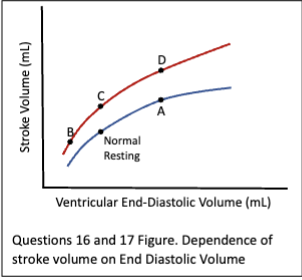
At which point of the cardiac cycle does the heart contain the smallest volume of blood?
a. Beginning of systole
b. End of systole
c. End of diastole
d. None of the above
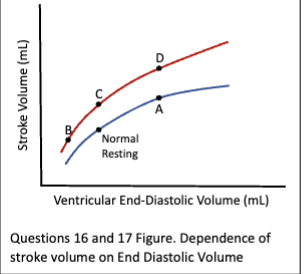
The figure illustrates the
dependence of cardiac stroke
volume on ventricular end-diastolic
volume. If all else is constant, an
increase in contractility will cause a
shift from the point labeled
“Normal Resting" to which of the following points on the graph.
A.
B.
C.
D
C