Ch 15 & 16 Practice Problems
 Call Kai
 Learn
Learn Practice Test
 Spaced Repetition
 Match
Match Flashcards
 Knowt Play
1/42

There's no tags or description
Looks like no tags are added yet.
Name | Mastery | Learn | Test | Matching | Spaced | Call with Kai |
|---|
No analytics yet
Send a link to your students to track their progress
43 Terms
A firm has market power if it can
influence the market price of the good it sells
Which of the following is not a characteristic of a competitive market?
Entry is limited
In a competitive market, the actions of any single buyer or seller will
have a negligible impact on the market price
When firms are said to be price takers, it implies that if a firm raises its price,
buyers will go elsewhere.
Suppose that in a competitive market ehe equilibrium price is $2.50. What is the marginal revenue for the last unit sold by the typical firm in this market?
exactly $2.50
If a competitive firm is currently producing a level of output at which marginal costs exceeds marginal revenue, then
decreasing output would increase the firm’s profit.
Robin owns a horse stables and riding academy and gives riding lessons for children at “pony camp.” Her business operates in a competitive industry. Robin gives riding lessons to 20 children per month. Her monthly total revenue is $4,000. The marginal cost of pony camp is $100 per child. In order to maximize profits, Robin should
give riding lessons to more than 20 children per month
If a perfectly competitive firm’s price is above its average total cost, the firm
is earning a profit
If a perfectly competitive firm’s price is less than its average total cost but greater than its average variable cost, the firm
is incurring a loss
The competitive firm’s long-run supply curve is that portion of the marginal cost curve that lies above average
total cost
Which of the following represents the firm’s long-run condition for exiting a market?
exit if P < ATC
Suppose that the organic-produce industry is composed of a large number of small firms. In recent years, these firms have suffered economic losses, and many sellers have left the industry. Economic theory suggests that these conditions will…
cause the market supply to decline and the price of organic produce to rise.
A natural monopoly is most likely to occur in which of the following industries?
an industry where fixed costs are very large relative to variable costs.
To have a monopoly in an industry there must be
barriers to entry so high that no other firms can enter the industry.
Governments grant patents to encourage
research and development on new products
Which of the following is a characteristic shared by a perfectly competitive firm and a monopoly?
Each maximizes profits by producing a quantity for which marginal revenue equals marginal cost.
A monopolist faces
a downward-sloping demand curve
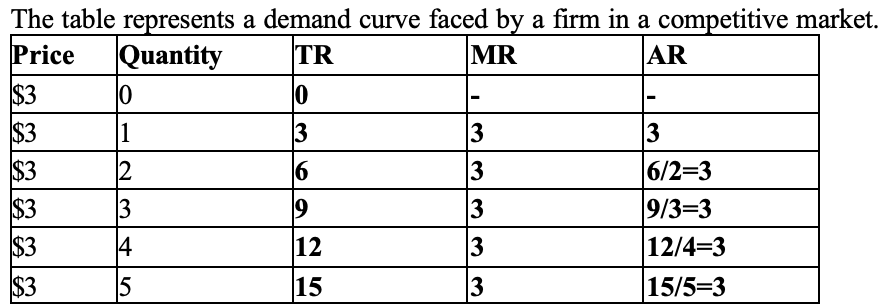
Refer to Table 14-2. For this firm, the marginal revenue from selling the 3rd unit is
$3
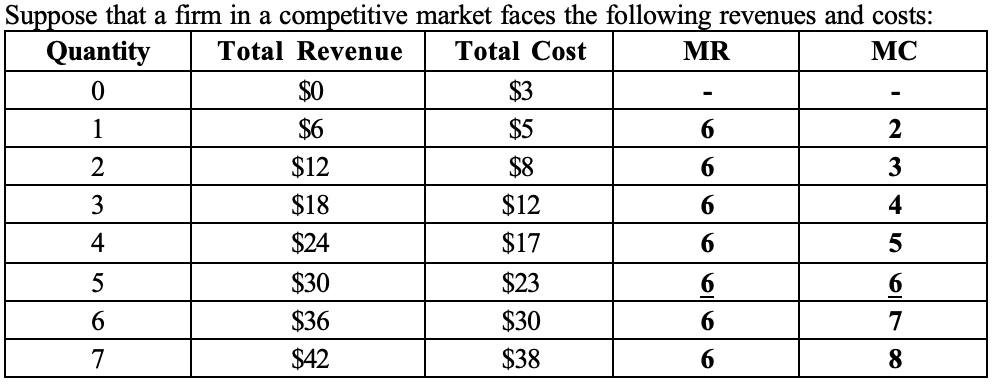
Refer to Table 14-8. The firm should not produce an output level beyond
5 units
Refer to Table 14-8. In order to maximize profits, the firm will produce
5 units of output because marginal revenue equals marginal cost.
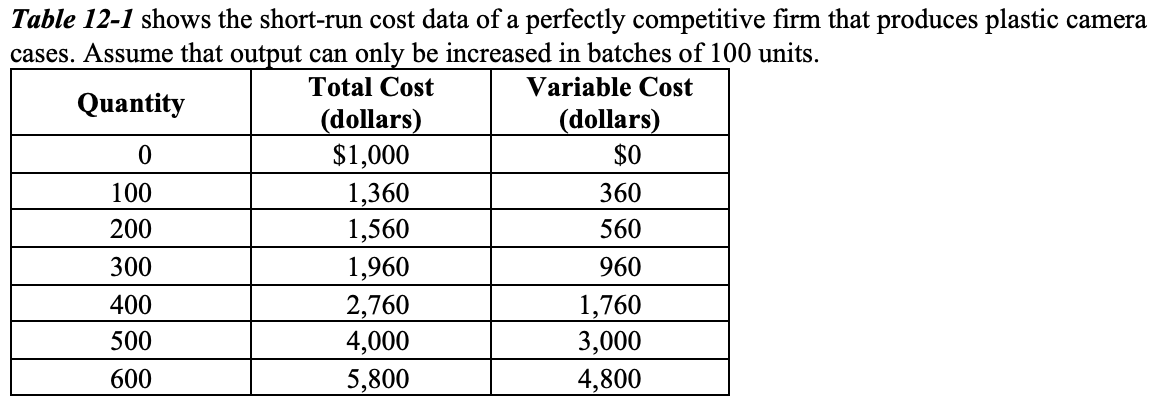
Refer to Table 12-1. If the market price of each camera case is $8, what is the profit-maximizing quantity?
400 units
Refer to Table 12-1. If the market price of each camera came is $8, what is the firm’s total revenue?
$3,200
Refer to Table 12-1. If the market price of each camera case is $8 and the firm maximizes profit, what is the amount of the firm’s profit or loss?
profit of $440
Refer to Table 12-1. Suppose the fixed cost of production rises by $500 and the price per unit is still $8. What happens to the firm’s profit-maximizing output level?
It will remain the same.
Refer to Table 12-1. The firm will not produce in the short run if the output price falls below
$2.80
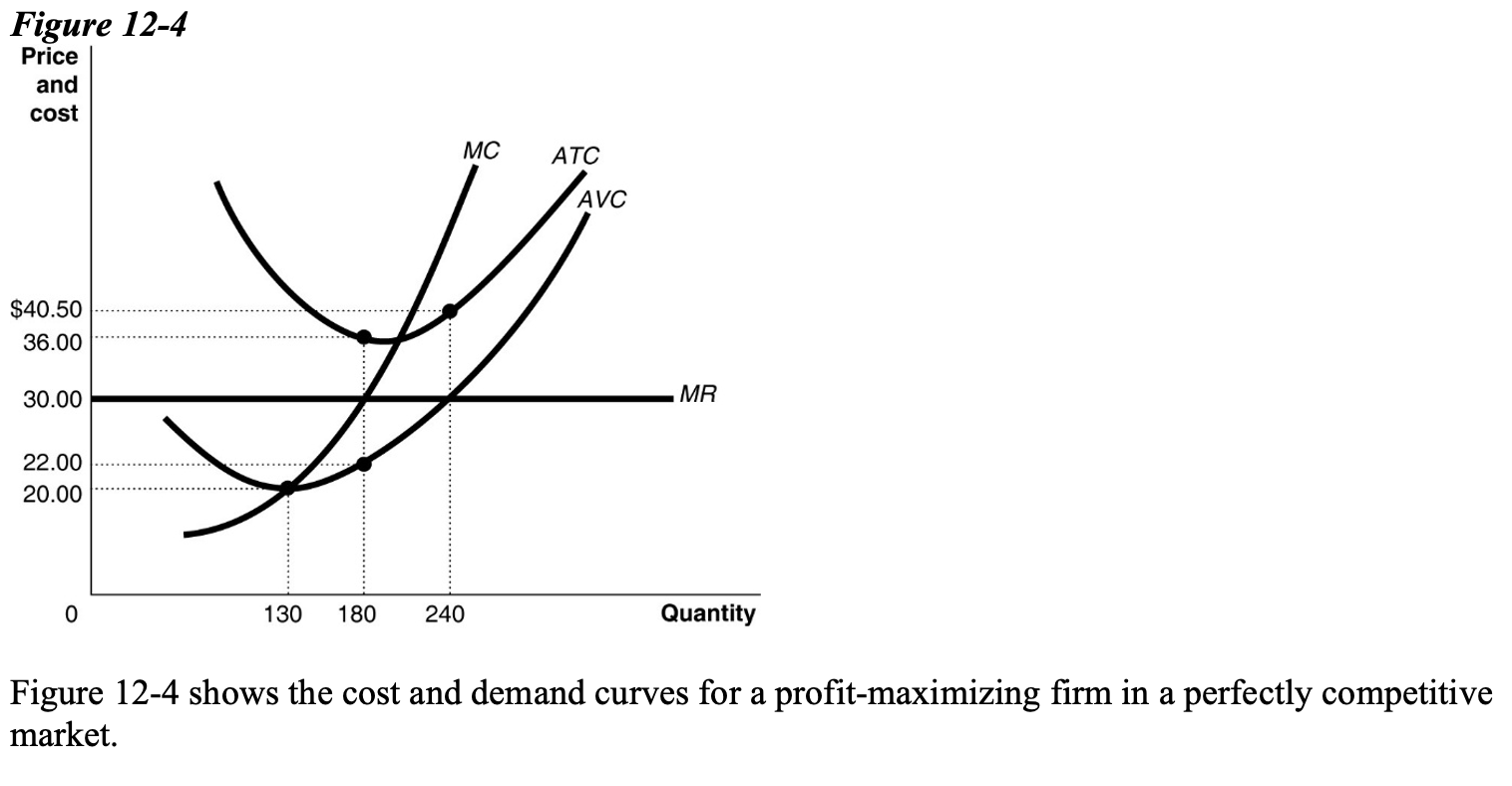
Refer to Figure 12-4. If the market price is $30, the firm’s profit-maximizing output level is
180
Refer to Figure 12-4. If the market price is $30 and the firm is producing output, what is th amount of the firm’s profit or loss?
loss of $1,080
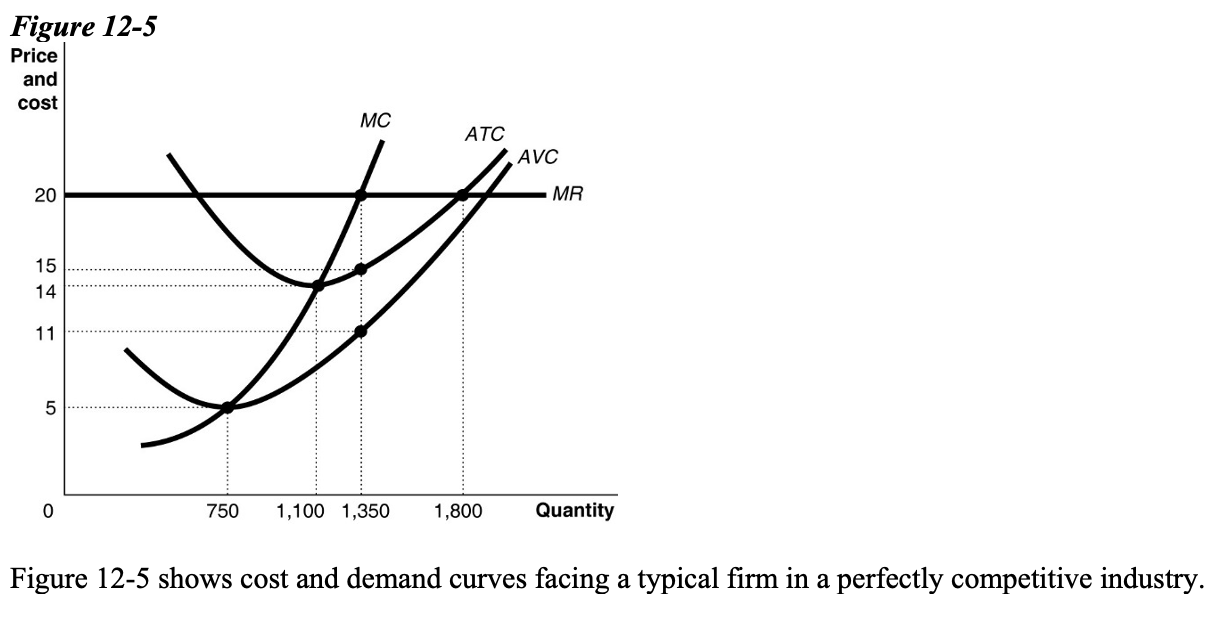
Refer to Figure 12-5. If the market price is $20, what is the amount of the firm’s profit?
$6,750
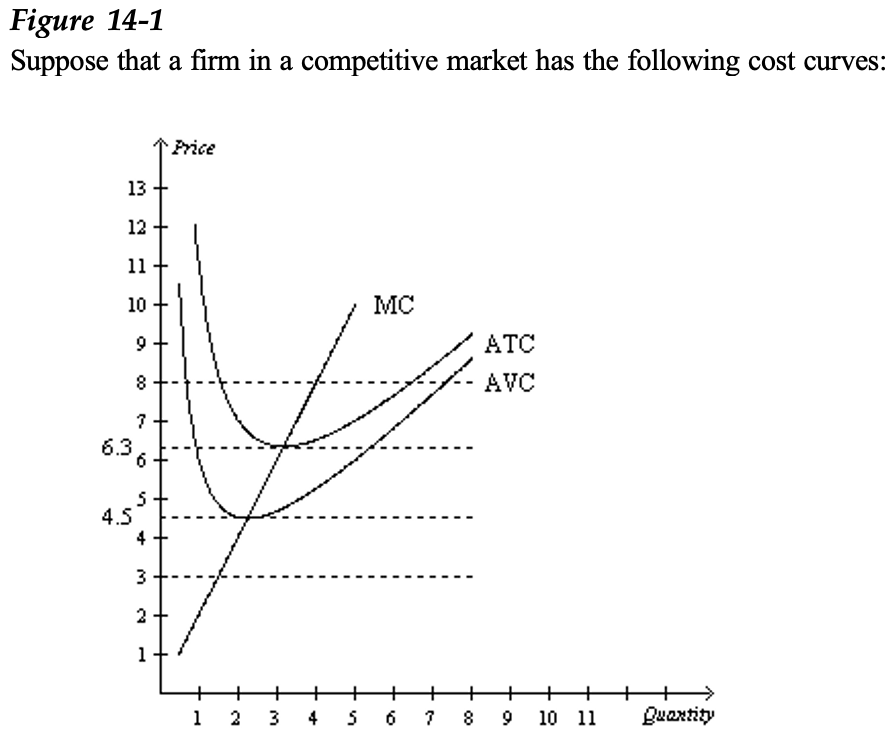
Refer to Figure 14-1. The firm’s short run supply curve is its marginal cost curve about
$4.50
Refer to Figure 14-1. The firm should shut down if the market price is
less than $4.50
Refer to Figure 14-1.The firm will earn a negative economic profit but remain in business in the short run if the market price is
less than $6.30 but more than $4.50
Refer to Figure 14-1. The firm will earn a positive economic profit in the short run if the market price is
above $6.30
Refer to Figure 14-1. If the market price is $5.00, the firm will earn
negative economic profits in the short run but remain in business.
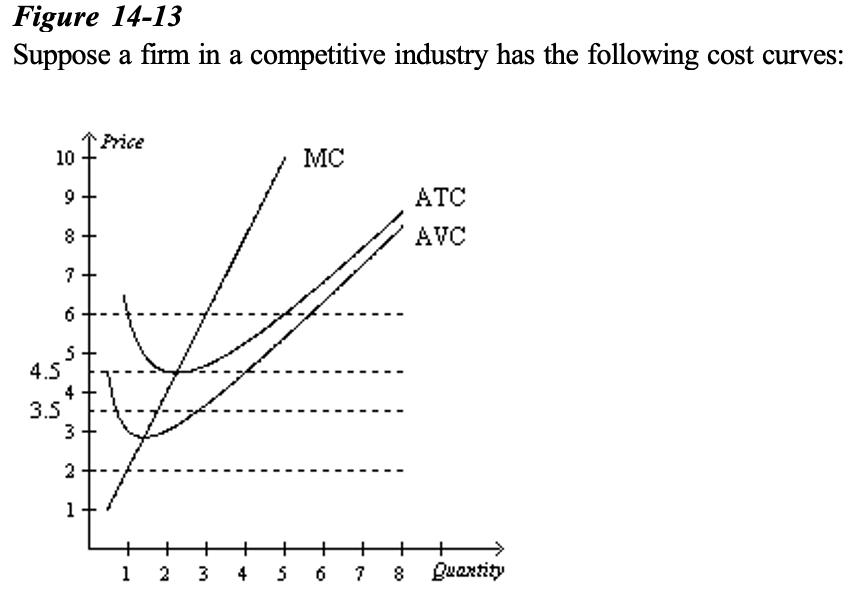
Refer to Figure 14-13. If the price is $6 in the short run, what will happen in the long run?
Individual firms will earn positive economic profits in the short run, which will entice other firms to enter the industry.
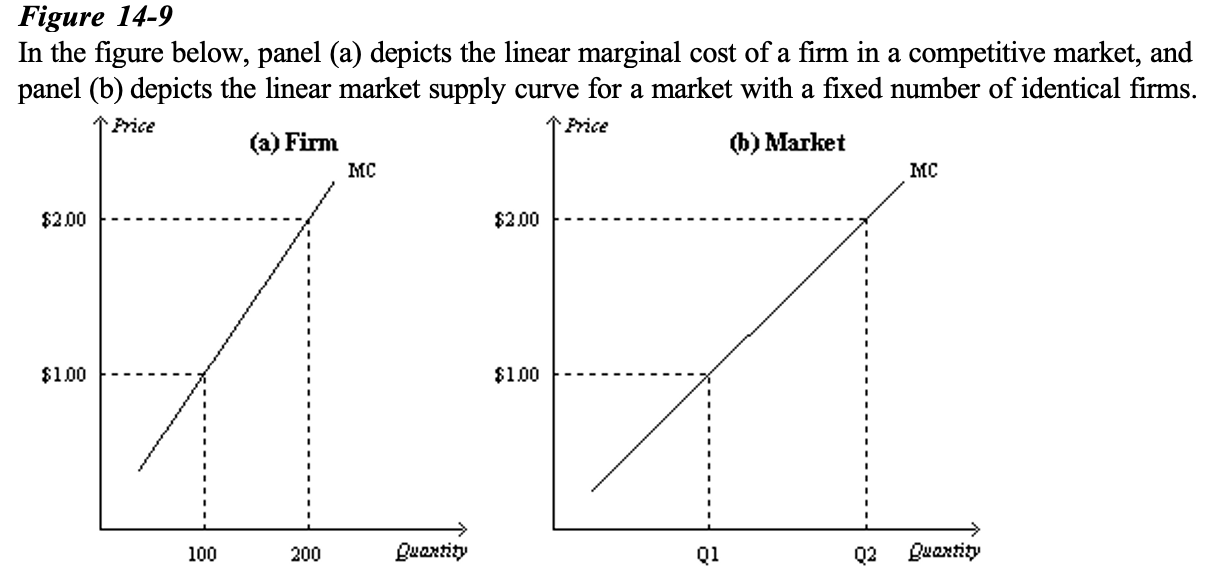
Refer to Figure 14-9. If there are 300 identical firms in this market, what level of output will be supplied to the market when price is $1.00?
30,000
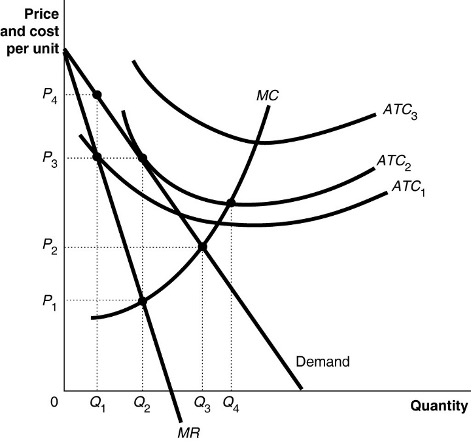
Refer to Figure 15-2. To maximize profit, the firm will produce
Q2
Refer to Figure 15-2. The firm’s profit maximizing price is
P3
Refer to Figure 15-2. If the firm’s average total cost curve it ATC2 , the firm will
break even
Refer to Figure 15-2. If the firm’s average total cost curve is ATC3 , the firm will
suffer a loss
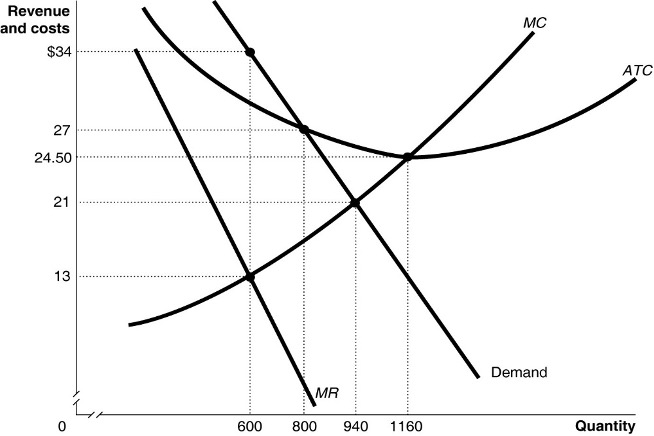
Refer to Figure 15-9. What is the economically efficient output level?
940 units
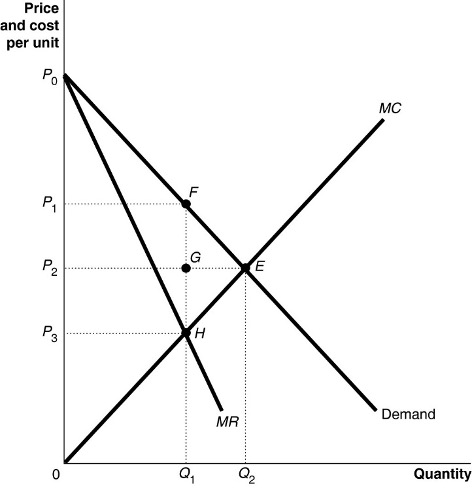
Refer to Figure 15-10. What is the area that represents consumer surplus under a monopoly?
the triangle P0 P1 F
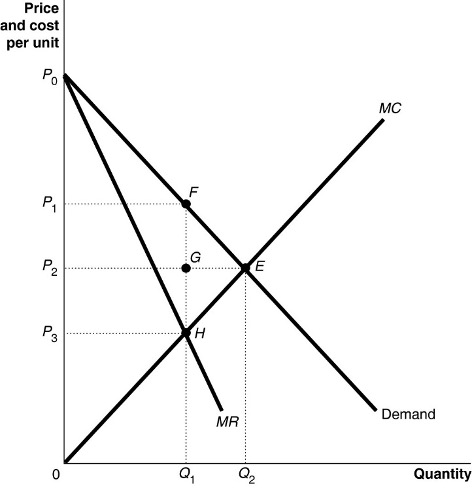
Refer to Figure 15-10. What is the area that represents producer surplus under a monopoly?
the trapezium 0 P1 F H
Refer to Figure 15-10. The deadweight loss due to a monopoly is represented by the area
F H E