Cog: Problem solving and creativity
 Call Kai
 Learn
Learn Practice Test
 Spaced Repetition
 Match
Match Flashcards
 Knowt Play
1/31

There's no tags or description
Looks like no tags are added yet.
Name | Mastery | Learn | Test | Matching | Spaced | Call with Kai |
|---|
No analytics yet
Send a link to your students to track their progress
32 Terms
Problem solving
used when you want to reach a certain goal, but the solution is not immediately obvious
missing information and/or obstacles block the path
Components of a problem
initial state
Point A
goal state
Point B
Obstacles
What comes in-between
understanding the problem
construct a well-organized mental representation of the problem
based on the information provided in the problem and previous experience
Paying attention to important information
identify and attend to the most relevant information
effective problem solvers read the description of a problem very carefully, paying particular attention to inconsistencies
bad decisions sometimes come from working/deciding too fast
Methods of representing a problem
problem representation
how you represent the problem in your mind
working-memory capacity
if you can keep a lot of things online at once, do not need to worry
symbols
algebra, translating words into symbols
oversimplification
do not want to leave out important pieces
matrices
matrix- grid showing all possible combinations of items
most useful for complex, stable, categorical information
Diagrams
instructions for assembling objects
represent abstract information in a concrete fashion
reduce large amount of complicated information into a concrete form
hierarchical tree diagram
Graphs
Situated Cognition approach
We often use helpful information in our immediate environment to create spatial representations; importance of external situation/context.
You kind of had to be there… taking in all of the situation to solve a problem
Our ability to solve a problem is tied into the specific physical and social context in which we learned to solve that problem.
An abstract intelligence test often fails to reveal how competent a person would be in solving problems in real-life settings.
Problem solving doesn’t only take place inside a person’s head.
Real life provides info needed to solve complicated problems.
Other people also provide information.
Adjusting and problem-solving on the fly based off of the situation and the context
implications for education
ecological validity
If it is applicable to a setting outside of a lab in the real-world
Embodied Cognition approach
We often use our own body and our own motor actions, in order to express our abstract thoughts and knowledge; importance of own body as context.
Embodied Cognition
People solve certain kinds of problems more quickly or more accurately if allowed to move parts of their bodies.
Motor patterns used to solve a problem
mental-rotation tasks
Question about turning shapes
swinging rope problem
If you can get the rope to swing, you can get further than you previously thought you could to solve a problem
Problem-solving strategies
algorithm
exhaustive search
heuristic/general rule
analogy approach
Algorithm
always produces a solution; sometimes inefficient
Not as quick; tend to do short cuts
Will do algorithm if decision comes with heavy cost (ex: buying a house)
Exhaustive search
try all possible answers
Heuristic- General rule
strategy in which you ignore some alternatives and explore only those alternatives that seem especially likely to produce a solution
See if you could do something on your own (building a coffee machine versus a couch; less daunting)
Will use heuristic when faced with a problem you are familiar with, when you are stressed (be careful of that)
Scams rush time so that you take short cuts in your decision making
weigh the costs and benefits of using heuristics
The analogy approach
using a solution to a similar, earlier problem to help in solving a new problem
Engineers, cross-cultural research, creative breakthroughs
The structure of the analogy approach
Determining the real problem
Often distracted by surface features
Need to focus on structural features
Often failure to see analogies or solving
A problem in a new setting
Cancer and war
Come at the castle from all sides
Hit cancer from all sides avoiding damaging the important tissues with the chemo
Need to sit back and figure out how problem solving strategies relate and work for different scenarios
Factors that Encourage Appropriate Use of Analogies
overcoming the influence of context
trying several structurally similar problems before the target problem
Making connections: using creativity
training to sort problems into categories based on structural similarities
Watson study and sport injury
Extinction (extinguish relationships)
Separate the association between two variables
Separating the injury from the technique or from the sport
Relationship of learned pain and fear to movement/context
The Means– Ends Heuristic
important components
1. divide the problem into subproblems
With each subproblem, how are you getting there
2. try to reduce the difference between the initial state and the goal state for each of the subproblems
identify the “ends” you want and then figure out the “means” to reach them
Doesn’t seem as daunting when you break it down
one of the most effective and flexible problem-solving strategiesR
Research on the Means-Ends Heuristic
People pause at points in the problem when they begin to tackle a subproblem and need to organize a sequence of moves.
Working memory is active during planning.
Sometimes the correct solution requires moving backward, temporarily increasing the distance to the goal.
Ex: to go forward, need to take a step back
People are reluctant to move away from their goal state.
The Hill-Climbing Heuristic
When you reach a choice point, choose the alternative that seems to lead most directly toward your goal.
useful when only the immediate next step can be seen; not enough information about alternatives
Could miss the other ways you could have gone about achieving goal
The less direct alternative may have greater long-term benefits.
doesn’t guarantee the goal will be reached
encourages short-term goals, rather than long-term solutions
Getting a job right out of high school (just want to make money and not do a side-ways route)
Factors that influence problem solving
Mental set
functional fixedness
insight versus noninsight problems
Factors that influence problem solving: Mental Set
using the same solution from previous problems, even though the problem could be solved by a different, easier method
Mindset gets rigid, limit you creativity and finding new ways to solve problems
close mind prematurely; stop thinking
Self-imposed limitations; at least let your head go there, does not hurt to think about it
Barriers can come from upbringing, culture, experience, etc.
Ex: deciding to live in a bus
breaking mental set associated with greater change in event-related brain potentials (ERPs)
overactive top-down processing
Fixed mindset
Factors that influence problem solving: Functional Fixedness
assign stable uses to an object
Hard time seeing different, creative ways to use objects
fail to think about the features of the object that might be useful in helping solve a problem
overactive top-down processing
Duncker’s candle problem
Have them figure out how to put up candle when given tacks in the box
Many of them thought the box could not be used (already holding the tacks); until the tacks were dumped out of the box
Insight Problem
seems impossible until sudden solution appears; light bulb, “aha”
Mentally stuck and then doing something different; and solutions randomly comes to mind
Noninsight problem
gradual solution
Data gathering, try different alternatives, heuristics, etc.
The Nature of Insight
The Nature of Insight
begin with inappropriate assumptions that need to be discarded
inappropriate use of top-down processing
Have to get away from how we thought of it before
Metacognition during Problem Solving
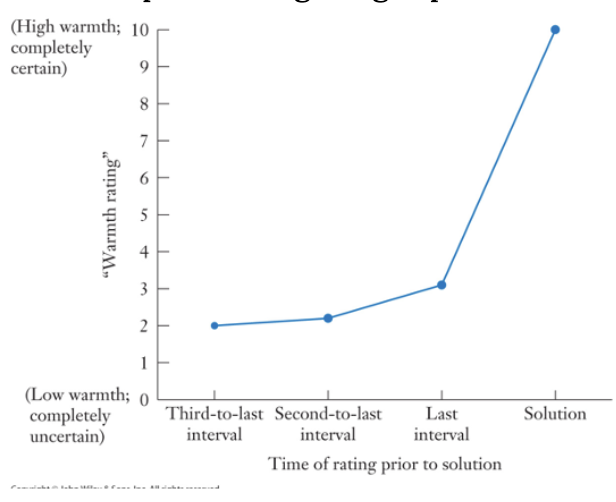
Janet Metcalfe (1986)—People’s confidence builds gradually for noninsight problems, but shows a sudden leap in solving insight problems.
A stranger approached a museum curator and offered him an ancient bronze coin. The coin had an authentic appearance and was marked with the date 544 B.C. The curator had happily made acquisitions from suspicious sources before, but this time he promptly called the police and had the stranger arrested. Why?
If they let themselves question whether or not it was correct, then got the answer
Problem solvers typically report a dramatic increase in their confidence when they believe they have located the correct solution to an insight problem.
Advice about Problem Solving
think about previous experience with similar problems
consider whether the problem might require insight.
If a problem seems to be an insight problem:
try to represent the problem in a different way
think about a different meaning for an ambiguous word
draw sketches, work with physical objects, use gestures
be willing to think “outside the box”
Creativity
finding solutions that are novel and useful
Psychologists disagree as to whether creativity involves ordinary thinking or exceptional people.
Guilford’s Classic Approach to Creativity
divergent production—measure creativity in terms of the number of different responses made to a test item
How many different approaches to a problem
Divergent Production Tests
moderate correlations between divergent production test scores and other judgments of creativity
number of solutions doesn’t indicate novelty and/or usefulness
The Nature of Creativity
1. Creativity includes convergent thinking as well as divergent thinking. (In contrast, convergent production asks test-takers to supply a single, best response.)
Kids are not as locked in in thinking
Come at things from a new angle
2. Creativity is associated with many regions within the left hemisphere as well as many regions within the right brain. (tend to hear it is from right brain but it is from both)
3. Creativity can occur when we use focused attention (conscious attention) as well as defocused attention (altered states of consciousness).
Research on creativity is limited; not really measurable
Creativity can show up in many domains
Extrinsic Motivation and creativity
extrinsic motivation—desire to work on a task to earn a promised reward
People often produce less creative projects if working on these projects for external reasons.
Creativity can be enhanced if the extrinsic factors provide useful feedback.
Intrinsic Motivation and Creativity
People more likely to be creative when working on a task that they truly enjoy.
The more self-efficacy and intrinsic motivation the better the work produced.