Part 2: Pure competition
 Call Kai
 Learn
Learn Practice Test
 Spaced Repetition
 Match
Match Flashcards
 Knowt Play
1/25

Earn XP
Description and Tags
Lecture slides: 25- 45
Name | Mastery | Learn | Test | Matching | Spaced | Call with Kai |
|---|
No analytics yet
Send a link to your students to track their progress
26 Terms
Again, what are the two approaches to analyse maximising profit in the short run
Total Revenue and Total Cost Approach
Marginal Revenue and Marginal cost approach
In the MR &MC approach, what does the firm compare
The amount that each additional unit of output will add to total revenue
What does it mean when
MR>MC
MC>MR
The most recent additional unit(last unit) produced brings in more revenue than the cost, so it’s worth producing
The last unit costs more than it earns, so it reduces the profit
Typically when output is relatively low _____ will exceed Marginal cost and the production is _____
BUT
When output is relatively large ______ will exceed marginal revenue and the firm will wan to _______

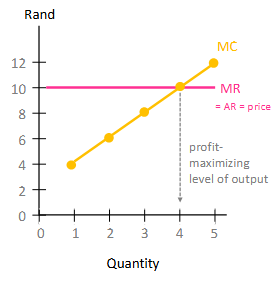
What’s the MR=MC Rule and for pure competition, how can it be reinstated?
Produce until Marginal revenue = Marginal cost, as long as Selling Price ≥ Average variable Cost. That’s where profit is maximized or loss minimized. If the selling price is smaller, then it is better to shut down
P=MR=MC
Why isn’t the profit-maximisation rule MR>MC instead
MR > MC means the firm should keep producing more, because each extra unit is still adding to profit.
But if you stop there, you haven’t yet reached the maximum — you’re still climbing.
Profit maximisation happens exactly at MR = MC(peak-producing less, means leaving profit unearned and producing more means profit starts shrinking, mc>mr)
True/False
The profit maximisation rule of MR=MC applies to all types of firms
True
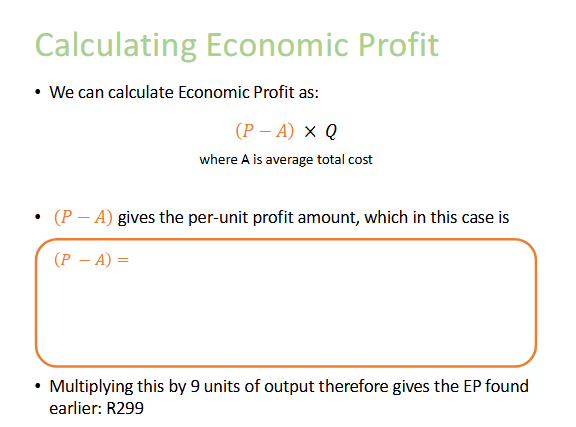
Why can we calculate economic profit like this (P-ATC) X Q
Price (P) = selling price per unit.
Average Total Cost (ATC) = cost per unit (explicit + implicit costs spread across output).
Per‑unit profit = P−ATC.
Multiply by quantity (Q) → total economic profit.
👉 Example:
Price per unit = R131
ATC per unit = R98
Per‑unit profit = R33
If Q = 9 units → Economic profit = 33×9=R297
For per-unit profit : P-ATC
If positive →
If zero →
If negative →
economic profit per unit.
normal profit (break‑even).
economic loss per unit.
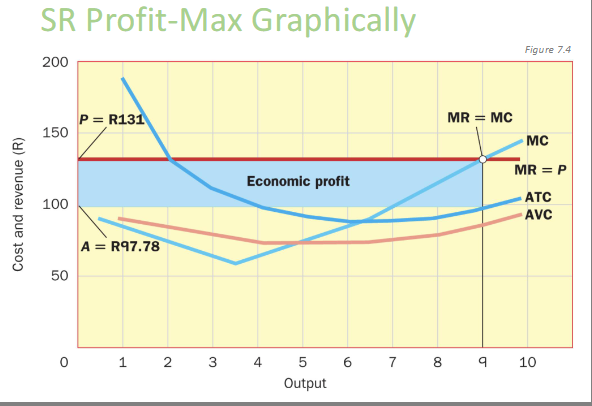
How to get the economic profit with the graph
AREA
Width: P-ATC(per-unit profit)
Length: Q (Units produced at MR=MC)
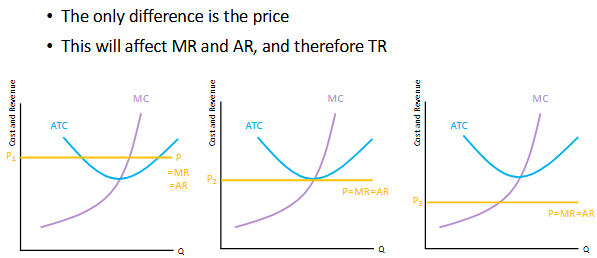
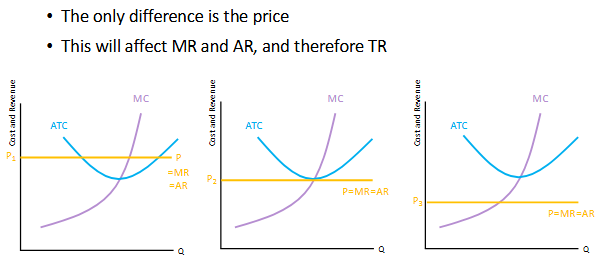
What do each of these graphs represent
Economic profit
Normal profit
Economic loss
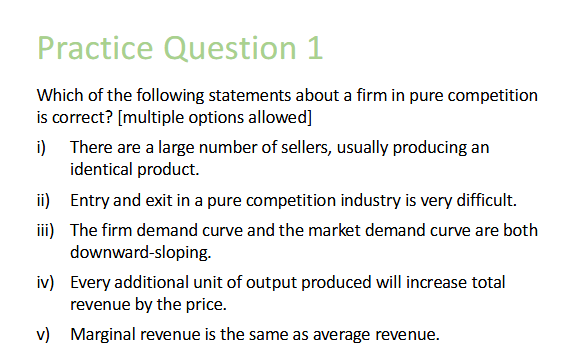
What’s true, what’s false
True
False
False: firm demand is horizontal perfect elastic
true
true
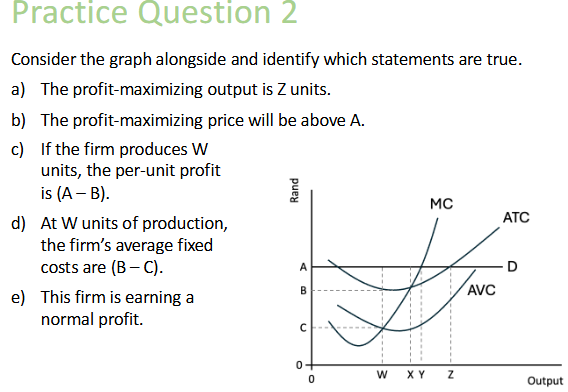
Whats true,whats false
False,Y
No,on A
True
Yes
False,economic profit (price above ATC)
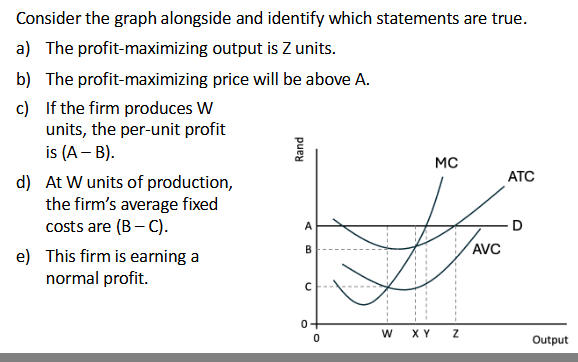
What does the intersection of mc and atc mean?
The intersection point is the minimum of the ATC curve.
Reason:
When MC < ATC, it pulls ATC down.
(If the cost of the next unit (MC) is lower than the current average (ATC), adding it reduces the overall average.
Example: If your average meal cost is R100, and the next meal costs R70, the new average drops below R100.)
When MC > ATC, it pushes ATC up.
So the only point where ATC stops falling and starts rising is exactly where MC = ATC.
Are Profit maximisation and loss minimisation the same thing,just said diffferently?
NO,JUST RELATED
Profit maximisation:
Happens when Total Revenue > Total Cost.
The firm chooses the output where MR = MC to make the biggest possible economic profit.
Loss minimisation:
Happens when Total Revenue < Total Cost.
The firm is still at MR = MC, but here the goal is to reduce losses as much as possible.
Producing at MR = MC ensures the firm loses the least compared to producing more (which increases losses) or less (which misses revenue that could cover some costs).
What does MR=MC mean in terms of loss minimisation
Even though the firm is losing overall,MR=MC is still gives the least possible loss
(Producing less would mean missing revenue that could cover some costs.
Producing more would mean MC > MR, so losses get bigger.)
True/false
In the short-run a firm will not incur fixed costs even if it does not produce
False,it will incur fixed costs
What is a sunk cost
ie.y ou eat a terrible $30 meal just to "get your money's worth," even though eating it makes you unhappy.

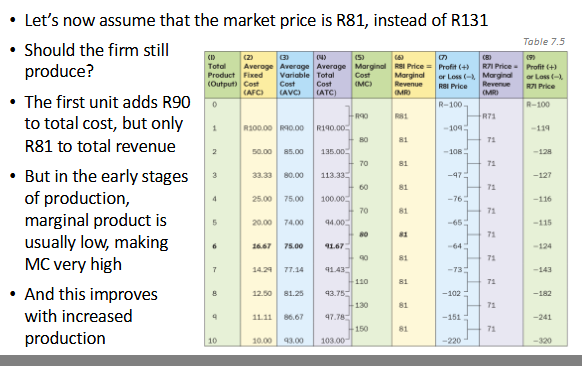
Whats the loss-minimizing case
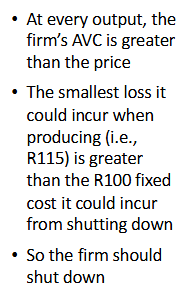
Why does for lose R100 if they shut down
The firm would lose R100 if it shuts down because of fixed costs.
Fixed costs (like rent, insurance, machinery) must be paid whether the firm produces or not.
If the firm shuts down in the short run, it earns zero revenue but still owes those fixed costs.
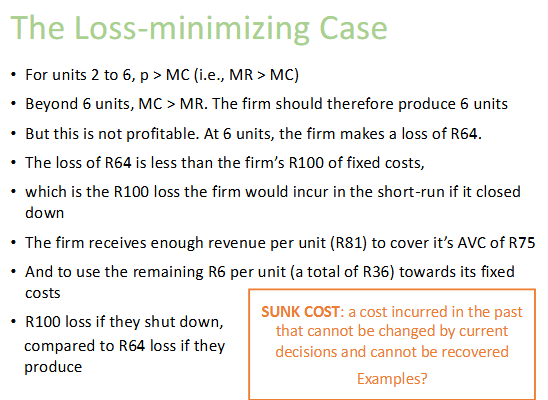
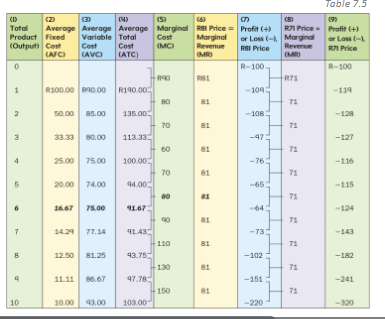
The price is R71
Explain why this firm is experiencing a ‘shutdown case’
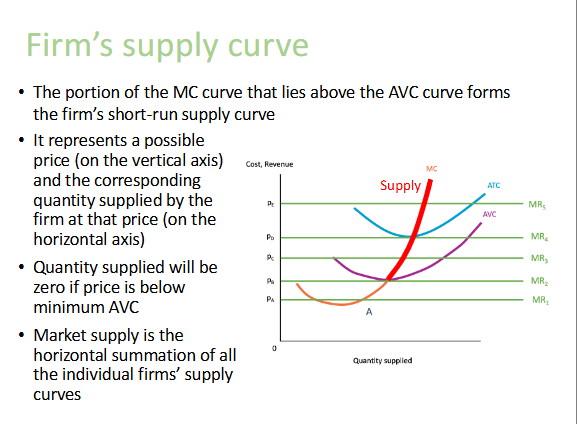
With the supply schedule a frim will not produce at a price lower than the _______cost
Quantity supplied increases as the ____increases
_____increases as the price increases
Minimum average variable cost
Price
Economic profit
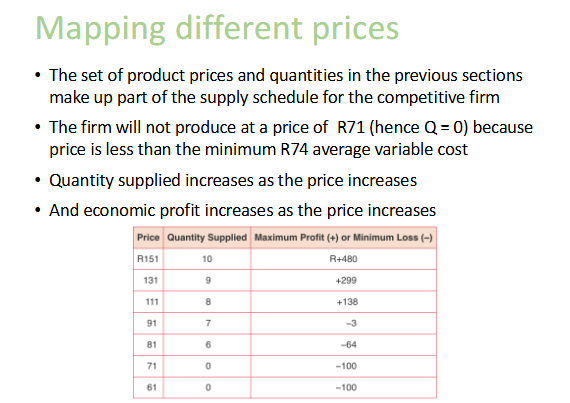
i thought competitive firms where price takers wdym that quantity will increase as price increases, don’t these people produce any amount of output
Market demand curve: Downward‑sloping. As the market price falls, the total quantity demanded in the whole market increases.
Individual firm’s demand curve: Perfectly elastic (horizontal) at the market price. The firm is a price taker — it cannot set its own price.
So:
When we say “quantity will increase as price increases,” we’re talking about the market as a whole. Higher price → more firms willing to supply → greater market quantity supplied.
For a single competitive firm, it can produce any amount of output at the given market price. Its decision is not about changing price, but about choosing the output where MR = MC at that fixed price.
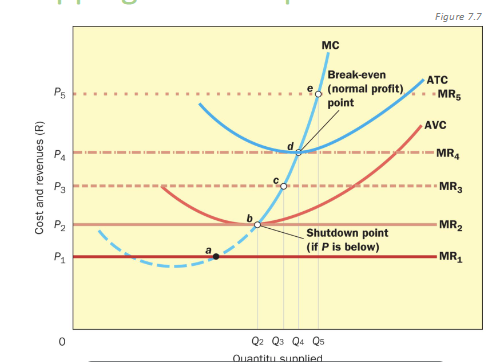
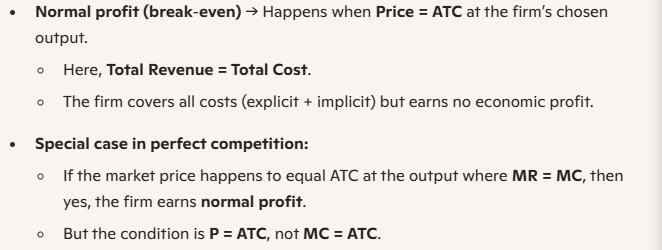
Why is the normal profit there
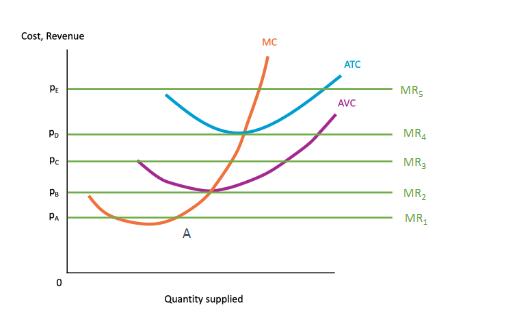
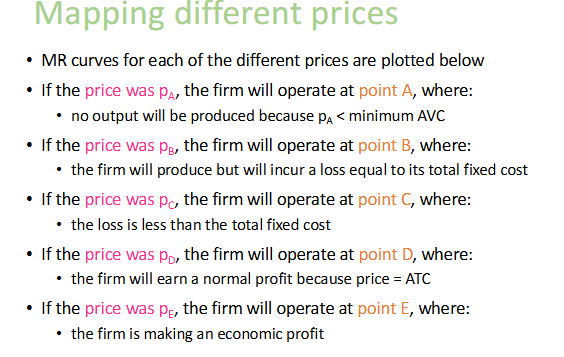
What happens at the different points
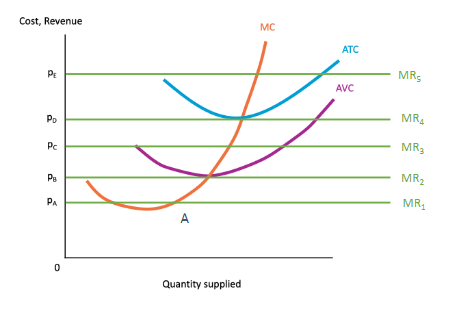
Which portion of the MC curve forms the firm’s short-run supply curve ?
What will the quantity be if the price is below the min. average variable cost
How to get market supply