Pt. 4 The Stages of Learning
 Call Kai
 Learn
Learn Practice Test
 Spaced Repetition
 Match
Match Flashcards
 Knowt Play
1/29

There's no tags or description
Looks like no tags are added yet.
Name | Mastery | Learn | Test | Matching | Spaced | Call with Kai |
|---|
No analytics yet
Send a link to your students to track their progress
30 Terms
Practice
In general, more practice produces more […]
Practice is more than just […]
Deliberate practice is
[…]
oriented towards goal-attainment
and actively uses augmented [….] to improve performance
learning
repetition
effortful
feedback
Benefits of Practice
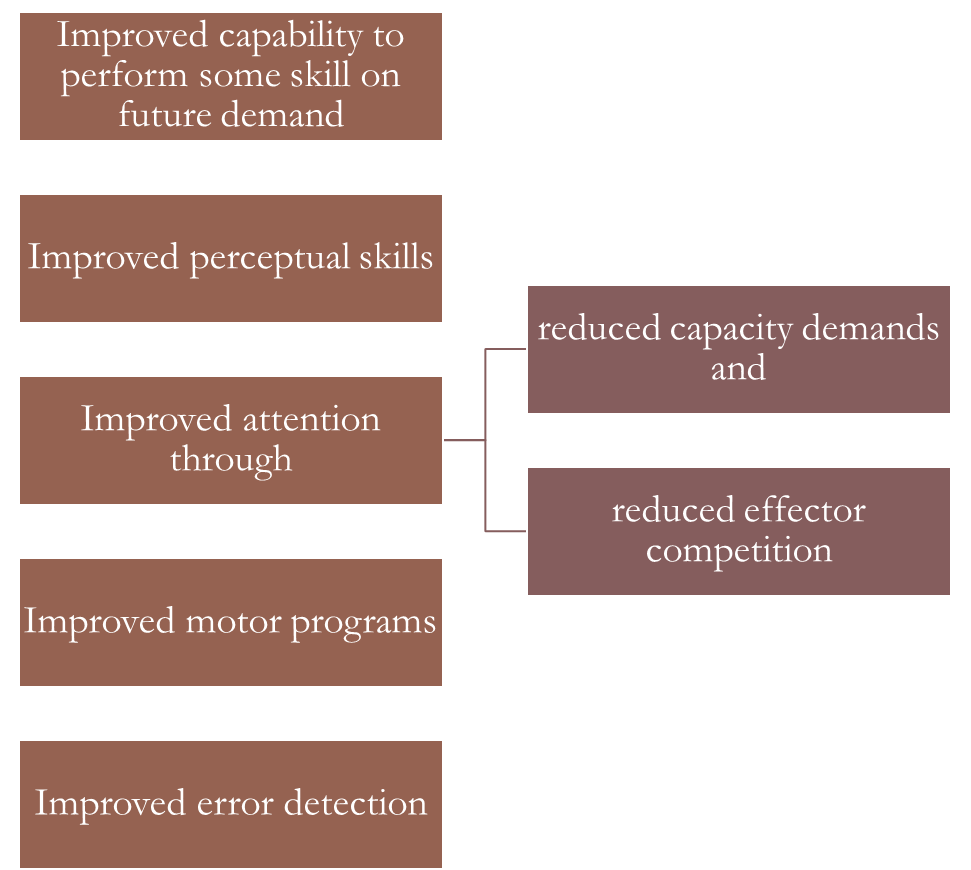
Specificity of Practice
Specificity of learning suggests that what you learn depends largely on what you […]
Practicing in a particular […] often leads to better performance
Mainly in that workspace
The […] resulting from performance during specific types of practice
Becomes part of the learned representation for skill
practice
environment or workspace
sensory feedback
Learning Versus Performance
During Practice
The learner who attempts to always perform as well as possible in practice
tends to be inhibited from […] movements from attempt to attempt
Providing both practice sessions and test sessions during practice
can help overcome the detriment to […]
modifying
learning
Phases in Learning
People progress through stages (phases) as they learn a motor skill
People progress from being a novice (beginner) to being an expert (highly skilled)
Three models proposed to identify and describe the stages
1.[…]
2. […]
3. […]
Fitts and Posner’s three-stage model
Gentile’s two-stage model
Bernstein’s perspective
The Three Stage Model of Skill Acquisition
Fitts and Posner (1967) proposed motor skill acquisition (learning) involves three stages:
1 .[…] – someone is a novice
2. […] stage
3. […] stage
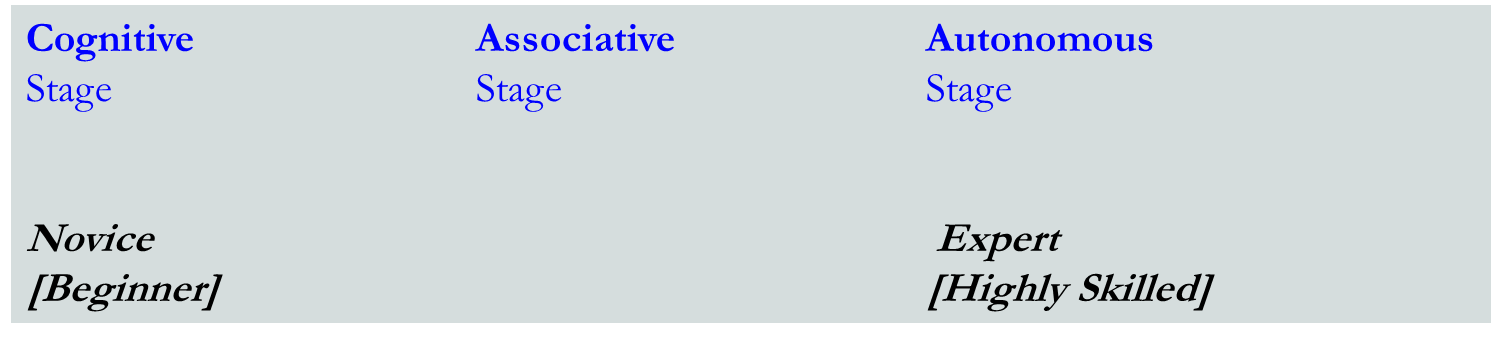
Cognitive stage
Associative
Autonomous
The Three Stage Model of Skill Acquisition
Cognitive stage
• Beginner focuses on solving cognitively oriented problems related to […] and […] this skill.
• Rapid […] in performance as time progresses
what to do
how to do
increase
The Three Stage Model of Skill Acquisition
Associative stage
• Person has learned to associate [….] with required movements to achieve the goal of the skill.
• Steady improvement – some […]
environmental context
inconsistency
The Three Stage Model of Skill Acquisition
Autonomous stage
• Final stage where performance of the skill is […] or […].
• […] improvements
"automatic" or habitual.
Slow
Fitts and Posner’s Stage 1: Cognitive Stage
Concerns
[…]
performance evaluation
what to do, and when to do it
Verbal and cognitive abilities dominate
Verbalizable information is […]
Gains in proficiency are verry […]
Indicating that more effective strategies are being discovered.
goal identification
useful
rapid and large
Fitts and Posner’s Stage 2: Associative Stage
◦ The learner’s focus shifts to […] more effective movement patterns
◦ In skills requiring quick movements, the learner begins to build a motor program
◦ In […] movements, the learner constructs ways to use movement-produced feedback
◦ […] gradually decreases
• Closed-skill movements begin to be more […]
• Open-skill movements become more […]
◦ Enhanced efficiency […] energy costs
◦ Self-talk becomes less important
◦ Learners begin to monitor their own feedback and detect their errors
organizing
slower
Inconsistency
stereotypic
adaptable
reduces
Fitts and Posner’s Stage 3: Autonomous Stage
Usually associated with the attainment of [….] performance
[…] attention demanded by perceptual and motor processes
Allows for simultaneous performance of higher-order cognitive activities
Self-confidence […]
Capability to detect and correct one’s own errors becomes more […]
expert
Decreased
increases
fine-tuned
Gentile’s Two-Stage Model
Initial stage of learning.
Learner works to achieve two goals:
Acquire a […] to enable some degree of success in achieving the action goal of the skill.
Discriminate between […] conditions in the environmental context in which the learner performs the skill.
movement pattern
regulatory and nonregulatory
Gentile’s Two-Stage Model
Later stages of learning.
Learner works to achieve three goals:
[…] movement pattern to the demands of any performance situation requiring that skill.
Increasing […] in achieving the goal of the skill.
Performing the skill with an […], which refers to the amount of force used to perform the skill.
Adapting
consistency
economy of effort
Gentile’s Two-Stage Model
[….] : Fixation and diversification as learning goals.
Learner’s movement goals depend on the type of skill being learned.
[…] skills: Require fixation of movement coordination pattern.
Learner must refine this pattern so that he or she can allow consistent action goal achievement.
[…] skills: Require diversification of the basic movement pattern.
Develop flexible movement pattern that can adapt to the continuously changing spatial and temporal regulatory conditions of the skill.
Unique feature of Gentile’s “Later Stages”
Closed
Open
Bernstein’s Description of the Learning Process
◦ Proposed that learning a skill is similar to solving a problem.
◦ Likened the process of solving a problem to staging a play, with the following phases:
Determine which […] in the motor control system will take the leading role in the performance.
Develop a […] to approach the problem, and recruit and assign roles to the lower levels of the motor control system.
Identify the most appropriate […] corrections.
Hand over the corrections to the background levels.
Achieve a [...] among the background corrections.
[…]relies on joint reaction forces to counteract external forces, replacing the need for sensory corrections during movement.
Stabilize the skill against external disturbances or changes.
level
plan or strategy
sensory
harmony
Standardization
Bernstein’s Description of the Learning Process
◦ Described appropriate practice as a form of repetition without repetition.
◦ Bernstein’s ideas:
• “The point is that during a correctly organized exercise, a student is repeating many times, not the means for solving a given motor problem, but the process of its solution, the changing and improving of the means.” (Bernstein, 1996, page 284).
Performer and Performance Changes Across the Stages of Learning
Stages-of-learning models describe […] performer and performance characteristics at each learning stage.
Benefits of considering these characteristics.
Provides a closer look at the skill […] process.
Explains why different […] strategies need to be developed for people in different learning stages.
distinct
learning
instruction
Performer and Performance Changes Across the Stages of Learning
◦ Changes in rate of improvement.
◦ As a person progresses along the skill learning continuum from the beginner stage to the highly skilled stage, the rate at which the performance improves changes.
•[…].
◦ A mathematical law describing the negatively accelerating change in rate of performance improvement during skill learning.
◦ Large amounts of improvement occur during early practice, but smaller improvement rates characterize further practice.
Power law of practice
Performer and Performance Changes Across the Stages of Learning
• Changes in […] coordination.
• […] Stages
• […]the degrees of freedom.
• Coordination pattern exploits passive forces
movement
Berstein’s
Freezing
Bernstein’s Stage 1: Reduce Degrees of Freedom
◦ Initial problem:
what to do with all of the possible degrees of freedom of movement that are available for the body
◦ Solution:
[…] the movement of nonessential or redundant body parts in initial stage of learning
by […] degrees of freedom
reduce
freezing
Bernstein’s Stage 2: Release Degrees of Freedom
◦ Learner attempts to improve performance
by […] some of the degrees of freedom that had initially been frozen
◦ Useful in tasks that require […] because it could allow for faster and greater accumulation of forces
releasing
power or speed
Bernstein’s Stage 3: Exploit Passive Dynamics
◦ The performer learns to exploit the […] dynamics of the body
◦ The movement becomes […] skilled in terms of
[….] (achieving the result with maximum assuredness) and
[…] (minimum outlay of energy)
passive
maximally
effectiveness
efficiency
Changes Across the Stages of Learning
• Characteristics that change
◦ Rate of […]
Power law of practice
◦ […]
Degrees of Freedom problem
This is what Bernstein’s perspective was very focused on
improvement
Movement coordination
Changes Across the Stages of Learning
• Characteristics that change
Altering an […] coordination pattern
Muscles used to perform the skill
Antagonist, agonist muscles – co-contractions – inefficient – this is what you might start with
◦ […]energy cost
old or preferred
Decreasing
Changes Across the Stages of Learning
• Characteristics that change
◦ Visual [….] (increase)
◦ […] attention with performing a skill (decrease)
◦ Error […] and correction capability (increase)
◦ Brain activity
• more and more automatic – brain activity changes from pre-frontal to more […]
• of course motor area always being used
selective attention
Conscious
detection
subcortical regions
Performer and Performance Changes Across the Stages of Learning
• Changes in how degrees of freedom are […].
• Changes in an […] coordination pattern.
• Changes in muscles used to perform the skill.
• Changes in energy […].
• Changes in visual […] attention.
• Changes in […] attention demands when performing a skill.
• Changes in error […] and correction […].
• Changes in brain activity: Plasticity.
controlled
established or preferred
cost
selective
conscious
detection
capability
Characteristics that do not change
Learning is specific to the sources of […] available during practice.
When visual feedback is used during practice in the first stage of learning, it continues to be needed throughout the later stages of learning.
Proteau and colleagues hypothesized and provided evidence that a dependency on the sensory feedback develops because it becomes part of an […] sensory component of the memory representation of the skill.
Result: If a person must perform without the same sensory feedback available, retrieval of the representation from memory is less than […].
sensory information
integrated
optimal
Expertise
An “expert” is a person who is located at the extreme end of the […] learning stages continuum
[…]
Exploiting Passive Dynamics
Experts in all skill performance areas have in common some […] characteristics
final
Autonomous
distinct
Expertise
Amount of practice that resulted in expertise
[….] is the popular phrase but it really all depends on the complexity and difficulty of the skill
Experts do spend a lot of time practicing and grow with experience
Knowledge structure
Able to piece together the […] given for a said performance area
Use of vision
10,000 hours
information