CHP 13- Glycolysis
 Call Kai
 Learn
Learn Practice Test
 Spaced Repetition
 Match
Match Flashcards
 Knowt Play
1/64

There's no tags or description
Looks like no tags are added yet.
Name | Mastery | Learn | Test | Matching | Spaced | Call with Kai |
|---|
No analytics yet
Send a link to your students to track their progress
65 Terms
What steps are the energy investment steps?
Steps 1-5
They convert glucose into higher-energy metabolites
What are the energy recovery steps?
Steps 6-10
They turn the high-energy metabolites into pyruvate, ATP, and NADH
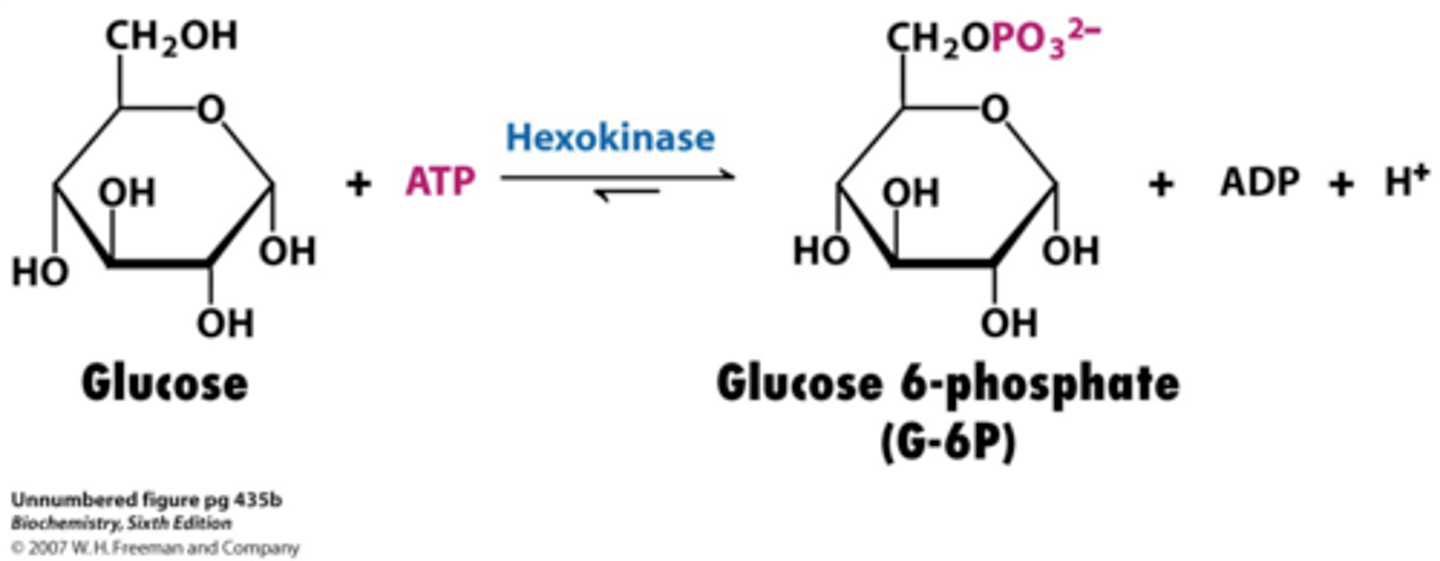
What is the first step of glycolysis?
Glucose (C6H12O6) + hexokinase + ATP → ADP + Glucose 6-phosphate (C6H13O9P)
What is the enzyme used in step 1 of glycolysis?
hexokinase
What is the role of Mg2+ in the hexokinase reaction?
It stabilizes the negative charges of the phosphate group transfer.
Why is the first step of glycolysis considered irreversible?
It is a commitment step that is far from equilibrium.
What is the significance of the large conformational change in hexokinase?
It allows for more sugar substrates to bind to the enzyme (15 angstrom change).
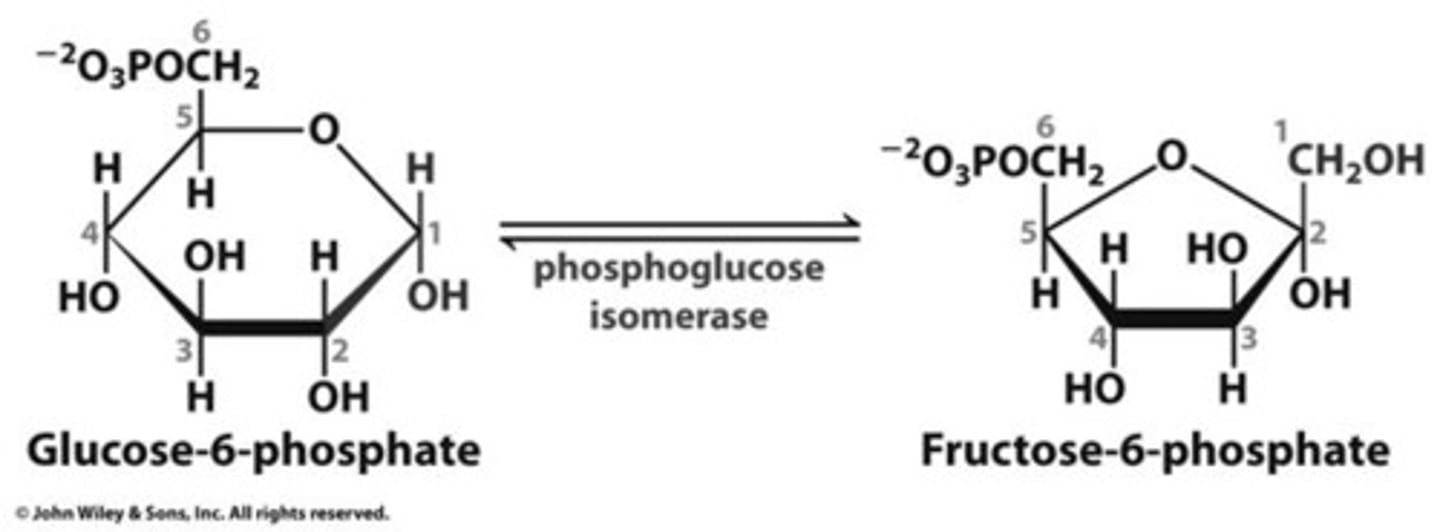
What is the second step of the glycolysis pathway?
Glucose-6-Phosphate ⇌ Fructose-6-Phosphate (F6P)
What is the enzyme for the 2nd step of glycolysis?
Phosphoglucose Isomerase: It changes the stereochemistry of Glucose-6-phosphate to its isomer, fructose-6-phosphate
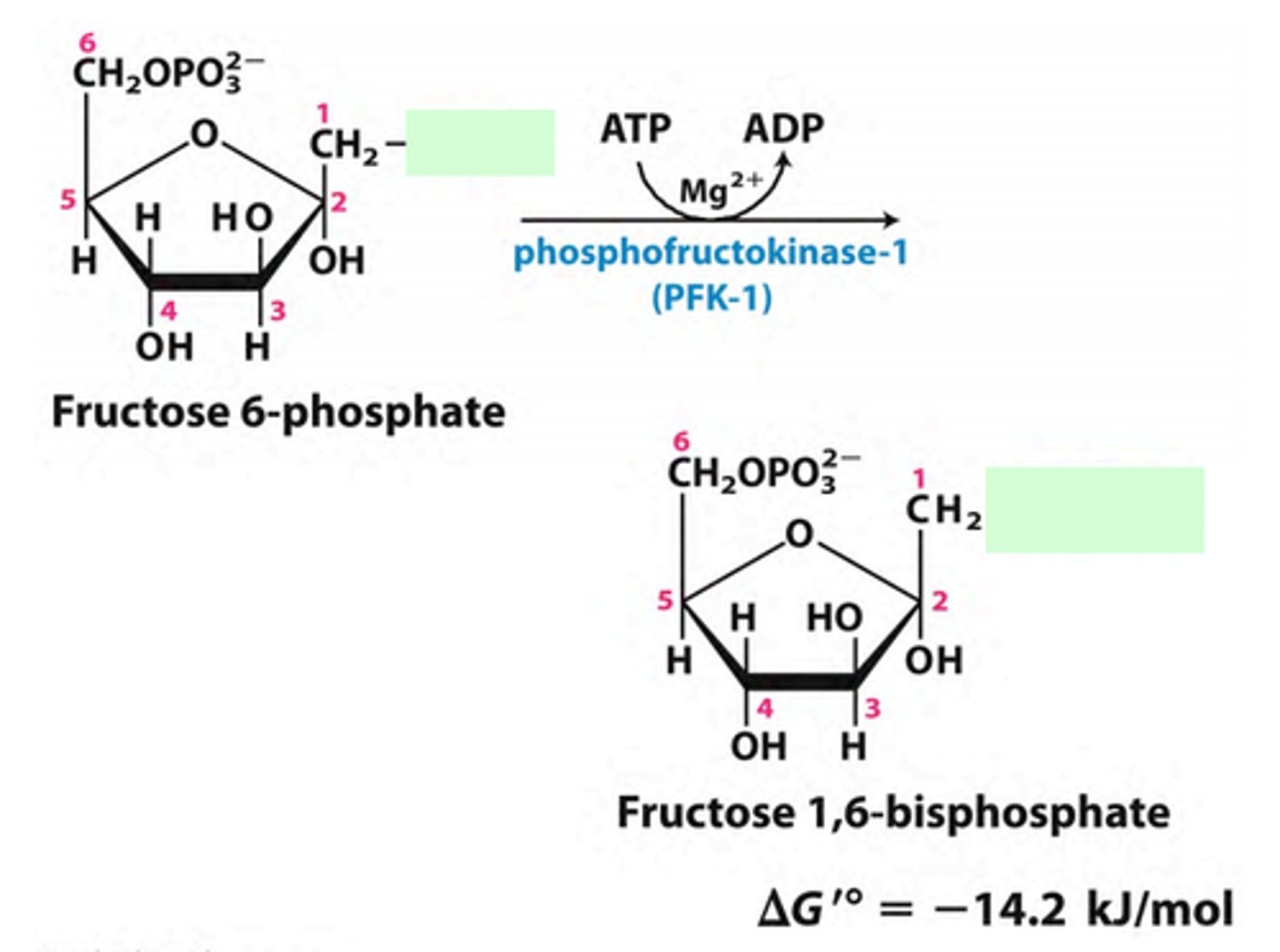
What is the third step of the glycolysis pathway?
Fructose-6-Phosphate (F6P) + ATP + H2O → Fructose-1,6-Bisphosphate
What is the enzyme for the 3rd step of glycolysis?
Phosphofructokinase: it phosphorylates F6P
Why is the phosphofructokinase step the most likely to be regulated?
It catalyzes the first committed step of the pathway. It is the rate-determining step, the slowest enzyme, and is far from equilibrium.
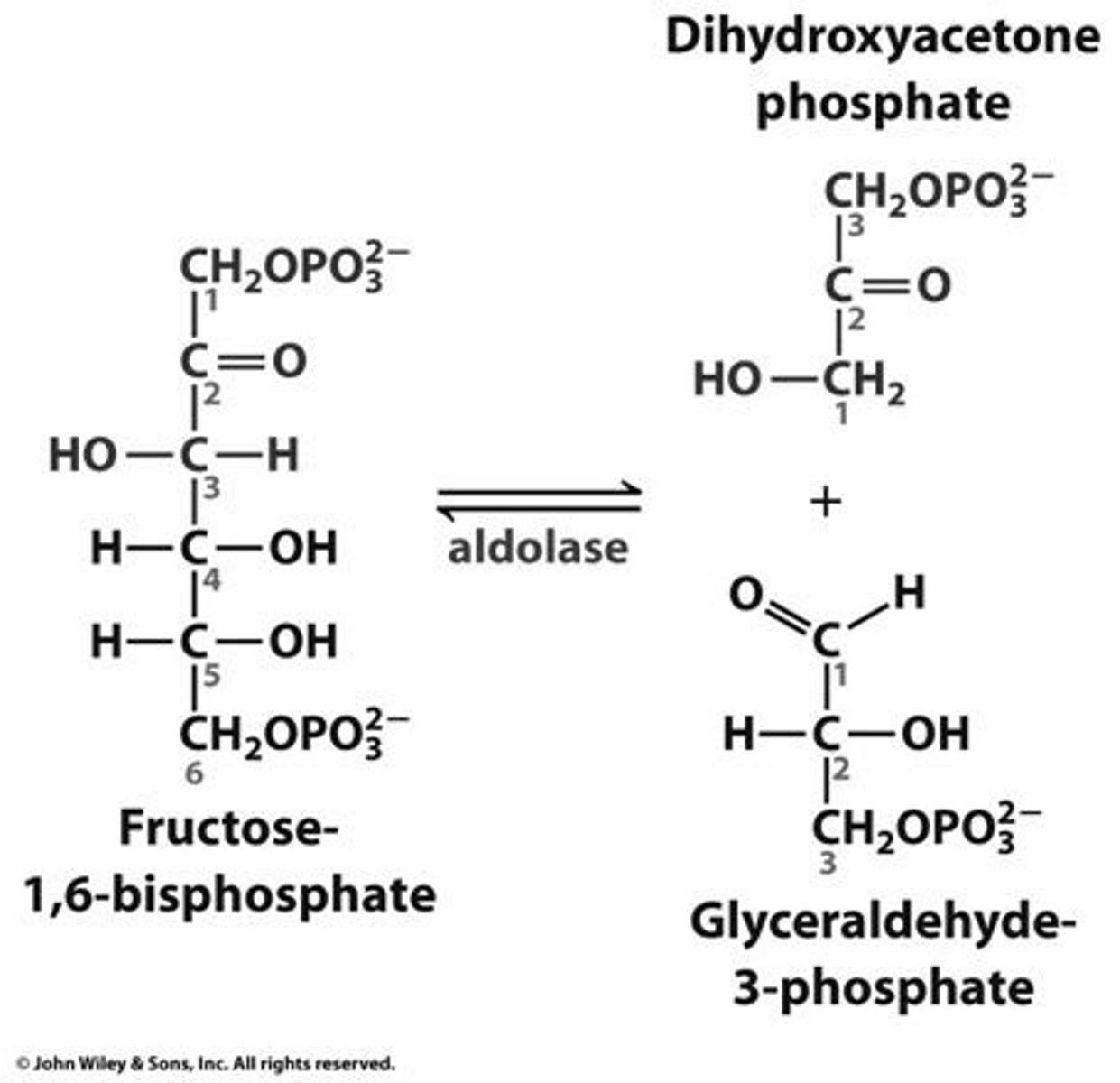
What is the fourth step of the glycolysis pathway?
Fructose-1,6-Bisphosphate (FBP) ⇌ Dihydroxyacetone phosphate (DHAP) + Glyceraldehyde-3-phosphate (GAP)
what is the enzyme for the 4th step of glycolysis
Aldolase: it cleaves the fructose 1,6-bisphosphate into two 3-carbon sugars (GAP and DHAP)
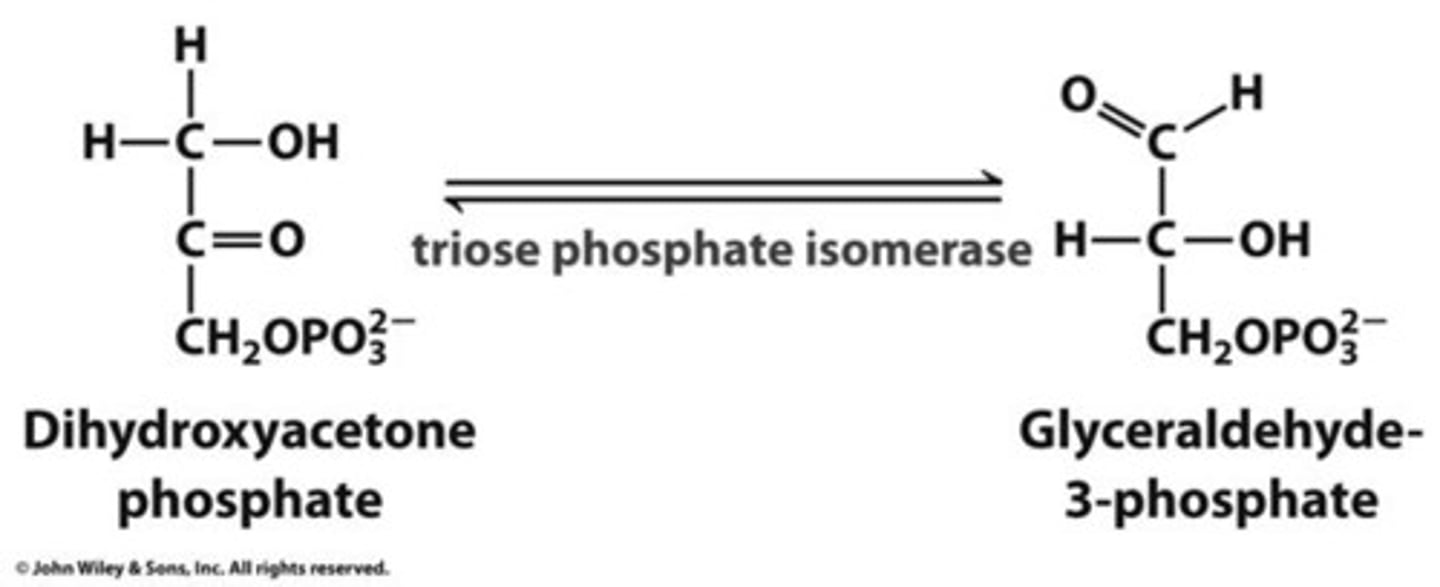
What is the fifth step of the glycolysis pathway?
DHAP ⇌ GAP
What is the enzyme for the 5th step of Glycolysis?
Triose Phosphate Isomerase: it changes the stereochemistry from a ketose to an aldose
How is DHAP converted into GAP in the cell despite the equilibrium constant favoring DHAP?
GAP is constantly consumed by the next reaction, and binding site stabilizing amino acids (like Asn) facilitate the conversion.
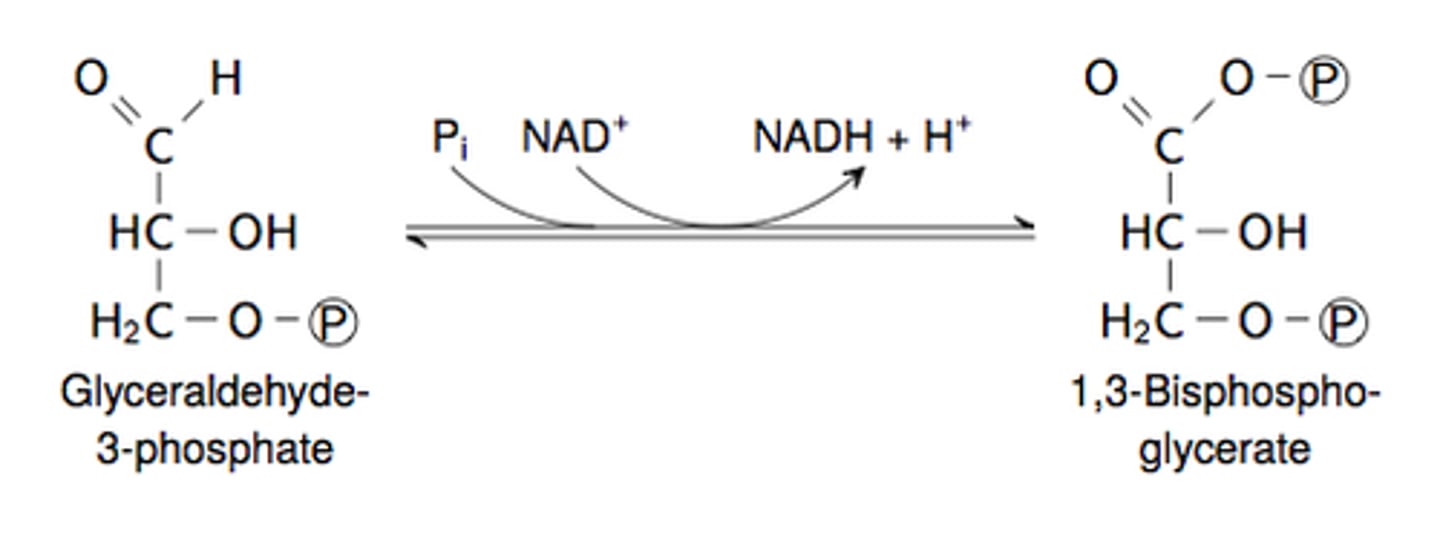
What is the sixth step of the glycolysis pathway?
2(GAP + NAD+ + Pi ⇌ 1,3-Bisphosphoglycerate + NADH + H+)
What is the enzyme used for the 6th step of glycolysis?
Glyceraldehyde-3-Phosphate Dehydrogenase: it generates NADH and converts GAP into 1,3- Bisphosphoglycerate
What is the seventh step of the glycolysis pathway?
1,3-Bisphosphoglycerate + ADP ⇌ 3-phosphoglycerate + ATP
What is the enzyme used for the 7th step of glycolysis?
Phosphoglycerate kinase: they phosphorylate ATP
What is the role of Mg2+ in the phosphoglycerate kinase reaction?
It helps stabilize ADP.
Kinase
adds a phosphate group.
What is the relationship of Gibbs Free energy between reaction step 6 and step 7?
Reaction 6 is heavily endergonic, while Reaction 7 is heavily exergonic, making the overall Gibbs Free Energy negative. The large negative Gibbs free energy from step 7 gives the coupled reaction a "driving force" that keeps the concentration of 1,3-BPG low, pulling the unfavorable reaction 6 towards the rest of the reaction forward to maintain metabolic flux
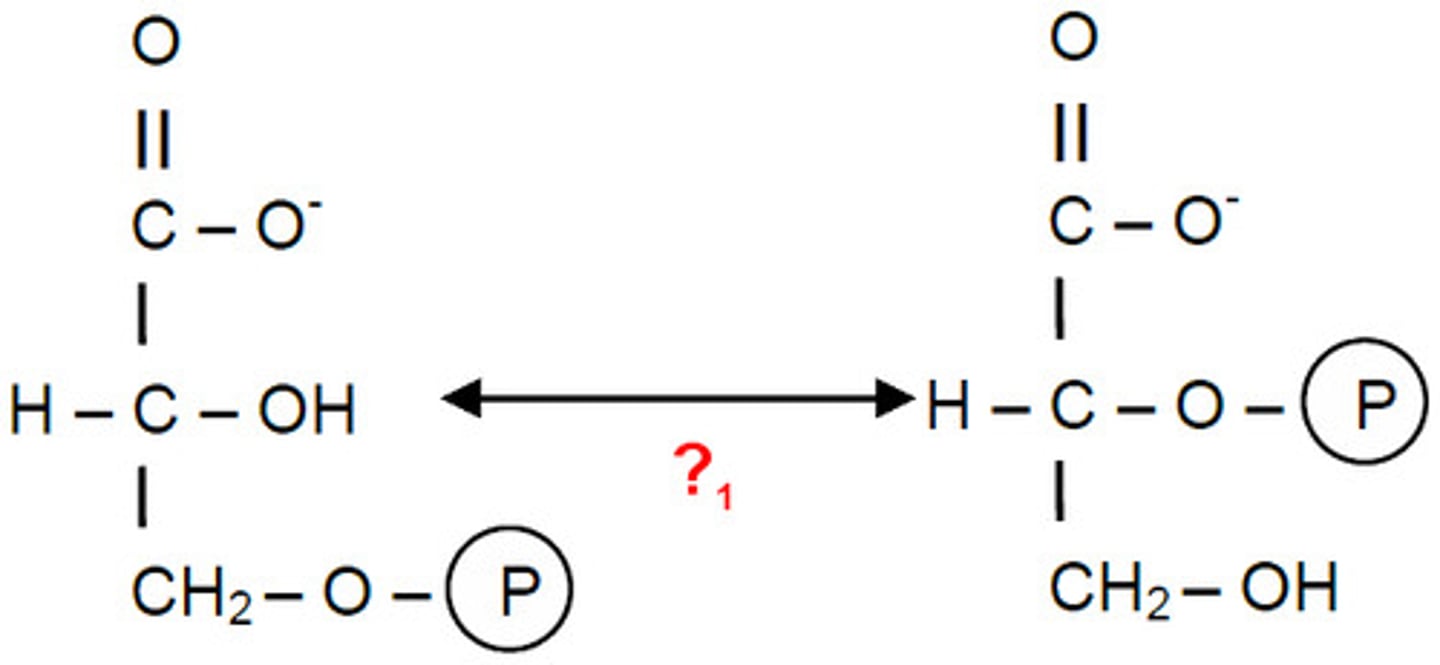
What is the eighth step of the glycolysis pathway?
Phosphoglycerate Mutase: 3-Phosphoglycerate (3PG) ⇌ 2-Phosphoglycerate (2PG)
What is the enzyme used for the 8th step of glycolysis?
Phosphoglycerate Mutase: a mutase catalyzes the transfer of a functional group from one position to another on a molecule
What is the ninth step of the glycolysis pathway?
2-Phosphoglycerate (2PG) ⇌ Phosphoenolpyruvate (PEP) + H2O
What is the enzyme used for the 9th step of glycolysis?
An enolase catalyzes the interconversion of a phosphoglycerate to a phosphopyruvate
How does the role of Mg2+ in the enolase reaction differ from its role in other steps?
It acts as a catalytic cofactor rather than a stabilizing one.
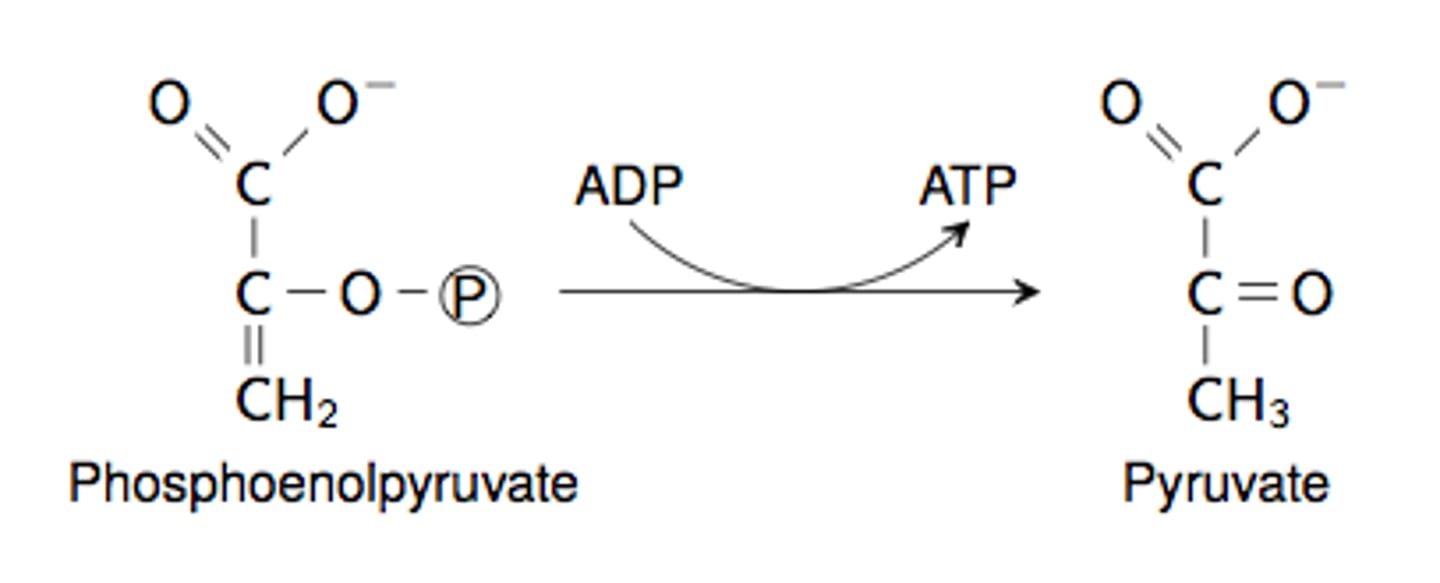
What is the tenth step of the glycolysis pathway?
Phosphoenolpyruvate (PEP) + ADP + H+ → Pyruvate + ATP
What is the enzyme used for the 10th step of glycolysis?
Pyruvate Kinase: it phosphorylates ADP to ATP by taking a phosphate group from PEP
Does the pyruvate kinase reaction require cofactors?
No, it has no cofactors.
Which step of glycolysis is known as the commitment step?
The first step, catalyzed by hexokinase.
What is the final product of the tenth step of glycolysis?
Pyruvate and ATP
What does Triose Phosphate Isomerase do?
It changes the stereochemistry of DHAP (ketose) to an aldose (GAP).
What are the substrates in rxn 1?
Glucose + ATP
Which enzyme mechanisms are used in RXN 2?
Acid/Base
Proximity and Orientation
Transition State Stability
Which enzyme mechanisms are used in RXN 3?
Acid/Base
Proximity and Orientation
Transition State Stability
What is acting as the nucleophile in RXN 2?
the substrate (the sugar)
In step 1 of rxn 2, Lys is the ___ and His is the ___
Lys acid/ His base
In step 2 of rxn 2, His is the ___
Base
In step 3 of rxn 2, Lys is the ___
Base
In step 1 of rxn 2, Lys is the ___
Base
Does the substrate covalently bind to the enzyme in RXN 2?
No, there is no covalent catalysis
What are the inhibitors in ATP generation?
ATP, Citrate, and H+
What are the activators in ATP generation?
AMP, Pi, and Fructose-2,6-biphosphate
When there is a high concentration of ATP, you start to see
Inhibition
The PFK activity x F6P graph is an example of
Cooperativity
In step 1 of rxn 4, Lys is the ___
Nucleophile
In step 2 of rxn 4, Asp is the ___
Base
In step 3 of rxn 4, Asp is the ___
Acid
In step 4 of rxn 4, Asp is the ___ **
Acid/Nucleophile
The surrounding amino acids in reaction 5 are
Binding site stabilization amino acids
What are the catalytic amino acids in rxn 5?
Glu 165 and His 95
In step 1 of rxn 5, Glu 165 is the ___
Base
In step 2 of rxn 5, His 95 is the ___
Acid
In step 3 of rxn 5, Glu 165 is the ___ and His 95 is the ___
Acid/ Base
What are the enzyme mechanisms used in rxn 5?
Acid/ Base Catalysis
Transition State Stabilization
Proximity and Orientation
Triose phosphate isomerase enzyme is catalytically perfect. What does that mean? What is the max rate?
It refers to the enzyme's catalytic efficiency.
Max rate is : 10 ^8 to 10^9
What step is water made in glycolysis?
Step 9
What step is NADH made in glycolysis?
Step 6
what steps in glycolysis produce ATP?
Steps 7 and 10
What steps of glycolysis are irreversible/far from equilibrium? (Delta G <0)
Steps 1, 3, and 10
What steps of glycolysis are close to equilibrium? (Delta G = 0)
Steps 2,4,5,6,7,8, and 9
Why does the energy waterfall have different sized steps?
The big steps are the far-from-equilibrium steps that push the reaction. The smaller steps are the ones that don't need a lot of energy to push the rxn.