ch 23 (chordates) and ch 24 (fishes)
 Call Kai
 Learn
Learn Practice Test
 Spaced Repetition
 Match
Match Flashcards
 Knowt Play
1/14

There's no tags or description
Looks like no tags are added yet.
Name | Mastery | Learn | Test | Matching | Spaced | Call with Kai |
|---|
No analytics yet
Send a link to your students to track their progress
15 Terms
name the 5 key characteristics for chordates
must be present during some point in development
notochord → provides support in early development
dorsal tubular nerve cord (our spinal cord) usually forms along notochord
post-anal tail — humans have during early development
pharyngeal pouches/slits → captures food
endostyle (produces mucus to capture food) or thyroid gland (gland for hormone production)
describe urochordates (tunicates) larvae and adults and adult cephalochordates
urochordate larvae
notochord
dorsal tubular nerve cord
post-anal tail
pharyngeal pouches/slits
endostyle or thyroid gland
urochordate adult
lack some chordate characteristics (no notochord, or dorsal nerve cord)
adult cephalochordate
has all 5 chordate characteristics
notochord
dorsal nerve cord
post-anal tail
pharyngeal slits
endostyle
what are protochordates?
includes the subphylums Urochordata (tunicates) and Cephalochordata (lancelets)
why are echinoderms said to have a common ancestor with chordates?
they are both deuterostomes
shares similar embryonic development (radial cleavage)
shared coelom structure
genetic similarities
how might you illustrate that phylogenetic trees and cladograms do not necessarily represent a macroevolutionary relationship between organisms?
phylogenetic trees and cladograms only represent the branching order of common ancestry rather than specific physical transformations
they often neglect the step-by-step process of macroevolution
what characteristics distinguish the hag fishes and lampreys (superclass agnatha) from all other fishes?
hagfish → eats dead organisms, uses a “knot” for leverage
lamprey → stone sucking (petromyzontidae)
they are both from superclass agnatha, meaning “jawless fish”
has cartilaginous skeletons with no bone
their feeding techniques
describe the life cycle of Sea Lamprey (Petromyzon Marinus) and the history (route) of its invasion of the Great Lakes
life cycle:
eggs are laid in bottom of stream, lives 3-7 years in the soil as ammocoete larvae
undergoes metamorphosis and emerges from soil
migrates towards lakes, adult parasitic stage in lakes and ocean
reproduces in streams, eggs laid in sandy bottom
they were originally in the Hudson River, followed Erie Canal (built early 1800s) over to Great Lakes
first invaded Lake Ontario
between Lake Erie and Ontario is Niagara Falls — a natural barrier
Welland Canal was built late 1800’s to bypass the falls, which allowed lampreys to travel to Lake Erie
controlled by: larvicides and sterile male release
what does Gnathostomata mean and who belongs to this group?
“Gnathostomata” → jawed fish (and tetrapods)
includes class Chondricythes — cartilage+fish (sharks and rays)
give examples of chondricythes. why do sharks and rays have spiracles?
ex. sharks and rays (whale shark, hammerhead shark, manta rays, etc.)
they have spiracles for respiration
water comes in, over gills, then leaves spiracles
sharks that do not have spiracles have to keep moving to breath
ram ventilation → swimming constantly with open mouths to force water over their gills
describe the lateral line system and ampullary organs of lorenzini in sharks and explain their function
gnathostomata uses lateral line to sense vibrations and pressure (many fish have lateral lines)
inside lateral line, there are neuromast cells
capsules have mechanoreceptor hair cells that detect pressure changes in the water
provides positional information — schools of fish use this to stay with the group
bioelectricity is sensed by ampullary organs of Lorenzini
detects bioelectricity of other organisms
describe the various breathing mechanisms fish use
gills → water in mouth, over gills, out through opening of operculum (class Actinopterygii, subclass Osteichthyes)
gill filaments contain lamella (increases surface area)
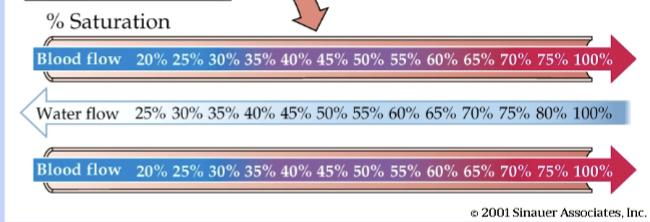
blood flow and water flow are counter current
lungs (lungfish) → gulp air, store air, extract it from sac
different from class Actinopterygii (ray-finned fish)
mouth (electric eel) → supplements oxygen from gills, gulps air, and extracts O2 from air in mouth
skin (eel) → diffusion
swim bladder (in some its connected to esophagus (garfish))
explain the purpose and function of swim bladder in bony fish. how is gas volume adjusted in the swim bladder?
fish use swim bladder for neutral buoyancy (does not rise or sink) — remain stationary in water column
swim bladder is impermeable to gas except at ovale and gas gland area
without swim bladder, fish tissues denser than water → fish would sink
maintains neutral buoyancy by increasing or decreasing the amount of gas to account for the pressure of the water around it
swim bladder allows fish to be same density as water
to rise → increase gases
to descend → decrease gases
how gas fills swim bladder:
done through a capillary loop
the gas gland produces lactic acid
this decreases pH which affects O2 affinity to Hb
O2 wants to leave blood and fill gas bladder
how gas is removed from swim bladder:
open valves to ovale
allows gases to diffuse to blood
what is meant by “counter current flow” as it applies to fish gills and compare concurrent and countercurrent flow in fish gills?
(be able to use an illustration to show how in countercurrent systems you maintain a concentration gradient that favors movement of oxygen from the water to the blood throughout the gill lamella)
countercurrent flow → water goes right to left, blood goes left to right in gills
water loses O2 as it travels
blood always has less O2 than water
blood continues to pick up O2 and gets to 100% saturation
considered the most efficient of any other animal group
concurrent flow → blood and water both go left to right in gills
about halfway, both become 50% saturated
now, there is no diffusion gradient, and blood would not obtain more O2
so max oxygen saturation % is just 50%
what is meant by the term catadromous as opposed to anadromous?
types of migration
catadromous (eels) — (‘cata’ = down, ‘dromous’ = to run)
live in freshwater and run down to ocean to reproduce
anadromous (salmon) — (‘ana’ = upward)
live in saltwater and run upstream to reproduce
describe the following terms: oviparous, viviparous, and ovoviviparous and gravid, pregnant (correctly associate these two terms)
oviparous → egg-laying (the mode of reproduction)
gravid → state of carrying developing eggs or young internally (associated with oviparous)
viviparous → live birth
pregnant → specific period and process of internal development (associated with viviparous)
ovoviviparous → produces eggs, but retained in body until hatched and then give live birth (gravid)