Econ 102 Exam 4
 Call Kai
 Learn
Learn Practice Test
 Spaced Repetition
 Match
Match Flashcards
 Knowt Play
1/113

There's no tags or description
Looks like no tags are added yet.
Name | Mastery | Learn | Test | Matching | Spaced | Call with Kai |
|---|
No analytics yet
Send a link to your students to track their progress
114 Terms
1) The central bank conducts countercyclical ________ policies by manipulating ________.
A) monetary; interest rates and government budgets
B) monetary; interest rates and bank reserves
C) fiscal; interest rates and bank reserves
D) fiscal; interest rates and inflation rates
B) monetary; interest rates and bank reserves
A countercyclical fiscal policy is conducted by ________ by acting to change ________.
A) the government; taxes and interest rates
B) the central bank; interest rates and taxes
C) the government; taxes and government expenditures
D) the government; government expenditures and interest rates
C) the government; taxes and government expenditures
The economy is in a recession. The Fed could take direct action to stimulate economic activity
by ________.
A) lowering short-term interest rates
B) increasing reserve ratios
C) increasing short-term interest rates
D) increasing long-term interest rates
A) lowering short-term interest rates
If the Fed wants to stimulate an economy, it will ________.
A) sell Treasury bonds
B) lower short-term interest rates
C) increase the quantity of required reserves
D) reduce money supply
B) lower short-term interest rates, encouraging borrowing and spending.
Expansionary fiscal policy uses ________ government spending and ________ taxes to
increase aggregate economic activity.
A) higher; higher
B) higher; lower
C) lower; higher
D) lower; lower
B) higher; lower
Contractionary fiscal policy uses ________ government spending and ________ taxes to
decrease aggregate economic activity.
A) higher; higher
B) higher; lower
C) lower; higher
D) lower; lower
C) lower; higher
Which of the following is an example of an automatic stabilizer during a recession?
A) A decrease in tax revenue due to an increase in unemployment
B) A decrease in inflation due to an increase in consumption
C) An increase in interest rates due to a decrease in investment
D) An increase in money supply due to a decrease in bank deposits
A) A decrease in tax revenue due to an increase in unemployment
Which of the following is an example of discretionary fiscal policy during a recession?
A) An increase in tax rates to increase revenue
B) A decrease in transfer payments to unemployed workers
C) A temporary tax cut to boost consumption
D) A decrease in money supply to lower the federal funds rate
C) A temporary tax cut to boost consumption
Mark can make three tables or one chair in a day, while John can make four tables or one chair in a day.
Refer to the scenario above. Mark's opportunity cost of making a table is ________.
A) 0.33 of a chair
B) 1 chair
C) 3 chairs
D) 3.33 chairs
A) 0.33 of a chair
Mark can make three tables or one chair in a day, while John can make four tables or one chair in a day.
Refer to the scenario above. Mark's opportunity cost of making a chair is ________.
A) 0.33 of a table
B) 1 table
C) 3 tables
D) 3.33 tables
C) 3 tables
Mark can make three tables or one chair in a day, while John can make four tables or one chair in a day.
Refer to the scenario above. John's opportunity cost of making a table is ________.
A) 0.25 of a chair
B) 1 chair
C) 4 chairs
D) 4.25 chairs
A) 0.25 of a chair
Mark can make three tables or one chair in a day, while John can make four tables or one chair in a day.
Refer to the scenario above. John's opportunity cost of making a chair is ________.
A) 0.25 of a table
B) 1 table
C) 4 tables
D) 4.25 tables
C) 4 tables
When international trade is based on the concept of comparative advantage, then a country
will specialize in producing goods that the country can produce ________.
A) at a lower cost than other countries in the same time span
B) at a higher price than other countries in the same time span
C) more of than other countries in the same time span
D) faster than other countries in the same time span
A) at a lower cost than other countries in the same time span
Once engaged in international trade, Asgard decides to specialize in producing armor,
according to its comparative advantage. What can we conclude about what happens next?
A) There will be no change in the price of armor in Asgard.
B) The world price of armor will increase.
C) More armor will be demanded in Asgard.
D) More armor will be produced in Asgard.
D) More armor will be produced in Asgard.
1) Which of the following is likely to happen if the government imposes a tariff on steel imports?
A) The domestic producers of steel will face more foreign competition.
B) The domestic producers of steel will face less foreign competition.
C) The domestic producers of steel will be worse off.
D) The domestic consumers of steel will be better off.
B) The domestic producers of steel will face less foreign competition.
Which of the following is likely to happen if the government imposes a tariff on the imports of
a good?
A) Domestic producers will face higher foreign competition.
B) The revenue earned by the government will decrease.
C) The domestic industry will earn higher profits.
D) Domestic consumers will be better off.
C) The domestic industry will earn higher profits.
Which of the following is likely to happen if the government imposes a tariff on sugar
imports?
A) The domestic producers of sugar will face higher foreign competition.
B) The firms in the sugar industry will earn lower profits.
C) The domestic consumers of sugar will be worse off.
D) The volume of imports of sugar will increase.
C) The domestic consumers of sugar will be worse off.
Which of the following is likely to happen if the government of a country lowers import
tariffs?
A) The volume of the country's imports will fall.
B) The revenue earned by the government will fall.
C) Domestic producers will be safe from foreign competition.
D) The prices of imported goods will rise in the domestic market.
B) The revenue earned by the government will fall.
A country imported goods and services worth $40 billion and exported goods and services
worth $37.8 billion during a particular year. This scenario implies that the country experienced a
________ during that year.
A) budget surplus
B) budget deficit
C) trade surplus
D) trade deficit
D) trade deficit
A country imported goods and services worth $16 billion and exported goods and services
worth $15.7 billion during a particular year. This implies that the country experienced a
________ during that year.
A) trade deficit
B) trade surplus
C) budget deficit
D) budget surplus
A) trade deficit
A country imported goods and services worth $16 billion and exported goods and services
worth $18.2 billion during a particular year. The country's trade ________ equals ________.
A) deficit; $2.2 billion
B) deficit; $16 billion
C) surplus; $2.2 billion
D) surplus; $18.2 billion
C) surplus; $2.2 billion
The correct calculation for the current account is given by ________.
A) Exports + Net factor payments from abroad + Net domestic transfers
B) Net exports + Net domestic factor payments + Net domestic transfers
C) Net exports + Net factor payments from abroad + Net transfers from abroad
D) Net exports + Net domestic factor payments + Net transfers from abroad
C) Net exports + Net factor payments from abroad + Net transfers from abroad
Which of the following is included a country's current account?
i) Exports of services
ii) Net transfers
iii) Increases in currency holdings
A) i), ii), and iii)
B) i) and ii)
C) i) and iii)
D) ii) and iii)
B) i) and ii) (Exports of services and Net transfers)
As the real interest rate ________, net capital outflows ________.
A) increases; increase
B) decreases; decrease
C) increases; decrease
D) decreases; remain unchanged
C) increases; decrease
As the real interest rate ________, net capital outflows ________ and net exports ________.
A) increases; increase; increase
B) decreases; decrease; decrease
C) increases; decrease; decrease
D) decreases; increase; decrease
C) increases; decrease; decrease
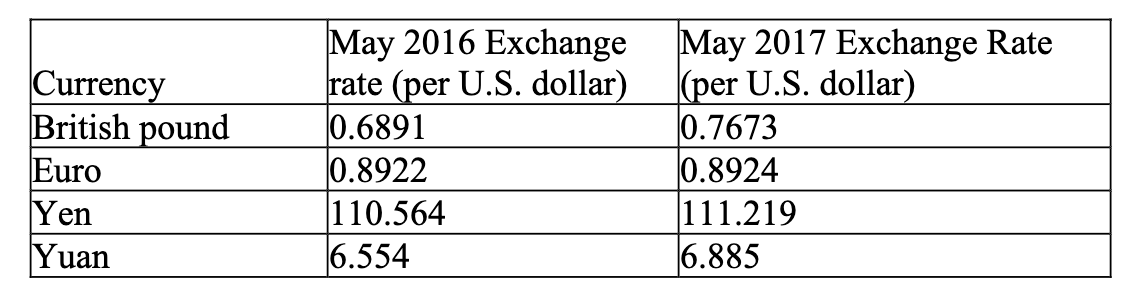
The following table shows the exchange rate between several foreign currencies and the U.S. dollar.
Refer to the table above. Between May 2016 and May 2017, the U.S. dollar has ________
against the euro, the yuan has ________ against the U.S. dollar, and the British pound has
________ against the U.S. dollar.
A) appreciated; appreciated; depreciated
B) depreciated; appreciated; depreciated
C) appreciated; depreciated; appreciated
D) appreciated; depreciated; depreciated
D) appreciated; depreciated; depreciated
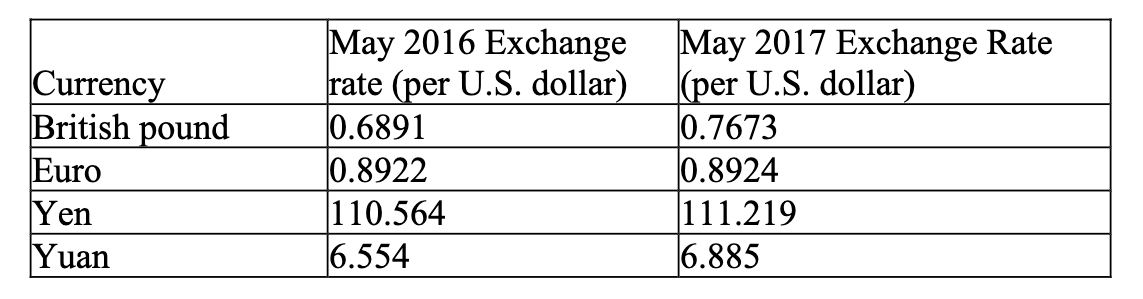
The following table shows the exchange rate between several foreign currencies and the U.S.
dollar.
Refer to the table above. Between May 2016 and May 2017, the U.S. dollar has ________
against the yuan and has ________ against the British pound, and the yen has ________ against
the U.S. dollar.
A) appreciated; appreciated; depreciated
B) depreciated; appreciated; depreciated
C) appreciated; depreciated; appreciated
D) appreciated; depreciated; depreciated
A) appreciated; appreciated; depreciated
If a country wants to keep a foreign currency overvalued against its domestic currency,
________.
A) it will buy both the foreign and the domestic currency
B) it will sell both the foreign and the domestic currency
C) it will buy the domestic currency and sell the foreign currency
D) it will buy the foreign currency and sell the domestic currency
D) it will buy the foreign currency and sell the domestic currency
If a country wants to keep a foreign currency undervalued against its domestic currency,
________.
A) it will buy both the foreign and the domestic currency
B) it will sell both the foreign and the domestic currency
C) it will buy the domestic currency and sell the foreign currency
D) it will buy the foreign currency and sell the domestic currency
C) it will buy the domestic currency and sell the foreign currency
If a country wants to keep its domestic currency overvalued against a foreign currency,
________.
A) it will buy both the foreign and the domestic currency
B) it will sell both the foreign and the domestic currency
C) it will buy the domestic currency and sell the foreign currency
D) it will buy the foreign currency and sell the domestic currency
C) it will buy the domestic currency and sell the foreign currency
If the Mexican government wants to keep the peso overvalued against the dollar, it will need
to ________ in the foreign exchange market.
A) sell both dollars and pesos
B) buy both dollars and pesos
C) buy pesos in exchange for dollars
D) buy dollars in exchange for pesos
C) buy pesos in exchange for dollars
Which of the following is likely to occur when the U.S. dollar is undervalued relative to the
peso?
A) There will be an excess supply of dollars at the pegged exchange rate in the foreign exchange
market.
B) The net exports of Mexico will increase.
C) The demand for dollars in exchange for pesos will exceed the supply of dollars in exchange for pesos.
D) The dollar will depreciate against the peso.
C) The demand for dollars in exchange for pesos will exceed the supply of dollars in exchange for pesos.
Countries that borrow large amounts of money from foreign lenders prefer to ________.
A) peg their currency to the dollar
B) hold an overvalued currency
C) hold an undervalued currency
D) maintain a high real interest rate
B) hold an overvalued currency
An overvalued domestic currency ________.
A) benefits all the economic agents in the country
B) harms all the economic agents in the country
C) makes imports more expensive for domestic consumers
D) makes imports less expensive for domestic consumers
D) makes imports less expensive for domestic consumers
An undervalued domestic currency ________.
A) benefits all the economic agents in the country
B) harms all the economic agents in the country
C) makes imports less expensive for domestic consumers
D) makes imports more expensive for domestic consumers
D) makes imports more expensive for domestic consumers
If the ratio of the dollar price of a U.S. toy to the dollar price of the same toy sold in China is greater than one, retailers in the United States should ________.
A) buy the toys from American suppliers
B) buy the toys from Chinese suppliers
C) buy the toys from both Chinese suppliers and U.S. suppliers
D) should not buy the toys from both Chinese suppliers and U.S. suppliers
B) buy the toys from Chinese suppliers
If the ratio of the dollar price of a U.S. toy to the dollar price of the same toy sold in China is greater than 1, U.S. toys are ________ than Chinese toys and retailers in the United States should
________.
A) cheaper; buy the toys from American suppliers
B) cheaper; buy the toys from Chinese suppliers
C) more expensive; buy the toys from American suppliers
D) more expensive; buy the toys from Chinese suppliers
D) more expensive; buy the toys from Chinese suppliers
If the ratio of the dollar price of a U.S. toy to the dollar price of the same toy sold in China is less than 1, retailers in the United States should ________.
A) buy the toys from U.S. suppliers
B) buy the toys from Chinese suppliers
C) buy the toys from both Chinese suppliers and U.S. suppliers
D) not buy the toys from either Chinese suppliers or U.S. suppliers
A) buy the toys from U.S. suppliers
If the ratio of the dollar price of a U.S. toy to the dollar price of the same toy sold in China is less than 1, U.S. toys are ________ than Chinese toys and retailers in the United States should
________.
A) cheaper; buy the toys from American suppliers
B) cheaper; buy the toys from Chinese suppliers
C) more expensive; buy the toys from American suppliers
D) more expensive; buy the toys from Chinese suppliers
A) cheaper; buy the toys from American suppliers
If a Japanese toy costs 20 yen and the yen per dollar exchange rate is 5, what is the dollar price of the Japanese toy?
A) $4
B) $5
C) $40
D) $100
A) $4
If a Japanese toy costs 40 yen and the yen per dollar exchange rate is 5, what is the correct way to calculate the dollar price of the Japanese toy?
A) 40 × 5
B) 40/10
C) 40 × 0.2
D) 40/0.2
C) 40 × 0.2
What is the correct way to calculate the dollar price of a British car, if we know the price of
the car in British pounds and we also know the British per dollar exchange rate?
A) Dollar price of British car = (Price of British car in pounds) (Exchange rate).
B) Dollar price of British car = (Price of British car in pounds) / (Exchange rate).
C) Dollar price of British car = (Price of British car in pounds) / ( 1/Exchange rate).
D) Dollar price of British car = (Exchange rate) / (Price of British car in pounds).
B) Dollar price of British car = (Price of British car in pounds) / (Exchange rate).
Everything else being equal, if the dollar appreciates against the Chinese yuan, ________.
A) China will stop trading with the United States
B) the Chinese government will sell yuan in the foreign exchange market
C) China will export more to and import less from the United States
D) China will import more from and export less to the United States
C) China will export more to and import less from the United States
Everything else being equal, if the dollar depreciates against the Chinese yuan, ________.
A) China will stop trading with the United States
B) the Chinese government will buy yuan from the foreign exchange market
C) China will export more to and import less from the United States
D) China will import more from and export less to the United States
D) China will import more from and export less to the United States
Everything else being equal, if the dollar appreciates against the peso, ________.
A) U.S. exports to and imports from Mexico will both increase
B) U.S. exports to and imports from Mexico will both decrease
C) the United States will export more to and import less from Mexico
D) the United States will import more from and export less to Mexico
D) the United States will import more from and export less to Mexico
If the government of a country adopts expansionary monetary policy, ________.
A) its currency will appreciate
B) its currency will depreciate
C) its currency will initially appreciate and then depreciate
D) the value of its currency in the foreign exchange market will not be affected
B) its currency will depreciate
If the government of a country adopts an expansionary monetary policy, ________.
A) the real interest rate falls, followed by a decrease in net exports and a decrease in the exchange rate
B) the real interest rate falls, followed by an increase in net exports and a decrease in the exchange rate
C) the real interest rate falls, followed by a decrease in net exports and an increase in the exchange rate
D) the real interest rate falls, followed by an increase in net exports and an increase in the exchange rate
B) the real interest rate falls, followed by an increase in net exports and a decrease in the exchange rate
If the government of a country adopts contractionary monetary policy, ________.
A) its currency will appreciate
B) its currency will depreciate
C) its currency will neither depreciate nor appreciate
D) its currency will initially appreciate then depreciate
A) its currency will appreciate
If the government of a country adopts a contractionary monetary policy, ________.
A) the real interest rate falls, followed by a decrease in net exports and a decrease in the exchange rate
B) the real interest rate rises, followed by an increase in net exports and a decrease in the exchange rate
C) the real interest rate rises, followed by a decrease in net exports and an increase in the exchange rate
D) the real interest rate falls, followed by an increase in net exports and a decrease in the exchange rate
C) the real interest rate rises, followed by a decrease in net exports and an increase in the exchange rate
Everything else being equal, an appreciation of the real exchange rate ________ net exports and ________ GDP.
A) increases; increases
B) decreases; increases
C) decreases; decreases
D) increases; decreases
C) decreases; decreases
Everything else being equal, a depreciation of the real exchange rate ________ net exports
and ________ GDP.
A) increases; increases
B) decreases; increases
C) decreases; decreases
D) increases; decreases
A) increases; increases
Suppose a monetary authority is holding its country's exchange rate below the equilibrium value by issuing domestic currency (e.g., the Indonesia rupiah), which the monetary authority uses to buy $10 billion of U.S. dollars per month.
How long can this situation last, assuming that the country has $100 billion of foreign currency
reserves?
A. 1 month since markets will begin to expect the issuance of new currency.
B. 10 months since they only have $100 billion in foreign currency reserves.
C. Indefinitely since they are issuing domestic currency.
D. 5 months since it draws down foreign currency reserves at an exponential rate.
C. Indefinitely since they are issuing domestic currency.
Suppose a monetary authority is holding its country's exchange rate below the
equilibrium value by issuing domestic currency (e.g., the Indonesia rupiah), which the
monetary authority uses to buy $10 billion of U.S. dollars per month.
Is there any way an (deep-pocketed) investor can profit from this situation?
A. Yes, buying and holding domestic currency will guarantee the investor at least a 10 percent return.
B. No, future exchange rates are difficult to predict.
C. Yes, buying and holding foreign currency will guarantee the investor at least a 10 percent return.
D. Yes, by buying foreign currency at the beginning of each month and selling the currency at the end of each month.
B. No, future exchange rates are difficult to predict.
Suppose a monetary authority is holding its country's exchange rate above the equilibrium value by using $10 billion of foreign currency reserves (e.g., U.S. dollars) each month to buy domestic currency.
How long can this situation last assuming that the country has $100 billion of foreign currency
reserves?
A. 10 months since they only have $100 billion in foreign currency reserves.
B. 5 months since it draws down foreign currency reserves at an exponential rate.
C. 1 month since markets will begin to expect the issuance of new currency.
D. Indefinitely since they are using foreign currency reserves.
A. 10 months since they only have $100 billion in foreign currency reserves.
Suppose a monetary authority is holding its country's exchange rate above the equilibrium value by using $10 billion of foreign currency reserves (e.g., U.S. dollars) each month to buy domestic currency.
Is there any way an investor can profit from this situation?
A. Yes, they can sell the domestic currency before the devaluation and buy it back
afterwards.
B. Yes, buying and holding domestic currency long-term will guarantee the investor at least
a 10 percent return.
C. Yes, buying and holding foreign currency long-term will guarantee the investor at least a
10 percent return.
D. Yes, they can buy the domestic currency before the devaluation and sell it back
afterwards.
A. Yes, they can sell the domestic currency before the devaluation and buy it back
Assume that Investment spending falls and the FOMC uses counter-cyclical monetary
policy. This policy is likely to cause
1. Credit demand to shift up, leading to higher borrowing costs and crowding out
2. Credit supply to shift up, leading to higher borrowing costs and crowding out
3. Credit demand to shift up, leading to long-run inflation
4. Credit supply to shift up, leading to long-run inflation
4. Credit supply to shift up, leading to long-run inflation
Assume that Investment spending falls and the federal government uses transfers to
stabilize Aggregate Expenditures. This policy is likely to cause
1. Credit demand to shift up, leading to higher borrowing costs and crowding out
2. Credit supply to shift up, leading to higher borrowing costs and crowding out
3. Credit demand to shift up, leading to long-run inflation
4. Credit supply to shift up, leading to long-run inflation
1. Credit demand to shift up, leading to higher borrowing costs and crowding out
Assume that a trade war increases economic uncertainty. This uncertainty is likely to
make expansionary monetary policy ______ effective, because banks are likely to hold
a ______ fraction of every deposit in reserve
1. More; larger
2. More; smaller
3. Less; larger
4. Less; smaller
3. Less; larger
Which of the following best describes the manufacturing data seen in class? From 1980
until the start of the Great Recession, manufacturing output _____ and manufacturing
employment ______
1. Rose dramatically; rose dramatically
2. Rose dramatically; fell dramatically
3. Fell dramatically; rose dramatically
4. Fell dramatically; fell dramatically
2. Rose dramatically; fell dramatically
Which of the following best describes the manufacturing data seen in class? Since the
recovery from the Great Recession, manufacturing output and employment have
______
1. Both risen dramatically
2. Both stagnated around their 2016 levels
3. Both fallen dramatically
4. Moved in opposite directions, with output increasing but employment decreasing
2. Both stagnated around their 2016 levels
A situation of low growth or recession, combined with inflation, is known as
1. The new economy
2. A liquidity trap
3. Crowding out
4. Stagflation
4. Stagflation
Which of the following is an example of government discretionary spending?
A) Social Security retirement payments
B) Medicare benefits for the elderly
C) defense spending
D) net interest paid on government debt held by the public
C) defense spending
Spending on a program that ________, such as Social Security and Medicare, is
classified as entitlement and mandatory spending.
A) is authorized by Congress on an annual basis
B) has been authorized by prior law
C) is authorized only in times of budget surpluses
D) is authorized only in times of budget deficits
B) has been authorized by prior law
Which of the following is the biggest share of US government spending?
A) Welfare programs
B) Interest payments on federal debt
C) Health care expenditures
D) Discretionary defense spending
C) Health care expenditures
Which of the following makes up the smallest share of US government spending?
A) Income subsidies
B) Discretionary defense spending
C) Interest payments on federal debt
D) Health care expenditures
A) Income subsidies
Individual income tax is the ________ single component of federal revenue.
A) largest
B) second largest
C) smallest
D) least important
A) largest
The "pay as you go" setup in the US Social Security System means that
A) Social security benefits are an Entitlement
B) Social security benefits come out of each individual's personal government savings account
C) Social security benefits are paid for by current tax collection from people of working age
D) Social security benefits are paid to individuals as they earn them
C) Social security benefits are paid for by current tax collection from people of working
If policymakers don’t actively change the laws governing the Social Security system
A) retirees will earn about 20% less than initially promised on their annual social security statements
B) younger generations will be taxed about 20% more in payroll taxes than currently
C) the federal government will have to borrow in order to cover these mandatory commitments, increasing the federal deficit and putting upward pressure on interest rates
D) the Social Security system will be bankrupt, be forced to shut down, and retirees will earn nothing at all.
A) retirees will earn about 20% less than initially promised on their annual social security statements
According to the information seen in class, US per-capita healthcare costs are higher
than in other rich countries because
A) the speed of service is faster and there are lower wait times to see doctors in the US than in other rich countries
B) the quality of healthcare is measurably better because Americans on average live longer than do people in other rich countries
C) a bigger fraction of Americans have access to healthcare than in other rich countries
D) none of the above
D) none of the above
Dynamic gains from trade include
1. More innovation induced by more competition
2. Lower costs and prices as exporters achieve economies of scale
3. Technology transfer, leading to innovations in import-competing sectors
4. All of the above
4. All of the above
Tariffs may be welfare-improving (make a country economically better off) if…
1. They protect domestic workers from competition
2. The protected industries generate positive national security externalities
3. They eliminate trade deficits
4. All of the above
2. The protected industries generate positive national security externalities
Imagine the small country of Autarky imposes tariffs on all imported goods. All other things being equal, this would most likely cause its currency to ______, which would ______
1. appreciate; make imports even more expensive for its citizens
2. appreciate; at least partially reducing some of the higher costs of imports caused by the tariffs
3. depreciate; make imports even more expensive for its citizens
4. depreciate; at least partially reducing some of the higher costs of imports caused by the tariffs
2. appreciate; at least partially reducing some of the higher costs of imports caused by the tariffs
Imagine the small country of Autarky imposes tariffs on all imported goods. All other things being equal, this would most likely cause its currency to ______, which would ______
1. appreciate; make its exports more attractive to foreigners
2. appreciate; make its exports less attractive to foreigners
3. depreciate; make its exports more attractive to foreigners
4. depreciate; make its exports less attractive to foreigners
2. appreciate; make its exports less attractive to foreigners
Imagine a small country wants to peg its exchange rate to the US dollar, and that the US FOMC decides to raise the target federal funds rate. In order to maintain the peg, the foreign country Treasury could _______ more dollar foreign exchange reserves or its Central Bank could ______ more bonds on the secondary bond market (or both).
1. Buy; buy
2. Buy; sell
3. Sell; buy
4. Sell; sell
4. Sell; sell
Expansionary fiscal policy is likely to cause the domestic currency to _____, whereas expansionary monetary policy is likely to cause the domestic currency to _________
1. Appreciate; appreciate
2. Appreciate; depreciate
3. Depreciate; appreciate
4. depreciate; depreciate
2. Appreciate; depreciate
Which of the following is not a reason why policymakers might implement growth reducing contractionary policies during a boom?
A.
To prevent unsustainable economic expansions from leading to a severe downturn.
B.
To bring the unemployment rate down to the target level.
C.
To bring the inflation rate down to the target level.
D.
To cool off an economy before it overheats.
B. To bring the unemployment rate down to the target level.
Suppose the Fed conducts an open market purchase.Such an action would be called for if the economy faced the possibility of
Recession
The Fed's open market purchase mpacts the federal funds market shown on the right by shifting the ______ reserves.
supply of
Following the Fed's successful open market
purchase,
the process that ensues is given by ____________.
A.
Short-term interest rates fall, Long-term interests rates rise, Demand for goods and services decreases, Labor demand shifts right.
B.
Short-term interest rates rise, Long-term interest rates rise, Demand for goods and services decreases, Labor demand shifts left.
C.
Long-term interest rates fall, Short-term interest rates fall, Demand
for goods and services increases, Labor demand shifts right.
D.
Short-term interest rates fall, Long-term interest rates fall, Demand for goods and services increases, Labor demand shifts right.
D.
Short-term interest rates fall, Long-term interest rates fall, Demand for goods and services increases, Labor demand shifts right.
Which of the following statements are correct in describing the efficiency of new public expenditures?
(Check all that apply.)
A.
Many of the projects with the highest social return have been funded already, raising the chance that a new project won't be socially desirable.
B.
Special interest groups always make sure that wasteful projects with negative social value never get funded.
C.
Expenditure based policies often face a huge lag in implementation, which reduces their effectiveness.
D.
The urgency of spending huge sums of new government expenditures makes it harder to identify and efficiently implement the projects that are socially beneficial.
A, C, D
Identify whether the following expenditure-based
policies would be affected by policy waste and policy lags or not.
Policy | Affected / Not affected |
|---|---|
Federal transfers to state governments to reduce layoffs of teachers and police officers. | |
Infrastructure spending on building a school which hasn't passed a rigorous cost-benefit analysis. |
Not affected, affected
How can expansionary expenditure-based fiscal policy lead to crowding out in the economy?
A. Expenditure-based fiscal policy raises inflation expectations and interest rates, causing private sector expenditures to fall.
B. Expenditure-based fiscal policy increases the national debt, inducing forward-looking households and firms to reduce expenditures in anticipation of higher future taxes.
C. Expenditure-based fiscal policy leads to more government borrowing, absorbing funds that would have otherwise been borrowed and spent by the private sector.
D. Expenditure-based fiscal policy requires the collection of additional taxes, which reduce household incomes and expenditures.
C. Expenditure-based fiscal policy leads to more government borrowing, absorbing funds that would have otherwise been borrowed and spent by the private sector.
Why might fiscal multipliers be lower during a pandemic?
A. All of the above.
B. Lower government revenue leads to significantly lower government spending.
C. Voluntary social distancing and mandatory lockdowns lead to lower consumer spending.
D. Firms significantly increase investment spending to attract new customers.
C. Voluntary social distancing and mandatory lockdowns lead to lower consumer spending.
Why might a tax cut have a smaller-than-expected effect on consumption?
A. As a result of diminishing returns to current consumption, consumers may choose to spread the extra spending over time rather than spending it all at once.
B. Consumers may choose to save much of the tax cut in anticipation of higher future taxes.
C. A decrease in taxes will necessitate lower government outlays, offsetting higher household consumption.
D. All of the above.
E. A and B only.
E. A and B only.

Which country has a comparative advantage in the production of rice?
Country B

Which country should specialize in the production of cars?
Country A

Which of the following statements are not correct in describing trade and its effects? (Check all that apply.)
A. The benefits of international trade are not very tangible. It’s easy to overlook the fact that the goods and services that we buy would cost much more if they all were to be produced domestically.
B. While it is easy for the government to identify how much each person has gained or lost from trade, politicians may not be interested in engaging in tax-transfer schemes that benefit the losing households.
C. Economists typically favor free international trade because the efficiencies achieved by exploiting comparative advantage and specialization are large enough to outweigh the costs borne by the losers.
D. International trade achieves the most equitable allocation of resources possible and creates large gains for society as a whole.
B and D
A country’s financial account includes ____________. (Check all that apply.)
A. the change in foreign assets held domestically
B. the change in domestic assets held by foreigners
C. transfers to foreigners
D. factor payments from abroad
E. factor payments to foreigners
A and B
The net flows in the financial account ____________.
A. are larger in absolute value than the net flows in the current account.
B. are smaller in absolute value than the net flows in the current account.
C. exactly offset the net flows in the current account.
D. are equal to the net changes in factor payments and transfers from abroad.
E. are equal to the net change in trade.
C. exactly offset the net flows in the current account.
A factor payment is ____________.
A. a payment in exchange for goods or services
B. the money exchanged for purchasing a financial asset, such as a bond
C. a payment received for assets owned
D. the payment of a gift received from a foreign resident or government
C. a payment received for assets owned
Transfers to foreigners are ____________.
A. the total earnings of foreign citizens who work domestically
B. gifts made to foreigners by domestic residents
C. payments of any type made to foreign citizens regardless of residency
D. payments made in exchange for goods or services
B. gifts made to foreigners by domestic residents
Examples of transfers to foreigners include ____________. (Check all that apply.)
A. A Chinese oil worker giving a one week training class in Nigeria and bringing his income from the class home
B. A Canadian citizen sending payment to a French winery for a bottle of Bordeaux wine
C. A British citizen permanently residing in New Zealand while sending money home to his parents in London
D. Donations by the U.S. government to countries after the Indian Ocean tsunami in 2004
C and D
What is the direct effect of a Japanese resident purchasing a dollar-denominated bond on the U.S. accounts?
Change in financial account: increase
What is the direct effect of a U.S. executive buying a villa in Dubai on the U.S. accounts?
Change in financial account: decrease
What is the direct effect of a New Jersey-based mutual fund purchasing JP Morgan Chase stock on the U.S. accounts?
No change
What is the direct effect of Singapore Airlines purchasing meals for passengers during a layover at JFK airport on the U.S. accounts?
Change in current account: increase
Which statements about current account deficits are correct? (Check all that apply.)
A. A current account deficit is considered abnormal for an economy.
B. A U.S. current account deficit enables foreign residents to buy U.S. assets more easily.
C. Income-based payments to foreigners should be greater than income-based payments from foreigners for a current account deficit.
D. If net exports are negative, then there is a current account deficit in the economy.
B and D
Why is Mozambique not allowed to export goods worth $42,000 to the U.S. if its imports from the U.S. are worth $112,000? (Check all that apply.)
A. Mozambique's current account deficit matches its financial account flows.
B. Mozambique's current account deficit does not match its financial account flows.
C. A country cannot spend more than it earns.
D. Mozambique cannot fund its extra spending.
B and D
Suppose the country Zeron follows a flexible exchange rate regime where the zip-dollar exchange rate is 6 zips per dollar. If Zeron fixes the exchange rate at 9 zips per dollar, this means the Zeronian currency (zip) is ____________.
Undervalued