Busman sac 3
 Call Kai
 Learn
Learn Practice Test
 Spaced Repetition
 Match
Match Flashcards
 Knowt Play
1/89

There's no tags or description
Looks like no tags are added yet.
Name | Mastery | Learn | Test | Matching | Spaced | Call with Kai |
|---|
No analytics yet
Send a link to your students to track their progress
90 Terms
operations management
the management of resources to achieve efficient output of goods and services, have the primary goal of ensuring effectiveness and efficiency of the production process in the business
efficiency
how well a business has used its resources to achieve its stated objectives
effectiveness
the degree to which a business achieves it stated objectives
responsibilities of operations management
Managing quality of products
Managing the materials used to make a product
Ensuring they have enough materials/products to meet production targets/customer demand
Implementing technology to aid the production process
Minimising waste in the production process
Distribution of products to customers
operations and business objectives
Operations use resources to create high quality products that will satisfy customers
This may help the business achieve objectives such as:
Increase profit
Meet shareholder expectations
Fulfil a market need
Fulfil a social need
Increase effectiveness
Increased productivity/efficiency
Reduced levels of waste
manufacturing business
produces a tangible, physical good either as a finished product or a component part that is used as an input in another manufacturing system
service business
provides an intangible product, services are performed rather than produced and usually involve provision of labour or expertise in return for payment
differences between manufacturing and business
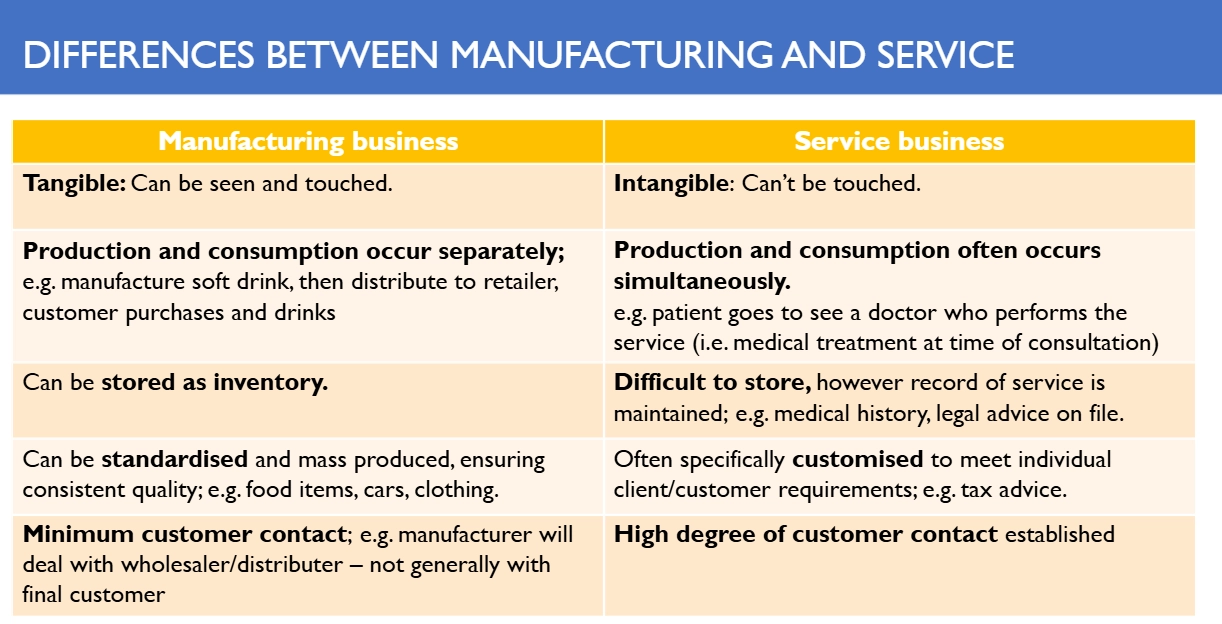
similarities
Utilise technology
Plan and develop organisational objectives
Deal with customers and suppliers
Aim to produce high quality products or services at the lowest cost
Aim to reduce costs of production
Aim to reduce waste
key elements of an operations system
inputs, process, outputs
inputs
the resources that will be converted into outputs
inputs can include:
Materials
Technology
Facilities, machinery, equipment
Human resources (labour)
Knowledge and skills
Time
process
processes are the activities that help transform inputs into outputs
Processes involve ‘doing’ such as storing, sorting, blending, packaging
The effectiveness of your processes can impact areas such as quality, wastage produced and productivity (through the speed of producing outputs)
outputs
final goods or services that are produced and ready for customers, the quality of the output is a reflection of the inputs and processes used in the operations system
connecting key elements to the characteristics of operations
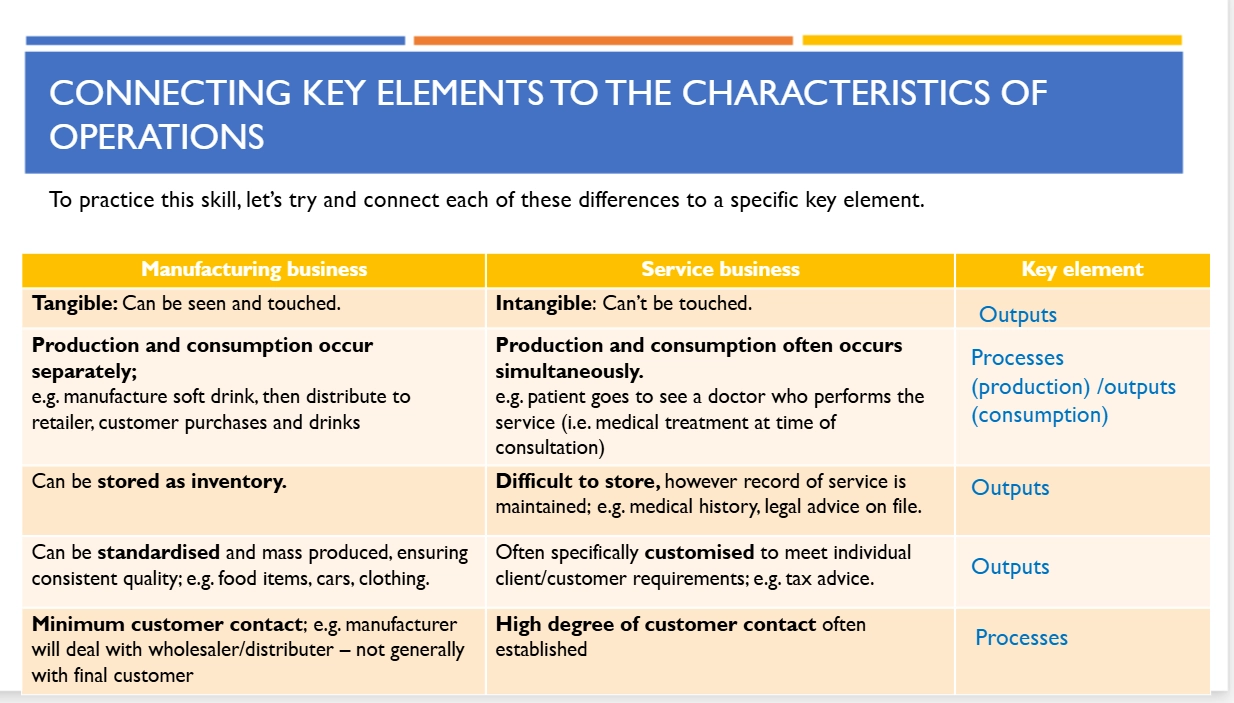
strategies to improve efficiency and effectiveness
technological developments, materials, quality, waste minimisation, lean management
technology
practical application of science to achieve a commercial or industrial objective
technological strategies
automated production lines, robotics, computer aided design, computer aided manufacturing, artificial intelligence, online services
automated production lines
Equipment and machines are arranged in a sequence and controlled by computer systems to perform tasks automatically
Often used for mass production
Series of workstations that perform a specific operation and the product is processed step by step as it moves along the line in a sequence
Each workstation is linked by an automated transfer system which moves products between stations
Timing and sequencing of equipment controlled by computers
Human role reduced to: system design, making adjustments to equipment, supervision and monitoring
automated production lines advantages
Improved productivity through reduced production time (efficiency)
Faster production allowing the business to meet customer demand (effectiveness)
Improved workplace safety (effectiveness) as dangerous tasks performed by technology rather than humans
Repetitive, boring and difficult jobs replaced by automation
Reduction in waste (efficiency) due to greater precision and less defects
automated production lines disadvantages
Huge initial costs in purchasing systems
Ongoing maintenance expensive because involves employment of highly skilled maintenance workers
Reduce available employment opportunities (negative CSR impact)
robotics
Integrates computer science and engineering in the design, construction and use of machines to perform manual tasks
Robots often perform tasks such as handling raw materials, welding, assembly and product packing
Robots are programmable machines with the ability to detect changes in their environment
robotics advantages
Speed of robot reduces production or service time improving efficiency
Robots are more accurate than humans reducing wastage, improving efficiency
Robots can be programmed to deliver a consistent quality improving customer satisfaction leading to increased effectiveness
Robots can replace dangerous jobs improving workplace safety
robotics disadvantages
Initial cost in purchasing robots
Downtime for maintenance and repairs if the robot breaks down (reducing efficiency)
Reduce available employment opportunities (negative CSR impact)
computer aided design (CAD)
Software that creates product possibilities from a series of parameters
Standard in most manufacturing and design businesses
Creation of 3-dimensional diagrams, allowing for accurate predictions of what final product will look like from all angles without building it
Used a lot by architects, engineers and designers
Used to draw and adjust 3-dimensional designs based on client requirements
CAD advantages
Customers are able to make suggestions and alterations to their product (improving effectiveness through increased satisfaction)
The design process is streamlines and less resources are used designing the product and making prototypes (improving efficiency)
Enables product to be tested before going into production —> reducing wastage by making less mistakes (improving efficiency)
CAD disadvantages
Costly to introduce
Requires technical training to use
May replace human labour
computer aided manufacturing (CAM)
Software used to allow the production process to be directed and controlled by computers
Machines are fed programmed instructions from a central computer
This reduces the need for manual resetting of machinery
This often works in tandem with CAD to allow machines to create objects directly from computer designs and software rather than engineers having to set up machines and processes manually
CAM advantages
Greater accuracy and consistency, improving the quality of the end product (effectiveness)
Reduces need for manual resetting of machinery = save time and labour costs (efficiency)
CAM disadvantages
Costly to introduce
Requires technical training
If computers break down, it can lead to expensive downtime that halts production (negative impact on efficiency)
artificial intelligence (AI)
Deals with the development of computer programs that imitate human intellect
AI helps machines to collect and extract data, acknowledge patterns, learn and adapt to new situations and environments through machine intelligence and speech recognition
AI is used extensively across many industries including banking, healthcare, retail, logistics and government sectors
AI advantages
Can analyse information and make decisions for businesses quickly, increasing efficiency
Can allow services to be provided to customers 24/7 e.g. through chat bots
Can increase accuracy as it is not prone to human error
AI disadvantages
Difficult to ensure accuracy — prone to errors which could lead to poor decisions
Require ongoing testing and validation which is time consuming
Can involve analysing personal data which requires adhering to privacy laws — time consuming to ensure you are adhering to laws
online services
Providing information or support over the internet
Examples
Online booking systems e.g. hotels, restaurants, events, beauty, medical appointments. By using an online database and diary it reduces scheduling issues and saves time
Feedback forms — allow businesses to gather information quickly to improve quality and enhance the customer experience
Could be used for customers to place orders online, and products are only manufactured after order is received (reducing waste and improving efficiency)
online services advantages
Can be used to gather customer feedback which can be used to help improve quality (effectiveness)
Can be used to automatically take customer orders and assist with effective materials planning
Booking appointments online requires less human energy (efficiency)
online services disadvantages
Web designers can be expensive
Time consuming to develop website
Security risks as websites and data are at risk of hackers
materials management
Involves the planning and coordination of all inputs that are required for an operation system
Businesses need to ensure they have the right amount of materials on hand so that production can meet demand
A major issue for businesses is running out of stock. If a business doesn’t have enough materials so production can meet demand they may lose sales
The operations manager needs to consider how much to purchase based on a number of factors:
Having enough materials on hand for production to flow continuously
The cost of purchasing materials and having them delivered
The storage required, availability and cost of storage
Are the materials likely to go to waste or get damaged while being stored?
materials strategies
forecasting, master production schedule, materials requirement planning, just in time
forecasting
Planning strategy where past data and trends are used to predict future demand so informed decisions can be made around materials
Some ways of forecasting include:
Looking at past data
Looking at market trends
Assessing business information (supplier lead times, new marketing campaign etc.)
forecasting link to efficiency and effectiveness
Effectiveness: the business can then ensure they have enough materials on hand to meet the production needs, ensuring consumer demand is met, allowing the business to maintain sales revenue and profit (less wastage, less storage costs
Efficiency:
Improve productivity because production does not need to wait
Reduces overstocking which reduces wastage
forecasting advantages
Ensures stock and materials are on hand as required to meet demand
Factors in lead-time for suppliers to deliver which reduces chance of supply shortages
forecasting disadvantages
It is just a prediction and cannot be relied upon 100%
Global events can impact supply or demand such as weather events, political and legal decisions, fads etc.
master production schedule (MPS)
Outlines what is going to be produced in what quantities and when it is going to be produced
Elements in the MPS include:
Each good/service that will be produced
The exact quantities of each good/service
How, when and where the production will take place
MPS link to efficiency and effectiveness
Effectiveness
Enables the business to have a clear picture on what needs to be produced to meet customer orders, increasing revenue and profit
Efficiency
Helps the business plan the exact amount of materials needed so the correct materials can be ordered, preventing over production and reducing wastage
MPS advantages
Assists decision making to ensure adequate resources and labour is available to fulfil contracts
Reduces stress as production plans are clear
Creates clear guidelines and expectations for staff
MPS disadvantages
Delays to supply delivery times may cause the schedule to be interrupted
Changes to customer demand could lead to changes in the MPS
materials requirement planning (MRP)
An itemised list of materials that are required to meet specific orders
To successfully plan the required materials, the operations manager must:
Consider stock already on hand
Lead times (how long it takes for the materials to arrive
Number of materials required to meet the orders
MRP link to efficiency and effectiveness
Effectiveness:
Ensures production has a continuous flow without waiting for materials
Enough materials on hand to meet demand, increasing sales revenue and profit
Efficiency:
Prevents overstocking, reducing wastage
MRP advantages
Ensures stock and materials are available for specific orders
Ensures productivity levels in production can be maintained due to adequate stock levels
MRP disadvantages
Delays to supply delivery times may cause the schedule to be interrupted
Glitches in computer system could lead to orders not being received
just in time (JIT)
Is a strategy that ensures the right amount of materials arrive just as they are needed for production
Ensures there is very little stock on hand
The exact amount of materials arrive only as they are needed
Saves money on storage and minimises the issues that come with large storage — lost or damaged stock, wastage
However if materials don’t arrive on time, production will slow or halt
JIT link to efficiency and effectiveness
Effectiveness:
Aims to have a continuous flow of production, reducing downtime and minimising expenses
Businesses can use extra space to maximise production
Money saved (not tied up in inventory) can be used in other areas of the business
Efficiency:
Reduces storage cost
Reduces wastage
JIT advantages
Save storage costs as you are not storing stock
Less wastage as only what is required is ordered
Money saved (not tied up in inventory) can be used in other areas of the business
JIT disadvantages
Delays may occur
Industrial action at suppliers (e.g. strike) impact production
Shortages of materials from suppliers may impact production
More frequent deliveries can be costly
quality
refers to achieving a standard of excellence in a finished good and service that is provided or delivered to an end customer
quality management
The management of the production process that ensures the outputs produced are consistently reliable and durable
Quality strategies aim to:
Minimise waste in production process
Minimise defects
Achieve set quality standards to ensure customer expectations are met
quality strategies
quality control, quality assurance, total quality management
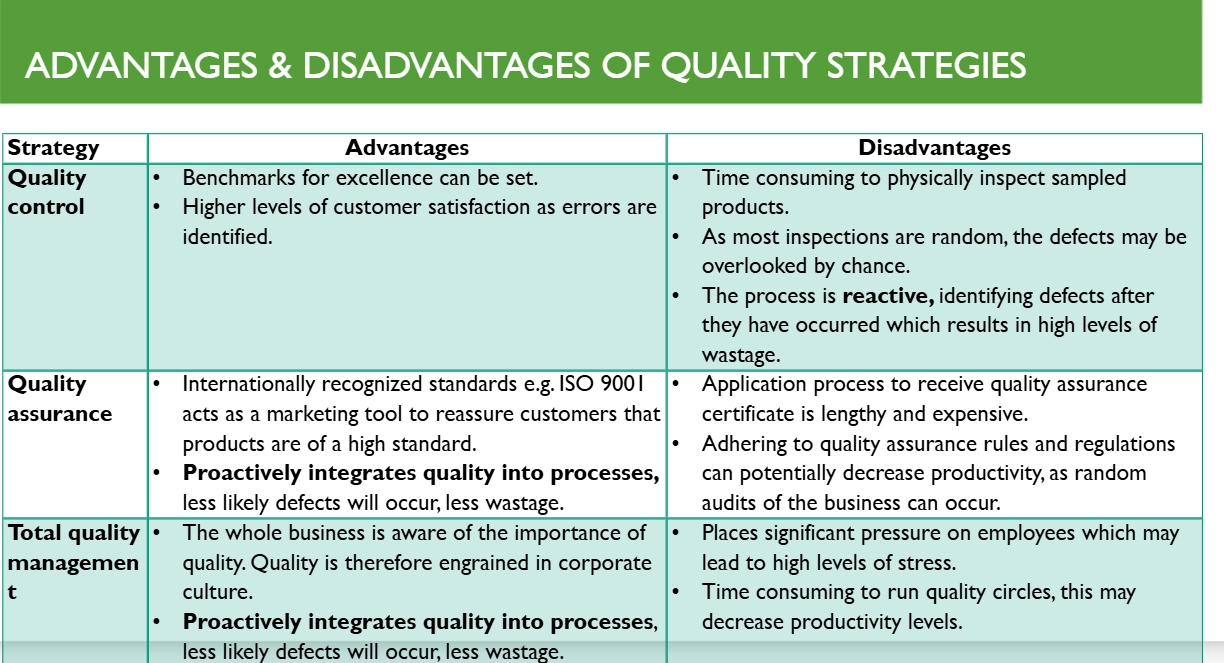
quality control
a procedure that aims to ensure that a good or service adheres to a set of quality criteria by performing checks at regular intervals
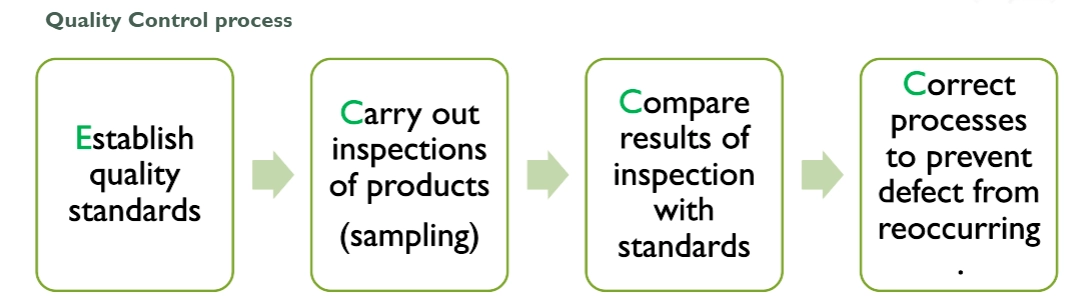
quality assurance
a system where the business meets a set of predetermined quality standards often set by an independent body
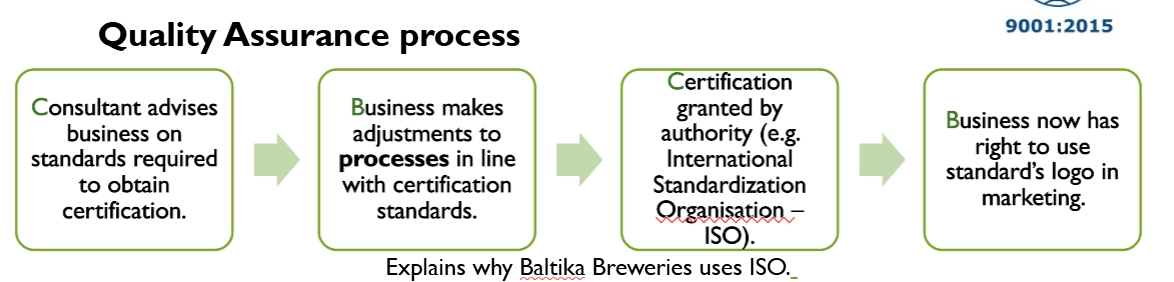
total quality management (TQM)
a holistic approach to quality where all members of an organisation focus on continuous process improvement, customer focus, defect prevention and universal responsibility
Core TQM concepts:
Continuous improvement — there is an ongoing commitment to achieving quality. It is a journey rather than a destination
Customer focus — every work group must think about providing value to the people who use their product. This may be an internal or external customer. Involves finding out what the customer wants and ensuring the process provides it
Defect prevention — prevent defects in products or services before they arise rather than relying on inspection
Universal responsibility — quality is the responsibility of every employee, not just inspection department
2 of the most popular strategies that can achieve TQM are:
Quality circle: a group of workers who meet regularly to discuss quality and production issues; proposed changes to production methods are then put forward to management
Kaizen: the Japanese notion of continuous improvement — all employees work proactively to achieve incremental improvements in the production process in an attempt to reduce waste and costs in production
quality — improving efficiency and effectiveness
All the quality strategies will improve effectiveness as they will improve the overall quality of the products being produced. This leads to objectives such as increased sales, reduced customer complaints and increased market share
All the quality strategies will improve efficiency because errors are either reduced or at the very least identified early, ensuring less wastage from faulty products being thrown out or needing to be put back into production for reworking
quality advantages and disadvantages
waste minimisation
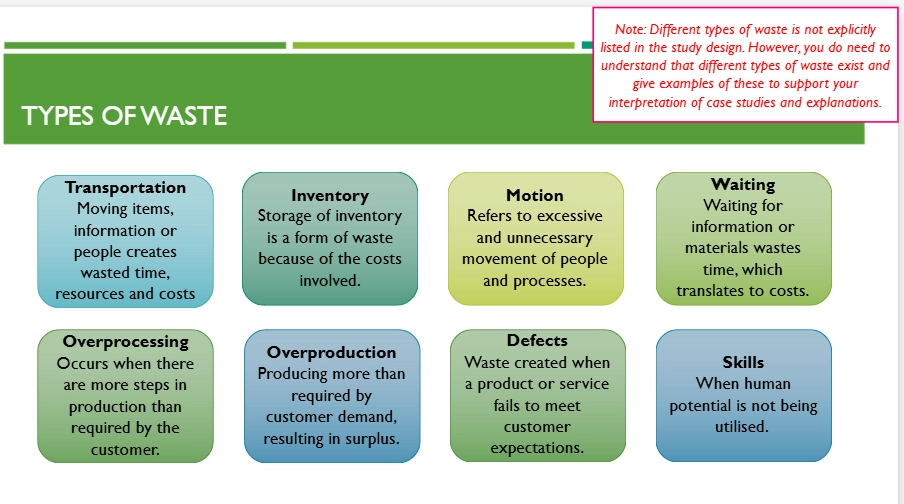
Waste includes any action in the production process that does not add value for the customer
Waste minimisation is the process of reducing the amount of discarded resources created by the businesses operations system
types of waste
waste minimisation strategies
Reduce: Decrease use of resources, activities, labour and time to decrease waste production
Reuse: if waste is produced, make effort to repurpose instead of discarding
Recycle: convert waste materials into useable products
Recover: recover waste that cannot be reused or recycled instead of discarding (not specifically mentioned in SD)
waste minimisation link to efficiency and effectiveness
Efficiency:
When a business reduces waste they are using fewer resources which therefore increases their efficiency
Effectiveness:
Waste prevention leads to significant cost savings. This can have a positive impact on the objective of increasing profit through decreased expenses
Examples of cost savings include: lower waste disposal costs, lower energy costs, lower storage costs, cost recovery through the sale of recyclable materials
lean management
Aims to deliver customer value by systematically reducing waste and focusing on continuous improvement
Lean management is a philosophy, a way of thinking
It first considers what the customer is willing to pay for
Activates that do not add value to the end product or customer are defined as waste and should be reduced or eliminated to free up resources to be used for adding value
Lean management can be described as ‘a way to do more and more with less and less — less human effort, equipment, time and space — while coming closer and closer to providing customers exactly what they want
principles of lean management (POTZ)
pull, one piece flow, takt, zero defects
pull
Production of the good or service is only started when the customer places an order. The customer order ‘pulls’ at the production system with their demand
This ensures inventory is kept to a minimum, waste is reduced, and customer satisfaction is assured as orders received are less likely to be damaged
one piece flow
An uninterrupted flow of process from the beginning until the end of the production process
When all steps are aligned, value is added one piece at a time and unnecessary activities that are wasteful are removed from the process
takt
The operations process seeks to create a rhythm whereby all the steps in the production of the good or service are synchronised to create a ‘continuous flow’
Takt is the German word for ‘timing’
zero defects
Focuses on quality, identifying potential defects as soon as possible to ensure that any issues are resolved quickly and efficiently, resulting in high quality
lean management advantages
Less infrastructure is required, with only essential building space, equipment and manpower (reduces expenses, contributing to objective of increased profit — effectiveness)
Responsive to customer needs develops strong customer relationships (may lead to increased sales revenue, contributing to objective of increased profit — effectiveness)
Reduces wase production and improves productivity as unnecessary resources are removed (improves productivity levels as less resources are used, improving efficiency
lean management disadvantages
Focus on short-term gains and waste reductions may be made at the expense of long term sustainable solutions
Time consuming to actively review all procedures to make changes to reduce wastage
Employees may be resistant to removing certain processes or resources
lean management link to efficiency and effectiveness
Efficiency is improved as wastage in all areas of the business is reduced
Products are made faster and with fewer resources
Can lead to increased profits and market share through decreased expenses and/or increased revenue
Can improve customer value
corporate social responsibility (CSR)
The commitment by business to go above and beyond legal obligations to ensure they are acting in an ethical manner in relation to social, economic and environmental considerations
Pressures to adopt socially responsible business practices come from:
Employees
Customers
Shareholders
Media
Suppliers
why be socially responsible
Communities expect businesses to act in a CSR manner
Shareholders examine performance of corporations based on social, environmental and economic performance (triple bottom line reporting)
Reputation of not behaving in a CSR manner gains negative reputation
CSR and environmentally sustainable inputs
Environmentally sustainable inputs
Environmental sustainability refers to a business making decisions that will allow it and the rest of society, to interact with the environment both now and into the future
Inputs used in the production process should not have a serious or negative impact on the environment
Select sustainable suppliers
Adopt a purchasing policy that includes social responsibility criteria to be applied when choosing suppliers e.g. does the supplier have appropriate environmental and social responsibility policies in place?
Audit suppliers to see which suppliers satisfy the criteria
Other strategies
Purchase sustainable inputs e.g. recyclable materials
Purchase energy-efficient technology e.g. company vehicles with hybrid engines
Purchase and use green energy potions e.g. solar panels, wind farms
Choose local suppliers — support local economy/less impact on co2 emissions as there is less distance to travel
CSR and processes
Reuse of resources
Recycling of resources
Utilisation of green technologies
Retain all processing within Australia to ensure all Australian workers are employed
Adopt processes that increase accuracy and decrease waste e.g. technology
CSR and outputs
Ensure that product is durable and reliable (beyond legal requirements) e.g. lasts longer than expected warranty period
Create sustainable packaging e.g. sign the Australian Packaging Covenant — commitment to reduce amount of packaging and use more sustainable packaging
Final output is biodegradable
CSR and operations strategies
Technology
Implement ‘green’ technology e.g. hybrid vehicles
Implement technology to increase accuracy and reduce wastage
Materials
Implement JIT to avoid wastage
Develop relationships with ethical supplies
Source sustainable inputs
Minimise deliveries to decrease carbon emissions
Quality
Implement quality strategies to ensure product lasts beyond warranty period
Implement TQM to involve employees into quality strategies (feel valued, increase morale)
Waste minimisation
Implement lean manufacturing to reduce wastage and landfill
Empower workers to develop waste reduction strategies in lean management (feel valued, increase morale)
Implement prevention techniques to minimise landfill 3Rs
global considerations
The global economy and technology have meant that a business must look beyond the borders of its country of origin when running its operations system while optimising competitiveness
supply chain management
Supply chain refers to the flow of supplies from the supplier, through the operations system and to the end consumer
Supply chain management involves meeting consumer demand for goods and services while making the most efficient use of the production process and the distribution of the finished product to the customer
A business must consider the interests and expectations of a number of stakeholders in a global supply chain:
Customers
Producers
Employees
Governments
types of global considerations
Businesses participate in the global supply chain through the following methods:
Global sourcing of inputs
A business uses suppliers from overseas countries
Overseas manufacture
When the production of a good occurs in an overseas location. This may be done by the business or outsourced (global outsourcing)
Global outsourcing
Where a business hands over part of its operations to an overseas business e.g. non-core business activities such as IT are often outsourced but it can be manufacturing (overseas manufacture)
global sourcing of inputs advantages
Opportunity to take advantage of global efficiencies
Due to types and quality of resources some countries have natural advantages in producing specific products e.g. Aus produce wheat/wool at lower cost to other nations
Resources not found in home country can be utilised
global sourcing of inputs disadvantages
Increased shipping costs and time
Risk of damage in shipping increases with disrance
Inefficiencies associated with time zones, cultural differences and language barriers
May be tariffs (taxes)
Exposed to changes in exchange rates
Not buying locally — can be seen as unethical
overseas manufacturing advantages
Lower cost of production
Labour costs in Australia is much higher than developing countries, so it can be cheaper to manufacture overseas
Skills and resources not found in home country can be utilised
e.g. Ripcurl manufactures wetsuits in tropical areas such as Thailand which has plentiful supplies of rubber trees. This also reduces transport costs of raw materials
Potential to be close to other markets
Australia is a long way from many countries
overseas manufacturing disadvantages
Increased shipping costs and time if going to ship products back to Australia
Inefficiencies associated with time zones, cultural differences and language barriers
More difficult to manage the quality of manufactured products
Loss of Australian jobs — can be seen as unethical
global outsourcing advantages
Skills not found in home country can be utilised
Outsourced to people who are specialised in their field — have specific equipment and technical expertise
Access to cheaper labour rates
global outsourcing disadvantages
Inefficiencies associated with time zones, cultural differences and language barriers
Customer frustration with language barriers
Loss of Australian jobs — can be seen as unethical
issues to be addressed in global sourcing
Local labour costs and conditions — must ensure you act ethically
Environmental impact — emissions generated by transport
Exchange rates — affect cost of doing business
Tariffs — tax on importing products can impact final cost of product