Multi store model
 Call Kai
 Learn
Learn Practice Test
 Spaced Repetition
 Match
Match Flashcards
 Knowt Play
1/5

There's no tags or description
Looks like no tags are added yet.
Name | Mastery | Learn | Test | Matching | Spaced | Call with Kai |
|---|
No analytics yet
Send a link to your students to track their progress
6 Terms
What is the Multi Store Model?
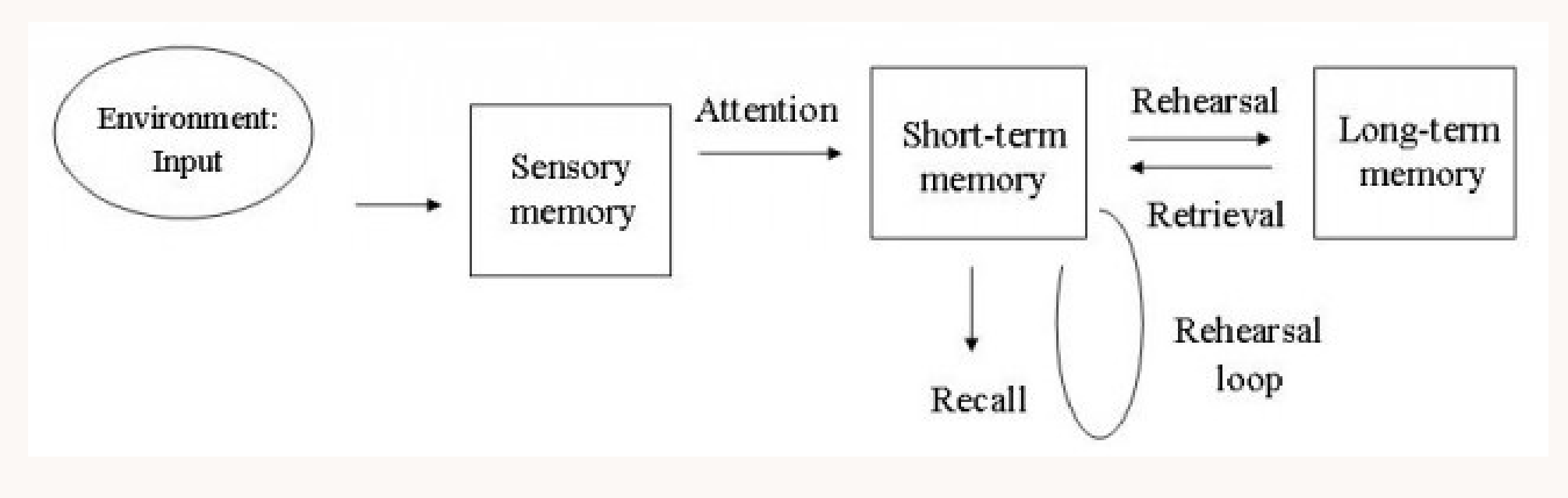
Cognitive model that uses 3 separate systems (sensory buffer/memory, Short term memory, long term memory) to explain how memory flows
Explain the 3 stores from multi store model
Sensory memory (sight, hearing, etc) → Info received through environmental stimulus using senses for brief moment
Short-term memory → Store with limited capacity (7±2) and duration
Info enters STM if attention is given to sensory buffer/memory
New info that is not rehearsed or disrupted → displaced
Long - memory → Store with unlimited capacity with extensive duration
Info transfers to LTM after rehearsal
Info transferred from LTM → STM = Retrival
Describe the study of HM (Milner)
Aim: To understand the effects of removing the hippocampus & Amygdala on memory.
Procedure:
Child (HM) suffering epileptic seizures after a head injury.
Surgeon removed Parts of his amygdala (emotional memories) and hippocampus (episodic, semantic and converting STM to LTM) to reduce epileptic seizures.
After removal
Could not acquire episodic (General factual) or semantic (autobiographical) memories
could not transfer STM → LTM,
Procedural memories (how to do something) were well maintained, Hm could learn how to mirror draw.
Conclusion: Showcases how memory correlates to different areas in brain
Hippocampus is responsible for converting STM to LTM.
Procedural memory is in separate area of brain → Allowing for Mirror drawing learning
The amygdala is responsible for emotional memories.
Apply the Multi Store Model to HM
Sensory memory and semantic procedural (how to) unaffected - HM improved & learned skill of mirror drawing using sensen
STM still worked - HM could repeat 584 through rehearsal for 15 minutes. → did not move to LTM
Transfer from STM to LTM was broken - without hippocampus rehearsal could not move information into permanent storage.
What are the strengths and limitations of the HM?
+ High internal validity (confidence IV affected DV) → Lab conditions are controlled → removed role of confounding/external variables such as outside noise (can effect focus & memory)
-- Low ecological validity - lab conditions not applicable to real life → lower generalizability
-- Unethical and correlational.
- Does not explain emotional influence on transfer between stores.
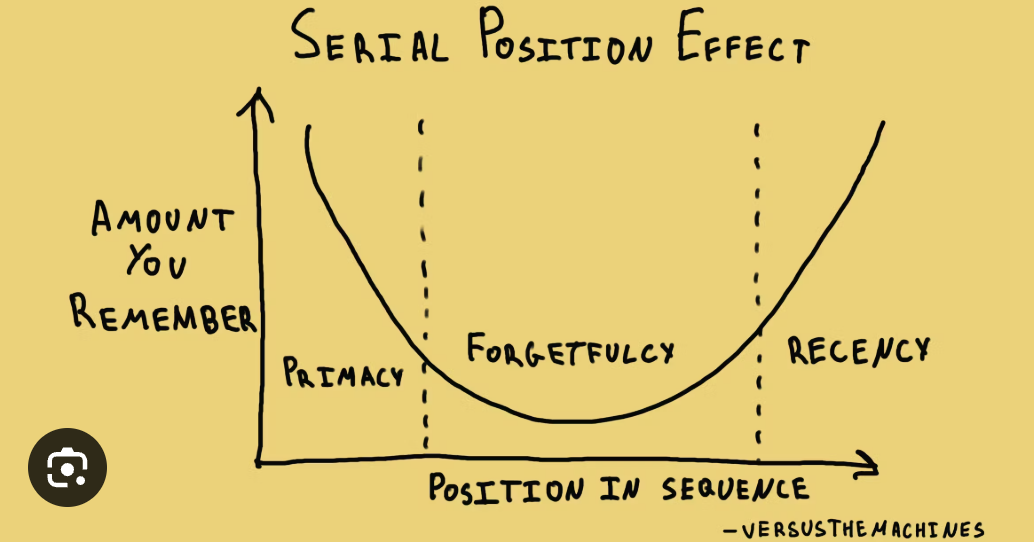
Explain the serial position effect
How position of info in sequence effects how well you remember it
Primacy effect: Words at beginning of list are remembered
Recency effect: Words at the end are best remembered