Lecture 13 - skeletal muscle pathology
 Call Kai
 Learn
Learn Practice Test
 Spaced Repetition
 Match
Match Flashcards
 Knowt Play
1/67

There's no tags or description
Looks like no tags are added yet.
Name | Mastery | Learn | Test | Matching | Spaced | Call with Kai |
|---|
No analytics yet
Send a link to your students to track their progress
68 Terms
What are four types of atrophy?
Denervation atrophy
Disuse atrophy
Endocrine disease
Malnutrition/cachexia
What is denervation atrophy? What causes it? What fibers does it affect?
-Myofibers lose connection with innervating nerve
-Neuropathy
-Affects both 1 and 2 type fibers
What is disuse atrophy? What fibers does it affect?
-Decreased contractile activity of innervated muscle
-Type 2
What causes atrophy of endocrine disease? What fibers does it affect?
-Hypothyroidism and hyperadrenocorticism (dogs)
-Selective type 2
What is cachexia? What causes it? What fibers does it commonly affect?
-Atrophy from chronic illness or neoplasia
-Caused by circulating cytokines
-Primarily type 2 preferentially
What is the difference between physiologic and pathologic hypertrophy?
Physiologic hypertrophy is from increased workload while pathologic hypertrophy may be compensatory or disease related (ex. double muscling)
What is segmental necrosis?
One segment is injured but other segments are fine
What is global necrosis? What causes it?
-Necrosis of the entire length of the fiber
-Only during severe distress
What does muscle necrosis look like grossly? On histo?
-Gross: pale yellow to grey to white
-Histo: Hypereosinophilic, fragmented, and mineralize
What are the factors necessary for regeneration?
-Persistence of the supportive basal lamina
-Presence of macrophages
-Appropriate neural activity
What is monophasic necrosis? What is key on histo?
-Caused by a single insult
-All myofibers are in the same stage
What is polyphasic necrosis? What will you see on histo?
-Repeated or ongoing insult
-Myofibers in various stages of necrosis, degeneration, or regeneration
What are two types of Myasthenia gravis? What is a common sequelae?
Congenital - inherited defect in acetylcholine end plate plate receptors at NMJ
Acquired - Immune mediated caused by antibodies against acetylcholine receptors
-Megaesophagus
What species cause tick paralysis? When will clinical signs start? How do you cure it?
-Dermacentor and Ixodes ticks
-5-7 days after a bite
-Remove tick
What is the pathogenesis of botulism? What toxin causes it?
-Botulism toxin disrupts neurotransmitter vesicle exocytosis at synapse
-Caused by exotoxin from Clostridium botulinum
What bacteria causes tetanus? What is the pathogenesis?
-Clostridium tetani
-Tetanus neurotoxins enters nervous system → binds cell membrane of inhibitory interneurons → prevents release of GABA → spastic muscle paralysis
What causes congenital muscular hyperplasia?
Defect in myostatin gene
What is canine X linked muscular dystrophy (CXLMD)? What age and breed is most commonly affected?
-Severe progressive degenerative myopathy lasting 8-12 months
-Affects young male dogs, commonly golden retrievers
What are the gross lesions found with CXLMD? Histo lesions?
-Gross: Severe degeneration of diaphragm and strap muscles
-Histo: Polyphasic necrosis and regeneration of predominantly type 1 fibers
What is the pathogenesis of congenital myotonia in goats?
Mutation in ClC-1 channel causing decreased conductance
What causes hyperkalemic periodic paralysis in horses (HYPP)? What is the common sign in bloodwork?
-Autosomal dominant mutation in muscle sodium channels causing increased opening time
-Hyperkalemia with ± elevated CK and AST
What causes equine polysaccharide storage myopathy?
-Autosomal dominant glycogen storage myopathy
-Most common in draft, warm blooded, and quarterhorse
What are the clinical signs of equine polysaccharide storage myopathy? What will you see on histo?
-Signs: recurrent exertional rhabdomyolysis, muscle atrophy
-Histo: intracytoplasmic accumulation of glycogen within type 2 myofibers
What causes malignant hyperthermia? In what species?
-Single point mutation in ryanodine receptor causing increased channel open time
-Excessive myofiber contraction generates heat causing hyperthermia
-Pigs (also horses and dogs)
What clinical signs will you see with malignant hyperthermia in swine? What will you see on necropsy?
-Signs: limb and torso muscle regidity, respiratory difficulty, tachycardia
-Gross: PSE (pale, soft, exudative) pork
What are possible causes of an ischemic injury to the muscle?
-Vascular occlusion due to pressure
-Occlusion of a major artery (saddle thrombus/aortic-iliac thrombosis)
-Widespread vascular injury
What will ischemic necrosis lead to? Why is this a problem?
-High CK and release of toxic myoglobin
-Reperfusion injury is a major concern
What species is compartment syndrome common in? In what muscles?
-Broiler chickens
-Supracoracoid muscle (from flapping wings)
What is downers syndrome? What can worsen it?
-Muscle ischemia caused by external pressure of body weight in large, down animals
-Can be worsened in an animal with pressure-induced peripheral nerve injury
What is another name for selenium/vit E deficiency? What species is it common in?
-White muscle disease
-Cattle, sheep and pigs most susceptible
What species is Monensin (ionophore) toxic in?
Horses (and other monogastrics)
What is maduramicin (ionophore) toxic in?
Cardiotoxic in cattle and sheep
What clinical signs can you see with ionophore toxicity? What about on histo?
-Lethargy, stiffness, muscular weakness, recumbency
-Histo: multifocal monophasic necrosis
What are some examples of myotoxic plants?
-Cassia (coffee senna)
-Ageratina altissium (white snakeroot)
-Gossypol (cottonseed)
What are clinical signs seen with myotoxic plants? Grossly/histo?
-Signs: weakness, increased muscle enzymes
-Gross/histo: multifocal necrosis
What is degenerative myopathy?
Muscle disease characterized by myofiber necrosis
What is exertional rhabdomyolysis? What species does this commonly affect?
-Myofiber damage/necrosis due to exercise stress
-Horses and dogs
What is capture myopathy? What species is it common in?
-Exertional rhabdomyolysis seen just after capture
-Zoo species/hoofstock
What are clinical signs seen with exertional myopathies?
-Dyspnea, weakness, muscle tremors, muscle rigidity, hyperthermia, collapse, death
-Myoglobinuric nephropathy
-Extremely high CK and AST
What is masticatory myosis? What species is it found in?
-Immune mediated myositis against type 2M myosin
-Dogs, esp. german shepherds
What are the clinical signs of masticatory myositis? What is seen on histo?
-Trismus, bilaterally symmetric swelling to atrophy
-Histo: multifocal polyphasic necrosis with interstitial lymphocytic to eosinophilic inflammation
What are conditions associated with polymyositis?
-Systemic lupus erythematosus
-Paraneoplastic disease
-Myocarditis, IBD, thyroiditis
What is extraocular muscle myositis? What species is it common in?
-Myositis affecting extraocular rectus and oblique muscles
-Common in young dogs, especially golden retrievers
What disease is purpura hemorrhagica associated with?
Streptococcus equi ssp equi (Strangles) infection
What are four types of bacteria that can cause suppurative myositis? What species does each commonly infect?
Trueperella pyogenes - cattle and swine
Corynebacterium pseudotuberculosis - sheep, goats, horses
Streptococcus zooepidemicus - horses
Pasteurella multocida - bite wounds from cats
What does corynebacterium cause in sheep and goats?
-Caseus lymphadenitis
-Main lesion in lymph nodes but can extend to overlying muscle
What does corynebacterium pseudotuberculosis cause in horses?
Pigeon fever → abscesses deep in pectoral muscles
What are two clostridial species that cause myositis in livestock and horses? What clinical signs do they cause?
Clostridium septicum = malignant edema
Clostridium perfringens = gas gangrene
Clostridium chauvoei = blackleg
What is the major lesion seen with clostridial myositis? What causes the lesions?
-Muscle necrosis, ± edema, hemorrhage, gas production, death
-Bacterial exotoxins
What animals does clostridium chauvoei commonly affect? What is seen grossly? On histo?
-Cattle who are the best growers
-Gross: large, swollen leg muscles, crepitus, dark red/black
-Histo: necrohemorrhagic or necrosuppurative myositis
What are two bacteria that cause granulomatous myositis? What is the common name of the disease for each?
Staph. aureus = Botryomycosis
Actinobacillus lingieresii = Wooden tongue
What species does trichinella spiralis infect? How does infection occur?
-Pigs and humans
-Ingestion of infected meat
What are 4 example of a primary muscle neoplasm? Are they usually benign or malignant?
Rhabdomyoma/rhabdomyosarcoma
Hemangiosarcoma
Nerve sheathe tumors
Granular cell tumor
-Usually malignant
What are three types of rhabdomyoma/rhabdomyosarcoma?
Cardiac rhabdomyoma (pigs)
Laryngeal rhabdomyoma (dogs)
Urinary bladder rhabdomyosarcoma (dogs)
What are three examples of secondary tumors found in muscle?
Infiltrative lipoma
Injection site sarcoma (cats usually)
Metastatic tumors - round cell, carcinomas, etc
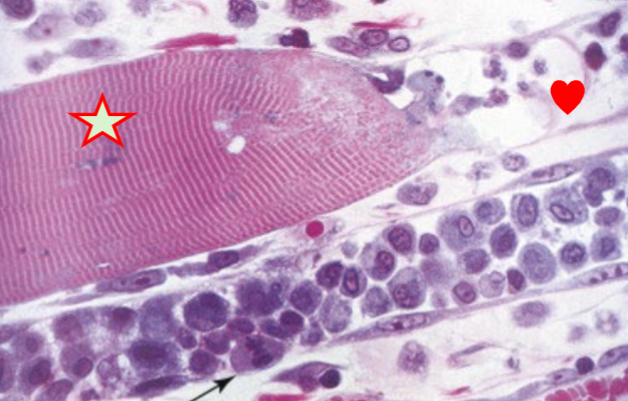
What is this image showing? What is the star? The heart?
-Segmental necrosis
-Star: normal myocyte
-Heart: area of necrosis
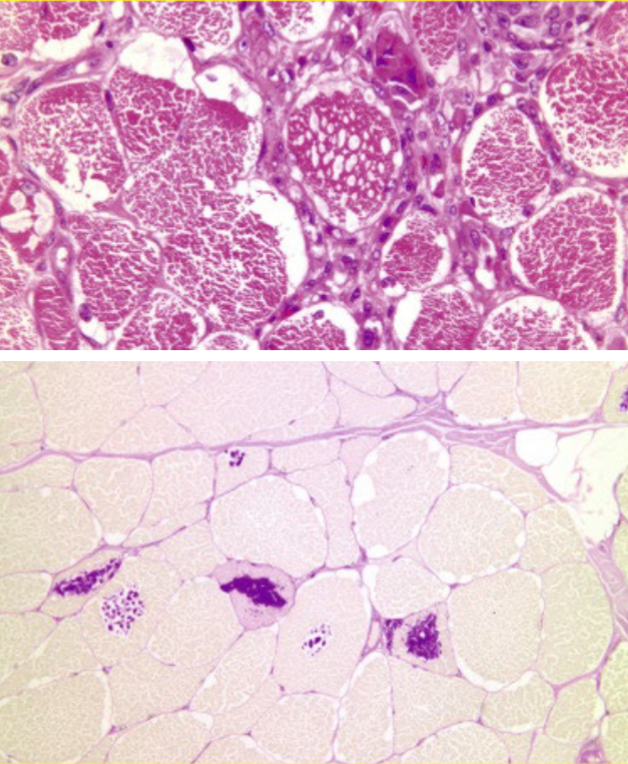
What is this image showing? Top stained with H&E bottom stained with PAS.
Equine polysaccharide storage myopathy
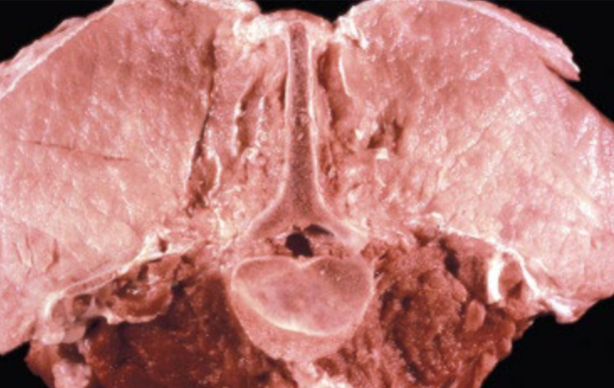
Cross section of skeletal muscle from a pig. What is this pig showing? What is a potential cause?
-PSE
-Malignant hyperthermia
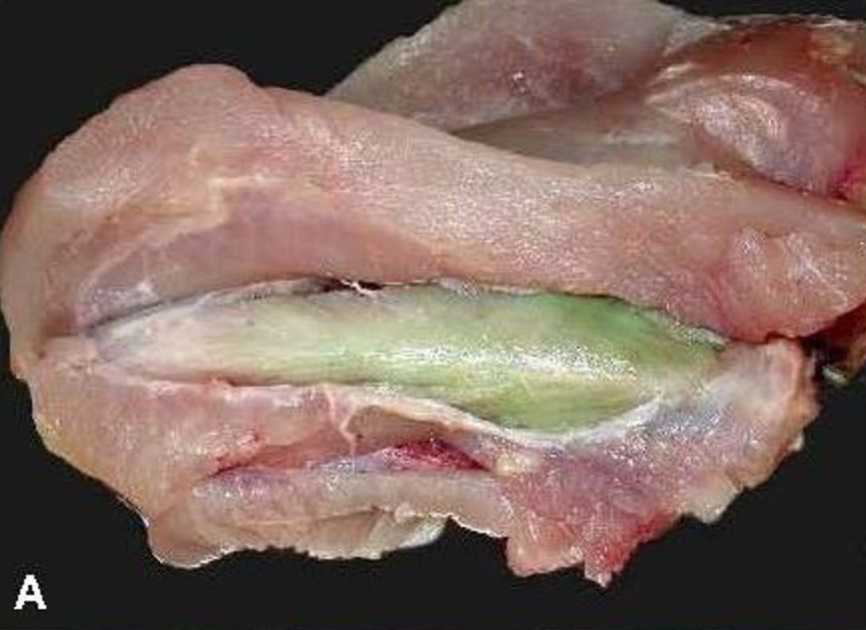
What disease occurred with this chicken?
Compartment syndrome
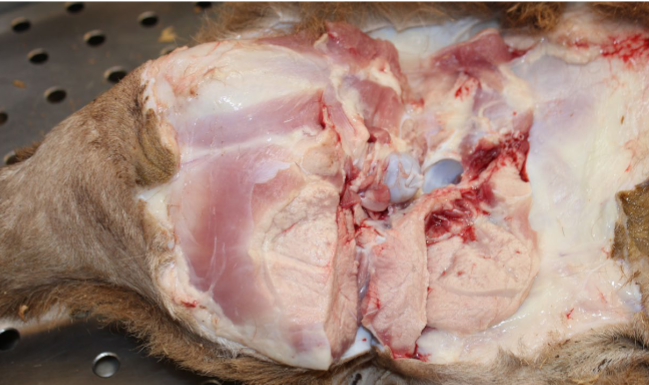
Skeletal muscle from the leg of a sheep. What likely caused this?
Selenium/vitamin E deficiency
Histo slide from the temporalis m. of a dog. Describe the slide and possible etiology.
-Mononuclear cells infiltrating myofibers, polyphastic lesions in myofibers
-Masticatory myositis
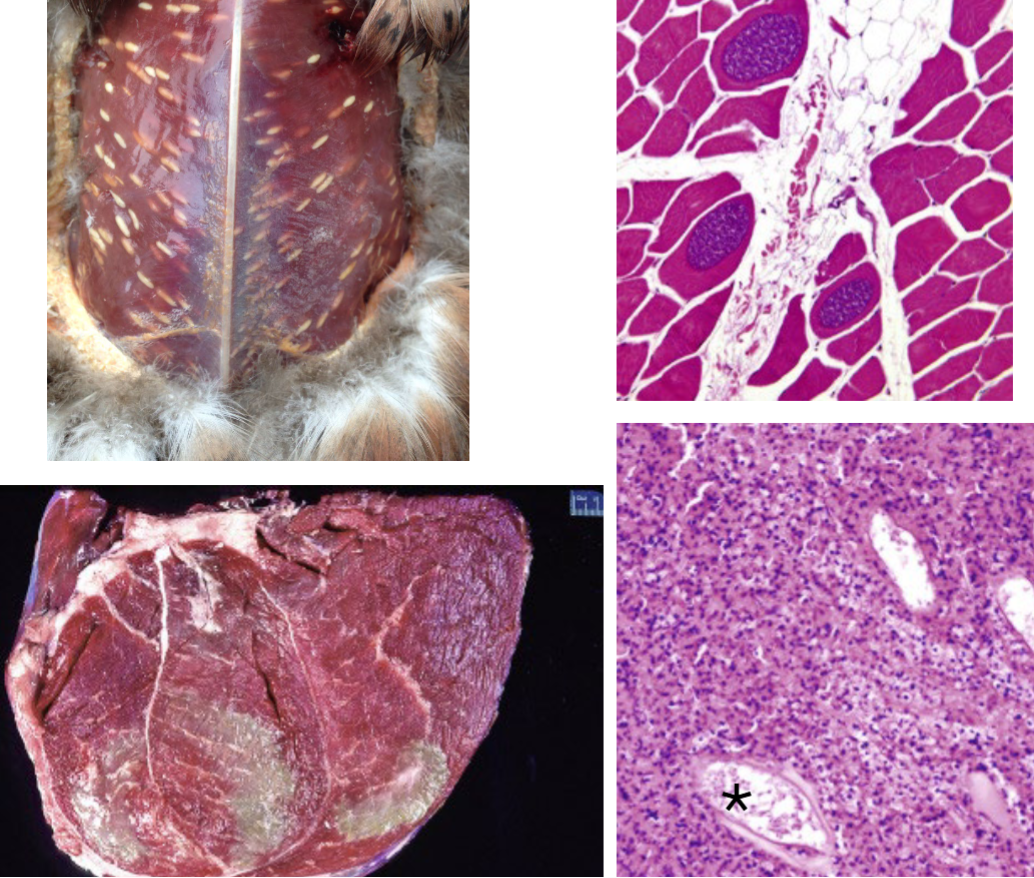
What organism likely caused these lesions?
Sarcocystis
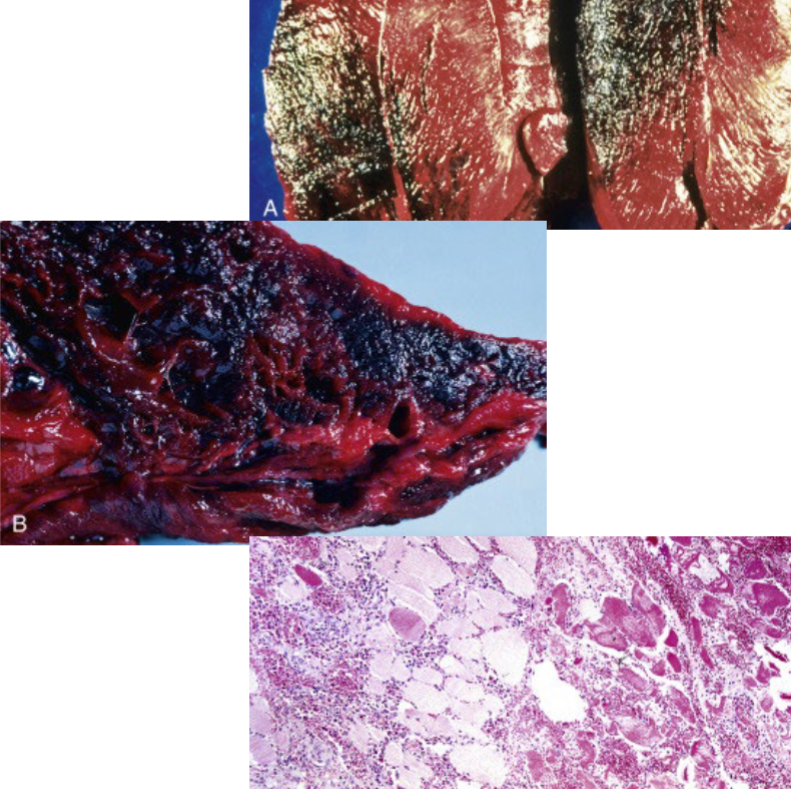
Image of skeletal muscle from a cow with histo slides. What likely caused these lesions?
Clostridium chauvoei = blackleg
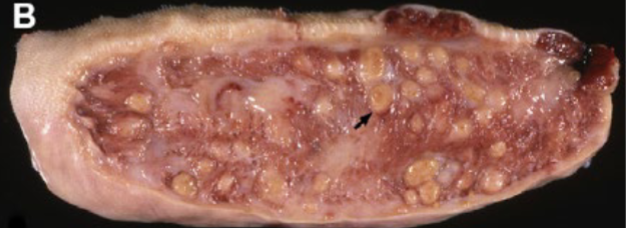
Cross section of a tongue from a cow. What likely caused these lesions?
Actinobacillus lingieresii = wooden tongue
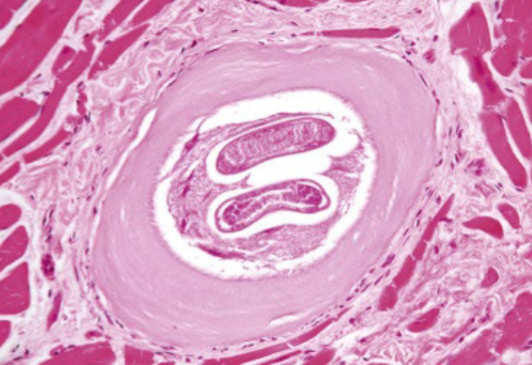
What parasite is this?
Trichenella spiralis
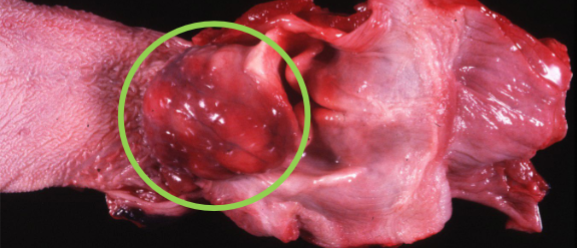
Image of the oropharynx region in a dog. What is circled?
Neoplasia = Laryngeal rhabdomyoma
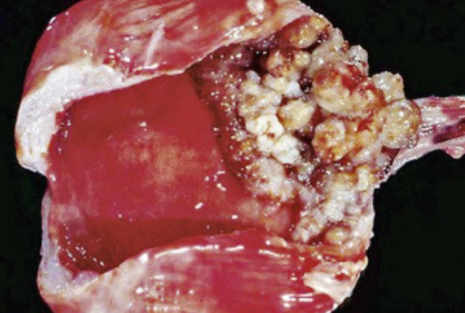
Image of the bladder of a dog. What is the likely cause?
Neoplasia = Botryoid rhabdomyosarcoma
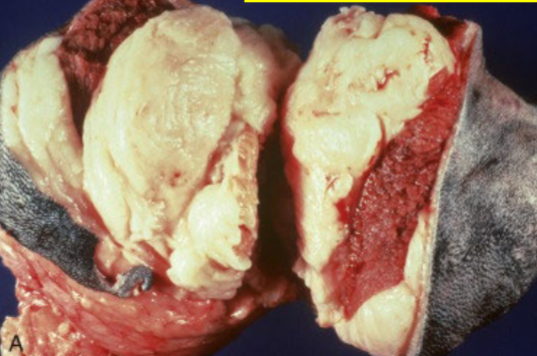
What is the likely cause of this lesion?
Lipoma