Stress, Strain and Material Behaviour (wk 2)
 Call Kai
 Learn
Learn Practice Test
 Spaced Repetition
 Match
Match Flashcards
 Knowt Play
1/12

There's no tags or description
Looks like no tags are added yet.
Name | Mastery | Learn | Test | Matching | Spaced | Call with Kai |
|---|
No analytics yet
Send a link to your students to track their progress
13 Terms
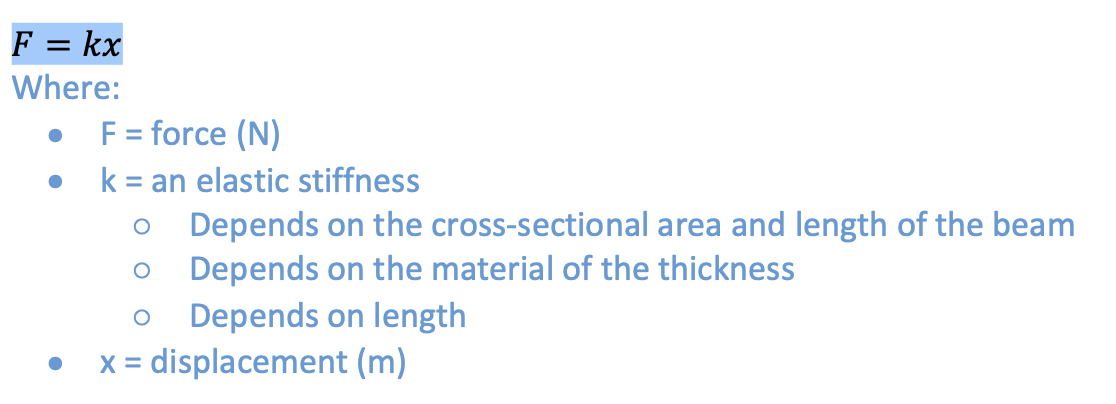
Hooke's Law + its general equation
The force (F) applied to an elastic member is directly proportional to the displacement (x)
What assumption do we make about material behaviour
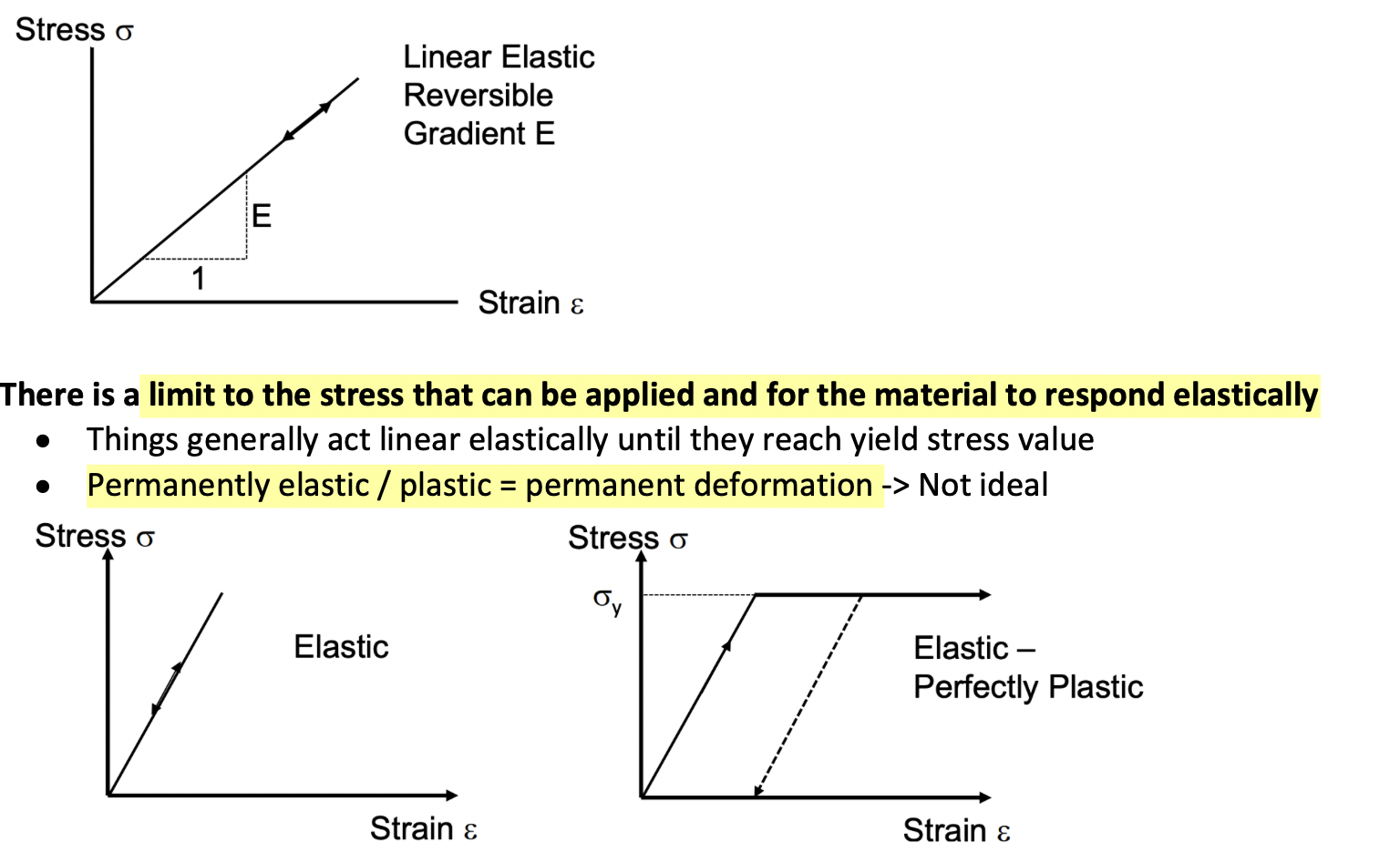
Civil engineering materials are assumed to behave linear elastically
Elastic = returns to original position when load is removed / no energy stored when load is removed
Linear elastic = behaves according to Hooke's Law → displacement and force are proportional
HOWEVER
There is a limit to the stress that can be applied and for the material to respond elastically
Things generally act linear elastically until they reach yield stress value
Permanently elastic / plastic = permanent deformation -> Not ideal
Factors that affect the elastic coefficient (k) in hookes law
K depends on cross-sectional area
-> greater area = more resistant to extensio
K depend on the length of the beam
-> longer the beam = more it extends
K = EA/L
E = young’s modulus
A = cross sectional area
L = length
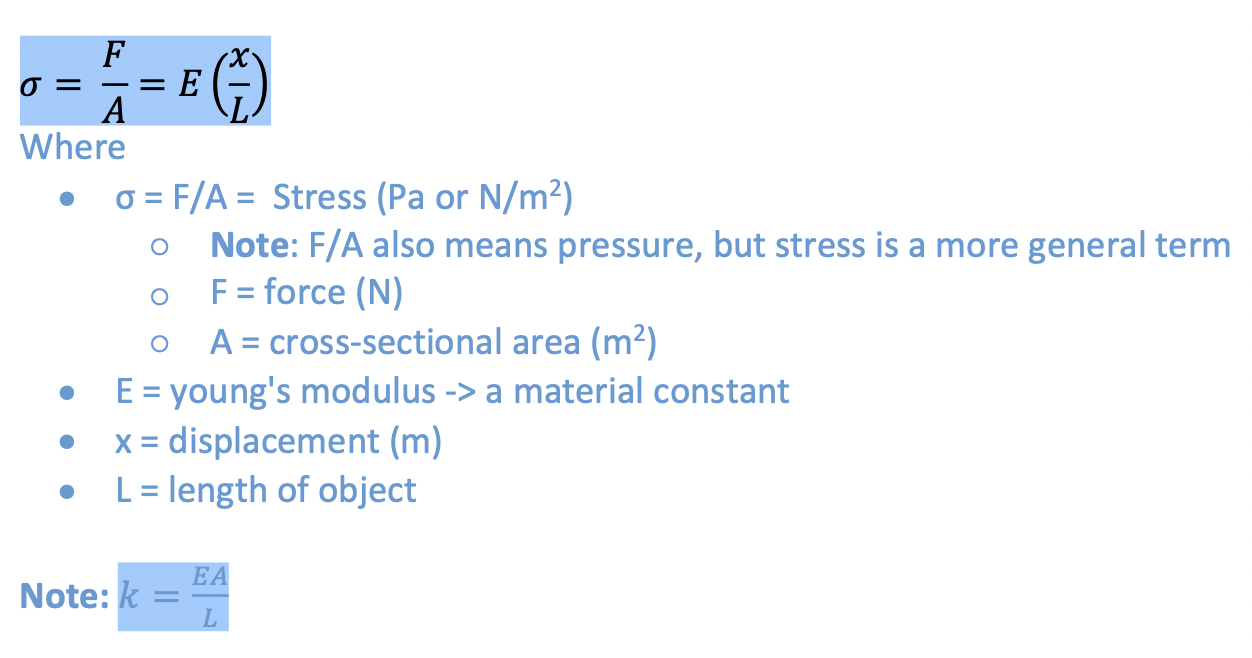
Stress
internal, resisting force a material develops to counteract that deformation
pressure comes from an external load
stress arises internally to oppose an external load placed on the object
Equation for stress
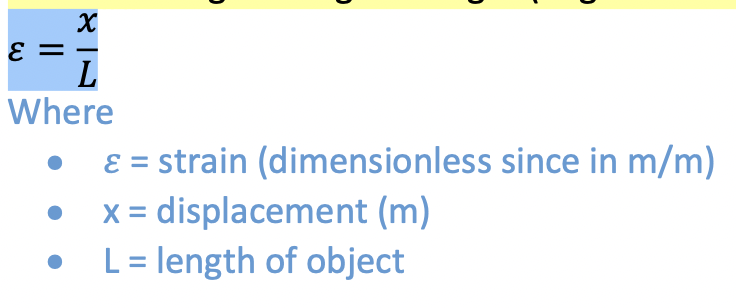
What is strain
change in original length (also called engineer's strain)
a ratio
compares two lengths
dimensionless → i.e. units cancel
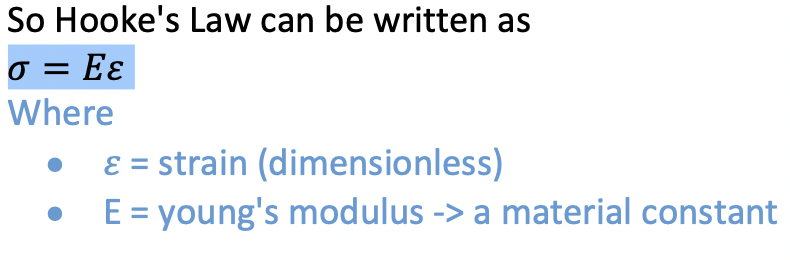
Hookes law but in terms of stress and strain
Stress vs strain graph
+gradient meaning
What is young’s modulus
just the gradient for the linear part of the stress-strain graph
Measure of stiffness
Higher E = more stiff/rigid
Lower E = more ductile/malleable
Define yield stress
Why is it important
stress level where a material transitions from elastic (reversible) to plastic (permanent) deformation
in structures → keep stress beneath yield stress
Ensures an elastic response and small deformations
Plastic straining has uses but not in structures
Making curved materials (e.g. doorknobs)
To make parts for vehicles (e.g. crumple zone of a car)
Main types of failure
Material failure
Material failure is a possible failure mode for all members
Can fail in compression, tension and shear (and bending)
Instability (buckling)
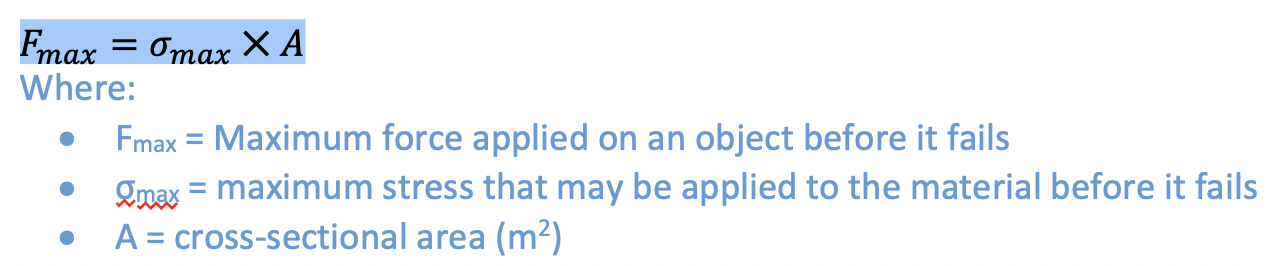
what is strength
maximum load that a member can handle before failing
why do we need to consider strength of a member in structural design
Strength ≥ applied load
If a load greater than the strength is applied to the column it will fail
need to ensure it doesn’t happen
will lose money
will cost lives
If the member consists of different parts with different materials, sum the strengths of the individual parts
E.g. if we know a column will be loaded with a compression force of 100kN, we need to ensure that the compression strength of the column is at least 100kN