Physics 3rd term
 Call Kai
 Learn
Learn Practice Test
 Spaced Repetition
 Match
Match Flashcards
 Knowt Play
1/35

Earn XP
Description and Tags
everything physics 3rd term
Name | Mastery | Learn | Test | Matching | Spaced | Call with Kai |
|---|
No analytics yet
Send a link to your students to track their progress
36 Terms
What happens when a substance is heated?
its internal energy (thermal energy/heat) increases
When a substances internal energy increases what increases with it?
its temperature
What are the two forms of energy the molecules in a substance possess?
Kinetic energy (due to their random motion/vibration)
Potential energy (due to the bonds between the molecules)
These two forms of energy make up the internal (thermal) energy of the substance
What is heat?
Heat is a transient form of energy that moves from hot bodies to cold bodies as result of temperature difference.
Heat energy is a scalar quantity and it measured in Joules with the aid of a calorimeter.
What are some effects of heat?
Rise in temperature
Change of state
Expansion
Increase in volume
Change in electrical resistance
Thermionic emission
Change in emf or electric current
What is temperature?
Temperature is the degree of hotness or coldness of a body. The human body cannot be used to determine the degree of hotness or coldness because it is unreliable and inaccurate.
Temperature is measured using a thermometer.
What is upper fixed point?
This is the temperature of steam from pure boiling water at normal atmospheric pressure i.e 100oC or 373K or 212oF.
What is lower fixed point?
This is the temperature of pure melting ice at normal atmospheric
pressure i.e 0oC or 273K or 32oF.
What is the triple point of water?
This is the temperature at which water co-exist in three states
simultaneously
What us absolute zero temperature?
This is the temperature at which total kinetic energy of the molecules of gases is zero and the volume of gas is zero. The temperature is 0K or -2730C.
What is fundamental interval?
This is the difference between the upper fixed point and lower fixed point. For example, the Celsius scale has 100o as the fundamental interval and Fahrenheit scale has interval of 180o
Inter polation of scale is used for converting…
arbitrary scale to standard scale
The formula is?
int-lfp/ufp-lfp=int-lfp/ufp-lfp
What is a thermometer?
A thermometer is a device for measuring temperature. They are made with substances whose certain physical properties change with temperature change. These substances are called thermometric substances.
What are thermometric substances?
These are substances used in thermometers whose physical properties change with temperature e.g mercury, alcohol, resistance wire, etc
What are thermometric properties?
These are measurable physical properties ( of substances used in thermometers) that respond to heat change or temperature change. Examples include;
Expansion of liquid
Change in volume at constant pressure
Change in pressure at constant volume
Change in electrical resistance
Change in emf / current produced
Radiation or colour change
What are the types of thermometers and their thermometric substances
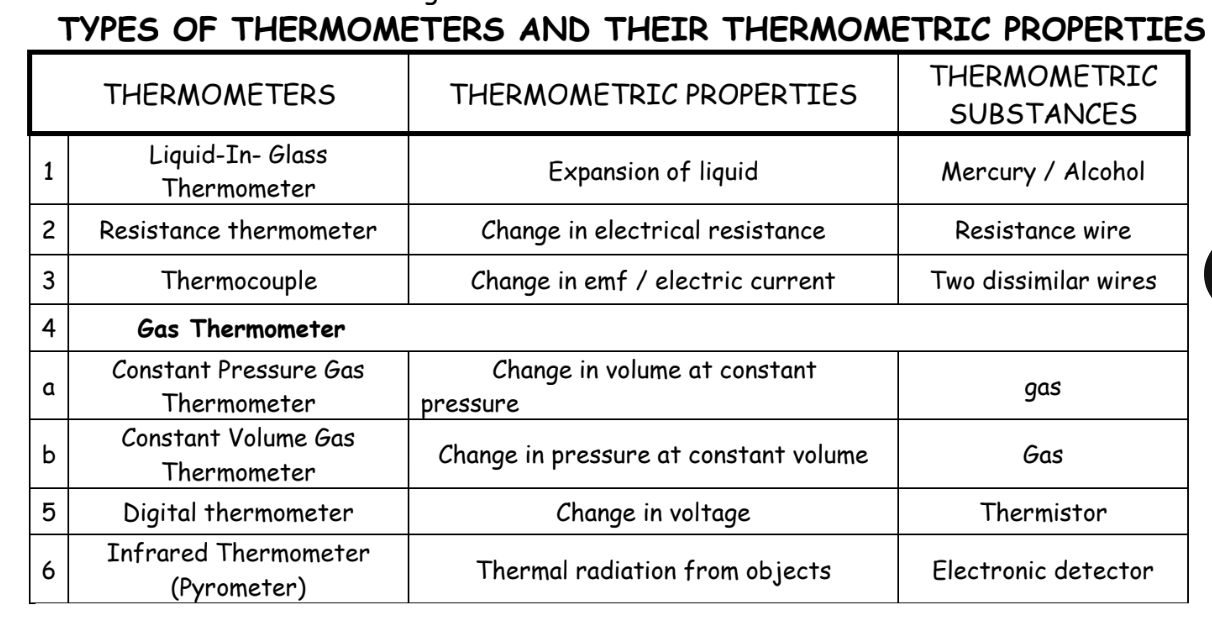
What are the most commonly used thermometers?
Most commonly used thermometers are Liquid-in-glass thermometers e.g clinical thermometer, laboratory thermometer etc.
What are the two types of liquid in glass thermometer?
mercury-in-glass and alcohol-in-glass thermometers.
What is an advantage of mercury in glass thermometer over alcohol in glass thermometer?
it can be used to measure very high temperature because its boiling point is high (357oC).
What is an advantage of alcohol in glass thermometer over mercury in glass thermometer
It can measure very low temperatures because its freezing point is very low (-115oC).
Why cant water be used as a thermometric liquid?
It wets glass
It is not opaque
It has small temperature range
It has uneven expansion
What are the special liquid in glass thermometers?
laboratory thermometer, clinical thermometer, six’s maximum and minimum thermometer
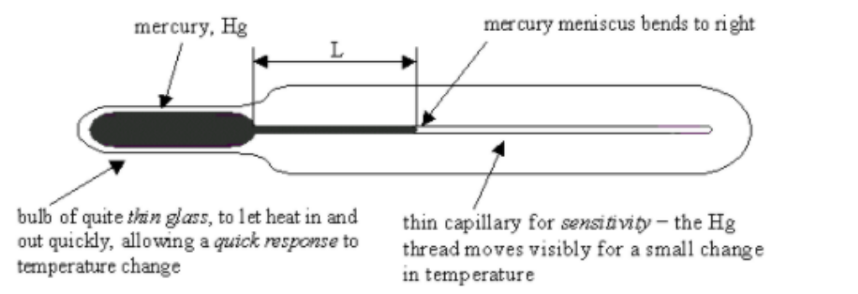
What is laboratory thermometer?
Laboratory thermometer: It is a mercury-in-glass thermometer. Its temperature is between 0oC – 200oC
W
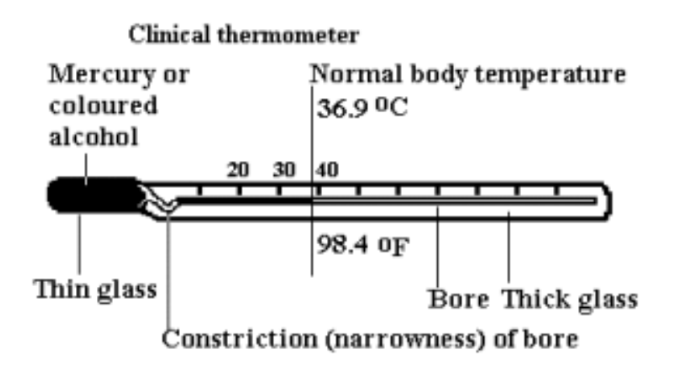
What is a clinical thermometer?
It is a special type of mercury-in-glass thermometer. It is designed to record temperature range few degrees below and above normal body temperature (about 37oC). Its range is 35oC to 43oC. It has a constriction or a kink in the capillary tube that prevents the mercury from running back to the bulb. So, to reuse the thermometer again, it is given a jerk.
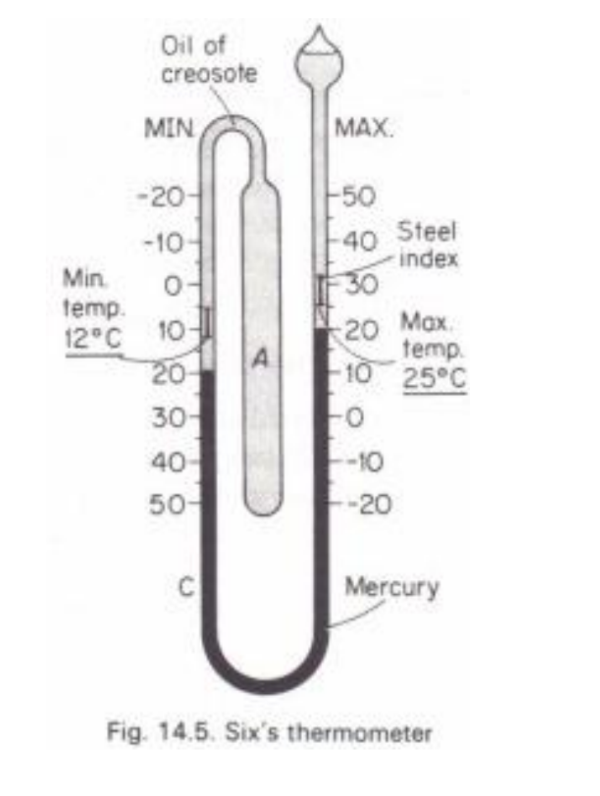
What is six’s maximum and minimum thermometer?
Six’s maximum and minimum thermometer is a registering thermometer that can record the daily maximum and minimum temperatures reached at a location. After readings have been taken, a small magnet is used to bring the indexes back into contact with the mercury.
What us the sensitivity of a thermometer?
The sensitivity of a thermometer is defined as the increase in the length of the mercury column per unit increase in temperature.
The sensitivity of a mercury thermometer can be increased by using a smaller mercury bulb, a thinner wall, and a smaller bore.
A smaller bulb contains less mercury and hence absorbs heat in shorter time. As a result it can respond faster to temperature change.
A glass bulb with a thinner wall can transfer heat to the bulb easier. Therefore, the thermometer can respond quickly to small changes of temperature near the surrounding.
Capillary with narrow bore produces a greater change in the length of the mercury column. Therefore a small change in temperature can be detected easily.
What is expansion/contraction of a substance?
Expansion of a substance means an increase in volume or size while contraction means decrease in volume or size. All substances expand when heated and contract when cooled. Also, when substances are heated their densities decrease and have increasing densities as they are cooled
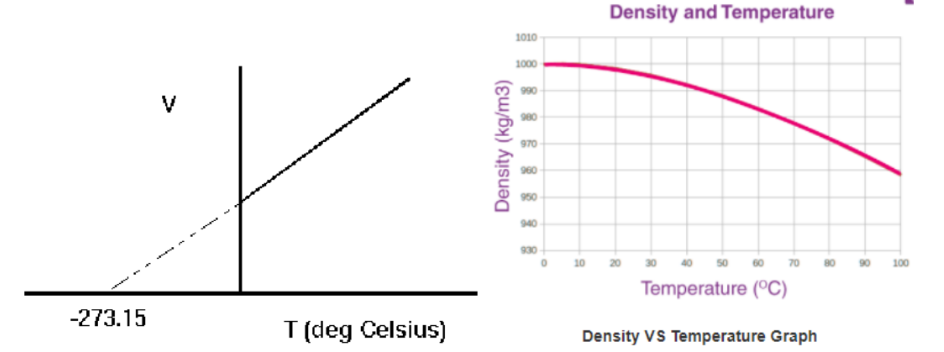
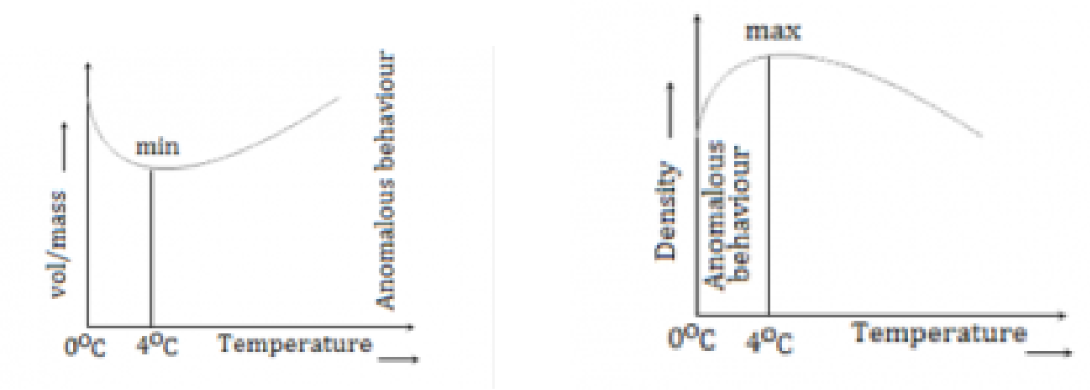
What is an exception to the above statement?
The expansion of water as it expands when cooled and contract when heated between 0oC to 4oC. This behaviour of water is called anomalous expansion of water.
What is the effect and application of thermal expansion of solid?
1. When hot water is poured in a glass tumbler, it might crack due to the uneven expansion of the inner wall of the tumbler.
2. The cracking noise of zinc roof during the day and night.
3. Thermal expansion of solid is used in the construction of bridges in which one side is fixed and the other is placed on rollers to allow for expansion.
4. The stopper of a bottle can be removed due to the expansion of the glass.
5. In the construction of concrete pavement, little spaces are left within the concrete to allow for expansion.
6. Gaps are left in the construction of railway tracks to give room for expansion.
7. Sagging of overhead cables
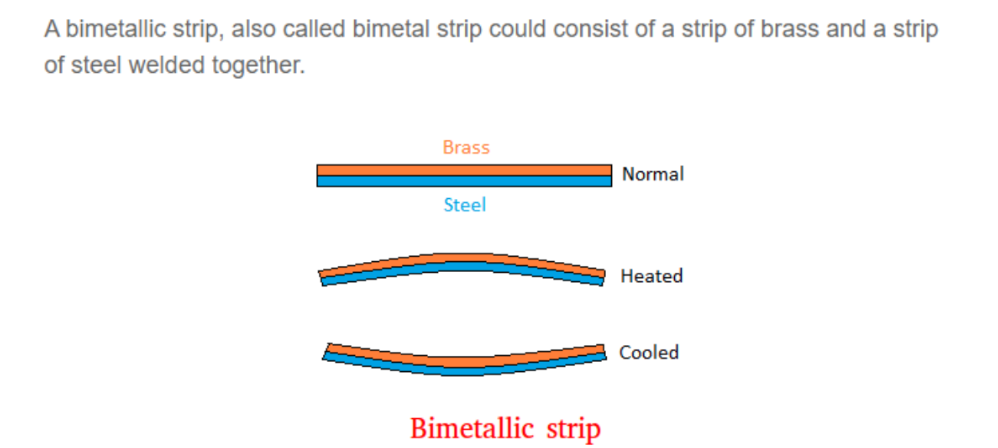
8. Bimetallic stripes are use in thermostat for controlling or regulating the flow of electric current.
What are the advantages of thermal expansion of solids?
1. Fire alarm e.g. electric bell
2. The fittings of wheels in rims
3. Bimetallic thermometer
4. Red hot rivet in ship building
5. Bimetallic stripes used in thermometer e.g. electric cooker etc
What are the disadvantages of thermal expansion of solids?
1. Cracking of drinking glass when hot liquid poured inside
2. If the balance wheel of a watch expands the time will be fast and if the balance
wheel of a watch contrasts the time will be slow
3. Expansion of metal of concrete bridges which can lead to eventual after a long
period
4. Sagging of overhead wire due to contraction in winter season
5. Expansion of railway tracks thereby forming distant railway tracks.
6. Bursting of water metal pipes.
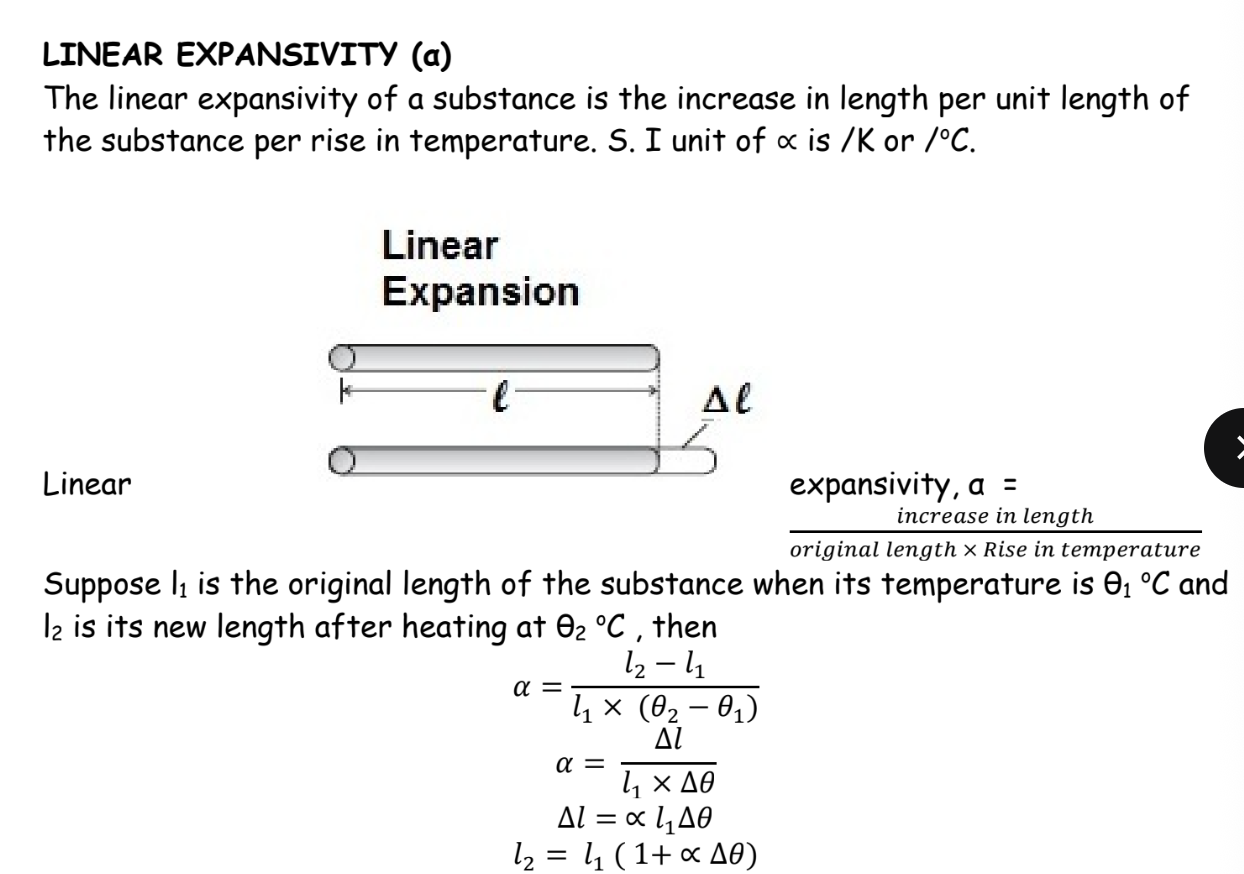
What is linear expansivity? (α)
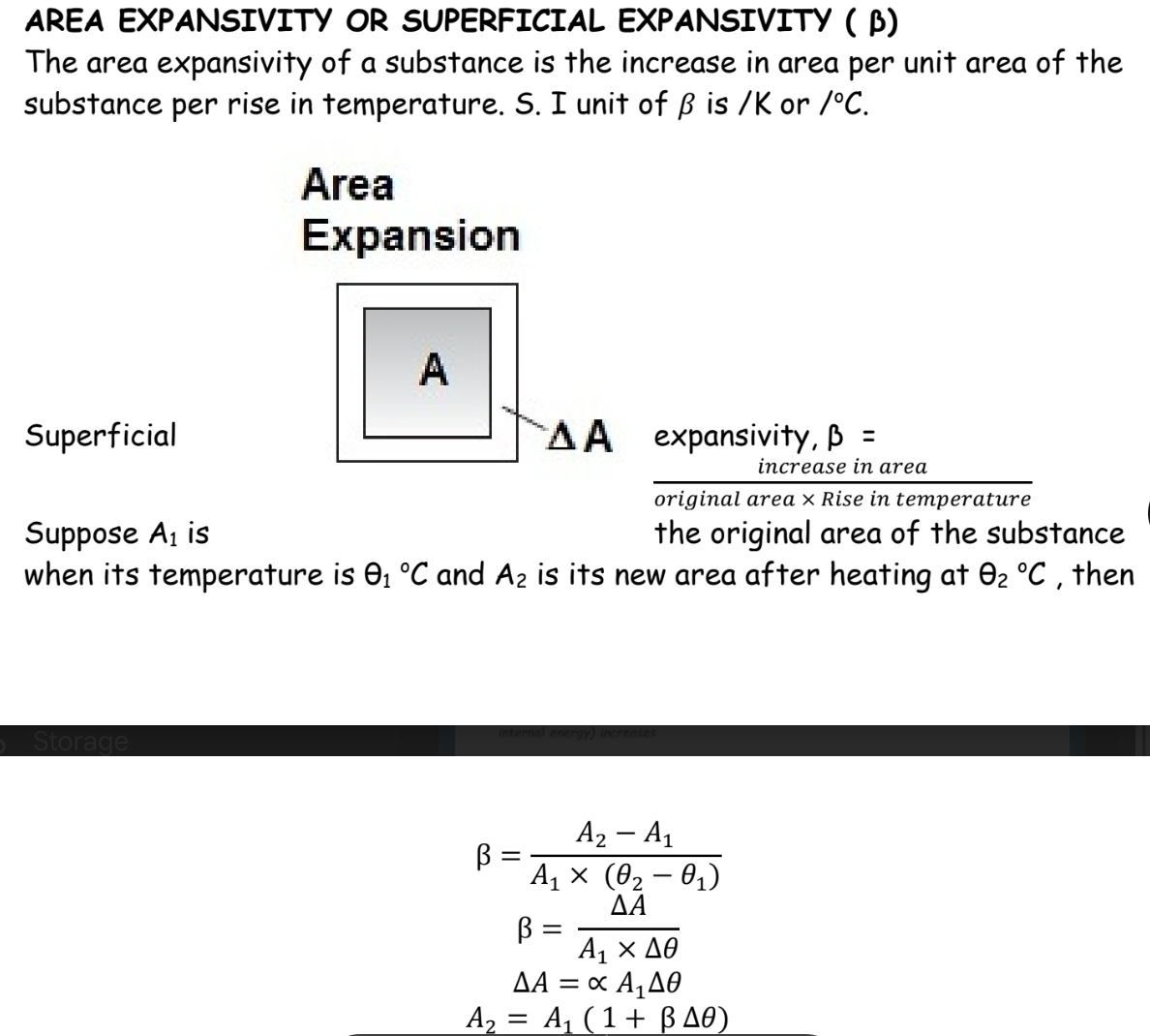
What is area expansivity or superficial expansivity? ( β)
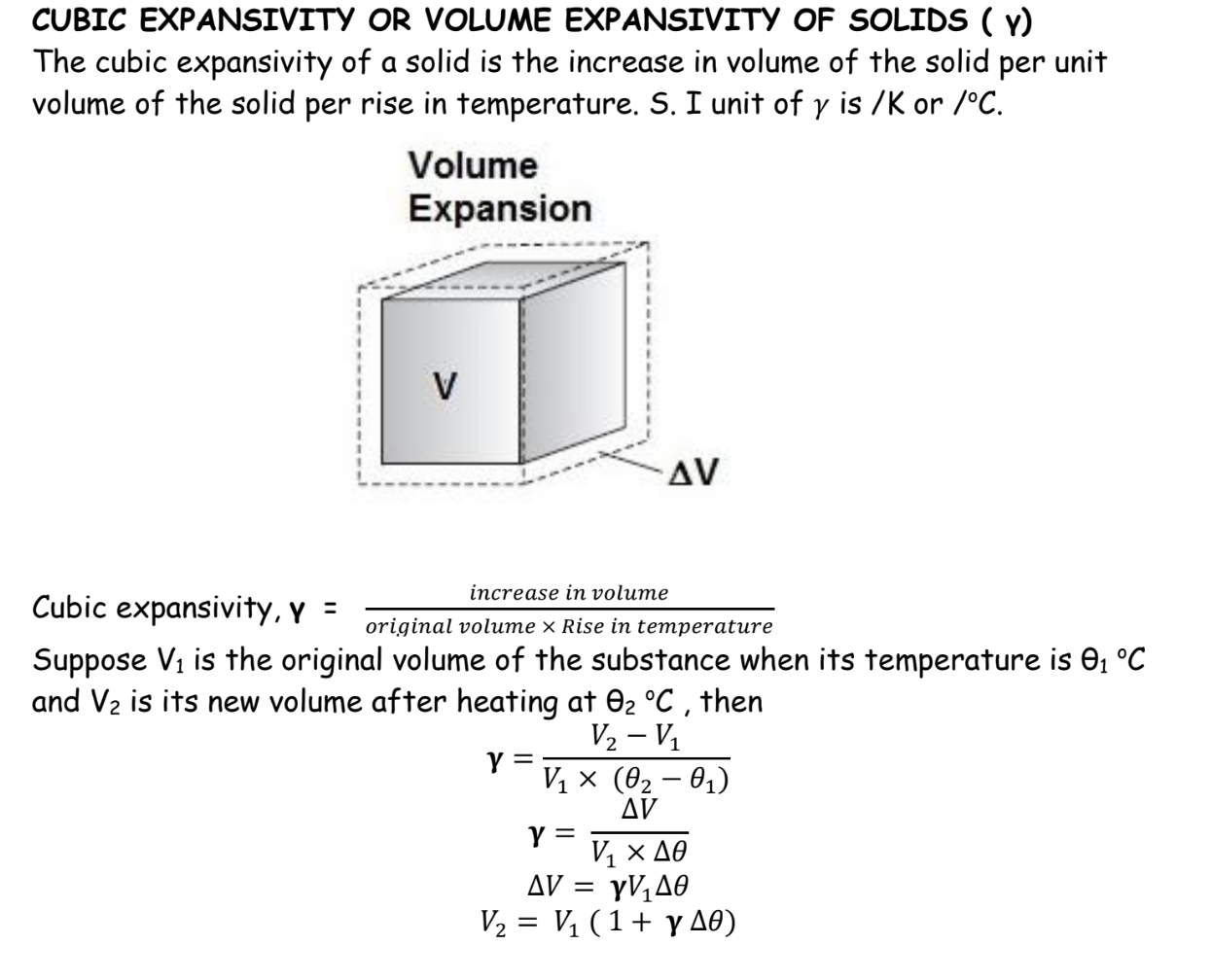
What is cubic expansivity of volume expansivity of solids? ( γ)