Week 7: Reading and speech perception
 Call Kai
 Learn
Learn Practice Test
 Spaced Repetition
 Match
Match Flashcards
 Knowt Play
1/36

There's no tags or description
Looks like no tags are added yet.
Name | Mastery | Learn | Test | Matching | Spaced | Call with Kai |
|---|
No analytics yet
Send a link to your students to track their progress
37 Terms
What is language?
A shared symbolic system for communication.
What is linguistics?
The discipline that takes language as its topic.
What is psycholinguistics?
The study of language as it is used and learned by people.
How do reading and speech perception differ in terms of word presentation?
Reading presents words as a whole, while speech perception spreads words out over time.
What is the ambiguity level in reading compared to speech perception?
Reading has low ambiguity, while speech perception has high ambiguity.
What cognitive demands are associated with reading versus speech perception?
Reading has low cognitive demands, while speech perception has high cognitive demands.
What cues are primarily used in reading compared to speech perception?
Punctuation is the main cue in reading and prosodic cues are used in speech.
What cues are primarily used in speech perception?
Prosodic cues are used in speech perception.
What are the different processing types involved in reading?
Orthography, phonology, semantics, syntax and grammar, and higher-level discourse integration.
Outline 3 research methods for studying reading
Naming task: say printed word out loud as rapidly as possible
Lexical decision task: decide rapidly whether string of letters forms a word
Prime words task: does a word presented before a target word affect processing of the target?
What are angloscentricites?
When the relationship between orthography and phonology is inconsistent
What is the weak phonological model?
It suggests that phonological processing is inessential for word identification.
What is the strong phonological model?
It posits that phonological processing is central for word identification.
Provide some evidence consistent with the strong phonological model
Homophones: words with one pronunciation, but 2 spellings
More errors made when word is homophone of real world (e.g. ROSE)
Errors suggests engaged in phonological processing
What are homophones?
Words with one pronunciation but two spellings.
What are phonological neighbours?
Words that differ in one phoneme, e.g. bait and gait
What is phonological priming?
Words processed faster when prime is phonologically identical
What is the word superiority effect?
A target letter is more readily detected in a letter string when it forms a word rather than a non-word.
What is the interactive activation model of visual word processing? What are the 3 levels of recognition?
Recognition units at 3 levels:
Feature level
Letter level
Word level
Involves parallel processing
Bottom-up and top-down processes interact
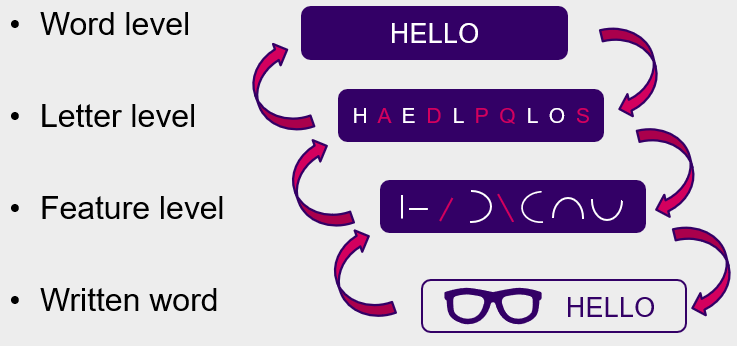
What can the interactive activation model account for?
Word superiority effect: target letter readily detected in a letter string when the string forms a word rather than a non-word
Orthographic neighbours: words formed by changing one of a target word's letters and can influence recognition time
Emphasis on top-down processes from word level to letter level
What are orthographic neighbours?
Words formed by changing one letter in target word
When word presented, neighbours activated
Neighbours facilitate target word recognition if they are less frequent (weakly activated) in language
Neighbours inhibit target word recognition if they are more frequent (strongly activated) in language

Name limitations of the interactive activation model
Too much importance attached to letter order
Able to read text when first and last letters in correct place but others transposed

What is semantic priming?
A phenomenon where a target word is recognised faster if preceded by a semantically related word.
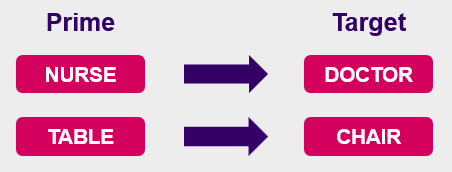
What are the 2 possible explanations of semantic priming?
Automatically activates related words due to learning
Expectation semantically related word will follow
What are the two major theoretical approaches to reading aloud?
The dual-route model and the connectionist triangle model.
What does the dual-route model propose? (Coltheart et al, 2001)
It proposes two routes between printed word and speech: grapheme-phoneme conversion and lexicon/semantic knowledge.
Activation at one level cascades onto the next
What does the connectionist triangle model suggest? (Plaut et al, 1996)
Based on highly interactive system between orthography (spelling), phonology (sound) and semantics (meaning)
Direct route between spelling and sound
Indirect route via word meaning
—> Semantics plays a greater role in reading aloud than in dual-route model
What is surface dyslexia? How do both the dual-route model and connectionist triangle model explain this?
A condition where individuals have difficulties reading irregular words.
Dual-route model: rely on grapheme-phoneme conversion
Connectionist triangle model: semantic deficit
What is phonological dyslexia? How do both the dual-route model and connectionist triangle model explain this?
A condition characterised by difficulties reading unfamiliar words and non-words.
Dual route model: problems with grapheme-phoneme conversion
Connectionist triangle model: general phonological deficit not specific to reading
What is deep dyslexia? How do both the dual-route model and connectionist triangle model explain this?
A condition involving difficulties reading unfamiliar words and non-words, often with semantic errors.
Dual-route model: out of scope of model, use different reading system based in RH of the brain
Connectionist triangle model: general phonological deficit not specific to reading
What are the two routes from spelling to sound in the connectionist triangle model?
A direct route between spelling and sound, and an indirect route via word meaning.
What are the 4 stages of speech perception?
Select signal of interest from irrelevant inputs
Extract (or decode) the elements of interest (e.g. phonemes) from the speech signal
Word identification
Comprehension and interpretation - construct meaning and integrate to construct speaker's intended message
What is co-articulation?
The phenomenon where multiple sounds are articulated at the same time, affecting pronunciation.
What is categorical perception?
The perception of phonemes as the same despite physical differences.
How does context influence phoneme perception?
Context provides top-down information that helps in accurately perceiving phonemes despite variability.
What is the phonemic restoration effect?
Listeners are unaware that a phoneme has been removed and replaced by a non-speech sound.
Which cues help us to deal with variability in listening to speech>
Stress
Coarticulation
Sentence context