EDEXCEL GCSE Psychology Memory
 Call Kai
 Learn
Learn Practice Test
 Spaced Repetition
 Match
Match Flashcards
 Knowt Play
1/33

There's no tags or description
Looks like no tags are added yet.
Name | Mastery | Learn | Test | Matching | Spaced | Call with Kai |
|---|
No analytics yet
Send a link to your students to track their progress
34 Terms
What is meant by the term processing?
The ability to transfer memory
What is meant by the term input?
The sensory information we receive from the environment
What is meant by the term storage?
The retention of information in our memory systems
What is meant by the term encoding?
Turning sensory information into a form which can be stored by the brain
What is meant by the term retrieval?
The recall of stored memory
What is meant by the term output?
The information we recall, the behavioural response
What is meant by the term short-term memory?
Information we pay attention to gets transferred to STM, it is a temporary store for memory
What is meant by long term memory?
This is a semi-permanent store, information can only make it here if we encode it.
What is meant by the term duration?
How long a piece of memory can be stored for
What is meant by the term capacity?
How much information a memory store can hold
What is meant by the term encoding?
How information gets into a store
What is amnesia?
Memory loss, often through disease or injury
What is retrograde amnesia?
The inability to remember events that occurred before the incidence of trauma or the onset of the disease that caused the amnesia
What is anterograde amnesia?
inability to form new memories after brain damage
What is a schema?
A concept or framework that organizes and interprets information, about people, places and things, made by personal experiences
Define the term active reconstruction
The ability to rebuild events using a schema
What was the aim of Bartlett's study?
To investigate whether memory of a story is affected by previous knowledge
To test if memory is reconstructive and whether or not cultural schema's and unfamiliarity with a story affect what is remembered about the story
What was the procedure of Bartlett's study?
20 british participants, asked to recall an unfamiliar story called the war of the ghosts. He asked participants to read it and tell it to someone else (serial production) and to rewrite the story at different intervals in time overall several years (repeated reproduction).
What were the findings of Bartlett's study?
Ommision: participants tended to leave out unfamiliar facts such as the place name.
Transformation: 10 out of 20 participants changed the title
Familarisation: some participants changed the names of things to more familiar things e.g. canoe to boat and hunting to fishing
Rationalisation: they added bits into the story to make it make sense
What was the conclusion of Bartlett's study?
We actively reconstruct our memories based on our past experiences (schemas)
What does the multi-store model look like?
Information goes into our sensory register, if we pay attention it is transferred to our short-term memory. In order to keep it here we have to rehearse it, if not it is forgotten. If we elaborate on the information it can transfer to the long-term memory. To get it back from long-term memory we need to retrieve it.
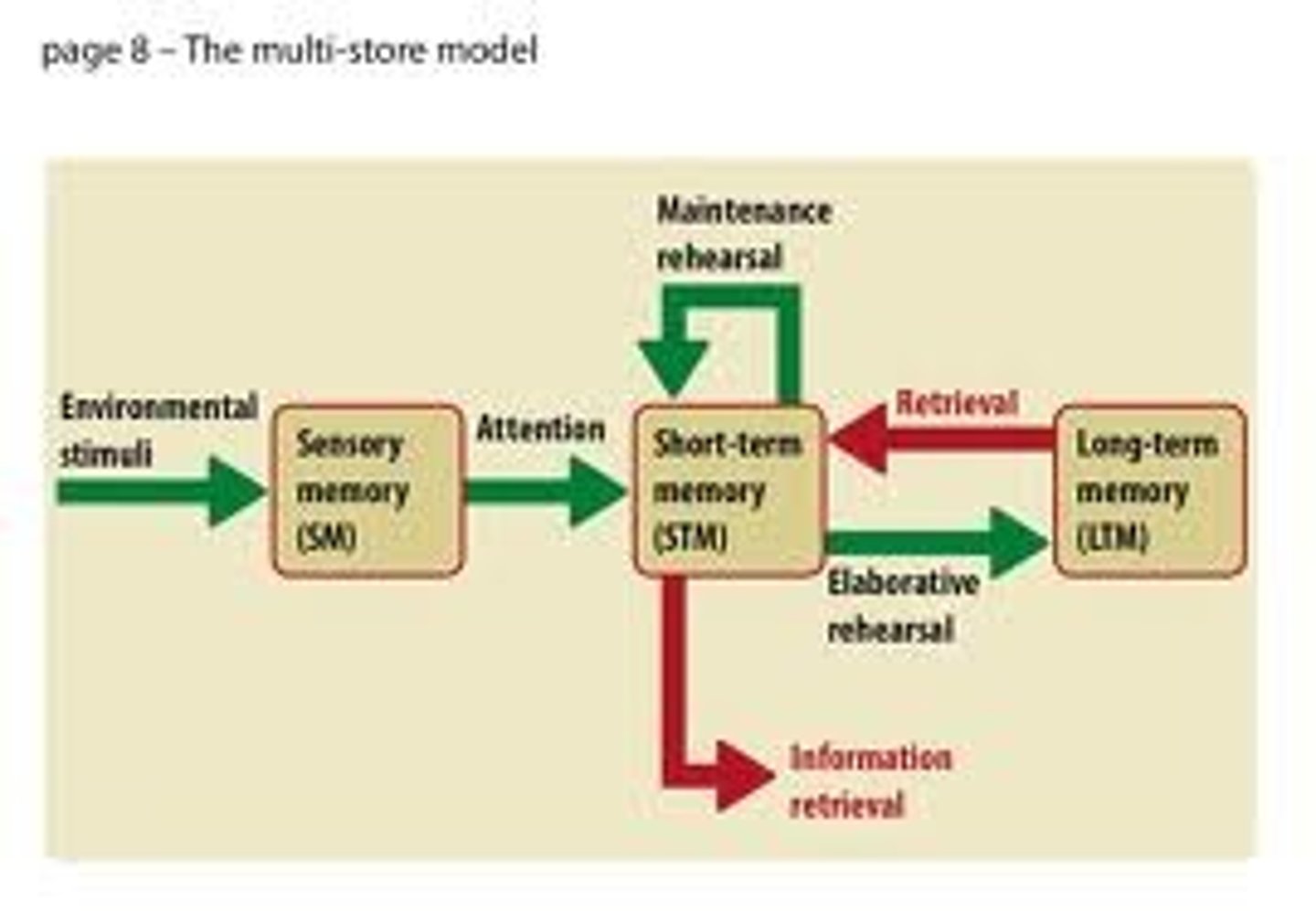
What is the role of the sensory register?
This is all the immediate information we receive from our senses and is held briefly in here (less than a second)
What is the role of rehearsal?
If we rehearse information (by repeating it over and over) it will stay in our short-term but if we do something with it such as exam questions or cue cards, information will go into our long-term memory (elaborative rehearsal).
What was the aim of Peterson and Petersons study?
To find out the duration of short-term memory when rehearsal is prevented.
What was the method of Peterson and Peterson's study?
24 psychology students from the USA were given a set of standardised instructions: green light = trial begin, red light = stop counting and recall trigram (three letter consonants).
The experimenter would spell out the trigram followed by three numbers e.g. WRT303 - each participant had to count back in 3's or 4's to stop rehearsal of trigram
When red light appeared they had to remember the three letter trigrams.
They had to recall the trigrams after different second intervals: 3,6,9,12,15,18 seconds
What were the results of Peterson and Peterson's experiment?
Participants recalled more trigrams at shorter intervals e.g. at 3 seconds they remembered 80% compared to 10% at 15 seconds
What was the conclusion of Peterson and Peterson's study?
Short term memory has a limited duration (about 18 seconds) and items decay if not rehearsed.
What is reductionism?
Human behaviour or cognitive processes can be explained by looking at the parts that make up that behaviour.
What is holism?
Human behaviour can be explained as a collection of parts put together.
Give one example of reductionism in Memory
The multi-store model - memory can be broken down into a series of component stores with specific functions.
Give one example of holism in Memory
Bartletts War of the Ghost study - he uses qualitative analysis of the data to understand each person's schema's. He looked into each persons background and character to explain the findings
What is the capacity, duration and encoding of the sensory register?
Capacity = large
Duration = less than a second
Encoding = through the senses
What is the capacity, duration and encoding of short-term memory
Capacity = 5-9 chunks
Duration 18 - 30 seconds
Encoding = acoustic (sound-based)
What is the capacity, duration and encoding of long-term memory?
Capacity = potentially unlimited
Duration = potentially unlimited
Encoding = semantic (meaning)