space class fin
 Call Kai
 Learn
Learn Practice Test
 Spaced Repetition
 Match
Match Flashcards
 Knowt Play
1/168

There's no tags or description
Looks like no tags are added yet.
Name | Mastery | Learn | Test | Matching | Spaced | Call with Kai |
|---|
No analytics yet
Send a link to your students to track their progress
169 Terms
Night Sky 1
If you want to know how high above the horizon to look for a specific star, which of the following would you need to know?
Altitude
Night Sky 2
Which of the following is NOT a cause of the seasons on Earth?
Variations in the distance between the Earth and the Sun.
Night Sky 3
The ______ is the point on the celestial sphere directly below any observer.
celestial equator
nadir
north celestial pole
south celestial pole
zenith
nadir
Night Sky 4
48 of the constellations known to the Greeks are still recognized as constellations. however, in modern times an additional 40 constellations have been recognized. These come from
the need to fill the gaps between historic constellations in order to have all parts of the sky be part of a constellation.
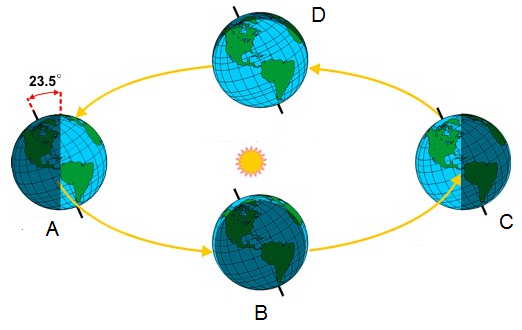
Night Sky 5
What season would the northern hemisphere be experiencing when the Earth is at point C?
Summer
Night Sky 6
The motion of the stars over the course of the night is due to which of the following?
The rotation of the Earth
Night Sky 7
Consider the star Alpha Centuari. What does the Alpha part tell you?
Its relative, apparent brightness within a single constellation.
Night Sky 8
A star is described as being circumpolar. What does this mean?
The star never goes below the horizon from an observers viewpoint.
Night Sky 9
What is the modern usage of a constellation?
It is a formally defined region of the sky.
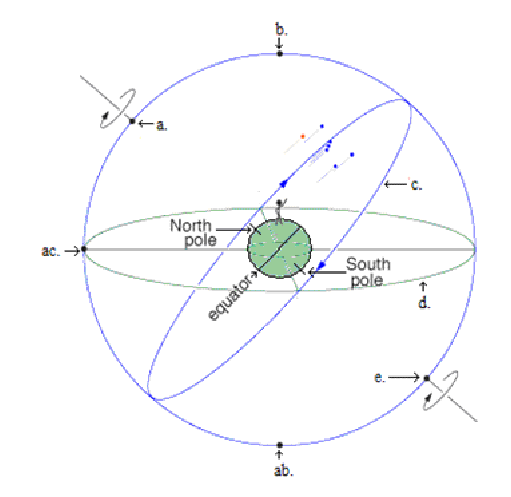
Night Sky 10 A
Identify what location on the Celestial Sphere is indicated by each of the following locations.
Celestial North Pole
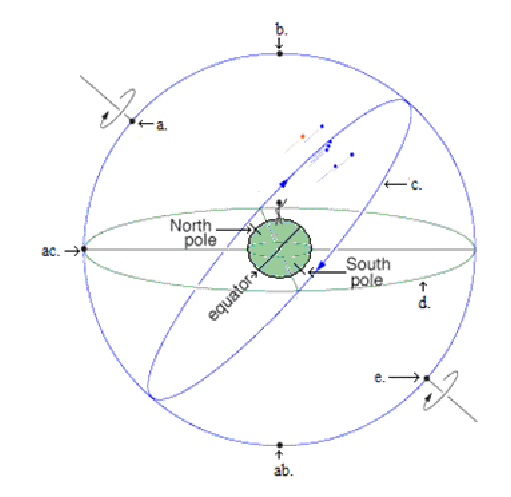
Night Sky 10 B
Identify what location on the Celestial Sphere is indicated by each of the following locations.
Zentih
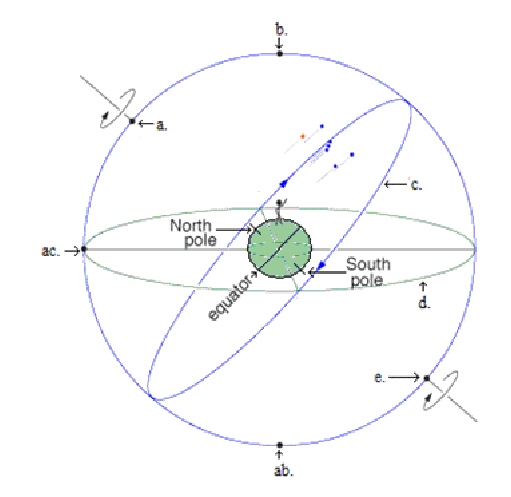
Night Sky 10 C
Identify what location on the Celestial Sphere is indicated by each of the following locations.
Celestial Equator
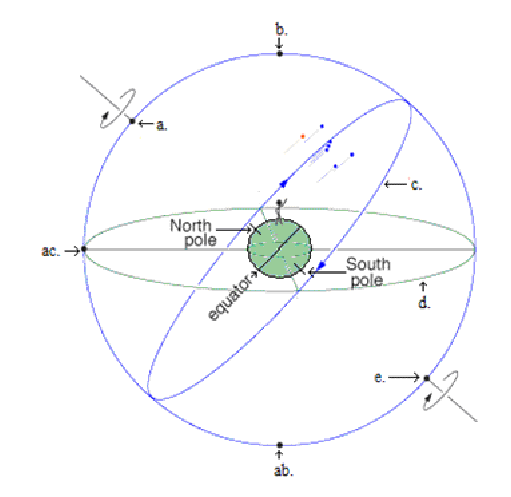
Night Sky 10 D
Identify what location on the Celestial Sphere is indicated by each of the following locations.
Horizon
Night Sky 11
Which star in the table would appear the brightest to an observer on the Earth?
Star Name | Apparent Visual Magnitude |
Dra | 3.07 |
Per | 3.98 |
Nim | 8.07 |
CMa | -1.46 |
Cet | 2.53 |
CMa
Night Sky 12
The motion of the Sun across the sky over the course of the year is due to which of the following?
The revolution of Earth around the Sun
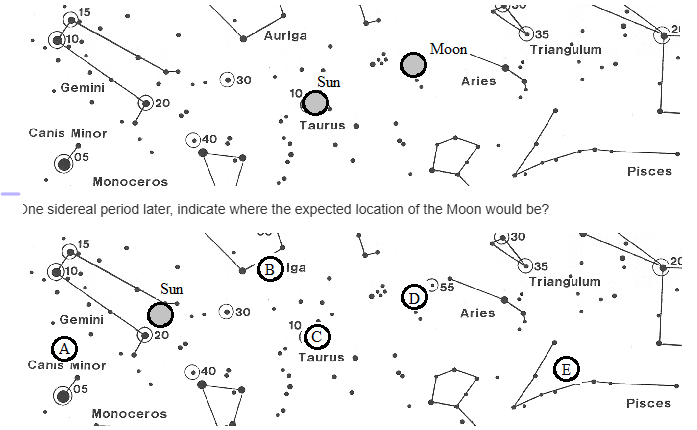
Cycles of the Sky 1
Below is an image of the sky at the end of May.
D
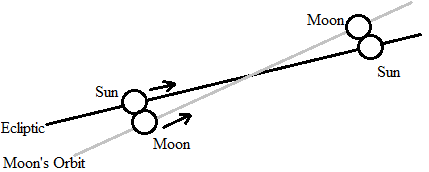
Cycles of the Sky 2
The time it takes the Sun and the Moon to move between the two locations shown on the diagram below is called which of the following?
Eclipse Season
Cycles of the Sky 3
Partial solar eclipses always occur
during the time of new moon.
Cycles of the Sky 4
Which of the following is the best explanation for the formation of the tides on the Earth?
The difference between the Moon's gravity acting on different parts of the Earth.
Cycles of the Sky 5
Tonight is a New Moon. What phase of the moon would you expect to see next?
Waxing Crescent
Cycles of the Sky 6
The reason that we always see the same side of the moon is because of
the Moon's rotation and revolution around the Earth are the same.
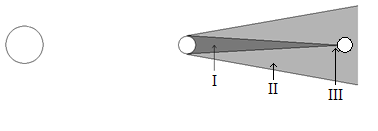
Cycles of the Sky 7
The diagram shows a two bodies in orbit around the Sun. What does the I. arrow point to?
Umbra
Cycles of the Sky 8
Spring tides occur
at new moon and full moon.
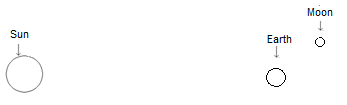
Cycles of the Sky 9
What phase of the Moon would an observer on the Earth see for the following alignment of the Earth, Sun, and Moon?
Gibbous Moon
Cycles of the Sky 10
A solar eclipse in which the observer is completely in the path of totality is called a(n)
total solar eclipse
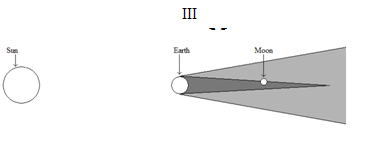
Cycles of the Sky 11
One the following diagram, what type of eclipse will an observer on the Earth see?
partial lunar eclipse
Cycles of the Sky 12
If the moon enters Earth's shadow but does not reach the umbra, the eclipse is termed
penumbral lunar eclipse.
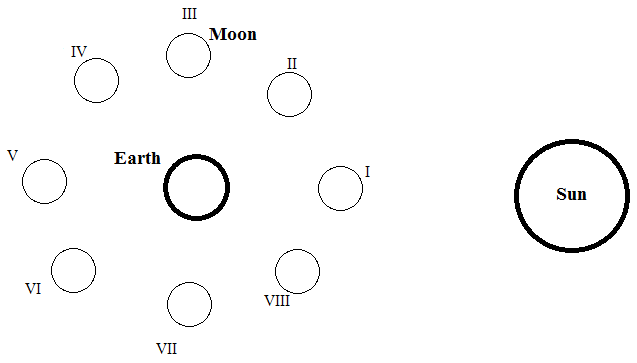
Cycles of the Sky 13
The phase of the moon shown by II is the _______
crescent
Cycles of the Sky 14
Total lunar eclipses always occur
during the time of full moon.
Cycles of the Sky 15
During a total lunar eclipse
the moon will glow a coppery red.
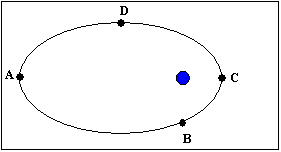
Development of Astronomy 1
The diagram below illustrates the orbit of a satellite around Earth. Which letter indicates the location where it will be moving the fastest?
c
Development of Astronomy 2
Galileo's observations of the gibbous phase of Venus proved
that Venus orbited the sun.
Development of Astronomy 3
A(n)______is a circle whose center is located on the circumference of another circle.
epicycle
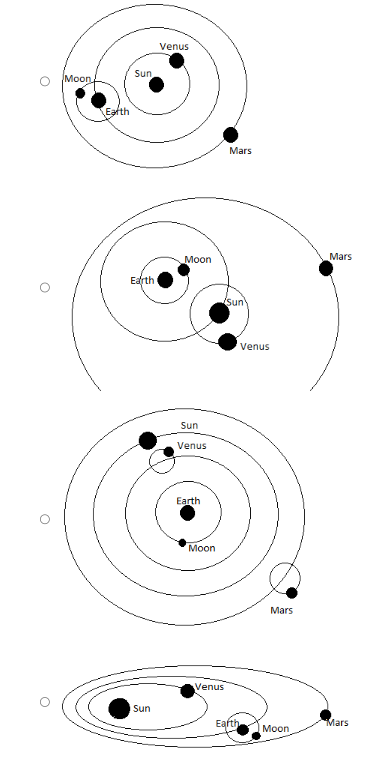
Development of Astronomy 4
Which of the following is a illustration of Kepler's Universe?
2
Development of Astronomy 5
What does a heliocentric universe mean?
The planets orbit the Sun
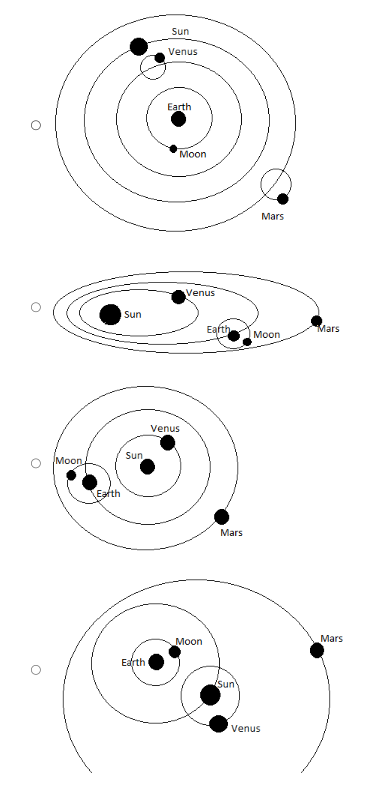
Development of Astronomy 6
Which of the following is a illustration of the Coperican Universe?
1
Development of Astronomy 7
Which of the following people did believed in a geocentric model for the universe?
Ptolemy
Development of Astronomy 8
A(n) ______ orbit is one where the orbiting object is always above the same location on Earth’s surface.
geosynchronous
Development of Astronomy 9
The Copernican system was no more accurate than the Ptolemaic system in predicting the positions of the planets because
the Copernican system included uniform circular motion.
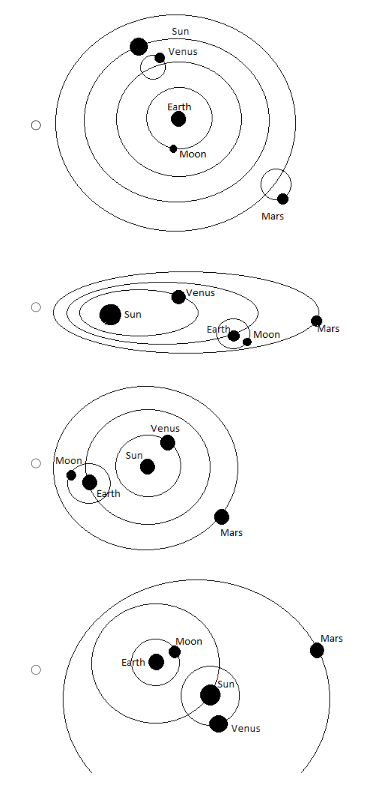
Development of Astronomy 10
Which of the following is a illustration of the Ptolamic Universe?
4
Telescopes 1
A telescope that suffers from chromatic aberration and has low light gathering power is most likely
a small diameter refracting telescope.
Telescopes 2
Resolving power is the ability of a telescope to ________
see fine details
Telescopes 3
Which of the following is the principle advantage that the Hubble Space Telescope (2.4 m mirror) has over the Keck Telescope (10 m mirror)
Hubble isn’t affected by seeing
Telescopes 4
Each color in a false color image can represent
all of the above
Telescopes 5
What program resulted in the landing of Humans on the Moon?
Apollo
Telescopes 6
Light gathering power is the ability of a telescope to_______
increase the brightness of an object
Telescopes 7
Which of the following was the first Human in space?
Yuri Gagarin
Telescopes 8
Select ALL of the following that would make a good site for a telescope?
Away from a a city,on a mountain top, & downwind of an ocean
Telescopes 9
Which type of light will mostly will, or have large ranges of wavelengths that will, reach the ground (i.e. sea level)?
Radio Waves
Telescopes 10
The technique called _______uses a computer controlled motors to support the weight of the miror.
active optics
Telescopes 11
Magnification is the ability of a telescope to
increase the size of an object
Telescopes 12
What limitation to traditional telescopes does a telescope using adaptive optics overcome? Assume that both telescopes are the same size.
atmospheric distortions
Telescopes 13
The scattering of artificial light that results in the brightening of the night sky is called which of the following?
light pollution.
Telescopes 14
Select ALL of the following that were, are current, or are planned future Space Station.
All of the above
Telescopes 15
Astronomers have not constructed a single major refracting telescope since about 1900. Which of the following is NOT a reason why?
Refracting telescopes have worse light gathering power than reflecting telescopes of the same size.
the Planets 1
What event was probably responsible for the heavy bombardment phase?
The migration of the gas giants to different orbits.
the Planets 2
Jupiter and Saturn are mostly composed out of
hydrogen and helium.
the Planets 3
The secondary atmosphere of a planet is believed to be
composed of gases that escaped from the protoplanet via outgassing.
the Planets 4
In the development of a planet, the stage of ________ occurred when molten rock flowed through fissures and filled deep basins with molten rock.
flooding
the Planets 5
Which of the following objects is most like the planetesimals that formed in the inner solar system?
asteroids
the Planets 6
Uranus and Neptune do not contain liquid metallic hydrogen cores because they
are not massive enough.
the Planets 7
Which of the following types of planets does liquid metallic hydrogen form the magnetic field?
Jovian
the Planets 8
Our Moon was formed by which of the following processes?
A protoplanet crashed into the Earth, ejecting material into space. This material later formed into the Moon.
the Planets 9
In general, astronomers can tell the relative age of parts of anyterrestrial planet's surface by comparing
the amount of craters on the surface.
the Planets 10
The geology of Venus appears to be dominated by
volcanism.
the Planets 11
Which of the following best describes how Neptune was discovered??
Based on predictions derived from the observed motion of other planet(s).
the Planets 12
What was the main component of the original solar nebula?
Hydrogen and Helium
the Planets 13
The condensation sequence suggests that _________should condense closest to the Sun.
metals and metal oxides
the Planets 14
Which of the following objects is most like the planetesimals that formed in the outer solar system?
comets
the Planets 15
Which of the following is an example of a Jovian planet?
Saturn
the Sun 1
Which of the following describes the formation of sunspots?
Magnetic field lines within the photosphere trap gases. Separated from convection flows, these gases gradually cool to a lower temperature than the rest of the photosphere.
the Sun 2
Which of the following describes a solar flare?
When oppositely directed magnetic fields meet and cancel each other out, in a process called recombination.
the Sun 3
Most of the light we see coming from the Sun ordinates in the
photosphere.
the Sun 4
How long is the Solar Cycle?
22 years
the Sun 5
The _______ are the hot, high speed, gases that are the moving extension of the Sun’s corona.
solar wind
the Sun 6
The photosphere is very thin because
the H- ion is a very good absorber of photons, so a photon can only travel a short length otherwise it is absorbed.
the Sun 7
Which of the following is NOT affected by the sunspot cycle?
The rotation rate of the sun’s equator at a given time.
the Sun 8
How long is the Sunspot Cycle?
11 years
the Sun 9
Sunspots
are cooler than their surroundings.
the Sun 10
___________occurs because photons we receive from the edge of the solar disk are emitted further from the base of the photosphere than the photons we receive from the center of the solar disk.
limb darkening
the Sun 11
The center of granules
are hot materials rising into the photosphere from below.
the Sun 12
Which of the following is a feature that is observed in the photosphere?
Sunspots
the Sun 13
Due to the differential rotation of the Sun, the magnetic field trapped in the Sun gradually gets more and more tangled. These tangles form sunspots. Eventually it gets so tangled that the whole field collapses and reforms, but reversed. This bests describes
the origin of the solar cycle.
the Sun 14
Which of the following describes a prominence?
A magnetic field that arches above the photosphere and chromosphere and into the lower corona carries ionized gas with it.
the Sun 15
Granulation is caused by
rising gases below the photosphere.
Light/Spectrums 1
Why don’t we see hydrogen Balmer lines in the spectra of stars with temperatures below 3200K?
These stars are so cool that nearly all of the electrons in the hydrogen atom are in the ground state.
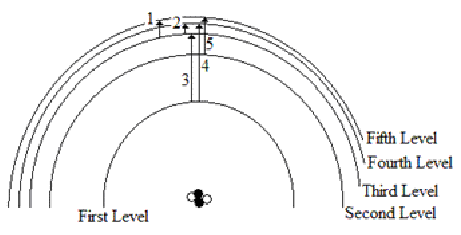
Light/Spectrums 2
In the diagram below, which of the transitions would absorb a photon of the smallest energy?
Transition 2
Light/Spectrums 3
The table below lists the spectral types for each of five stars. Which star in this table would have the lowest temperature?
For - F8
o Cet - M7
35 Ari - B3
Tri - A0
Per - O7
o Cet
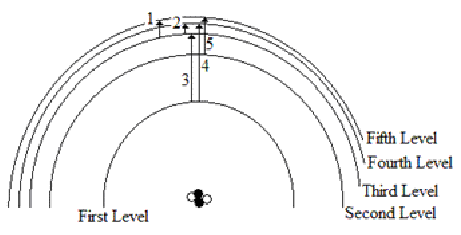
Light/Spectrums 4
In the diagram below, which of the transitions would absorb a photon of the shortest wavelength?
Transition 4
Light/Spectrums 5
The process that best describe the creation of an absorption spectrum is which of the following?
When an electron absorbs a photon whose energy is equal to the difference between the two energy levels, the electron is removed from the ground state and goes to a higher energy level.
Light/Spectrums 6
The light emitted by a blackbody is best described as a
continuous spectrum.
Light/Spectrums 7
In the laboratory, you observe the emission spectrum lines of a specific element. For the same element where will the dark lines form in the absorption spectrum?
The same wavelengths as the bright lines.
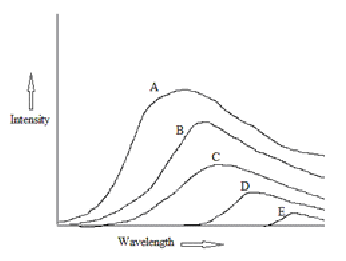
Light/Spectrums 8
A plot of the spectra of five different stars are shown in the figure below. Based on these spectra, which star is the hottest?
Star A
Light/Spectrums 9
When an astronomer refers to a red shift, it means that
the light has shifted to longer wavelengths and that the source is moving away from us.
Light/Spectrums 10
The process that best describe the creation of light by blackbody radiation is which of the following?
Temperature is the motion of the particles, including the electrons. Since the electrons have a charge, the movement of this charged particle creates a photon.
Light/Spectrums 11
The process that best describe the creation of an emission spectrum is which of the following?
As the electron drops back into the ground state, it emits a photon whose energy is equal to the difference between the two energy levels.
Light/Spectrums 12
Which series of transitions for hydrogen will produce the visual spectral lines?
Balmer
Light/Spectrums 13
A hydrogen line has a wavelength of 434.0 nm when observed in the laboratory. If the same line appears in a stars sectrum at 434.5 nm, in what direction is star moving in?
Away from the Earth
Light/Spectrums 14
In order for an electron to enter an excited state by absorbing a photon, that photon had to have
the same energy as the difference between the ground state and the energy level the electron enters.
Light/Spectrums 15
Inside a gas, the atoms are in random motion due to the temperature of the star. This creates red and blue shifts due to the motion of the gas away from or towards the observer. This effect is called?
Doppler Broadening