Fires
 Call Kai
 Learn
Learn Practice Test
 Spaced Repetition
 Match
Match Flashcards
 Knowt Play
1/52

There's no tags or description
Looks like no tags are added yet.
Name | Mastery | Learn | Test | Matching | Spaced | Call with Kai |
|---|
No analytics yet
Send a link to your students to track their progress
53 Terms
Primary, secondary, deliberate, accidental fires
• Primary fires = all fires in buildings, vehicles, and outdoor structures, any fires involving casualties or rescues, or fires attended by five or more appliances.
• Appliance = e.g., fire engine
• Secondary fires comprise the majority of outdoor fires including grassland and refuse fires unless they involve casualties or rescues, property loss or five or more appliances attend. They also include fires in derelict buildings.
• Deliberate fires include those where deliberate ignition was merely suspected and recorded by the fire and rescue service as “doubtful”.
• Reasonable suspicion for investigation.
• Accidental fires are those that started accidentally. Those where the cause was recorded as “not known” are grouped with these in the statistics.
Reaons for arson
• Many fires are started as an attempt to destroy evidence of a different crime at the scene.
• In an attempt to destroy:
• Fingerprints
• Fibres
• DNA evidence
• Common settings
• Vehicle fires
• Theft locations
• Dwellings
• To destroy physical evidence
• To obscure a victims death
Combustion, fire, flame definitions
Combustion = the process of burning.
A chemical change, especially oxidation, accompanied by the production of heat and light.
Fire = A rapid, persistent chemical change that releases heat and light and is accompanied by flame, especially the exothermic oxidation of a combustible substance.
Flame = The zone of burning gases and fine suspended matter associated with rapid combustion; a hot glowing mass of burning gas or vapour. The condition of active, blazing combustion.
Fire triangle
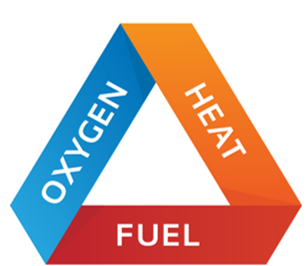
Fire can be prevented or extinguished by removing one or more of the three components of the fire triangle
Oxidation is an exothermic process – one in which heat energy is liberated
Heat that is liberated is called the heat of combustion
Enthalpy is the correct energy term at constant pressure
Pyrophoric definition + white phosphorus + applications
White phosphorus smoke grenades:
- White phosphorus is dangerous, but very powerful.
Wide array of military applications:
- Tracer fire
- Smokescreen
- Incendiary
Self-igniting at 32 °𝐶.
It's particularly dangerous to use in warfare.
- Very hot
- Sticks to skin
- Then 𝑃_4 𝑂_10 hydrolyses on skin.
The use of white phosphorus has been prohibited by the chemical weapons convention.
Clandestine use still observed.
If you are exposed to white phosphorus and on fire, copper sulphate solution (aq. obviously!) is the answer.
Radical and paramagnetic definition
Radical = an atomic or molecular species that possesses unpaired electrons in an otherwise open-shell configuration (open shell = unshelled valence shell)
Paramagnetic (unpaired electrons are attracted to a magnetic field)
Heterolysis vs homolysis
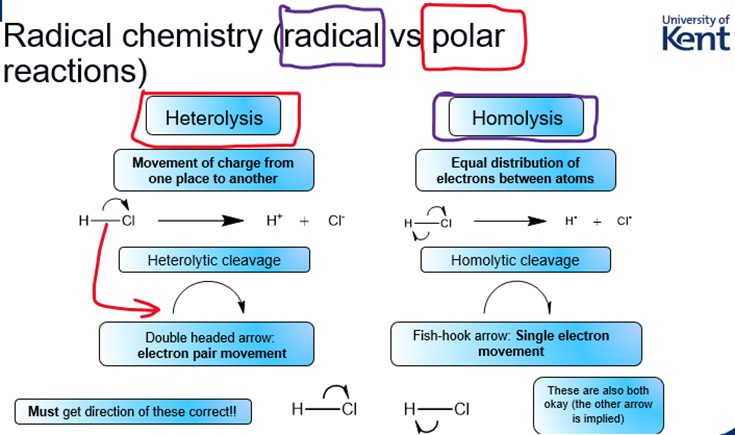
Initiation, propagation and termination definitions
Initiation – generation of the reactive intermediate.
requires hv or heat
Propagation – the generated reactive intermediate attacks a stable chemical species to generate another reactive intermediate. (and so on and so forth)
Termination – two radicals combine to quench the unpaired electrons, halting the reaction. This is often a by-product.
Eventually, we will propagate all the fuel available, then we will have a higher concentration of radicals.
Without further initiation, the reaction will cease once all radical species have self-quenched.
Branching definition + concept
• An alternative is a branching reaction. This is where two (or more) radicals are produced when a radical reacts with a molecule
• Branching reactions are analogous to fission reactions
• The generation of a flame is due to branching reactions dominating over termination reactions
• When branching reactions dominate over termination reactions, the fire will consume a lot of fuel.
Oxygen being a di-radical
Two electrons occupy the anti-bonding orbitals - one located on the x orbital, other on the y orbital
Liquid oxygen is an example, it wants to stay within the magnetic field
Being a di-radical makes it highly energetic
Is essential for combustion of organic matter
At room temp, oxygen is in its triplet state, so not on fire all the time!
Bond order equation

Halon 1211
A dense cloud forms over a fire that is difficult to disperse, aiding smothering
Not an oxidant – naturally smothers a fire by depriving it of oxygen
Halon undergoes reaction to form free radicals, requires energy to do this. Takes this energy from the fire, absorbing some energy of activation that would otherwise propagate the fire
The free radicals produced by the Halon react with the free radicals produced by the fire, quenching them in a termination reaction
Pyrolysis and plastic pyrolysis
Pyrolysis: decomposition of molecules via heat (oxygen not required)
When plastics are pyrolysed, the products can be highly toxic, resembling arson accelerants.
Different colours of flame concept
Flame colour is determined by wavelengths of light emitted, depends on the flame contents
Colour can be important
Glowing/ smouldering combustion
Surface oxidation
Absence of flame
Presence of very hot materials on surface of which combustion is proceeding
Takes place in the gas phase
As it doesn’t take place in the gas phase, can occur at very low O2 concentrations, especially if there is already oxygen in the fuel (e.g. carbohydrates like cellulose)
Char formation can slow a fire by acting as a physical barrier
Flames will often occur if more O2 becomes available: “backdraft” is a major hazard in firefighting
Smouldering concepts
- Smouldering fires produce large amounts of poisonous CO.
- Are usually the first and/or last stage of a fire incident
- Examples, cigarettes, matches.
Application of heat and limiting factors in fires
- Is the driving force of fires, and also the acceleration of fires
- Heat spreads fires, and causes damage
- It is the limiting factor in the early stages of a fire – lost rapidly to the surroundings
- Reaction rates typically double with every additional 10 degrees.
- Next limiting factor is oxygen; a closed room will deplete oxygen and result in smouldering fire
- Last limiting factor is fuel – until the entire structure is destroyed.
Propagation and spread of fire - conduction
Conduction - transfer of heat through a material by direct atomic or molecular contact.
Materials with a low thermal conductivity (insulators) heat up the most quickly. As a result, they quickly reach the required temperature for pyrolysis (and therefore ignition).
- Materials like metals have a high thermal conductivity and dissipate heat. This dissipation means heat gets conducted away
- This means that metals can transfer large quantities of heat energy to other locations
- Also consider the specific heat capacity of a substance, and its relative definition. If materials require less energy to be heated up by one degree, then they would be able to conduct heat quicker, has its effects.
Propagation and spread of fire - convection
• Convection – transfer of heat in a gas or a liquid by the circulation of molecules, which is caused by temperature differences
• Regions of high temperature are less dense and therefore rise upwards.
• Atoms have more relative motion, have to spread out.
• In a burning fire, this creates air currents. These air currents draw more oxygen to the base of the fire, increasing ventilation.
• Also dissipates heat around the room.
• “fires burn upwards”
• Walls and ceilings are dried and heated by the hot gases rising from a fire (the “fire plume”).
• Even if the flames do not reach them directly, they can auto-ignite if hot enough.
Propagation and spread of fire - radiation
• Radiation – The emission of heat as electromagnetic radiation (infra-red region).
• Doesn’t involve the transfer of heat through molecules
• How much power is being ‘shone’ over an area
• The Watt is the unit of power, 1 Watt = 1 Joule per second
Flame over and flash over
• If a fire plume cannot escape from a compartment, it will spread a layer of hot gases underneath the ceiling. These may be flammable.
• Flames can spread horizontally at great speed (“flameover”).
• Hot flames all across the ceiling can produce radiant heat at floor level
• At these heat fluxes, all flammable fuels and gases in the room begin to decompose. Within a few seconds they reach their ignition temperatures and catch fire. This is “radiation induced flashover”.
• It represents downward spread of the fire.
Flashover represents the transition from ‘fire in room’ to ‘room on fire’
Vapour pressure + equation
Vapour pressure = partial atmospheric pressure exerted by the vapours of a liquid (how much liquid comes from the evaporating gases)
When vapour pressure = atmospheric pressure, this is the boiling point
The more vapour, the more likely the vapour concentration may enter the flammable range. However, mixtures below the LFL are too lean, and mixtures above the UEL are too fuel rich.
Vapour concentration = vapour pressure/ atmospheric pressure x 100
Calculating the LFL of a substance example
• Stoichiometric molecular ratio CH4 : O2 is 1 : 2
• Ideal gas laws :
• The volume relates to the number of molecules, not their size
• So the stoichiometric volume ratio CH4 : O2 is also 1 : 2
• O2 comprises 21% of air
• Stoichiometric volume ratio methane : air is therefore
• 1 : 2(100/21) = 1 : 200/21 = 1 : 9.52
• So 1 part in 10.52 of the mixture is methane
• which is 9.5% methane, 90.5% air
LFL calculation assumptions
uniform mixing throughout the whole room;
no ventilation losses;
no adsorption onto surfaces;
constant temperature and pressure
vapour is denser than air, so low-level accumulation may occur
Relies on an assumption from White’s rule of thumb
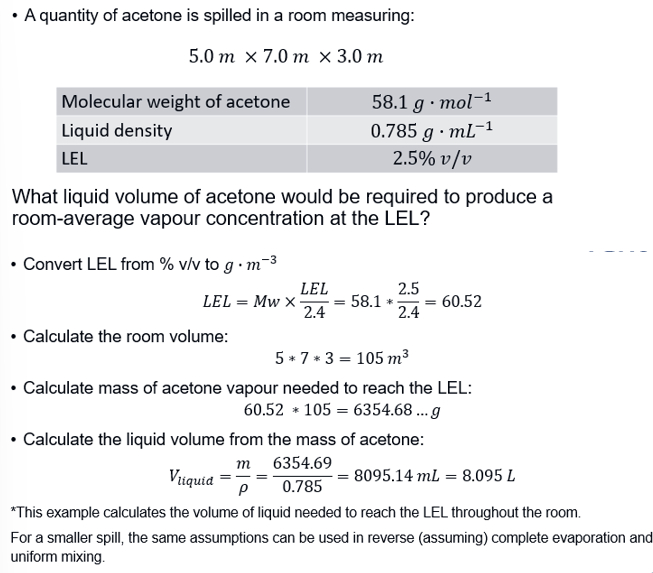
Dangerous Substances and Explosive Atmospheres Regulations (DSEAR)
Dangerous substances = are any substances used or present at work that could, if not properly controlled, cause harm to people because of a fire or explosion or corrosion of metal.
• A fire-risk-analysis is an initial step before a full fire risk assessment or detailed investigation is carried out. It considers whether a fire hazard is likely to arise, whether a flammable atmosphere or ignitable fuel source could be created, and whether additional control measures are required.
• A DSEAR considers whether:
• A flammable or explosive atmosphere could form
• Sufficient fuel vapour could be generated
• Ignition sources may be present;
• The room, process, or task could allow vapour accumulation
• Additional control measures are required.
DSEAR calculation worked example
Flash point + factors affecting it
= minimum temperature at which the vapour produced by a liquid can be ignited momentarily in air
The ignition source is external. It can be an applied small flame, a glowing wire, an electrical spark, etc., which supplies the initial activation energy and is then quickly removed
The resultant flame does not self-sustain at this temperature, after the ignition source is removed. Several factors influence this: the heat generated from enthalpy of combustion; the heat capacity of the combustion products; the rate of heat loss from the flame by radiation; and the kinetic rate of production of more vapour
Low flash point temperature correlates with high vapour pressure, i.e., high volatility
Fire point
= the minimum temperature at which sufficient vapour is produced by a liquid to sustain combustion after ignition in air
• A few degrees higher than the flash point
• After the ignition source is removed, heat produced by combustion must balance heat loss from the flame, so that the temperature does not drop
Ignition temperature definition
• Also called autoignition or spontaneous ignition temperature
• The temperature at which the fuel will ignite without any additional source (flame, spark)
• Reflects activation energy more than volatility
Polymer, oligomer, monomer definitions
• Polymer: A large molecule composed of many subunits (monomers) joined together
• Oligomer: A small portion of a polymeric chain (i.e. a couple of subunits or monomers long)
• Monomer: The smallest subunit of the polymer.
Pyrolysis of thermoplastics vs thermosetting plastics
Thermoplastics = the melting temperature is lower than the ignition temperature, fires may be spread by burning droplets, or a pool of molten polymer
Thermosetting plastics = burning is like that of wood. Pyrolysis gives volatile molecules, leaving a solid char.
- Pyrolysis products, as well as being flammable, may be highly toxic and corrosive.
Thermosetting plastic decomposition mechanisms
• end-chain scission: successive removal of monomer units from the end of the polymer backbone. Produces monomers
• random scission: main chain bonds are broken at random locations along the polymer backbone until sections small enough to volatilise are generated. Produces a range of oligomeric molecules
• chain stripping: the polymer backbone remains intact, but molecular species which are not part of main chain break away
• cross-linking: some thermosetting polymers undergo further cross-linking during pyrolysis, generating a lot of char
Common locations of plastics
• Carpets – polypropylene yarn and backing over polyurethane underlay
• Curtains – synthetic fabrics
• Sofas/cushions/mattresses – polyurethane foams
• Window – polyvinylchloride
• Flooring – melamine
• Paint – latex, polyvinyl acetate, acrylic
Metals - pyrophoric + example
Mg burns with bright white flame, cannot be extinguished with water – will react with water, producing H2 gas
How do we heat things up?
Light
Electricity
Friction
Contact with hot surface
Chemical reaction
Nuclear fission
Electricity - sparks and arcs
Involves the movement of current through a gas, producing plasma
Static sparks, spark plugs, lightning
Very localised, so only ignites gases or vapours
Electrical spark (short)
Electrical ark (maintained)
Electricity - overheating
Electrical currents generate heat when they meet resistance
- Amount of current that a wire can carry is proportional to its diameter, material and covering
Heat can build up in a wire by:
• Excessive current (wrong fuse, short circuit)
• Tightly coiled wires (which can’t dissipate heat)
• Poor or loose connection (e.g wire on a screw terminal)
• Insulation breakdown (charred wood/plastic becomes a semi-conductor).
• Aluminium fittings (old wiring systems) – not as good a conductor as copper, makes oxide films (creates a heat barrier).
Smoking - potentially causing fire
- Normally due to a discarded match
- Cigarette has a low heat release rate, so requires direct contact with fuel for some time
- Preventing radiation by covering end can increase temps.
Reasons why fires may start
Spontaneous combustion, e.g., respiration for some substances
Gas appliances
Gas flames
Fireplaces and chimneys - soot build up can catch alight
Animal activity: rare, but could include gnawing wires and accumulating combustibles
• Lightning: mainly just dead trees
• Microorganisms: can make their substrate hot, but then they die – chemical reaction needed to ignite fermentation products (e.g. stacked hay is a combination of chemical reaction taking over after the microbes die from fermenting).
• Nuclear fission/fusion
General aspects of a fire post incident
• Fire causes the destruction of evidence (but not always!)
• Anything flammable at the scene will be damaged or destroyed
• Materials and surfaces that are far from the initial scene will still be affected by the scene (covered in soot, debris) or affected by the heat.
• Set your cordons carefully.
• Evidence is also destroyed as the fire is combatted by first responders (surfactants, fire suppressants).
• Fire-fighting techniques may cause physical damage. Doors and windows broken; ceilings collapse under weight of water; objects disturbed or removed.
• Post fire clean up can also destroy evidence
Physical, chemical, circumstantial evidence of a fire post incident
Physical evidence:
- Burn patterns
- Smoke records
- Temperature indications, surface flaking of plaster
- Debris layer sequences
- Remains of ignition devices or suspicious containers?
Chemical evidence:
- Analysis of trace residues
- Presence of accelerants?
Related, cicumstantial evidence:
- Evidence of forced entry? Removal of goods before fire?
- Witness statements (rapid spread of fire is not proof of arson)
Safety aspects to consider post fire incident
• Structural collapse of the building
• Live electrical cables
• Damaged sewers/drainage (biohazard)
• Dust inhalation hazards (asbestos)
• Unknown building contents (toxic chemical, biohazards)
• Due to the nature of fire scenes, risk assessment must be dynamic
• You need to constantly assess the situation for changes
Fire patterns and clues indicative to where a fire started
Fires burn upwards - lowest point of burning is generally the seat of the fire, but not always!
So, rapid circulation of the fire gives a characteristic “V” shaped smoke pattern on adjacent walls
Most damaged area is not always the origin of the fire
Glasses and plastics melt towards the heat of the fire
Must consider ventilation, fuel load, fire development, and other scene evidence when considering origin of fire
Distance fuel package is from wall affects fire pattern
Fuel package closer to the wall will produce sharper “V” pattern
Smoke records
• Smoke will have left deposits on all open surfaces
• It’s a great indicator for depicting what’s happened at the scene.
• Regions without smoke deposits must have been covered
Lifestyle of people predicting cause of fire
Actions people carry out which may indicate cause of fire:
Careless cigarettes left out?
Evidence of prior minor burning from cooking?
Unsafe electronics around?
Candle use?
Suspicious signs - physical evidence of arson
• Several seats of fire, or in unusual place
• Previous fires in building or area
• Unnatural spread of fire, spread trailers – evidence of accelerants
• Seat near expensive equipment
• Alarms decactivated
• Incendiary devices
Suspicious signs - circumstances
• Records destroyed
• Financial difficulties
• Contents removed prior to fire
• Forced entry, evidence of search
• Interested parties know a lot, pay close attention
Chemical analysis of fire scene residues
• Unburned accelerant is most likely to remain in carpets, floorboard timbers, upholstery, rags, floor cracks
• If there has been a flashover, unburned accelerant is less likely to occur, but the floor underneath furniture may have been sheltered from fire
• Some types of concrete are porous and can retain traces of unburned accelerants
Detection of fire scene residues
• GC-MS
• Sniffer dog – can only indicate possibility of accelerants, lab samples still needed
• “Sniffer” – portable hydrocarbon detector
Types of samples to take for fire analysis
• Flooring where accelerant use suspected:
• At least 1 m2
• Include both burnt and unburnt (i.e. edge of burn)
• Include underlay
• Swab-able surfaces:
• Frequently tiles and light bulbs are coated with condensation products
• Sterile swabbing of tiles, with control swabs from clean areas
• Package smaller objects like light bulbs
• Floorboards:
• Tongue and groove burning patterns can indicate seepage of fuel between cracks
• Control samples
• Careful if petrol-powered tools needed to obtain sample
Soil:
• Soil under completely burnt floors may have soaked up fuel
• Take top few cm – and control
Sample packaging and containers for fire analysis
• Must be airtight and retain long volatile chain hydrocarbons and aromatic molecules such as toluene and xylene.
• Ordinary polythene bags are too porous to hydrocarbons.
• Dual bagging in nylon (inner) and polypropylene/polyethylene (outer). Must be free of plasticisers.
• Closed by knotting the neck, sealed with cable tag - not with adhesive tape.
• Glass jars - with metal (not plastic) lids.
• Lids must be able to withstand vapour pressure of volatile liquids.
• Metal cans - not lined (because plastic linings contain hydrocarbons). These are resistant to puncture, but not suitable for corrosive samples.
• Avoid contamination (e.g., from gloves and tools)
Recovery of accelerants
Passive headspace analysis:
• Accelerant revovery by vapour concentration
• Vapour in sealed container is exposed to activated charcoal, where it is trapped for later analysis
Dyanmic headpsace analysis:
• Vapour drawn from sample through an adsorbent using a flow of carrier gas such as dry nitrogen
• Adsorbent is activated charcoal, a porous polymer, which traps organic volatiles but has a low affiinity for water
• Applicable to a wide range of accelerants, including alcohols and ketones
Interpreting GC for fire analysis
Interpretation of gas chromatography:
• Retention time depends primarily on molecular mass
• i.e. the number of carbon atoms in the skeleton of the molecule
• It depends secondarily on the structure of the molecule
• linear/branched/cyclic/aromatic
• For samples with a broad boiling point range, programmed temperature increase of the column is used
• Recognition of chromatographic patterns of common flammable liquids
• Recognition of mixtures