IPS1 - B1-B3- Overview of dispersed system ➡️ Solubility Phenomena
 Call Kai
 Learn
Learn Practice Test
 Spaced Repetition
 Match
Match Flashcards
 Knowt Play
1/111

Earn XP
Description and Tags
Proverbs 16:3
Name | Mastery | Learn | Test | Matching | Spaced | Call with Kai |
|---|
No analytics yet
Send a link to your students to track their progress
112 Terms
System
____- is a bounded space of an exact quantity of a material
Dispersion
____ - consist of at least two phases with one or more dispersed phase (internal) contained in a single continuous (external) phase
dispersed phase
single continuous phase (dispersion medium)
Dispersion consists of at least two phases such as ___ [2]
internal phase
In Dispersion
dispersed phase is our ____ [internal/extenal phase]
external phase
In Dispersion
single continuous phase is our ____ [internal/extenal phase]
external or continuous phase
Dispesion medium is the ____ [internal/extenal phase]
Phase
____ - is a distinct homogenous part of a system
Molecular dispersion
Colloidal dipersion
Coarse dispersion
Types of Dispersion [3]
Molecular dispersion
[Types of Dispersion]
____-
A.k.a. True Solutions (one phase)
is a HOMOGENEOUS SYSTEM
Diameter of particles <1 nm
one phase
True solution have _____ [how many] phase ?
Colloidal dispersion
[Types of Dispersion]
____-
Diameter of particles 1 to 500 nm
is a HETEROGENEOUS SYSTEM
b.) Colloidal dispersion
Gelatin, milk is an example of what type of dispersion ?
a.) Molecular dispersion
b.) Colloidal dispersion
c.) Coarse dispersion
Coarse dispersion
[Types of Dispersion]
____-
diameter of particles > 500 nm
c.) Coarse dispersion
emulsions and suspension is an example of what type of dispersion ?
a.) Molecular dispersion
b.) Colloidal dispersion
c.) Coarse dispersion
Molecular Dispersion
True solution is aka ___ ?
a.) True solution (Molecular Dispersion)
Binary Solution is what kind of solution?
a.) True solution
b.) Simple solution
Binary solutions
_____ - is a true solution (molecular dispersion) that is composed of only two substances
True solutions (Molecular dispersion)
____- is a mixture of two or more components that form a homogenous molecular dispersion or one-phase system
a.) < 1 nm
What is the particle size of true solution (molecular dispersion) ?
a.) < 1 nm
b.) 0.5 nm
c.) > 2nm
Solute – lesser amount
Solvent – greater amount
Components/Constituents of True Solution (Molecular Dispersion) such as ___ [2]
a.) Solute
Components/Constituents of True Solution that have lesser amt ?
a.) Solute
b.) Solvent
b.) Solvent
Components/Constituents of True Solution that have greater amt ?
a.) Solute
b.) Solvent
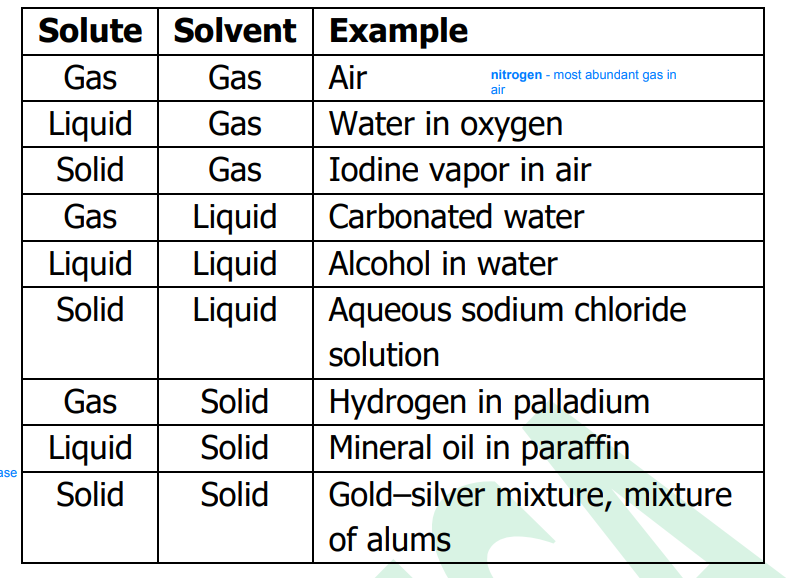
Example of Solute + Solvent = Product
ANALYZE MO LNG
b.) Nitrogen
What is the most abundant gas in air
a.) Oxygen
b.) Nitrogen
C. Carbon dioxide
Non- electrolytes
Electrolytes
Types of Solute [2]
b.) non electrolyte
[Classify the Type of Solute]
____ -
Do not ionize in water
a.) electrolyte
b.) non electrolyte
a.) electrolyte
[Classify the Type of Solute]
Ionize in water (form ions)
a.) electrolyte
b.) non electrolyte
b.) non electrolyte
[Classify the Type of Solute]
Do not conduct electric current
a.) electrolyte
b.) non electrolyte
a.) electrolyte
[Classify the Type of Solute]
Conduct electric current
a.) electrolyte
b.) non electrolyte
b.) non electrolyte
[Classify the Type of Solute]
Sucrose, glycerin, naphthalene, urea
a.) electrolyte
b.) non electrolyte
a.) monoclinic
What is the shape of SUCROSE ?
a.) monoclinic
b.) tetragonal
c.) trigonal planar
b.) tetragonal
What is the shape of UREA ?
a.) monoclinic
b.) tetragonal
c.) trigonal planar
Alcohol ( specifically: Trihydric alcohol )
____ - is the functional group of GLYCERIN
a.) electrolyte
[Classify the Type of Solute]
HCl, NaCl
a.) electrolyte
b.) non electrolyte
a.) electrolyte
[Classify the Type of Solute]
Atropine, phenobarbital, sulfadiazine
a.) electrolyte
b.) non electrolyte
Protophilic (Basic)
Protogenic (Acidic)
Amphiprotic
Aprotic
Types of Solvent [4]
a.) Protophilic or Basic
[Classify the Type of Solvent]
Proton-accepting
a.) Protophilic or Basic
b.) Protogenic or Acidic
c.) Amphiprotic
d.) Aprotic
a.) Protophilic or Basic
[Classify the Type of Solvent]
Acetone, ether, and liquid ammonia
a.) Protophilic or Basic
b.) Protogenic or Acidic
c.) Amphiprotic
d.) Aprotic
b.) Protogenic or Acid
[Classify the Type of Solvent]
Proton-donating
a.) Protophilic or Basic
b.) Protogenic or Acid
c.) Amphiprotic
d.) Aprotic
b.) Protogenic or Acid
[Classify the Type of Solvent]
formic acid, acetic acid, sulfuric acid, liquid HCl, and liquid HF
a.) Protophilic or Basic
b.) Protogenic
c.) Amphiprotic
d.) Aprotic
c.) Amphiprotic
[Classify the Type of Solvent]
Act as both acid and base
a.) Protophilic or Basic
b.) Protogenic or Acid
c.) Amphiprotic
d.) Aprotic
c.) Amphiprotic
[Classify the Type of Solvent]
water and alcohol
a.) Protophilic or Basic
b.) Protogenic
c.) Amphiprotic
d.) Aprotic
d.) Aprotic
[Classify the Type of Solvent]
Neither accept nor donate protons
neutral
a.) Protophilic or Basic
b.) Protogenic
c.) Amphiprotic
d.) Aprotic
d.) Aprotic
[Classify the Type of Solvent]
Hydrocarbon
a.) Protophilic or Basic
b.) Protogenic
c.) Amphiprotic
d.) Aprotic
Concentration Expressions
____- are expressions of
quantity of solute/volume of solution
quantity of solute/mass of solvent or solution
Normality (N)
____- is the gram-equivalent weight per liter of solution ( UNIT:mEq/mL or Eqwt / L )
Solubility
____ - quantitatively is the concentration of solute in saturated solution at a certain temperature
Solubility
____ - qualitatively is the spontaneous interaction of two or more substances to form homogenous molecular dispersion
Saturated Solutions
Unsaturated Solutions
Supersaturated Solutions
Types of Solutions [3]
a. Saturated solution
[Classify the Types of Solution]
Solute in a solution is in equilibrium with the solid phase
a. Saturated solution
b. Unsaturated solution
c. Supersaturated solution
b. Unsaturated solution
[Classify the Types of Solution]
Solute concentration < saturation point
a. Saturated solution
b. Unsaturated solution
c. Supersaturated solution
c. Supersaturated solution
[Classify the Types of Solution]
Solute concentration > saturation point
Undissolved solutes are present
is a HOMOGENEOUS SYSTEM
a. Saturated solution
b. Unsaturated solution
c. Supersaturated solution
Dissolution
____ - is the transfer of molecules / ions from a solid state into solution
Dissolution
____ - is when the solute dissolves in a solution
Solubility
_____- is the extent of dissolution
1g/mL of solute in solvent
What is the Part of Solvent Required for One part of solute?
a. 1g/mL of solute in solvent
b. 3g/mL of solute in solvent
c. 4g/mL of solute in solvent
d. 10g/mL of solute in solvent
mg/mL or g/L
Solubility Range units
True
[T/F] The greater the similarity between the solute and the solvent (similar physicalchemical properties), the greater the solubility.
Like dissolves like principle
According to ____ principle
The greater the similarity between the solute and the solvent (similar physical/chemical properties), the greater the solubility
polarity of solvent (dipole moment)
Solubility of drug is due to the large measure to the _____ ?
Dipole moment
Form H-bond
Short chain
> 4C or 5C
Increase Branching
Polarity involves [5]
a. Polar Solvent
Polar solvent + Ionic solute or Polar solutes
a. Polar Solvent
b. Non Polar Solvent
Phenols
Alcohols
Aldehyde
Amines
Except: ether and ketone
Functional Groups that forms H-bond [4]
Mnemonic : PAAA
a. Hydrogen Bond
Phenols , Alcohols , Aldehyde , Amines functional groups that forms
a. Hydrogen Bond
b. Ionic Bond
c. Covalent Bond
less water soluble
Longer Chain = ____ [more/less] water soluble
> 4C or 5C
Straight chain monohydroxy Alcohol (ROH), Aldehyde (RCHO), Carboxylic Acid (RCOOH) have ____ [how many] Carbons ?
slightly water soluble
> 4C or 5C = ____ [more/less/slightly] water soluble
more water soluble
Increase Branching = ____ [more/less] water soluble
b. Non Polar Solvent
Non-polar Solutes + Non-polar Solvents
a. Polar Solvent
b. Non Polar Solvent
b. Induce dipole
Non-polar Solvents is due to the ___ ?
a. Dipole moment
b. Induce dipole
Benzene
Carbon tetrachloride (CCI4)
Mineral Oil
Example of Nonpolar Solvents [3]
b. Non Polar Solvent
[Classify the Type of Solvent]
Oils and Fats are soluble in Carbon tetrachloride (CCI4), benzene, mineral oil
a. Polar Solvent
b. Non Polar Solvent
c. Semipolar Solvent
[Classify the Type of Solvent]
Can induce a certain polarity in nonpolar solvents
a. Polar Solvent
b. Non Polar Solvent
c. Semipolar Solvent
ketone (e.g. acetone)
alcohol
Example of Semipolar Solvent [2]
c. Semipolar Solvent
[Classify the Type of Solvent]
ketone and alcohol
a. Polar Solvent
b. Non Polar Solvent
c. Semipolar Solvent
c. Semipolar Solvent
[Classify the Type of Solvent]
Can act as intermediate solvents
a. Polar Solvent
b. Non Polar Solvent
c. Semipolar Solvent
c. Semipolar Solvent
Acetone, Alcohol, Propylene glycol are Example
a. Polar Solvent
b. Non Polar Solvent
c. Semipolar Solvent
Acetone
Alcohol
Propylene glycol
____ [3] can act as intermediate solvent
Acetone
[What Intermediate/Semi-Polar Solvent ]
___- increases the solubility of ether in water
Alcohol
[What Intermediate/Semi-Polar Solvent ]
___- increases miscibility of the water-castor oil mixture
Propylene glycol
[What Intermediate/Semi-Polar Solvent ]
___- increases miscibility of: ⏬
water and peppermint oil
water and benzyl benzoate
Propanol
____ - acts as a co-solvent of hexane and water
1. Dielectric constant
2. Presence of Salts
2. Effect of temperature
3. Effect of pH
5. Effect of Particle Size
Factors affecting solubility [5]
Dielectric constant
____- is a quantitiy measure the ability of substance to store electrical energy in electric field.
decrease polarity
Low dielectric constant = ___ [increase/decrease] polarity
decrease water solubility
Low dielectric constant = ___ [increase/decrease] water solubility
increase solubility
Increase Temperature = ____ [increase/decrease] solubility
increase KE
Increase Temperature ____ [increase/decrease] KE
increase solubility
Increase KE = ____[increase/decrease] solubility
a. Endothermic
Heat is absorbed
a. Endothermic
b. Exothermic
b. Exothermic
Heat is released
a. Endothermic
b. Exothermic
a. Endothermic
Potassium nitrate (KNO3), Potassium chloride (KCl) are common example of what reaction ?
a. Endothermic
b. Exothermic
b. Exothermic
Sodium sulfate (Na2SO4) , Calcium hydroxide (Ca(OH)2)are example of what reaction ?
a. Endothermic
b. Exothermic
Calcium Hydroxide (Ca(OH))
____- is the most common example of substance that undergo Exothermic Reaction
increase solubility
For endothermic substance
increase temperature = ____[increase/decrease] solubility
decrease solubility
For exothermic substance:
increase temperature = ____[increase/decrease] solubility
improve solubility
Acid + Basic = ___ [improve/reduce] solubility
decrease solubility
Acidic Drugs + Acid (low pH) = ____ [increase/decrease] solubility
decrease solubility
Basic Drugs + Base (high pH) = ____ [increase/decrease] solubility
soluble
Phenobarbital (weak acid) + high pH (base) = ____ [soluble / insoluble]